Landscape photography is the photography of outdoor places: mountains, coastlines, forests, deserts, fields, lakes and skies, where the land and the light falling on it are the subject rather than a person or an event. Strong landscape photographs come from three things working together: good light, a deliberate composition, and a camera held still enough to record fine detail from front to back. This guide covers the camera settings, light, composition, gear and planning that make landscapes work consistently.
In this guide: jump to hyperfocal distance and depth of field for front-to-back sharpness, golden hour for the best light, composition techniques, or long exposure for silky water and skies.
What Counts as Landscape Photography
The genre is broad. It includes the grand view from a summit and the small scene at your feet, natural places and places shaped by people. The main kinds:
- Grand landscapes: wide views with a strong foreground, a middle ground and a distant horizon, usually shot with a wide-angle lens.
- Intimate landscapes: a section of a larger scene, such as a pattern of trees on a hillside, ice on a pond or the texture of a rock face, often shot with a longer lens and no horizon at all.
- Seascapes and water: coastlines, seascapes, rivers, lakes and waterfalls, where moving water invites slow shutter speeds.
- Mountains, forests and deserts: each with its own light problems, covered in mountain photography and forest photography.
- Urban landscapes: cityscapes and skylines, which follow the same rules of light and composition.
- Night landscapes: the land under moonlight or stars, which leads into astrophotography.
What unites them is that the photographer cannot move the subject. You control only where you stand, which way you point the camera, the moment you press the shutter, and the settings you use. Everything in this guide comes back to those four choices.
What Makes a Strong Landscape Photo
The difference between a snapshot of scenery and a compelling landscape photograph usually comes down to three things: light, composition, and patience. Anyone can visit a beautiful location and take a picture of it. What makes a landscape photograph stand out is the photographer’s ability to read the light, find a strong composition within the scene, and wait for the right moment.
Great landscape images share several qualities:
- Compelling light: The quality and direction of light creates mood, depth, and drama. Most strong landscape photos are taken during the first or last hour of daylight.
- Clear focal point: Even in a vast scene, the viewer’s eye needs somewhere to land. A lone tree, a winding river, a rock formation, or a burst of color gives the image purpose.
- Foreground interest: Including textured or interesting elements in the foreground creates depth and pulls the viewer into the scene.
- Thoughtful composition: The placement of horizon lines, leading lines, and visual elements follows a deliberate structure rather than centering everything.
Essential Camera Settings for Landscapes
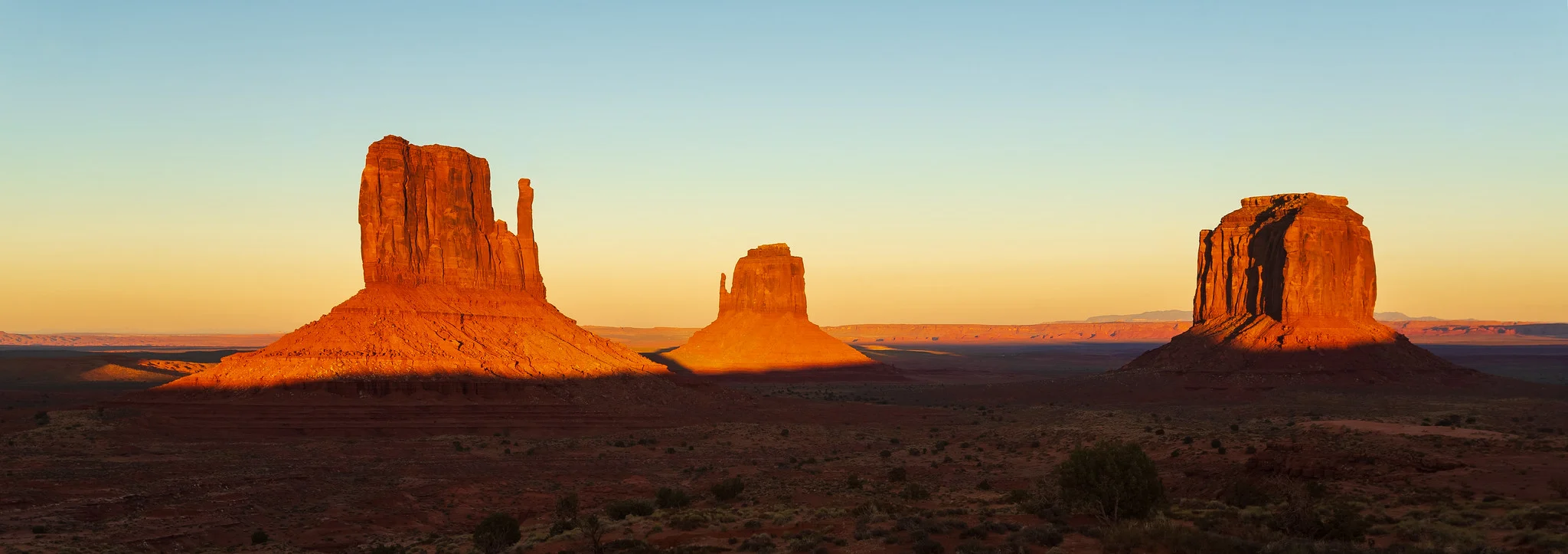
For sharp, well-exposed landscapes, use aperture priority or manual mode at f/8 to f/11 for maximum sharpness across the frame. Set ISO to 100 for the cleanest files, and let the shutter speed adjust accordingly. A tripod allows longer exposures when needed. Use hyperfocal distance, or focus on the most important element in the scene and stop down enough to bring the rest into acceptable focus, for front-to-back sharpness.
Landscape photography demands technical precision. Because you are often working with a tripod and have time to compose carefully, there is no excuse for soft images or incorrect exposure.
Aperture
Most landscape photographs benefit from a deep depth of field that keeps everything sharp from the nearest foreground element to the distant horizon. Set your aperture between f/8 and f/11 for the sharpest results. This range sits in the sweet spot of most lenses, delivering edge-to-edge sharpness without the diffraction softening that occurs at very small apertures like f/16 or f/22.
If you need maximum depth of field with a very close foreground, try f/13 to f/16 and accept a slight loss of peak sharpness in exchange for deeper focus. For most scenes, f/8 to f/11 is optimal.
ISO
Keep your ISO at your camera’s base setting (usually 100 or 200) to maximize image quality and minimize noise. Clean shadows and smooth gradients in the sky depend on low ISO values. Since you will be using a tripod for most landscape work, you can afford slower shutter speeds rather than raising the ISO.
Shutter Speed
Shutter speed is where landscape photography becomes creative. With a tripod, you have complete freedom to choose your shutter speed based on the effect you want:
- 1/500s or faster: Freezes crashing waves, wind-blown grasses, and waterfalls in sharp detail
- 1/4s to 2 seconds: Creates smooth, silky water effects in streams and waterfalls
- 10 to 30 seconds: Smooths ocean waves into a misty, ethereal surface and blurs moving clouds
- Several minutes: Turns moving clouds into dramatic streaks across the sky (requires an ND filter in daylight)
Focusing for Landscapes
For landscapes with both foreground and background elements, hyperfocal distance focusing ensures maximum sharpness throughout the scene. The hyperfocal distance is the closest point at which you can focus while keeping the distant horizon acceptably sharp. When you focus at this distance, everything from half the hyperfocal distance to infinity falls within the depth of field.
“Focus a third of the way into the scene” is a common shortcut, but it is not accurate: hyperfocal distance depends on your aperture, focal length, and sensor size, and can fall much closer or much farther than a third of the way into the frame. Use the Hyperfocal Distance Calculator to get the correct distance for your lens and aperture. Without a calculator in the field, a reliable fallback is to focus on the nearest element you actually need sharp and stop down until the background falls inside the resulting depth of field, checking a zoomed-in preview or focus peaking to confirm.
Getting Focus Exactly Right
The most reliable way to focus a landscape on a tripod is live view with magnification. Put the focus point on the spot you want sharp, magnify the live view as far as it goes, and turn the focus ring by hand until fine detail snaps into focus. Then switch the lens to manual focus so the camera cannot refocus when you press the shutter. Take a test frame and zoom in on the nearest and farthest parts of the scene to confirm both are sharp. In fog, low light or scenes with little contrast, where autofocus hunts, manual focus with magnification is often the only method that works.
Keeping the Camera Still
A tripod only solves half the problem. Pressing the shutter button shakes the camera, so trigger it with a remote release or the two-second self-timer. Many lenses and cameras recommend turning image stabilization off on a tripod, because the system can introduce small movements when there is no shake to correct. On a camera with a mirror, use mirror lockup or the electronic front-curtain shutter, which removes the vibration of the mirror and first shutter curtain at slow speeds. In wind, lower the tripod, keep the center column down and shield the camera with your body.
RAW Files and White Balance
Shoot RAW. A RAW file holds far more tonal information than a JPEG, which matters in landscapes where a bright sky and a dark foreground sit in the same frame, and it lets you recover highlights and lift shadows with less damage. White balance in a RAW file is only a setting attached to the file, so you can change it later without loss. Auto white balance is a fine starting point, but setting a fixed preset such as Daylight keeps the colors of a sunrise from being neutralized on the camera screen and keeps a sequence of frames consistent.
Use the Histogram
Your camera’s histogram is the most reliable exposure tool in the field. Bright sunlight makes the LCD screen hard to read, and your eyes can be fooled by the ambient light. The histogram shows you objectively whether you are clipping highlights or crushing shadows. Aim for an exposure that pushes data as far right as possible without clipping the highlights (expose to the right), then pull back the brightness in post-processing for the cleanest possible file.
Practice choosing an aperture that holds a scene sharp from front to back:
Want the other challenges? The full camera simulator has all 21, across eight scenes.
The Best Light for Landscapes
Light is the single most important factor in landscape photography. The same location photographed at noon and at sunrise can look like two completely different places. Learning to read, predict, and position yourself for the best light is what separates serious landscape photographers from casual tourists.
Golden Hour
Golden hour, roughly the first hour after sunrise and the last hour before sunset, provides warm, low-angle light that rakes across the land and reveals texture in every surface. Mountains gain depth as ridges cast long shadows. Fields of grass glow. Water reflects warm tones. This is the most universally flattering light for landscape photography.
The warm color temperature during golden hour (approximately 3,000-4,000K) also creates a natural warmth that is difficult to replicate in post-processing. Shoot during golden hour whenever possible.
Side Light, Backlight and Front Light
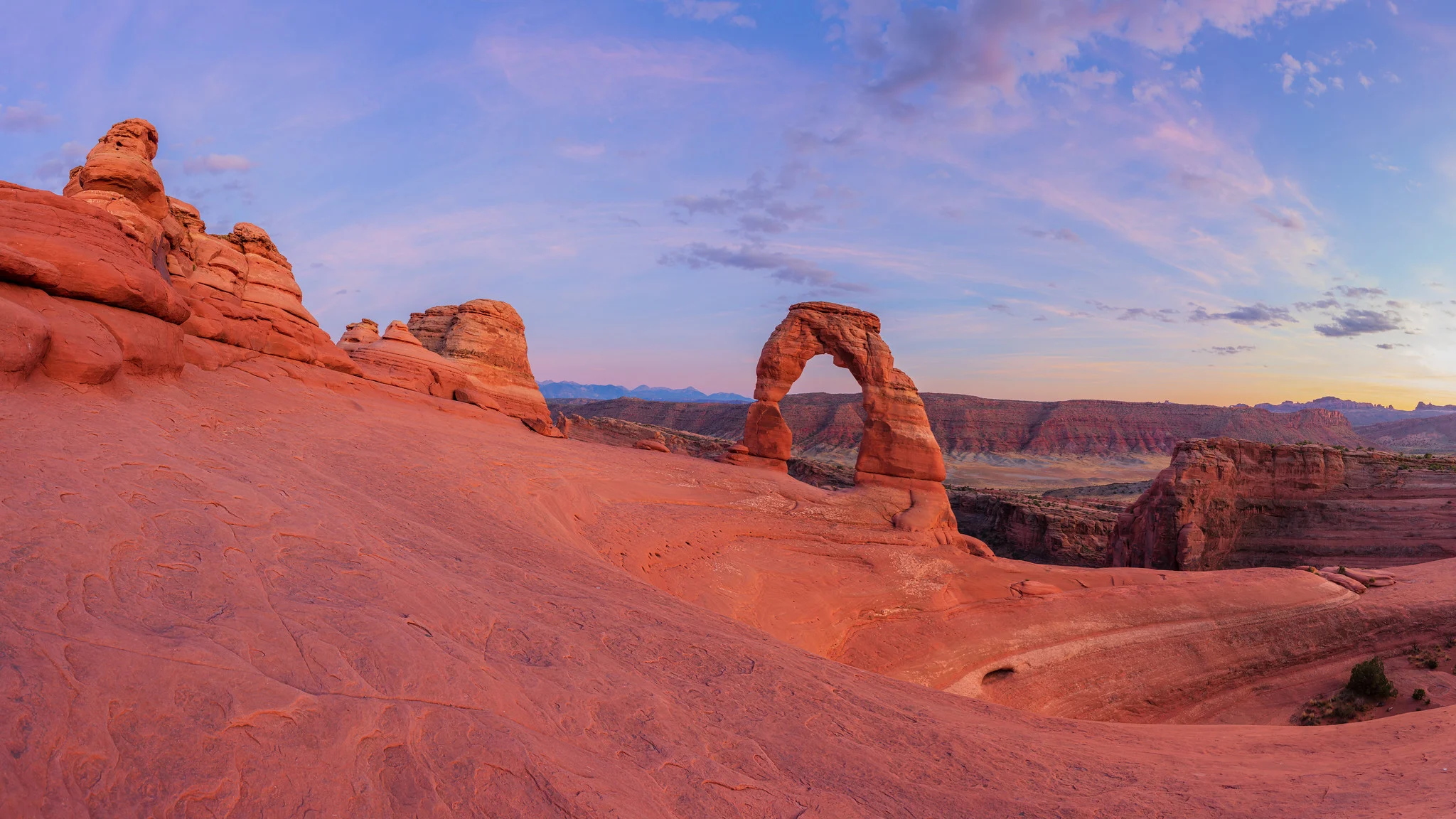
The direction of the light matters as much as its color. Side light, with the sun roughly 90 degrees to one side of the camera, rakes across the land and shows texture in rock, sand, snow and bark; it is the most useful direction for landscapes. Backlight, shooting toward a low sun, turns ridges and trees into silhouettes and makes grass, leaves and mist glow at the edges, but it needs careful exposure and a lens hood against flare. Front light, with the sun behind you, gives strong color but flattens shapes because the shadows fall behind everything. Before you set up, work out where the sun will be and choose a position that puts it to the side of your subject.
Blue Hour
Blue hour occurs in the 20-40 minutes before sunrise and after sunset, when the sky turns a deep, saturated blue. This light creates a cool, contemplative mood that works beautifully for seascapes, cityscapes, and mountain scenes. During blue hour, the sky and land are closer in brightness than at any other time, which makes it easier to capture balanced exposures without filters or bracketing.
Overcast Days
Many landscape photographers pack up when clouds roll in, but overcast light has its own strengths. The diffused, even illumination is ideal for waterfalls, forests, and intimate landscape details where harsh shadows would be distracting. Overcast skies also saturate colors, making autumn foliage, wildflowers, and green landscapes more vibrant than they appear in direct sunlight.
The one challenge of overcast days is a dull, featureless white sky. Solve this by keeping the sky out of the frame and focusing on the landscape itself, or by including just a sliver of sky for context. A bright white sky can also fool the meter into underexposing the land, so check the histogram and add exposure compensation if the foreground comes out dark.
Dramatic Weather
The most dramatic landscape photographs are often taken in challenging weather conditions. Storm light, where a shaft of sunlight breaks through dark clouds and spotlights a section of the landscape, creates images that are impossible to replicate. Fog and mist simplify complex scenes and add depth by separating foreground layers. Rain adds sheen and reflections. Snow transforms familiar landscapes into minimalist compositions. Watch the sky closely in storms: if you can hear thunder, you are close enough to be struck, so get off ridges and away from open ground before you think about the photograph.
Want fog to stay bright rather than turn grey? Fog and mist photography covers what fog does to light, exposing it and focusing when there is almost no contrast.
The lesson: do not stay home because the forecast is bad. Some of the best landscape light happens when conditions are unsettled.
Composition Techniques for Landscapes
Strong composition transforms a pretty view into a photograph that holds the viewer’s attention. These techniques work together to create images with depth, structure, and visual flow.
Leading Lines
Leading lines guide the viewer’s eye through the image. Rivers, roads, shorelines, fences, rows of trees, and natural ridgelines all work as leading lines. The strongest compositions use lines that start near the bottom corners of the frame and lead toward the main subject or into the distance, creating a sense of depth and journey.
Foreground Interest
A strong foreground element anchors the image and gives the viewer an entry point into the scene. Textured rocks, wildflowers, tidal pools, frost patterns, or weathered wood in the bottom third of the frame create a sense of three-dimensionality that draws the viewer in. Get low and close to foreground elements with a wide-angle lens to exaggerate their size and presence.
Rule of Thirds and Horizon Placement
Place the horizon along the upper or lower third line rather than dead center. A low horizon emphasizes a dramatic sky; a high horizon emphasizes the land or water. Use the rule of thirds to position focal points at the intersections of the grid lines for naturally balanced compositions.
Simplification
Landscape photography often suffers from trying to include too much. When a scene overwhelms you with beauty, your instinct is to zoom out and capture everything. Resist this. The most powerful landscape images isolate a specific element or relationship within the scene. Step back and use a longer focal length to fill the frame from a distance, which compresses the spacing between layers, and simplifies the composition. Remove distracting elements by adjusting your position. Ask yourself: what is this photograph actually about?
Framing
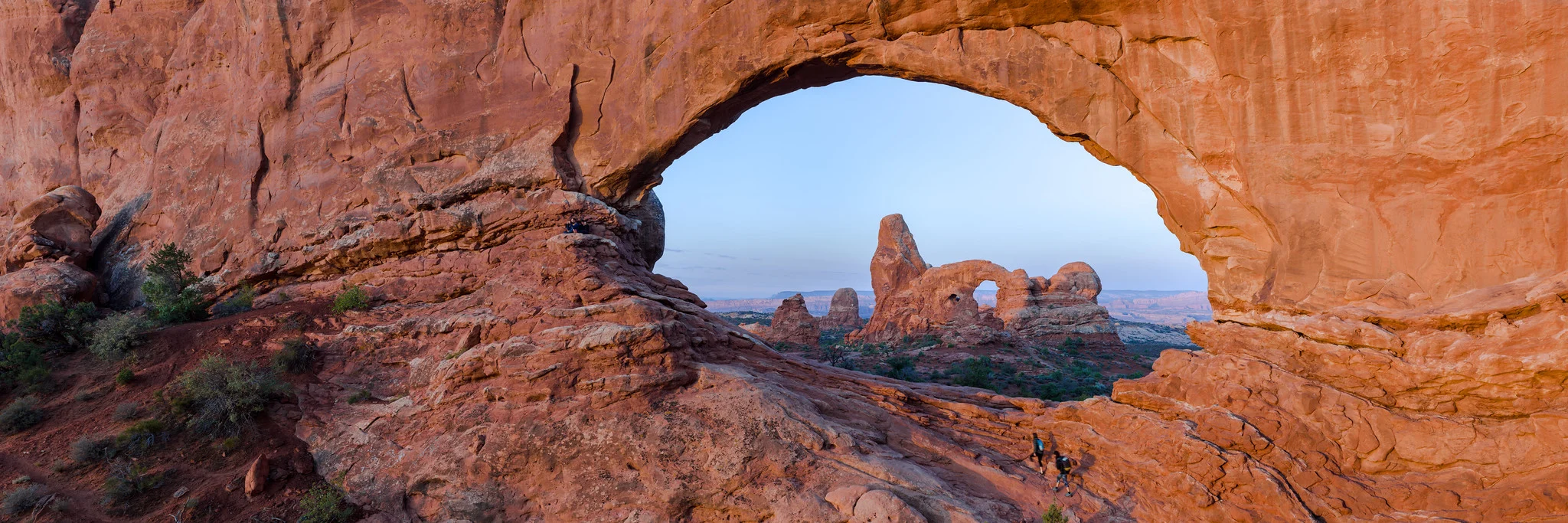
Overhanging branches, a rock arch, a gap between boulders or the edges of a canyon can frame the main subject and add depth by putting something close to the lens. The frame should support the subject, not compete with it. It does not need to surround the subject on all four sides; a frame along one or two edges is often enough.
Reflections, Symmetry and Patterns
Calm water reflecting mountains or trees is the one common case where a centered horizon works, because the reflection line is the subject. Level the camera carefully, since any tilt is obvious in a symmetrical frame. Look for repeating patterns too: ripples in sand, rows of trees, cracked mud, waves arriving at a beach. Patterns are strongest when they fill the frame, and stronger still when one element breaks the pattern.
Change Your Viewpoint
Most landscape photos are taken from standing eye level at the main viewpoint. Kneel or put the tripod low to make a foreground rock or flower large in the frame. Climb to higher ground to show the pattern of a river or a field. Walk a few steps left, right, forward and back; small moves change how foreground and background line up. Try the same scene in vertical orientation, which often suits a strong foreground leading to a distant peak.
Check the Edges Before You Shoot
Before each frame, run your eye around all four edges and corners of the viewfinder. Look for a bright branch poking in, a cut-off rock, a sign, litter or a half-included person. A small shift in position or framing fixes most of these, and it is better than cropping later, which throws away resolution.
Color, Contrast and Black and White
A small area of strong color in a muted scene, such as a red tree in a gray forest, draws the eye at once. Complementary colors, such as orange rock under a blue sky, create energy; neighboring colors, such as blues and greens, feel calm. When color adds nothing, try black and white, which turns the photograph into shape, texture and tone and suits stormy skies, fog and strong side light.
Layers and Depth
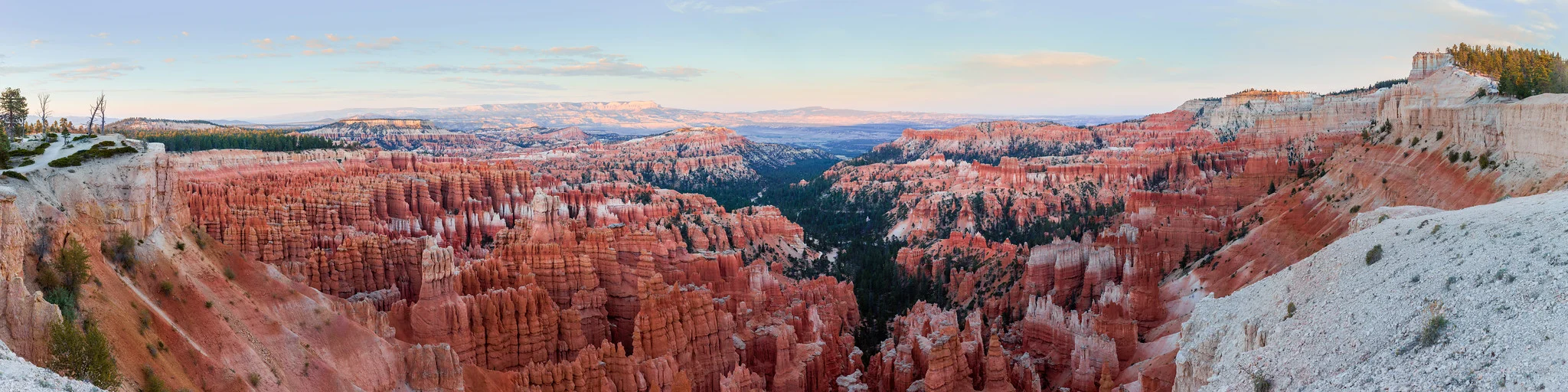
Create a sense of depth by including distinct foreground, middle ground, and background layers. Atmospheric haze, which naturally lightens and desaturates distant elements, enhances this layering effect. Mountain ranges, rolling hills, and forest scenes with receding layers are classic subjects for this approach.
Wondering how to build those layers on purpose? Foreground, midground and background shows what each layer is for and how to build layers in a landscape.
For more composition strategies, see the photography composition guide.
Essential Gear for Landscape Photography
Landscape photography does not require the most expensive camera body, but it does benefit from specific gear choices that enable technical precision and creative flexibility.
Tripod
A sturdy tripod is the single most important landscape photography accessory. It enables long exposures, ensures sharp images at any shutter speed, allows precise composition, and makes focus stacking and bracketing possible. Choose a tripod that is stable enough to resist wind, tall enough to use without the center column extended, and light enough to carry on hikes. Carbon fiber models offer the best balance of strength and weight.
Lenses
- Wide-angle zoom (16-35mm or equivalent): The workhorse landscape lens. Wide enough for sweeping vistas and dramatic foreground-to-background compositions.
- Standard zoom (24-70mm or 24-105mm): Versatile for mid-range compositions, isolating sections of a landscape, and compressed perspectives. Excellent when you cannot get closer to your subject.
- Telephoto (70-200mm or longer): Shot from farther back, it stacks distant layers together (the compression comes from the distance, not the lens) and isolates specific landscape elements into abstract, minimalist compositions. A telephoto lens is underused in landscape work but capable of producing some of the most striking images.
For more on choosing focal lengths, see lenses for landscape photography.
Filters
Two types of filters remain essential even in the age of digital post-processing:
- Circular polarizer: Reduces glare on water and foliage, deepens blue skies, and increases color saturation. These effects cannot be replicated in software. The effect is strongest when the camera points at roughly 90 degrees to the sun. A polarizer costs one to two stops of light, and on very wide lenses it can darken one part of a blue sky more than another, so reduce the effect or check the sky carefully.
- Neutral density (ND) filters: Block light to enable long exposures in bright conditions. A 6-stop or 10-stop ND filter lets you shoot multi-second exposures at midday for smooth water and streaky clouds. Use the ND filter exposure calculator to determine the correct adjusted exposure time.
Not sure which ND strength gives the blur you want? ND filter guide explains stops, ND numbers and exposure times.
Graduated ND filters (darker on top, clear on bottom) balance bright skies against darker foregrounds. A soft-edge grad suits horizons broken by mountains or trees, a hard-edge grad suits a flat sea or plain, and a reverse grad, darkest just above the horizon, suits a sunrise or sunset where the brightest band of sky sits on the horizon. While exposure bracketing and HDR processing can achieve similar results, many photographers still prefer graduated NDs for a more natural look straight out of camera.
The Rest of the Field Kit
- Spare batteries and cards: cold, long exposures and live view drain batteries fast. Keep spares warm in an inside pocket.
- A headlamp: sunrise and sunset shoots mean walking in or out in the dark. A red-light mode protects night vision.
- Cleaning gear: a blower and a microfiber cloth for spray, rain and dust on the lens or filters. Use the blower first so grit is not dragged across the glass.
- Rain protection: a rain cover or even a plastic bag and a lens hood keep drops off the front element.
- An L-bracket: lets you switch between horizontal and vertical framing on the tripod without tipping the head over to one side.
- Clothing in layers: you will stand still for long periods in wind and cold. Waterproof footwear with good grip matters on wet rock.
Advanced Landscape Techniques
Long Exposure Photography
Long exposures transform landscapes by rendering motion as blur. Water becomes silky smooth, clouds streak across the sky, and moving elements disappear. The technique requires a tripod, a remote shutter release, and often an ND filter. Start with a 1-2 second exposure for subtle water smoothing, and extend to 30 seconds or more for dramatic cloud movement.
HDR and Exposure Bracketing
HDR photography combines multiple exposures of the same scene to capture the full dynamic range from the brightest highlights to the darkest shadows. This is particularly useful for sunrise and sunset scenes where the sky is dramatically brighter than the foreground. Modern HDR processing in Lightroom produces natural-looking results when used with restraint. To shoot the frames, put the camera on a tripod, keep the aperture and ISO fixed, and use auto exposure bracketing so only the shutter speed changes; three frames two stops apart cover most sunrise and sunset scenes. Shoot brackets only when the histogram shows that one frame cannot hold both the brightest and darkest parts.
Panorama Stitching
Panorama stitching combines multiple overlapping frames into a single ultra-wide or high-resolution image. Beyond the obvious benefit of a wider field of view, panorama stitching also produces files with enormous resolution that can be printed at very large sizes. Use a tripod, overlap each frame by 30-40%, and lock your exposure and white balance to manual settings before shooting the sequence.
Focus Stacking
When a single aperture setting cannot keep both a very close foreground and a distant background in focus, take multiple shots at different focus distances and blend them in software. This technique is common in macro-landscape photography where flowers, rocks, or other small objects are positioned very close to the lens.
Wondering how to shoot and merge a focus stack? Focus stacking covers how to shoot a stack and merge it in software.
Planning Your Landscape Shoot
Successful landscape photography depends heavily on planning and preparation.
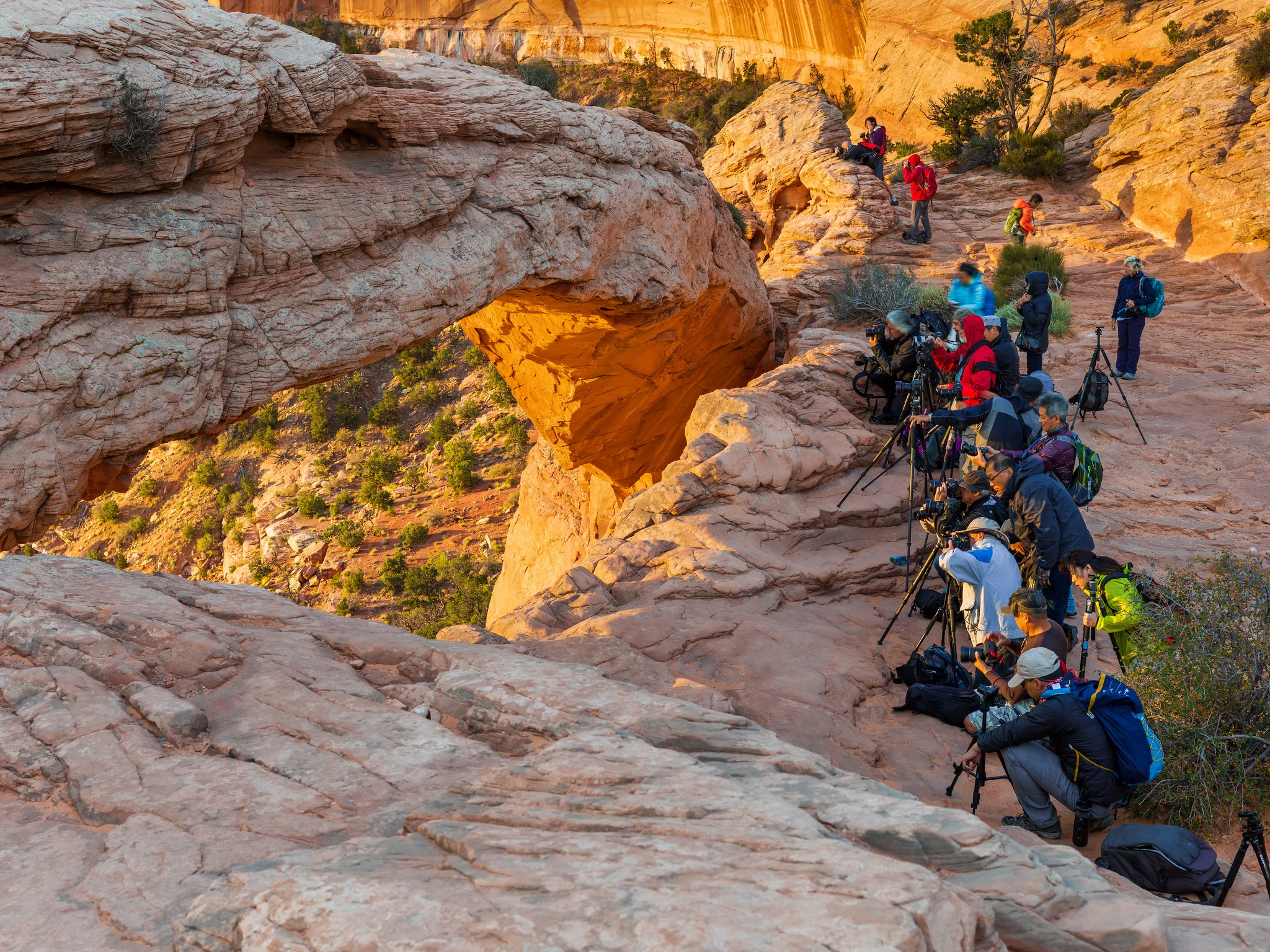
- Scout locations in advance. Visit potential shooting spots during the day to identify strong compositions. Note where the sun rises and sets relative to your position.
- Scout on a screen first. Satellite maps and 3D terrain views show where the ridges, lakes and viewpoints are, and a sun and moon position app shows which way the light will fall on them on any date. Searching photos taken at a location shows what has been done there, so you can look for something different.
- Check tides for the coast. Rock shelves, sea stacks and tide pools look completely different at high and low water, and a rising tide can cut off your way back.
- Check weather forecasts. Interesting weather often produces the best light. Partly cloudy skies at sunrise and sunset create the most dramatic color. Rain clearing at golden hour is a gift.
- Arrive early. Be at your chosen location at least 30 minutes before the light you are targeting. This gives you time to set up, find your composition, and make test exposures while the light is still building.
- Stay late. Do not pack up the moment the sun drops below the horizon. Blue hour light after sunset can be as beautiful as the sunset itself, and the sky often intensifies 10-15 minutes after the sun disappears.
- Revisit locations. Familiar spots reveal new opportunities in different seasons, weather conditions, and light. Some of the best landscape photographers return to the same locations dozens of times.
Curious what happens in the dark before the sun clears the horizon? Sunrise photography lays out the pre-dawn timeline from first light to full sun.
Safety and Leaving No Trace
No photograph is worth an injury. Tell someone where you are going and when you expect to be back. Carry water, food, a map you can read without a signal, a headlamp and warm layers, because a short sunset walk becomes a hike in the dark on the way out. Watch your footing near cliff edges and on wet or mossy rock, keep an eye on tides and waves on the coast, and give wildlife plenty of space.
Protect the places you photograph. Stay on trails, especially in fragile ground such as wildflower meadows, desert crust and alpine tundra. Do not pick plants, break branches or move things to improve a composition; find a composition that works with the place as it is. Carry out everything you carry in, and do not block a viewpoint for other visitors for long.
Post-Processing Landscape Photos
Landscape images benefit from careful post-processing that enhances what was already there without creating an artificial look.
- White balance: Adjust to match the mood of the scene. Slightly warm for golden hour, slightly cool for blue hour or overcast conditions.
- Graduated filters: Apply digital graduated filters to balance the exposure between a bright sky and a darker foreground.
- Clarity and texture: Moderate increases in clarity and texture enhance the detail and three-dimensionality of landscapes. Do not overdo it, as heavy clarity creates halos around edges.
- Color adjustments: Use the HSL panel to fine-tune individual colors. Deepen blue skies, warm up golden light, and increase the saturation of greens without affecting other colors.
- Lens corrections: Enable lens profile corrections to remove distortion and vignetting, particularly with wide-angle lenses.
- Sharpening: Apply capture sharpening to compensate for the inherent softness of digital capture, then output sharpening appropriate for your display medium (screen or print).
For detailed editing tutorials, see photo editing for beginners, editing landscape photos in Lightroom and the Lightroom tutorials.
Common Landscape Photography Mistakes
Most landscape mistakes trace back to two habits: shooting whenever you happen to arrive, and reaching for the same wide-angle lens every time.
- Shooting only in the middle of the day. Harsh, overhead sunlight flattens landscapes and creates unflattering contrast. Wake up early or stay out late for dramatically better results.
- Centering the horizon. Unless a reflection or a symmetrical scene calls for it, a centered horizon makes a static composition. Place it on the upper or lower third based on whether the sky or the land is more interesting.
- Ignoring the foreground. A landscape photo without foreground interest often looks flat and two-dimensional, like a postcard rather than a photograph you can step into.
- Leaving the tripod at home. Handheld landscape photography limits your creative options. You cannot shoot long exposures, bracketed sequences, or panoramas without a stable platform.
- Over-processing HDR. Heavy-handed HDR processing creates an unnatural, overcooked look that screams “filter.” Use HDR to extend dynamic range, not to create a surreal effect.
- Not waiting for the light. Arriving, shooting, and leaving in 15 minutes rarely produces strong results. The best landscape photographers spend hours at a single location waiting for conditions to align.
- Shooting only from eye level at the main viewpoint. Everyone else has that picture. Walk around, get low, try a longer lens.
- A tilted horizon. Even a slight tilt is obvious in a landscape, especially over water. Use the camera’s level or a grid and check it before every frame.
- Not checking the edges. Bright branches, cut-off rocks and stray objects at the frame edge pull the eye out of the picture.
- Using the wrong aperture. Shooting wide open at f/2.8 in a landscape wastes the depth of field you need. Stopping down to f/22 introduces diffraction softening. Stay in the f/8-f/11 sweet spot.
Try This: One Scene, Five Pictures
Pick one place close to home: a park, a riverbank, a field at the edge of town. Go at sunrise or sunset with a tripod. Make five different photographs of it without leaving a circle about 50 meters across: one with a wide lens and a strong foreground, one vertical, one with a longer lens picking out a detail, one from as low as you can get, and one facing away from the sun so the light is behind you. At home, compare them. The point is to learn how much a picture depends on choices you make on the spot rather than on the place itself.
Questions People Ask About Landscape Photography
What is landscape photography?
It is the photography of outdoor places, where the land, water, sky and the light on them are the subject. It ranges from wide views of mountains and coasts to close, intimate scenes such as patterns in ice or trees, and it includes cityscapes and night landscapes.
What are the best camera settings for landscape photography?
A good starting point is aperture priority or manual mode, f/8 to f/11, base ISO (usually 100), RAW files, and the camera on a tripod so the shutter speed can be as slow as the light requires. Focus on the nearest thing that must be sharp or at the hyperfocal distance, and check the histogram for clipped highlights. The landscape settings guide goes through each one.
What is the best time of day for landscape photography?
The hour after sunrise and the hour before sunset, when low, warm light shows texture, plus the blue hour before sunrise and after sunset. Overcast days suit forests and waterfalls, and unsettled weather often gives the most dramatic light. Midday sun is the hardest light to use.
What lens is best for landscapes?
A wide-angle zoom covers most grand landscapes and strong foregrounds. A telephoto is the second most useful lens, for picking out details and stacking distant layers together. A standard zoom alone can still produce excellent landscapes.
Do you need a tripod for landscape photography?
For most serious landscape work, yes. It lets you use a low ISO and a mid aperture at any shutter speed, and it makes long exposures, bracketing, panoramas and focus stacking possible. In bright light you can shoot handheld, as long as the shutter speed is fast enough to avoid shake.
Test Your Landscape Photography Knowledge
Each quiz takes 2-5 minutes and gives you instant results. Find out what you know and what to study next.
- Hyperfocal Distance and Depth of Field Quiz
- HDR and Tone Mapping Quiz
- Dynamic Range Quiz
- Photography Composition Quiz
Related Guides
- Best Camera Settings for Landscape Photography
- Best Lenses for Landscape Photography
- How to Photograph Waterfalls
- Golden Hour Photography
- Long Exposure Photography
- What HDR Is and When to Use It
- Panorama Photography
- Photography Composition Techniques
- Night Photography
- Portrait Photography
- Astrophotography
- Blue Hour Photography
- aerial photography without a drone
- photography in bad weather