The Rule Itself
The inverse square law states that the intensity of light from a point source falls off with the square of the distance from that source. Double the distance and the light reaching the subject drops to one quarter of its original intensity, a loss of exactly two stops. Triple the distance and intensity drops to one ninth, a loss of about 3.2 stops. The relationship holds for any small, unobstructed source in open space, and it is the single most useful equation in lighting because it explains why moving a light a small amount produces such a large, nonlinear change in both exposure and shadow falloff.
Worked Example
Say a flash sits 1 meter from a subject and produces a correct exposure at f/8. Move that same flash, at the same power, to 2 meters (double the distance): the light reaching the subject is now one quarter as intense, a two-stop loss, so the correct aperture drops to f/4 to maintain the same exposure, or you need four times the flash power to stay at f/8. Move it to 4 meters (double again): another two-stop loss, four stops total from the original 1-meter position, meaning the light is now one sixteenth as intense as it was at the start. Small distance changes near the light matter far more than the same distance change farther away, because the relationship is squared, not linear: going from 1 to 2 meters costs two stops, but going from 10 to 11 meters costs a small fraction of one stop.
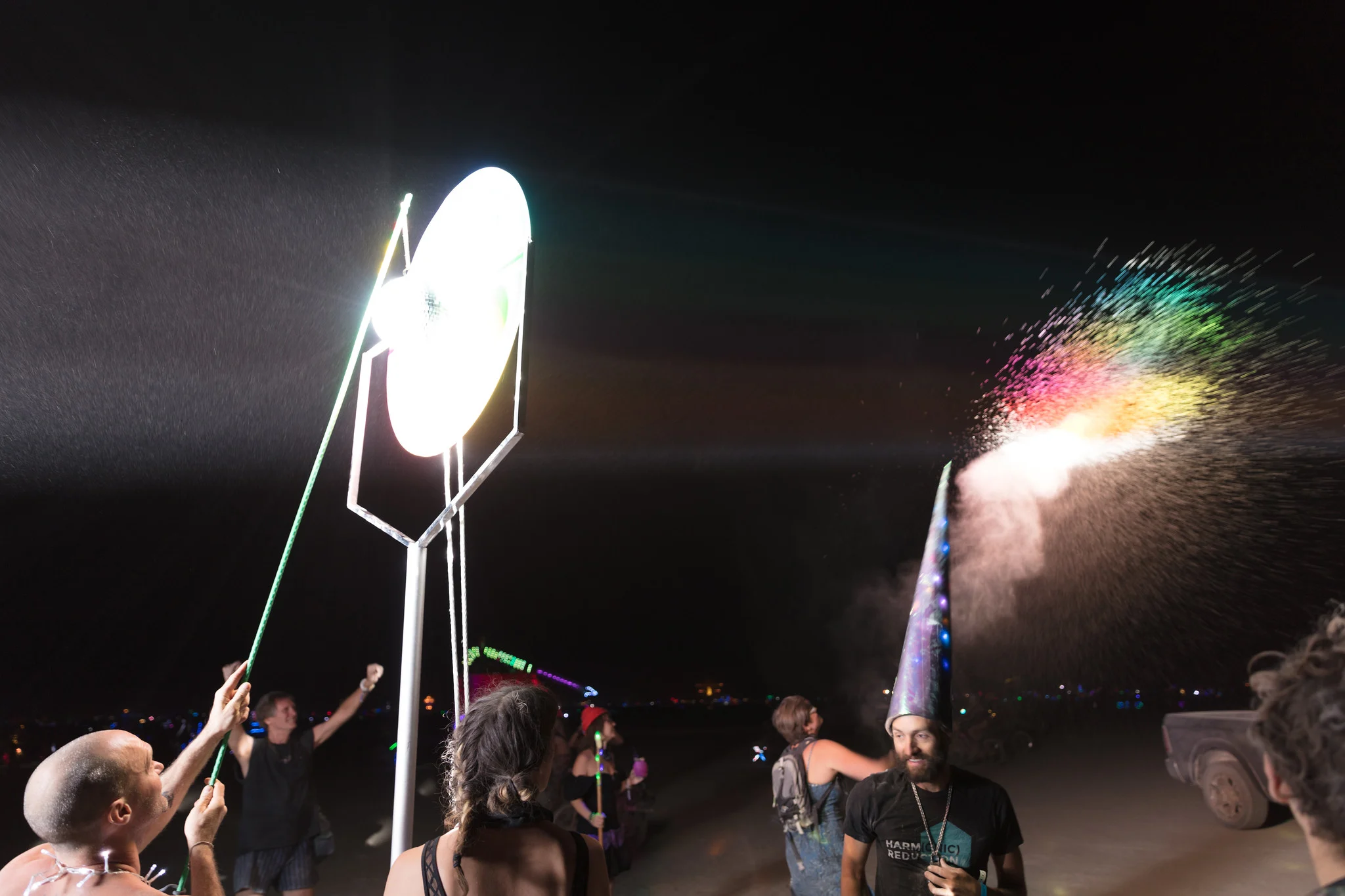
Move the light and watch the law work: the face stays correctly exposed while the wall behind goes darker the closer the light gets.
Shadow Falloff Across a Subject
The most visible consequence is falloff across a single subject. A softbox placed close to a face, say 1 meter from the nose and 1.2 meters from the ear, is lighting those two points at meaningfully different relative distances, so the ear reads noticeably darker than the nose. Move that same softbox to 4 meters away, and the nose-to-ear distance difference becomes a much smaller fraction of the total distance, so the two points receive far more similar intensity. Photographers exploit this deliberately: move a light close for dramatic, fast falloff across a face or body, or move it back for even, nearly flat illumination. A light close enough that one side of a face is two stops brighter than the other is a common, intentional way to add dimension and drama to an otherwise flat portrait.
Background Separation
The same math governs how a subject separates from its background. Placing a subject close to a wall lights both at nearly identical intensity, since they’re at nearly the same distance from the light, and the wall reads almost as bright as the subject, flattening the shot. Moving the subject away from the wall, while keeping the light near the subject, increases the wall’s distance from the light proportionally more than it increases the subject’s, so the wall falls darker while the subject stays bright. A few extra feet of gap between subject and background, with the light staying close to the subject, can drop the background by a stop or more, which is why studio setups routinely pull subjects well off the backdrop rather than placing them against it.
Bounce Flash and the Hidden Distance Cost
Bounce flash demonstrates the exposure cost of this rule in a way many photographers underestimate. A flash aimed at the ceiling travels up, hits the ceiling, scatters, and travels back down to the subject. The total path is often four to six meters in a typical room, against a direct path of perhaps two to three meters. That is roughly double to triple the direct distance, which by itself costs two to a bit over three stops, and the ceiling absorbs some of the light on top of that. This is why bounce flash so often needs a flash near full power to match an exposure that direct flash would achieve at a fraction of the power.
A Simple Diagram
Where the Law Does Not Apply
The law is precise only for sources that are small relative to the distance involved, true point sources or a close approximation of one. Large area sources, a huge softbox or a wall acting as a giant reflector, follow it less strictly once the subject is closer than the source’s own longest dimension, because at that range the source behaves like many overlapping points rather than one, and falloff becomes gentler than the simple formula predicts. Ambient outdoor light is the other major exception: the sun and sky sit at effectively infinite distance, so there is no meaningful falloff across a human-scale scene. Sunlight on foreground rocks is the same intensity as sunlight on a distant mountain in the same frame. Indoors or on a small set, where lights sit just a few meters from the subject, the law dominates nearly every lighting decision; outdoors under natural light, it is almost irrelevant, because nothing is close enough to the sun for distance to matter.
Common Mistakes
- Applying the law to sunlight. Walking ten feet closer to a landscape does not change how bright the sun looks on it. The sun is effectively at infinite distance; inverse square falloff only shows up with sources close enough to the subject to matter, which sunlight never is at any distance a photographer can walk.
- Forgetting the squared relationship and expecting linear changes. Doubling distance does not halve intensity, it quarters it. Photographers who eyeball light placement by “a bit closer, a bit farther” without accounting for the square often end up badly over- or under-lit.
- Treating a large, close softbox with the same math as a small bare flash. A big source close to the subject falls off more gently than the point-source formula predicts, because it isn’t behaving like a point anymore.
- Rounding “roughly three stops” up to “four stops” for a tripled distance. The actual figure is about 3.2 stops (one ninth of the original intensity); the error compounds quickly if you’re calculating flash power for a shoot.
Try This
Set up a single light, a flash, a lamp, even a phone flashlight in a dark room, and a light meter or your camera’s own meter. Take a reading with the light 1 meter from your subject. Move it to exactly 2 meters and take another reading, then to 4 meters for a third. You should see almost exactly a two-stop drop between each pair, confirming the doubling relationship directly rather than taking it on faith. If you have a second light or reflector, repeat the background-separation test: light a subject standing right in front of a wall, meter the wall, then move the subject 1.5 meters off the wall without moving the light, and meter the wall again.
Related
- Photography Lighting: The Complete Guide, the full hub this page’s techniques feed into.
- Qualities of Light: Hard, Soft, and Everything In Between: how the same distance changes that drive falloff also change apparent source size and hardness.
- Guide Number: flash-power math built directly on this relationship.
- Softbox and Reflector: the tools most often placed using inverse square math.
- Bounce Flash: the practical exposure cost worked through above.