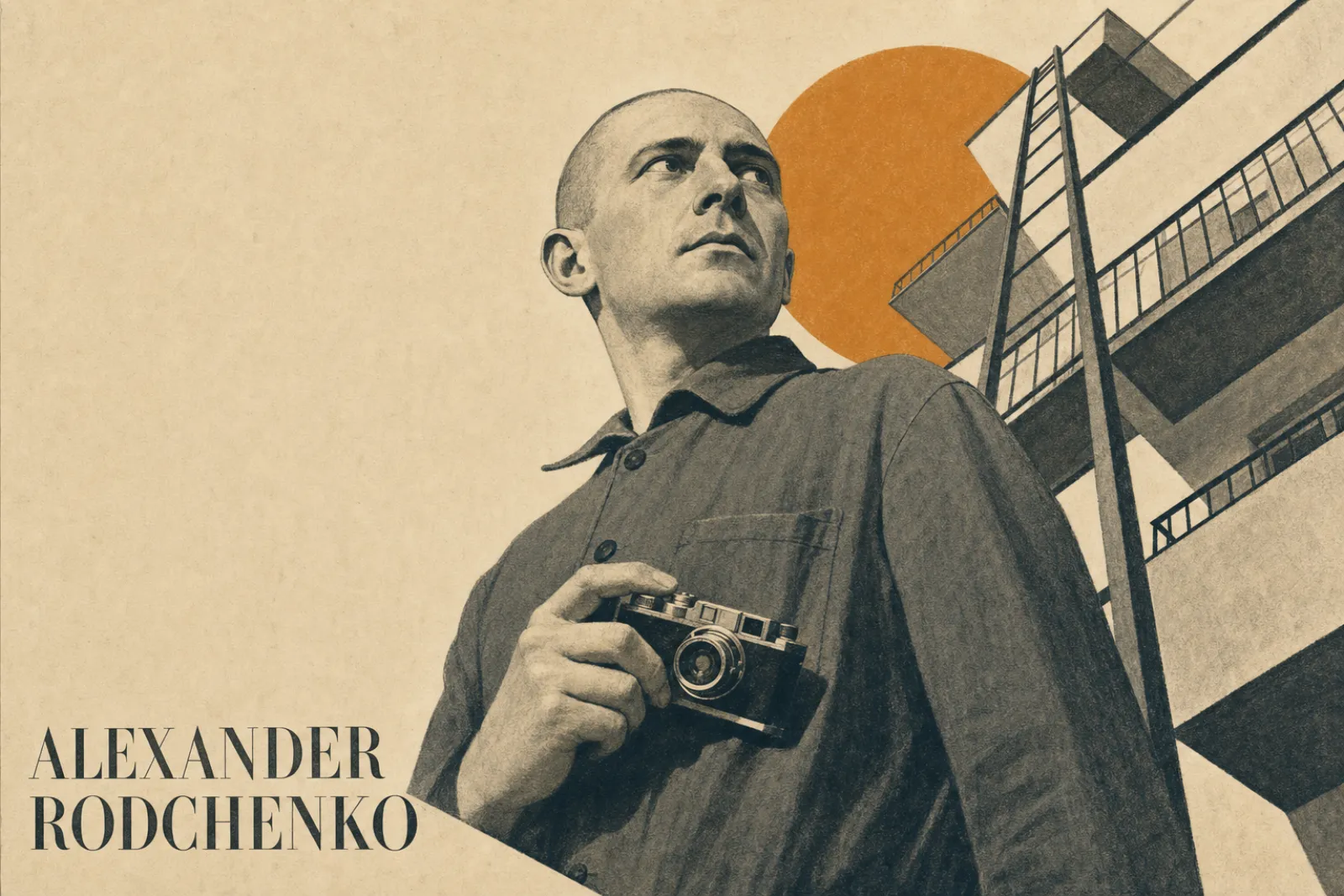
Alexander Rodchenko (1891 to 1956) was a Russian artist, designer and photographer who worked in Moscow in the years after the 1917 revolution. A founder of Constructivism, he gave up painting in 1921, moved into posters, books and photomontage, and began taking his own photographs in 1924. He is known for pictures shot from steep angles, looking straight up or straight down, so that ordinary things appear unfamiliar.
Rodchenko trained as a painter. His first abstract drawings, made in 1915, were influenced by Kazimir Malevich, and Vladimir Tatlin was a formative influence soon after. With Tatlin he is credited as a founder of Constructivism, which held that art should reflect the modern industrial world and take part in changing everyday life. What he reacted against was art made for its own sake. His closest collaborators were his wife, the artist Varvara Stepanova, and the poet Vladimir Mayakovsky. His reach was long: Alexey Titarenko, working in the 1980s, drew on Rodchenko for his early photomontages and names him among his influences alongside Man Ray.
Where does Constructivism sit among the other schools? Photography movements and the ideas behind them sets them side by side.
From ruler and compass to three blank canvases
Rodchenko was born in Saint Petersburg on 5 December 1891. His father was a theatre props manager and his mother a washerwoman. The family later moved to Kazan, where Rodchenko entered the Kazan Art School in 1910 and met Stepanova. He continued his training at the Stroganov Institute in Moscow.
In his early abstract work he drew with a compass and ruler to remove expressive brushwork. In 1916 he showed in the exhibition The Store. After the revolution he held official posts. He was put in charge of the Museum Bureau, and from 1920 to 1930 he taught at the VKhUTEMAS school in Moscow.
In 1921 he joined the Productivist group with Stepanova and Aleksei Gan. That year, at the exhibition 5×5=25 in Moscow, he showed three single-colour canvases: Pure Red Colour, Pure Yellow Colour and Pure Blue Colour. He regarded them as the logical end of painting, and he stopped painting to work on design for posters, books and films.
Scissors first, then a camera
Rodchenko came to photography through other people’s pictures. In 1922 he worked closely with the filmmaker Dziga Vertov. In 1923 he began using found photographs in photomontage, and his first published montages illustrated Mayakovsky’s poem About This. In 1924 he started making his own photographs.
His first subjects were close to hand. He photographed the circle around the journal LEF, including Mayakovsky, Osip Brik and Lilya Brik, and in 1924 he made a portrait of his mother. The same year Lilya Brik was the model for his poster for the Lengiz publishing house, in which a young woman shouts a slogan about books in all branches of knowledge. He designed the covers of LEF, published from 1923 to 1925, and of Novy LEF, published from 1927 to 1929. The earlier covers used photomontage and the later ones used photographs. He designed posters for Sergei Eisenstein’s 1925 film Battleship Potemkin, and in 1925 a Workers’ Club for the international exhibition of decorative arts in Paris.
Outdoors he turned the camera on Moscow. The series House on Myasnitskaya dates from 1925 and a series on the Mosselprom building from 1926. He also made a series of pine trees at Pushkino. In these pictures he pointed the camera steeply up or down instead of holding it level.
The charge of formalism
The angles were soon attacked. In 1928 the magazine Sovetskoe Foto accused Rodchenko of formalism, meaning that he cared more for form than for content. Colleagues from his own circle joined in. Osip Brik objected to pictures of a single building or tree as mere aesthetics, and Sergei Tretyakov wrote that Rodchenko was interested only in photography’s aesthetic function. Rodchenko defended his method in articles, among them Paths of Contemporary Photography.
He was a member of the October group of artists, and he left it in the early 1930s after being charged again with formalism. His steeply angled pictures of 1930, Pioneer and Pioneer Trumpeter, were among the works that drew criticism.
He went on working for the state. In 1933 he photographed the White Sea Canal, which was built by prisoners between 1931 and 1933 and cost many thousands of lives. He made more than 2,000 photographs there, of which fewer than 30 survive. With Stepanova he designed layouts and covers for issues of USSR in Construction, a monthly magazine published in several languages to show Soviet industry to the world. In 1935, in order to exhibit, he was required to denounce his earlier formalist work in public, and he published a statement in Sovetskoe Foto putting ideology ahead of form.
From 1938 to 1940 he photographed circus performers. He stopped photographing in 1942. He had returned to painting in the late 1930s and made abstract works in the 1940s, and he continued to organise photography exhibitions for the government. He died in Moscow on 3 December 1956.
Why the camera is never at eye level
Rodchenko’s argument was simple and it can be tested with any camera. He held that a subject should be photographed several times, from different viewpoints and in different situations, as if walking around it, instead of always from the same position.
- Change the height before anything else. His pictures favour the view from above and the view from below. Camera angle and position change what a subject means. Pioneer Trumpeter was shot at a steep angle, and that viewpoint was what his critics objected to.
- Let line organise the frame. In The Staircase the steps supply the geometry and the figures are set against it. See how lines in composition direct the eye.
- Tilt on purpose. When a camera points steeply up or down, vertical edges lean and converge. Rodchenko used that perspective distortion as energy, where an architect’s photographer would correct it.
- Repeat. Steps, building fronts and tree trunks give him rhythm and pattern, which a single figure can then interrupt.
- Work in series. The Myasnitskaya, Mosselprom and Pushkino pictures are sets, not single frames. One angle is a trick. Several angles on one subject are a study.
Are the leaning verticals a fault or a tool? How to photograph architecture and buildings explains when to keep them straight and when to let them go.
Photographs to look for
- Portrait of Mother (1924). A portrait from the year he took up the camera, made alongside his pictures of the LEF circle.
- House on Myasnitskaya (1925). A series on a single Moscow building, and one of the series that was criticised at the time.
- Pine Trees in Pushkino. The method applied to trees instead of buildings. This series was criticised too.
- The Staircase (1930). A woman with a child is set against the geometry of a flight of steps. Notice how the figures and the pattern of the architecture depend on each other.
- Pioneer Trumpeter (1930). A steeply angled picture that drew criticism. Ask what the same subject would look like from eye level.
- Girl with a Leica (1934). One of his best known photographs, made after the first attacks on his work and a year before he had to denounce his formalism in public.
Want more ways to arrange a frame? Photography composition: 15 techniques covers the ones that sit alongside line and pattern.
Try this: one subject, six viewpoints
Take 15 minutes with a camera or phone and one fixed subject: a staircase, a fire escape, a block of flats or a single tree. Make exactly six pictures. First, eye level and straight on, as a control. Second, from directly underneath, looking up. Third, from as high as you can safely get, looking down. Fourth, with the camera tilted so that the main lines run corner to corner. Fifth, close enough that the subject becomes only lines and pattern. Sixth, any of those again, but wait until a person enters the frame. Lay the six side by side. Decide which one tells a stranger most about the subject, and which one you would never have made by habit.
Questions people ask about Alexander Rodchenko
What is Alexander Rodchenko known for?
He was a founder of Russian Constructivism who worked across painting, graphic design, photomontage and photography. In photography he is known for steep, unexpected camera angles, and in design for posters such as the 1924 Books poster with Lilya Brik.
When did Rodchenko start taking photographs?
In 1924. He had been using other people’s photographs in photomontage since 1923, including the illustrations for Mayakovsky’s About This. He stopped photographing in 1942.
Why was Rodchenko accused of formalism?
Soviet critics argued that his unusual angles put form ahead of content. The charge was first made in Sovetskoe Foto in 1928, it led to his departure from the October group in the early 1930s, and in 1935 he had to renounce his earlier work publicly in order to exhibit.
Why did Rodchenko stop painting?
In 1921 he showed three canvases, each a single colour, at the exhibition 5×5=25, and judged that painting had reached its end. He turned to design for posters, books and films. He took up painting again in the late 1930s.
More photographers who changed how the camera is used are listed in the A to Z of photographers.