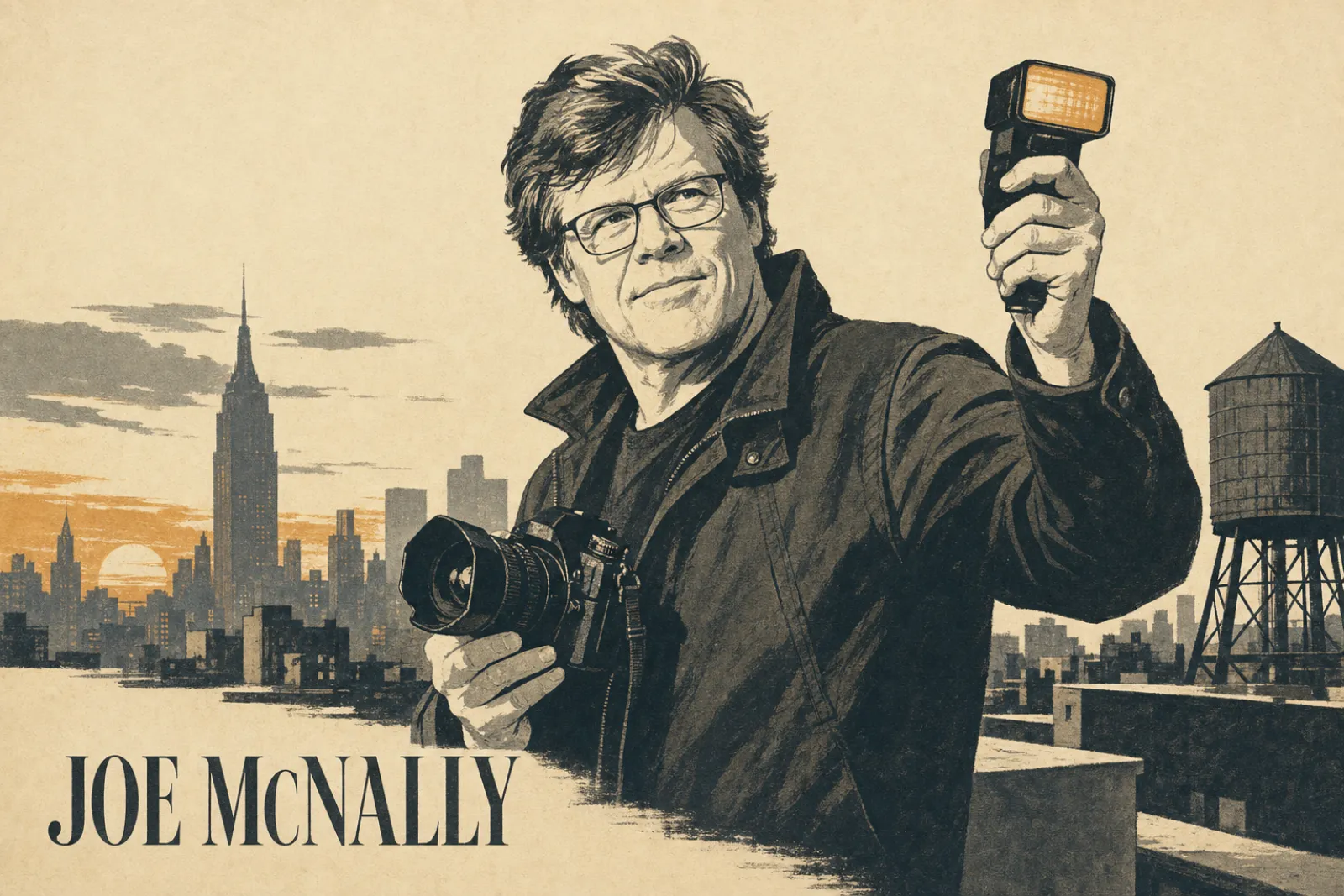
Joe McNally is an American magazine photographer, born in Montclair, New Jersey, in 1952. He was a staff photographer at Life from 1994 to 1998 and a long-term contributor to National Geographic, and he photographed cover stories for many other magazines. He is known for two things: skilled use of flash on location, and Faces of Ground Zero, a set of life-size Polaroid portraits made in New York in the weeks after September 11, 2001.
McNally came out of the American picture magazine tradition. He studied at the S. I. Newhouse School of Public Communications at Syracuse University, where he took both a bachelor’s and a graduate degree, and made his career on magazine assignments. When Life hired him in 1994 he was its first staff photographer in 23 years. Life was the magazine whose first issue, in 1936, carried five pages of pictures by Alfred Eisenstaedt and a cover by Margaret Bourke-White. In 1998 McNally won the Alfred Eisenstaedt Award for magazine photography, a prize that carries the older photographer’s name.
An assignment photographer for Life and National Geographic
McNally’s working life was built on assignments. A magazine sets a subject, a deadline and a number of pages, and the photographer has to come back with pictures that fill them. Besides Life and National Geographic, he shot cover stories for Sports Illustrated, Time, Newsweek, Geo, Fortune, New York, Business Week and Men’s Journal. His own biography counts seven Life covers and fifteen National Geographic coverages, five of them cover stories.
An early job shows the kind of picture he went after. Around 1978, while working for ABC television, he climbed the antenna on top of the North Tower of the World Trade Center. By his own account he carried a Nikon F2, a 16mm fisheye lens and Kodachrome film. A fisheye bends straight lines and takes in a very wide view, which suits a picture made from a mast high above a city.
In December 2003 National Geographic published “The Future of Flying”, a 32-page cover story by McNally that marked the centennial of the Wright brothers’ first flight. It was the first story in the magazine’s history to be photographed entirely with digital cameras. The issue was a finalist for a National Magazine Award.
Wondering how a set of magazine pages is planned and filled? How to create a photo story or series walks through building pictures that work together.
Faces of Ground Zero and the giant Polaroid
McNally’s best-known project used a camera unlike anything in his magazine bag. In the three weeks after the September 11 attacks he made 246 portraits in the Moby C studio, near the World Trade Center site. The studio housed what has been described as the world’s largest instant camera, a one-of-a-kind machine that produced Polaroid prints measuring 9 feet by 4 feet. A standing adult fits on a sheet that size at life scale.
The sitters were emergency workers, survivors and relatives of people who died. Some frames hold more than one person, so about 272 people appear in the series. The pictures were framed life-size and shown in 2002 as a travelling exhibition, at venues that included Vanderbilt Hall at Grand Central Terminal in New York, the Boston Public Library, the Royal Exchange in London, Union Station in Chicago, San Francisco and Los Angeles. A book, Faces of Ground Zero: Portraits of the Heroes of September 11, 2001, was published by Little, Brown in 2002, and a large share of the proceeds went to September 11 charities.
The lesson in the project is about scale. A person shown at their real height meets the viewer eye to eye, which a small print on a page cannot do. How large a portrait is shown changes how it is read.
Curious about instant prints at ordinary sizes? The guide to instant film photography covers Polaroid and Instax and how each behaves.
The flash principles behind McNally’s kind of picture
McNally is known for flash photography. He published three books with New Riders: The Moment It Clicks (2008), The Hot Shoe Diaries (2009) and Sketching Light (2011). A fourth book, The Real Deal, followed from Rocky Nook in 2022. He also taught through workshops. The ideas below are the standard building blocks of location flash in general, not an account of his own methods, and they are useful things to look for in any flash picture, his included.
- Two exposures in one frame. A flash picture on location records the existing light and the flash at the same time. The shutter speed controls how bright the surroundings look. The flash power and aperture control how bright the subject looks. Learning to set them separately is the heart of balancing flash and ambient light.
- Light from somewhere other than the camera. A flash fired from the camera position flattens a face. Moving it to one side gives shape and shadow. That is the whole reason for off-camera flash.
- Size decides softness. A bare flash is a small, hard source. Firing it through a diffuser or a softbox, or bouncing it off a wall, makes the source larger and the shadows softer.
- Distance decides fall-off. Light close to a subject drops away quickly behind them. Light far away covers a scene more evenly. The inverse square law explains why.
- The place stays in the picture. Magazine portraits usually show people where they work or live. Flash is there to make the person readable without wiping out the setting, which is the aim of an environmental portrait.
New to flash altogether? Flash photography for beginners explains when a flash helps and how to start using one.
Work to look for
- Faces of Ground Zero (2001). The 246 life-size Polaroid portraits of emergency workers, survivors and relatives. Notice how much a full standing figure tells about a person when it is shown at real height.
- “The Future of Flying” (National Geographic, December 2003). A 32-page cover story for the centennial of the Wright brothers’ flight, and the magazine’s first all-digital shoot. It is worth reading as a complete story rather than as single frames.
- The World Trade Center antenna climb (around 1978). Made while he worked for ABC television, with a Nikon F2, a 16mm fisheye and Kodachrome. Look at what a very wide lens does when the photographer is part of the scene.
- The World Press Photo portrait (1997). McNally won first prize for a single picture in the Portraits category of the 1997 contest. He also placed in the contest in 1996, 1998 and 2000.
- The Hot Shoe Diaries (2009). The title refers to the hot shoe, the mount on top of a camera that holds a flash. Read the pictures in it for where the light comes from and how bright the background was allowed to stay.
Try this: one light, two brightness controls
This takes about 15 minutes and needs a camera with a flash, or a phone and a second phone or torch held by a friend.
- Stand a person in a room in the evening with a lamp or a window behind them.
- Take one picture with no added light. Note how the person and the background look.
- Now light the person from the camera position. Take a picture.
- Move the light an arm’s length to one side and a little above the person’s eyes. Take another.
- Keep the light in that place and make three more pictures, each with the background darker than the last. On a camera, use a faster shutter speed each time. On a phone, drag the exposure slider down.
- Compare the five lit frames. Pick the one where the person looks solid and the room still looks like a room.
The constraint is one light only. The point is to see that the subject and the background can be set separately.
Want to add light outdoors in daylight? Fill flash shows how to lift shadows on a face without the flash taking over.
Questions people ask about Joe McNally
What is Joe McNally known for?
He is known for magazine photography made with flash, for his years at Life and National Geographic, and for Faces of Ground Zero. He is also known as a teacher of lighting through his books and workshops.
What was Faces of Ground Zero?
It was a series of 246 life-size Polaroid portraits of emergency workers, survivors and relatives of victims, made over three weeks in a studio near the World Trade Center site after September 11, 2001. The prints measured 9 feet by 4 feet. The series toured as an exhibition in 2002 and was published as a book the same year.
Did Joe McNally work for Life magazine?
Yes. He was a Life staff photographer from 1994 to 1998, the first the magazine had hired in 23 years. He photographed seven Life covers.
What books has Joe McNally written?
His books are Faces of Ground Zero (2002), The Moment It Clicks (2008), The Hot Shoe Diaries (2009), Sketching Light (2011) and The Real Deal (2022).
For more photographers who worked for the picture magazines, and everyone else profiled on this site, see the A to Z of photographers.