Astrophotography rewards patience and planning more than any other genre: the right night, the right location, and a few settings you can dial in ahead of time matter more than expensive gear. This guide covers nightscapes, tracked deep-sky imaging, the moon and planets, star trails, and meteor showers, with the settings and reasoning behind each.
Go deeper: How to Photograph Stars, How to Photograph the Moon, How to Photograph Northern Lights, Star Trail Photography, and Night Photography Hub.
Try It Yourself: Camera Simulator
Practice reading a night sky and dialing in the settings that hold points of light sharp before you rely on it under real stars:
Want the other challenges? The full camera simulator has all 21, across eight scenes.
What Is Astrophotography?
Astrophotography is the art and science of photographing celestial objects and phenomena: stars, the Milky Way, planets, the moon, nebulae, galaxies, meteor showers, and eclipses. It ranges from simple nightscape photography (stars above a landscape, achievable with basic camera equipment) to deep-sky imaging (detailed photos of distant galaxies and nebulae, requiring specialized equipment and techniques).
This guide covers the complete spectrum of astrophotography, starting with the equipment and techniques a beginner needs and progressing to advanced methods that reveal detail invisible to the naked eye. Whether you want to capture a stunning Milky Way landscape or photograph the Andromeda Galaxy, you will find the settings and methods here.
Equipment for Getting Started
The good news: you can start astrophotography with gear you probably already own. The basics are simpler than you might think.
Camera
Any camera with manual controls (aperture, shutter speed, ISO) and a Bulb mode works. Full-frame cameras excel at high-ISO astrophotography due to larger pixels that gather more light, but crop-sensor cameras produce excellent results. Some cameras have an “astro” or “star” mode that provides useful presets but is not required.
Lenses
For nightscape and Milky Way photography, a fast wide-angle lens is ideal: 14mm to 24mm at f/1.4 to f/2.8. A wider aperture gathers more starlight per frame, allowing lower ISO or shorter exposures. Check out our Zone System for more details. For the moon and planets, a telephoto lens (200mm to 600mm) or a telescope with an adapter provides the magnification needed for surface detail. For detailed guidance on star photography specifically, see our star photography guide.
Tripod
A sturdy tripod is essential for all astrophotography. Exposures range from a few seconds to several minutes, making any camera movement visible. Avoid cheap, lightweight tripods that vibrate in the wind. Carbon fiber tripods are lighter and dampen vibration better than aluminum, though aluminum works fine in calm conditions.
Remote Trigger or Intervalometer
A remote trigger or intervalometer lets you fire the shutter without touching the camera (eliminating vibration) and program automated sequences for time-lapses and star trail stacking. Many cameras also have built-in intervalometer functionality and can be triggered via smartphone apps.
Understanding the Night Sky
Before you photograph the sky, you need to know what you are looking at and when key objects will be visible.
The Milky Way
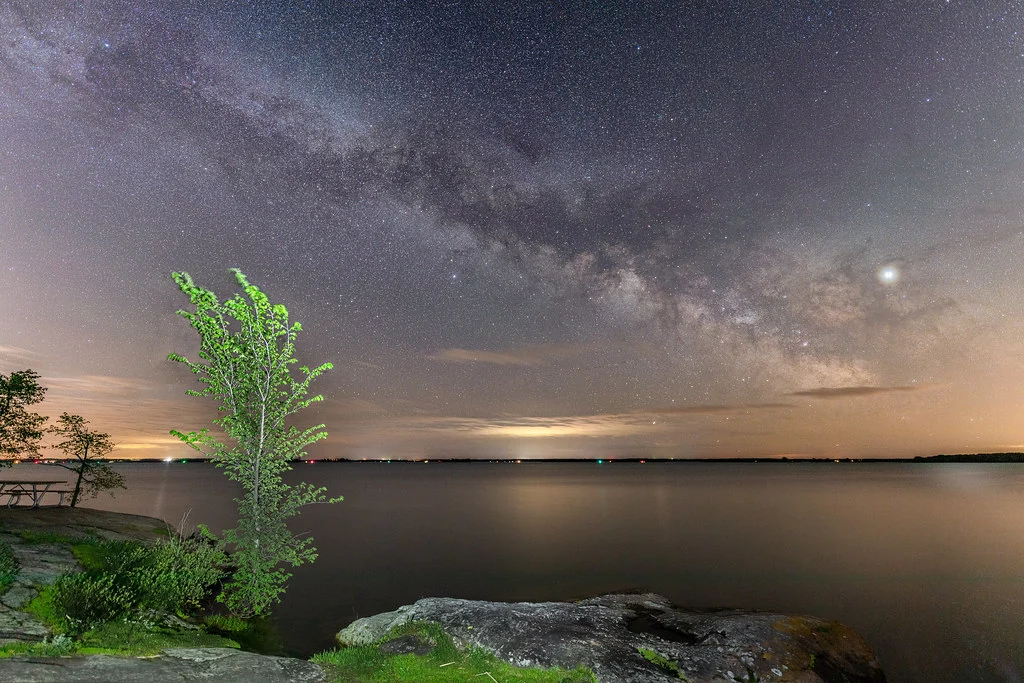
Our galaxy’s core, the bright, cloudy band that dominates nightscape photos, is visible in the Northern Hemisphere from roughly March through October. It is most prominent during June, July, and August when it arches high across the sky. In the Southern Hemisphere, the core is visible from roughly February through October, with the best viewing from April through August.
The Milky Way’s position in the sky changes throughout the night and throughout the year. At sunset in June (Northern Hemisphere), the core is low on the southeastern horizon. By midnight, it arcs overhead. By dawn, it is setting in the southwest. A planetarium app (Stellarium, Star Walk, PhotoPills) shows its exact position at any time and date.
The Moon’s Impact
Moonlight is the enemy of faint astrophotography targets. A full moon brightens the sky enough to wash out the Milky Way, faint nebulae, and most deep-sky objects. Plan your most ambitious astrophotography sessions during the new moon phase (when the moon is not visible), or when the moon is below the horizon during your shooting hours. A thin crescent moon that sets early in the evening is acceptable. For detailed moon photography, see our moon photography guide.
Light Pollution
Artificial light from cities creates a glow that overwhelms faint celestial objects. For the best astrophotography results, you need dark skies. Light pollution maps (lightpollutionmap.info) show sky brightness levels worldwide. Designated Dark Sky Parks and preserves offer the darkest conditions and are often the best destinations for astrophotography.
Weather and Atmospheric Conditions
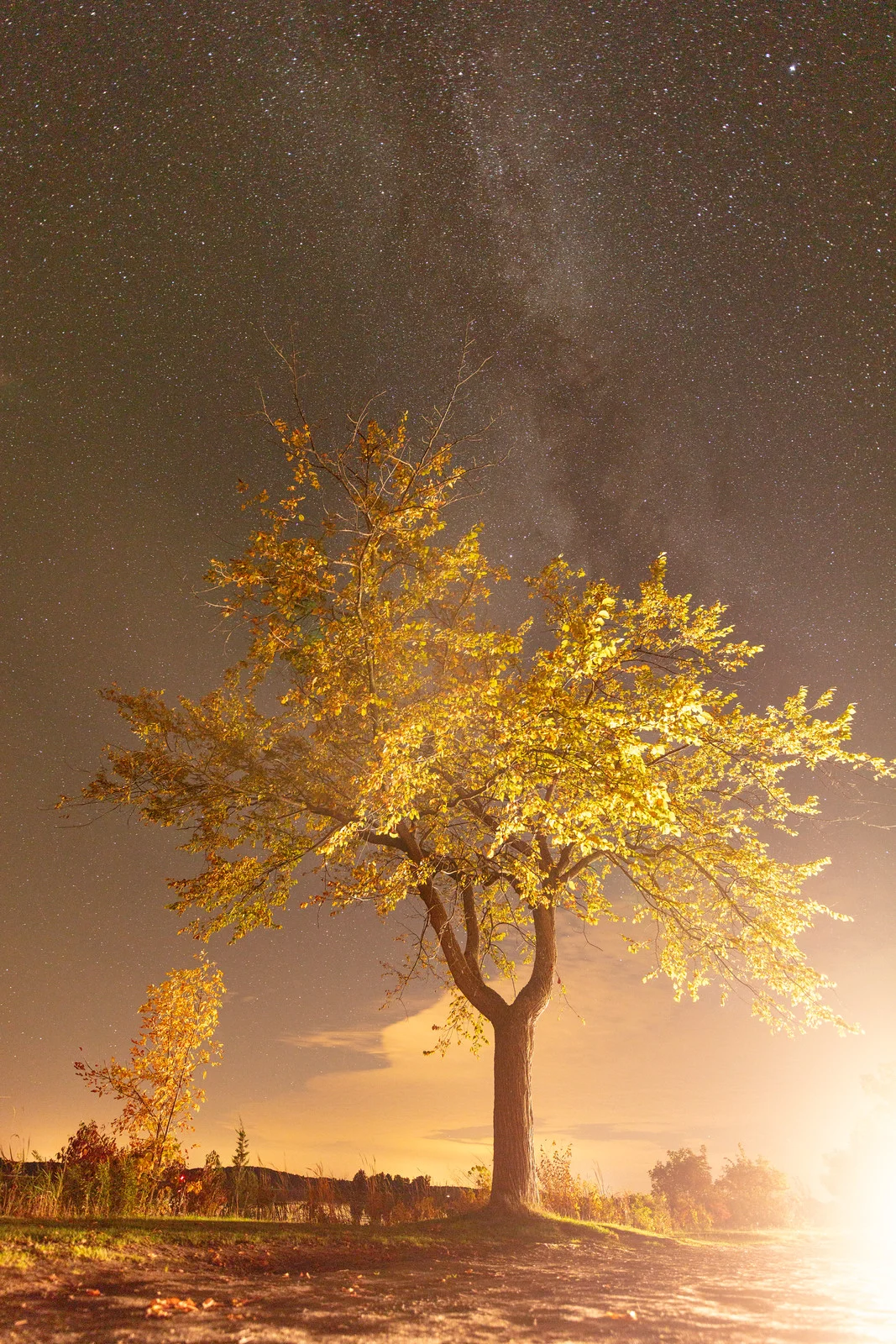
Clear skies are mandatory. Even thin high-altitude clouds scatter moonlight and artificial light, reducing contrast and hiding faint stars. “Seeing” (atmospheric stability) affects how sharp stars and planets appear at high magnification. Cold, dry, high-altitude locations typically offer the best seeing conditions.
Nightscape Astrophotography: Settings and Technique
Nightscape astrophotography (stars and Milky Way above a landscape) is the most accessible form of astrophotography and produces some of the most dramatic images.
| Setting | Value | Why |
|---|---|---|
| Mode | Manual (M) | Auto exposure fails in near-total darkness |
| Aperture | f/1.4 – f/2.8 (widest available) | Gather maximum starlight |
| Shutter Speed | 500 / focal length = max seconds | Prevent star trailing (the 500 Rule) |
| ISO | 1600 – 6400 | Amplify faint starlight |
| Focus | Manual, on a bright star using Live View at max zoom | Autofocus cannot lock on stars |
| White Balance | 3800K – 4200K | Neutral night sky without orange/blue cast |
| Image Stabilization | OFF | Can cause vibration on a tripod |
| Long Exposure NR | OFF | Saves time between shots |
| File Format | RAW (14-bit if available) | Maximum data for recovering faint celestial detail |
The 500 Rule in Detail
Earth rotates, causing stars to appear to move across the sky. During a long exposure, this movement creates star trails instead of sharp points. The 500 Rule gives you the maximum exposure before trailing becomes visible: 500 / focal length = maximum seconds.
- 14mm: 500 / 14 = 35 seconds maximum
- 20mm: 500 / 20 = 25 seconds
- 24mm: 500 / 24 = 20 seconds
- 35mm: 500 / 35 = 14 seconds
On crop-sensor cameras, use the equivalent focal length (e.g., 16mm on 1.5x crop = 24mm equivalent, so 500/24 = 20 seconds). For large prints or high-megapixel cameras, use the stricter 300 Rule (300 / focal length) for sharper stars.
Focusing on Stars
Autofocus cannot lock on stars in the dark. Switch to manual focus, point at the brightest star or planet, activate Live View, zoom to maximum magnification, and carefully turn the focus ring until the star is the smallest, sharpest point. Use back-button focus so the shutter button cannot accidentally trigger autofocus. Tape the focus ring in place after achieving focus.
Composing Nightscape Photos
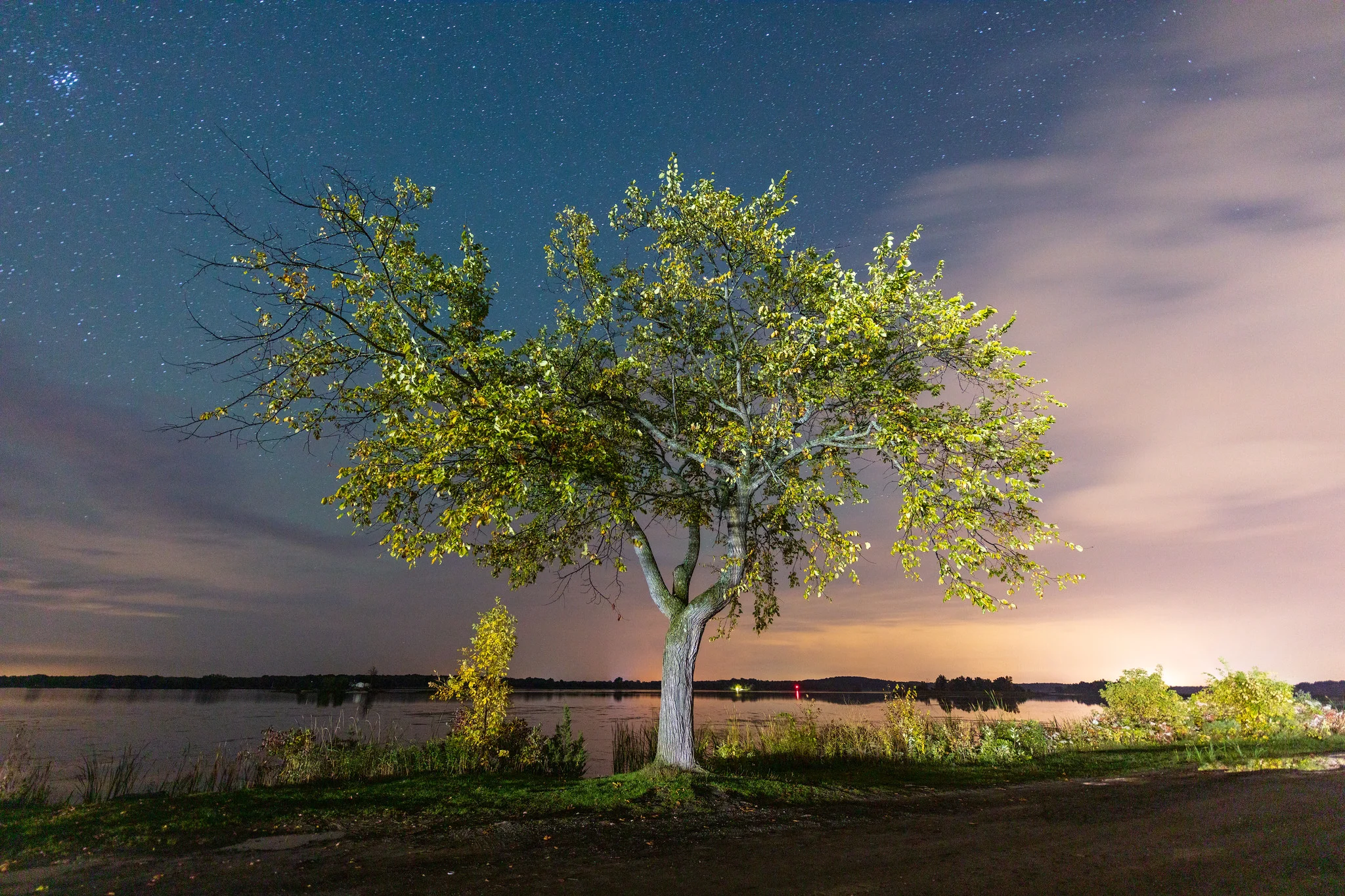
The most compelling nightscape photos include both sky and landscape. The foreground, a mountain silhouette, a lone tree, a lake with reflections, or an interesting rock formation, provides scale and context. Without foreground, a photo of the Milky Way is just sky. With foreground, it becomes a place, a mood, an experience.
Scout your location during daylight. Identify compelling foreground elements and the direction the Milky Way will appear. Compose with leading lines in the foreground that draw the eye upward toward the sky. Experiment with vertical orientation (to capture the Milky Way’s full arc) and horizontal (to include a wide landscape).
Tracked Astrophotography: Going Deeper
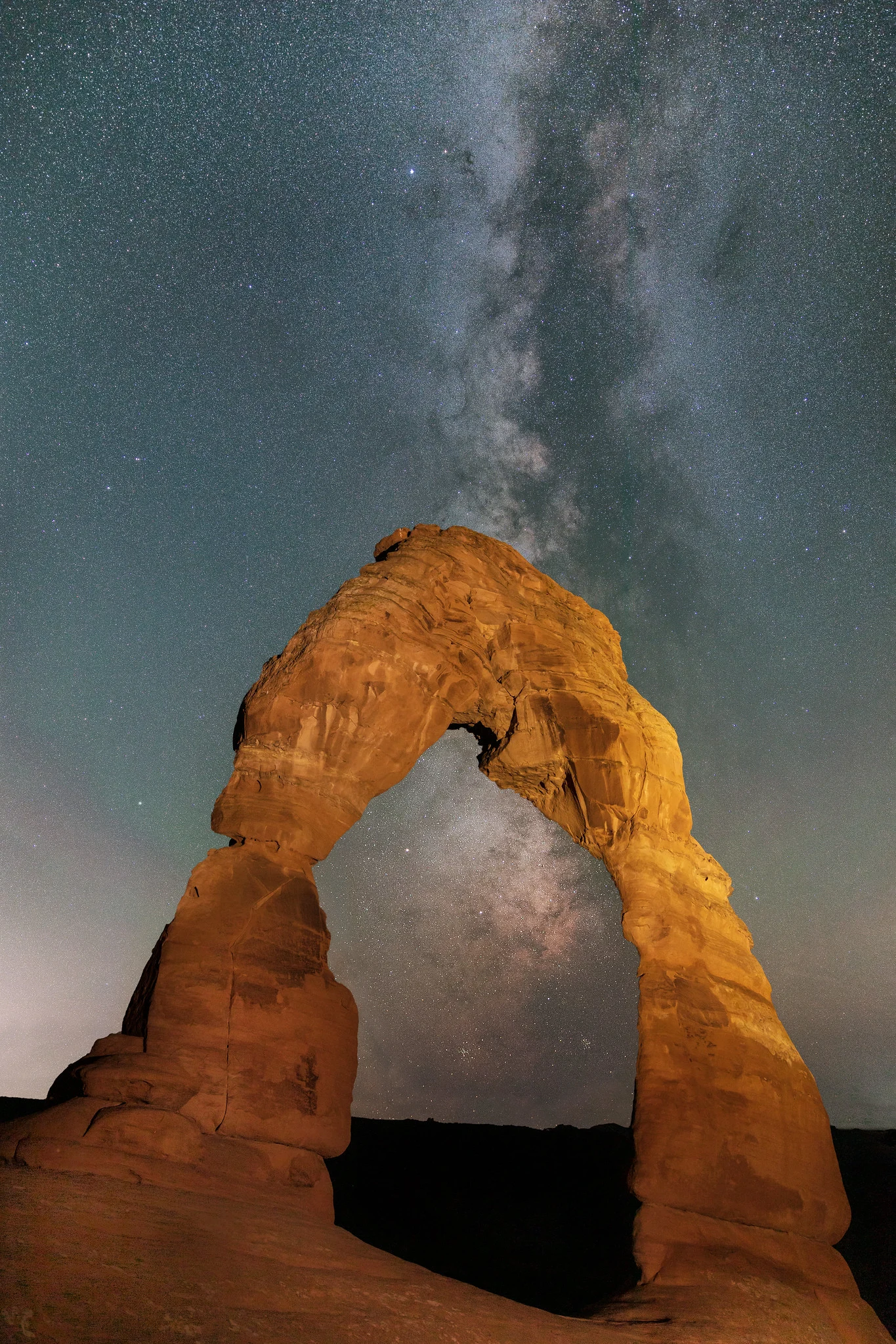
A star tracker is a motorized mount that compensates for Earth’s rotation, allowing much longer exposures without star trailing. This is the bridge between nightscape photography and deep-sky imaging.
What a Tracker Does
The tracker rotates your camera at the same rate as Earth’s rotation, keeping the stars stationary on the sensor. This means you can expose for 2, 5, or even 10 minutes at low ISO, producing dramatically cleaner images with far more celestial detail than the 15 to 25 second exposures limited by the 500 Rule.
Tracked Settings
| Setting | Without Tracker | With Tracker |
|---|---|---|
| Aperture | f/1.4 – f/2.8 | f/2.8 – f/4 (can stop down for sharper stars) |
| Shutter Speed | 15 – 25 seconds (limited) | 60 – 300 seconds (no trailing) |
| ISO | 3200 – 6400 | 800 – 1600 (dramatically lower noise) |
The advantage is dramatic. A tracked 3-minute exposure at ISO 800 captures approximately 10 times more signal (detail) than an untracked 20-second exposure at ISO 6400, with far less noise. Faint nebulae, dim star clusters, and subtle Milky Way structure become visible that are impossible in untracked shots.
Polar Alignment
For a star tracker to work accurately, it must be aligned with Earth’s rotational axis. In the Northern Hemisphere, this means pointing the tracker’s polar axis at Polaris (the North Star). Most trackers include a polar scope or phone app for alignment. Accurate polar alignment is critical for long exposures; poor alignment causes stars to drift and create short trails.
Planetary and Lunar Photography
Planets and the moon require completely different techniques from nightscape photography. Instead of wide-angle lenses and long exposures, you need maximum magnification and fast shutter speeds.
Moon Photography Settings
| Setting | Value |
|---|---|
| Aperture | f/8 – f/11 |
| Shutter Speed | 1/125s – 1/250s |
| ISO | 100 – 200 |
| Focal Length | 300mm – 600mm+ (longer is better) |
The moon is sunlit, so it is much brighter than you expect. Use the “Looney 11” rule: at f/11, your shutter speed equals 1/ISO. For detailed lunar techniques, see our moon photography guide.
Planetary Photography
Jupiter, Saturn, Mars, and Venus are bright enough to photograph with a telephoto lens, but showing surface detail (Jupiter’s bands, Saturn’s rings) requires high magnification, typically a telescope with a camera adapter. The technique involves taking short video clips (hundreds of frames) and “stacking” the best frames in software (RegiStax, AutoStakkert) to produce a single sharp image that overcomes atmospheric distortion.
Star Trails
Instead of fighting Earth’s rotation with short exposures, star trail photography embraces it. Over the course of 30 minutes to several hours, stars trace circular arcs across the sky centered on the celestial pole.
Modern Star Trail Technique
Rather than one extremely long exposure (which introduces noise, hot pixels, and battery issues), take many consecutive 30-second exposures and stack them in software:
- Set your camera on a tripod pointed toward the celestial pole (north for Polaris, south for the Southern Celestial Pole).
- Use settings: f/2.8, ISO 400 to 800, 30-second exposures.
- Program your intervalometer: 30 seconds exposure, 1 second gap, repeat for 1 to 4 hours.
- Stack all frames in free software (StarStaX, Sequator) using “lighten” or “maximum” blend mode.
This method produces smooth, gap-free star trails with low noise. You also get the raw frames for a stunning time-lapse video of the rotating sky.
Meteor Showers
Photographing meteors (shooting stars) is largely a numbers game. Set up your camera for wide-angle star photography (widest aperture, 500 Rule shutter speed, high ISO) and shoot continuously throughout the shower. Most frames will have no meteor. When one does appear during an exposure, you have captured it.
Meteor Shower Settings
| Setting | Value |
|---|---|
| Aperture | f/1.4 – f/2.8 |
| Shutter Speed | 15 – 25 seconds (per 500 Rule) |
| ISO | 1600 – 3200 |
| Focal Length | 14mm – 24mm (wide angle captures more sky) |
| Direction | Toward the radiant point, or just capture as much sky as possible |
Use an intervalometer to fire continuously with minimal gaps. Over 2 to 4 hours of shooting, you may capture 5 to 20 meteors during a major shower. Composite the best meteor frames together in Photoshop for a dramatic multi-meteor image.
Post-Processing Astrophotography
Astrophotography requires more post-processing than most genres. The camera RAW file will look flat and unimpressive. This is normal. The detail is there in the data; post-processing reveals it.
Essential Adjustments
- White balance: Adjust to 3800K to 4200K for a neutral sky. Light pollution creates orange/green gradients that need correcting.
- Exposure and contrast: Brighten shadows to reveal faint stars and Milky Way structure. Increase contrast to separate celestial objects from the sky background.
- Clarity/Texture: Increase to sharpen Milky Way dust lanes and nebula structure. This is the most impactful single slider for astrophotography.
- Noise reduction: Apply luminance noise reduction carefully. Too aggressive and stars become blobs. Modern AI denoising tools are excellent for astro images.
- Gradient removal: Light pollution and natural airglow create brightness gradients. Use gradient filters or specialized astro software to flatten the background.
- Color saturation: Subtle increases reveal star colors and nebula hues. The Milky Way contains pink hydrogen regions, blue reflection nebulae, and golden star clouds that emerge with careful saturation.
Stacking for Better Results
Taking multiple identical frames and stacking them in software (Deep Sky Stacker, Sequator, Starry Landscape Stacker) dramatically reduces noise while preserving detail. Noise is random, so averaging multiple frames cancels it out. Stacking 16 frames reduces noise by 75% compared to a single frame. This is the single most effective technique for improving astrophotography image quality.
Common Astrophotography Mistakes
1. Not Going Dark Enough
Suburban skies reveal a fraction of what dark skies show. The difference between a Bortle 5 (suburban) and a Bortle 2 (dark) location is enormous. It is worth driving an extra hour to reach darker skies.
2. Shooting During a Full Moon
A full moon washes out the Milky Way and most deep-sky targets. Plan sessions around the new moon for the darkest possible skies.
3. Trusting the Lens Infinity Mark
Most lenses focus past true infinity. Do not twist the focus ring to the infinity symbol and assume it is correct. Always verify focus on a bright star at maximum Live View zoom.
4. Underexposing
Many beginners shoot darker than optimal, thinking a dark scene should look dark on the LCD. Check the histogram and push data toward the right edge without clipping. You can darken in post; you cannot recover signal that was never captured.
5. Not Shooting RAW
RAW files contain far more data than JPEG, especially in the shadow tones where faint celestial detail lives. JPEG compression discards exactly the information you need. Always shoot RAW for astrophotography.
6. Image Stabilization on a Tripod
Stabilization systems can introduce micro-vibrations on a stable tripod, turning sharp star points into wobbled smears. Turn off all stabilization (lens and body) when using a tripod.
Frequently Asked Questions
Do I need an expensive camera for astrophotography?
No. Any camera with manual controls produces impressive astrophotography results from a dark sky location. Full-frame cameras handle high ISO better, which is an advantage, but crop-sensor cameras are entirely capable. The most important factors are dark skies, a fast lens, a stable tripod, and proper technique.
What is the best lens for Milky Way photography?
A 14mm to 20mm lens at f/1.4 to f/2.8 is ideal. Wider is better for capturing the full arc of the Milky Way, and faster is better for gathering starlight. A 14mm f/2.8 or 20mm f/1.4 are popular choices. If budget is limited, a 24mm f/1.8 or even a 50mm f/1.8 can produce excellent Milky Way detail (though framed tighter).
Do I need a star tracker?
For nightscape Milky Way photography, no. The 500 Rule with a fast lens produces excellent results. A tracker becomes valuable when you want to push for maximum detail with long exposures at low ISO, use longer focal lengths for deep-sky targets, or take images that benefit from stacking many frames with precise alignment.
Can I photograph the Milky Way from a city?
The Milky Way core is extremely difficult to photograph from urban areas due to light pollution. You may capture a faint suggestion of it, but the dramatic detail visible from dark sky locations will be absent. City astrophotography is better suited to bright targets: the moon, planets, bright star clusters, and star trails (which are visible even in moderate light pollution).
How do I photograph the northern lights?
Aurora photography uses similar equipment (tripod, wide fast lens) but different settings: shorter exposures (5 to 15 seconds instead of 15 to 25 seconds) to freeze the aurora’s movement, and white balance adjusted to preserve the aurora’s natural colors. See our dedicated northern lights photography guide for complete settings and techniques.
Try This: Practice Exercises
Exercise 1: Backyard Star Photography
You do not need a dark sky location for your first attempt. Set up a tripod in your backyard on a clear night. Set your camera to f/2.8 (or widest), 20 seconds, ISO 3200. Point at the brightest patch of sky and take a shot. You will likely capture more stars than you can see with your eyes, even from a suburban location. This first successful capture builds motivation for a trip to darker skies.
Exercise 2: Star Stacking Comparison
From a dark (or moderately dark) location, take 16 identical frames of the same patch of sky. Stack all 16 in free stacking software (Sequator for Windows, Starry Landscape Stacker for Mac). Compare the stacked result to a single frame at 100% zoom. The noise reduction from stacking 16 frames is dramatic, revealing faint stars and nebulosity invisible in a single frame.
Exercise 3: Star Trail Project
On any clear night, set up your camera pointed at the North Star (Polaris). Program your intervalometer for 30-second exposures with 1-second gaps, running for 1 hour (approximately 120 frames). Stack them in StarStaX. The resulting image shows beautiful concentric star arcs centered on Polaris. This exercise teaches intervalometer programming, long-session discipline, and stacking workflow.
Related Resources
- How to Photograph Stars – Focused guide on star and Milky Way photography
- How to Photograph the Moon – Detailed lunar photography settings
- How to Photograph Northern Lights – Aurora borealis techniques
- Night Photography Hub – Complete guide to all night photography
- Night Photography Settings – City, light trails, and general night settings
- Understanding ISO – Managing noise at high values
- The Exposure Triangle – How aperture, shutter speed, and ISO interact
- Tripod Guide – Stability for long astrophotography exposures
- Camera Histogram – Verify exposure in the dark