Grade 3 photography notes come down to three choices: where you stand, what you leave out, and what the picture is trying to say. If you can say what a photo is about in one sentence, and then make three pictures that tell a short story, you are doing the work. A phone or tablet is enough. Two students can share one.
These notes are for you, the student. You can read them again when you need them. Your teacher has a matching Grade 3 photography lesson plan with the class activities and how the work is marked. Use both. When you are ready for more tools, the Grade 4 photography notes teach lines, patterns and frames.
How to use these notes
Read a little, then go and try it. Photography is learned by making pictures and then saying why they look the way they do.
For every picture you care about, try this:
- Say what the picture is about in one sentence.
- Point to the thing in the picture that shows it.
- Ask if anything in the edges should have been left out.
- If you are making a story, ask if the next picture adds something the first one did not show.
If you do not know a word, look it up in the short glossary below. Then you can follow the longer guide it points to.
Say what the picture is about
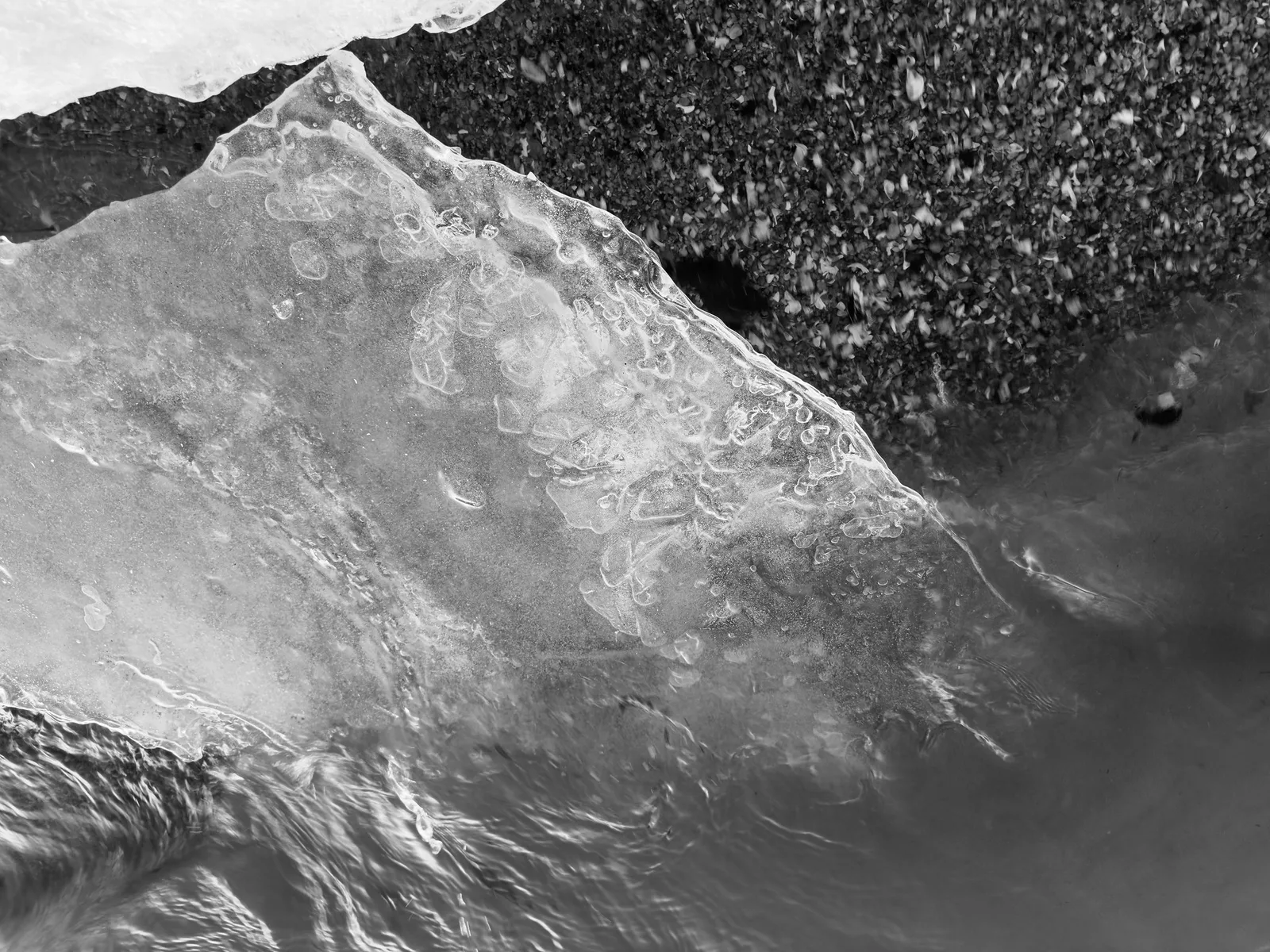
A good Grade 3 photo can be described in one sentence. “This picture is about a piece of ice beside moving water.” “This picture is about old paint on a sign.” If you cannot say the sentence, the picture may be about too many things at once, or it may not have a main thing yet.
Look at the ice at the top of this page. The sentence could be: this picture is about a broken piece of ice meeting rippling water. You can point to the sharp edge of the ice, the dark pebbles, and the rings in the water. The camera got close, so you can see those parts clearly. If the photographer had stood far away, the ice might have been a tiny white shape, and the sentence would have been harder to prove. Getting close is one of the three choices. Fill the frame is the longer guide to that idea. Visual storytelling in photography explains how a single picture can carry a story.
Write your sentence before you share the picture, or right after you take it. If the sentence and the picture do not match, take the picture again, or change the sentence so it is true. The photography in school hub lists every grade’s lesson plan and student notes in one place.
Where you stand, and what you leave out
Where you stand changes the picture. Take a step closer. Take a step to the side. Crouch down. Hold the camera a little higher. The same object can look kind, tall, small, or messy just because you moved. The guide to photography angles shows more ways to change height and place.
What you leave out matters as much as what you keep. Glance at all four edges. A trash can, a bright corner, or half of another object can pull the eye away from your sentence. Step closer, or move to the side, until the extra thing is gone. You can also use a doorway or a window as a border around the subject. That idea is called framing in photography.
Light still helps, even in Grade 3. Side light can show texture on ice, bark, or peeling paint. Soft light from a window can make an indoor object easier to see. You do not need every lighting word yet. You should still be able to point to the light. Direction of light and window light are there if you want them. Photography composition gathers many of these choices in one place.

A three photo story
A three photo story is a beginning, a middle, and an end, told with pictures. The first picture often shows where you are, or starts the idea. The second picture shows what happens, or shows the subject from a different place. The third picture can be a close detail, or a last look that finishes the idea.
Look at the weathered sign in the photograph above. One sentence could be: this picture is about old paint coming off a sign. A three photo story about that sign might start with a wider view of the building and the roof, then this closer picture of the peeling letters, then a very close picture of one flake of paint or one letter. If all three pictures are the same sign from the same spot, it is not a story yet. It is the same picture three times.
Choose a theme that is small enough to test. “A close look at ice and water” can work. “Old surfaces I found” can work. “My whole town” is too big. Shoot more than three pictures, then keep the three that belong together. Write one sentence for the set, and one short line for each picture. Photograph objects, plants, buildings, water, and places. Do not photograph classmates or strangers without asking. What to photograph can help you find a subject close to home.
Need more ideas for ordinary subjects you can shoot at home, on a street, or in a park? What to photograph groups those ideas in one place.
A worked example and a short glossary
Theme: “ice, water, and stone.” Picture one could be a slightly wider view of the shore, so the viewer knows this is a real place. Picture two could be the close ice and ripples, like the first photograph on this page. Picture three could be only the pebbles, or only the edge of the ice. The set works if each picture adds a part of the same idea. It fails if picture three is a playground that has nothing to do with the water.
Theme: “paint that is old.” Picture one could show the whole sign and the roof. Picture two could be the letters with the paint missing. Picture three could be a tiny patch of the surface. The captions can be short: “This is the whole sign.” “This is where the paint has come away.” “This is one small piece of that surface.”
| Term | Plain meaning |
|---|---|
| Subject | The main thing the picture is about. |
| Viewpoint | Where you stand, how high or low the camera is, and how close you get. |
| Edges | The four sides of the picture, where messy things often hide. |
| Three photo story | Three pictures in an order that has a beginning, a middle, and an end. |
| Caption | A short line that says what the picture is about, or why it is in the story. |
| Theme | One idea that all the pictures in a set share. |
Common mistakes
Taking a picture without a sentence. Fix: say what the picture is about, in one line, before you share it. If you cannot, look again and take a clearer picture.
Standing far away so the subject is tiny. Fix: take a step closer, then another. Fill more of the picture with the thing you care about.
Leaving messy things in the edges. Fix: glance at all four sides. Move your feet until the extra things are gone.
Making three pictures that are almost the same. Fix: change your distance or your height for each one. The middle and the end should add something the beginning did not show.
Picking a theme that is too big. Fix: make it smaller. “The sign on this wall” can work. “Everything outside” cannot.
Photographing people without asking. Fix: use objects, plants, water, buildings, and places unless you have permission.
Try this: ten minutes, one subject, three pictures
Choose one subject you can walk around safely: a plant, a door, a puddle, a sign, a chair, or a rock. Spend ten minutes and make only six pictures, then keep three.
- Write one sentence about what the pictures will be about.
- Make two wider pictures that show where the subject is. Keep the clearer one.
- Make two medium pictures from a different height or side. Keep the clearer one.
- Make two close pictures of a detail that still belongs to the sentence. Keep the clearer one.
Put the three keepers in an order. Read your sentence out loud and ask if the pictures show it. Write one short line for each picture. If two pictures still look the same, take only that one again. That is a complete Grade 3 practice in a short sitting.
Want more ways that a single picture can carry a story? Visual storytelling in photography is a good next page after these notes.
Frequently asked questions
How many pictures should a Grade 3 story have? Three is enough if each one has a job. You can shoot more, then keep three. Six almost identical pictures are weaker than three different ones.
Is a phone enough? Yes. These skills are about looking, moving your feet, and saying what the picture is about. Any phone or tablet will do. Hold it with two hands.
What if I cannot think of a sentence? Look at the picture and finish this line: “This picture is about ____.” If you still cannot, the picture may have too many things in it. Get closer and try again.
Can I photograph my friends? Only with permission, and only if the assignment allows it. Objects, plants, water, and places are enough.
Does the story have to be exciting? No. A quiet story about ice, a sign, or a plant is complete if the three pictures belong together and you can explain them.
How is this marked? Teachers usually look at whether you can say what a picture is about, whether you chose what to leave out, and whether the three pictures work as a short story. Your teacher’s lesson plan has the full details.
Related guides
When you want more help with one idea from these notes, these pages are the next stop:
- Grade 3 photography lesson plan for the classroom version of this work.
- Fill the frame for getting closer.
- Photography angles for changing height and place.
- Visual storytelling in photography for how a picture can carry a story.
- What to photograph for subject ideas close to home.
- Grade 4 photography notes when you are ready for lines, patterns and frames.