Seascape photography is landscape photography where the main subject moves. Your shutter speed decides what the sea looks like: fast speeds freeze a breaking wave, speeds around half a second draw textured streaks as water pours off rocks, and exposures of many seconds turn the surface into soft mist. Combine that choice with a strong foreground, a tide that suits the location, good light and constant attention to the waves, and you have the core of the craft.
Shutter speed decides what the water looks like
The same wave photographed at 1/2000 s and at 30 s gives two completely different pictures. Neither is right. Choose the look first, then set the shutter speed that produces it.
| Look | Shutter speed | What you see |
|---|---|---|
| Frozen spray | 1/1000 s to 1/4000 s | Individual droplets, crisp wave lips, the sea as a solid sculpture |
| Frozen wave, soft spray | 1/250 s to 1/500 s | A sharp wave shape with a little softness in the finest spray |
| Texture and streaks | 1/4 s to 1 s | White lines tracing the movement of water, especially as it drains off rocks |
| Soft and misty | 2 s to 30 s | Waves blend into a smooth haze, rocks stand out sharp and dark |
| Flat and glassy | 1 minute or longer | A calm, featureless surface, like a mirror or fog |
Each look has its own mood. Frozen water feels powerful and dramatic, which suits big surf and stormy days. Streaks show direction and energy while keeping detail. Mist and glass feel calm, quiet and timeless, and they simplify a busy sea into a clean background for sharp rocks.
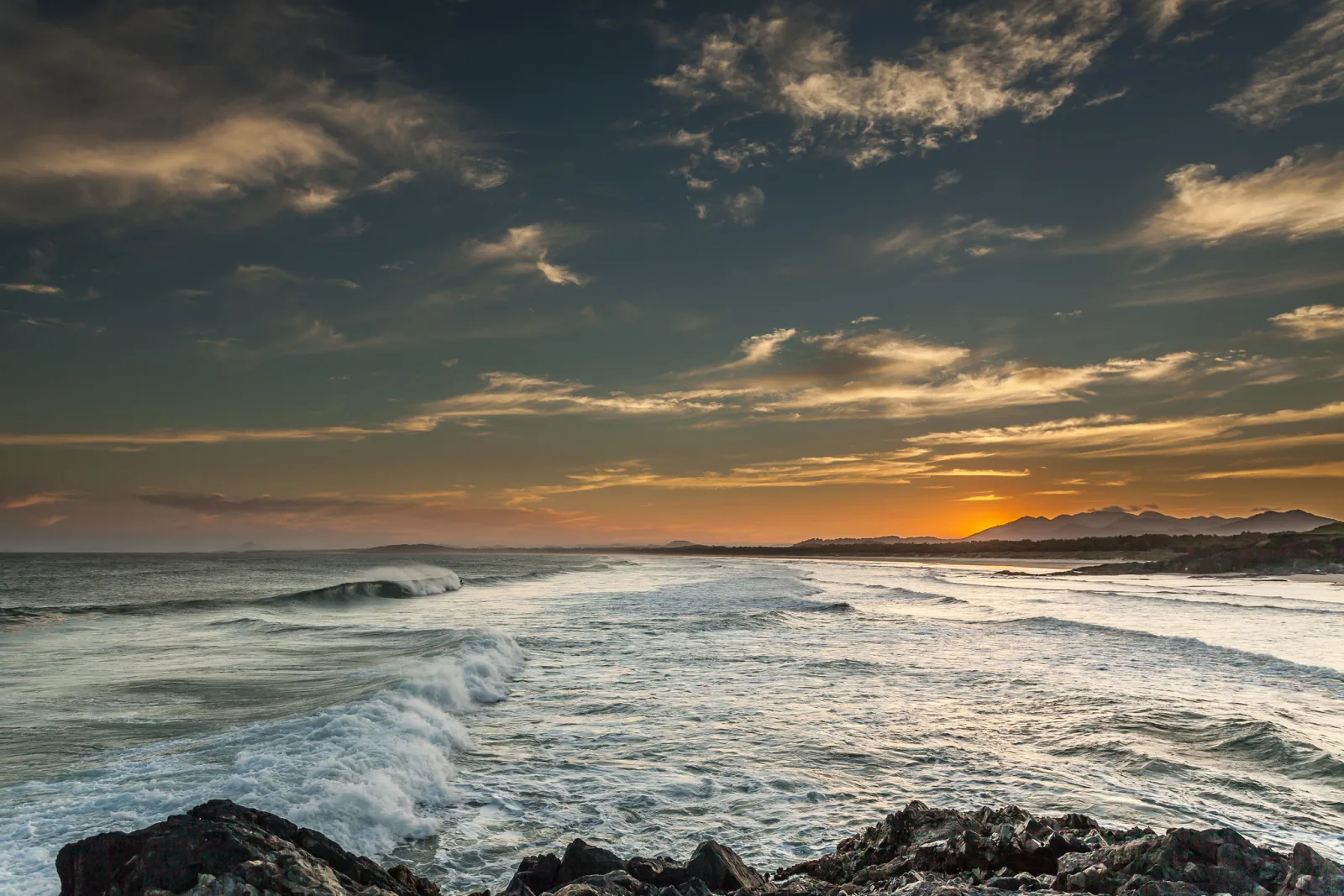
Freezing a wave
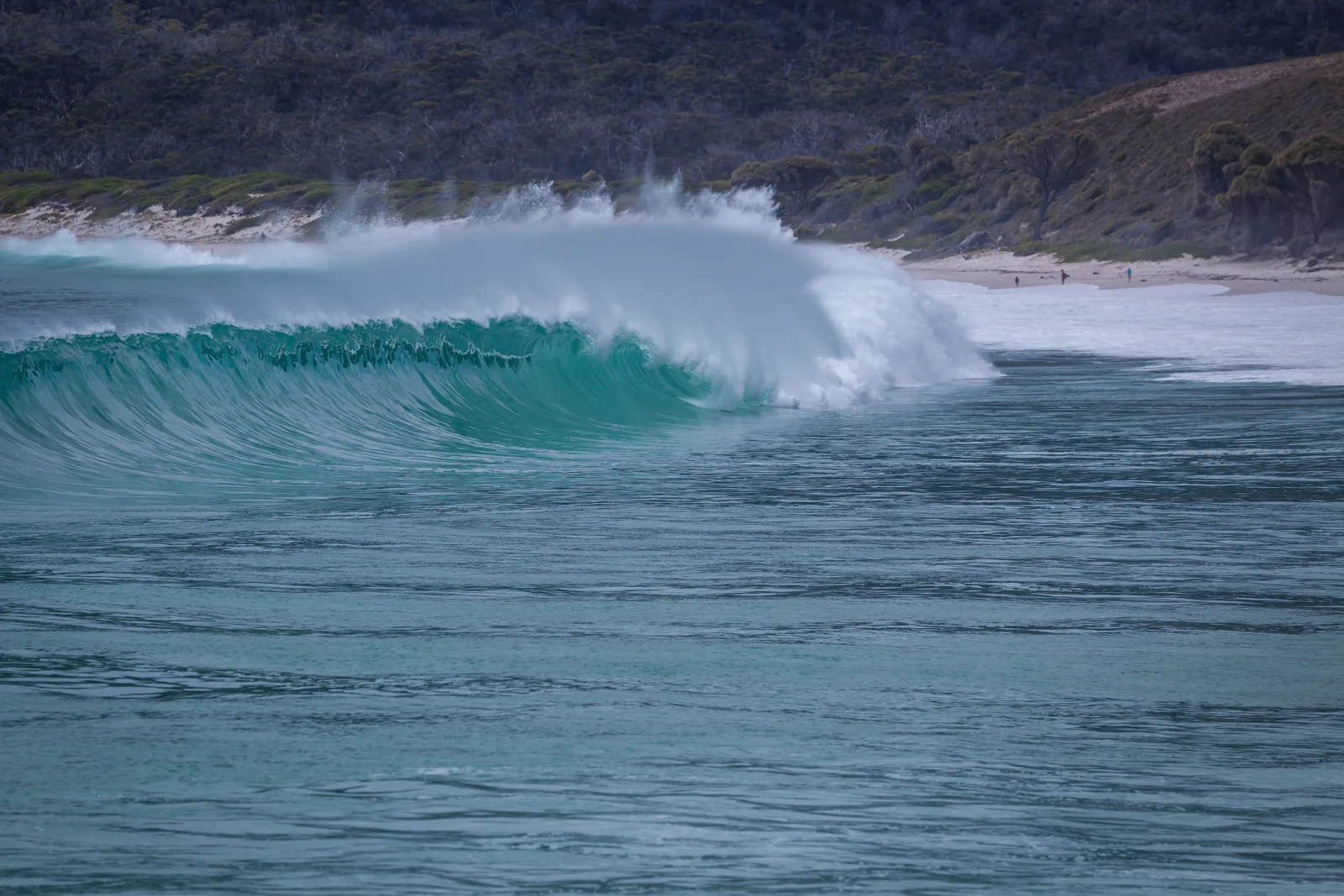
To freeze water you need plenty of light or a higher ISO. At sunset you may need ISO 800 to 1600 at f/5.6 to reach 1/1000 s. The best moment is usually just as the lip of the wave starts to throw forward, or when spray lifts off the crest in an offshore wind. Waves come in rhythm, so watch several before shooting, then use short bursts as the wave peaks. The page on how to freeze motion covers the general technique.
Timing a texture shot
The 1/4 s to 1 s range gives the most variable results, which is why seascape photographers take many frames. The strongest streaks usually come not as a wave arrives, but as it drains back across rocks or sand toward the sea, leaving white lines that point back to the water. Start the exposure just as the water begins to retreat. Shoot the same composition over a dozen waves and choose the frame where the lines are cleanest.
Going long
Exposures of several seconds or more average out the motion of many waves. There is no single moment to time, so results are more consistent. You will need a solid tripod and, in anything brighter than dusk, a neutral density filter. The guide to long exposure photography explains the technique more broadly.
Neutral density filters and how to use them
A neutral density filter is dark glass or resin that reduces the light reaching the sensor without changing its colour, letting you use a slower shutter speed in the same light. Strength is measured in stops, and each stop doubles the exposure time.
| Filter | Exposure multiplied by | 1/30 s becomes |
|---|---|---|
| 3 stops | 8 | 1/4 s |
| 6 stops | 64 | 2 s |
| 10 stops | 1,024 | about 34 s |
| 15 stops | about 32,000 | about 18 minutes |
In practical terms, a 3-stop filter is useful for texture shots in soft light, a 6-stop filter gives misty water around sunrise and sunset, and a 10-stop filter makes long exposures possible in daylight. The exposure calculator works out the conversion for any strength.
A reliable workflow with a strong filter:
- Compose and focus without the filter, while you can still see clearly.
- Switch the lens to manual focus so it does not hunt once the filter is on.
- Meter without the filter and note the shutter speed.
- Fit the filter and multiply the exposure by the filter’s factor, using bulb mode and a remote release for anything longer than 30 s.
- Cover the viewfinder eyepiece if your camera has an optical viewfinder, because light leaking in through it can fog long exposures.
- Check the histogram and adjust. Strong filters often add a slight colour cast, which is easy to correct in a raw file.
When the sky is much brighter than the sea, a graduated ND filter darkens only the top of the frame. A polarizing filter cuts glare from wet rocks and the water surface and can also act as a weak ND filter, taking away around one and a half to two stops.
Tides: planning the shoot around the water level
The same beach can be a field of rocks and pools at low tide and a line of waves breaking against a cliff at high tide. Neither is better. They are different photographs, and you should choose which one you want before you go.
- Low tide exposes ledges, tide pools, sand patterns and rocks that make strong foregrounds. Pools can reflect the sky at sunrise and sunset.
- Mid tide, especially a rising one, often gives the best texture shots, because waves reach the rocks without swamping them.
- High tide brings waves against sea walls, cliffs and sea stacks, which suits dramatic frozen spray, but it also leaves you with less space to stand safely.
Tidal range varies enormously by coast. Some shores barely change through the day, while others rise and fall by several metres. Spring tides, which happen around the new and full moon, have a larger range than neap tides in between. Check a tide table for the specific location, not just the nearest large port, and note whether the tide will be rising or falling during your shoot. The guide to planning around the sun, moon and tides shows how to line up a low tide with a sunset.
Staying safe on the shore
The sea kills photographers. That is not an exaggeration for effect. Waves knock people off rocks, and rising tides cut off people who were watching their viewfinders instead of the water. Treat every coast with respect.
- Never turn your back on the sea. Waves arrive in sets, and after several small ones a much larger wave can arrive without warning. Some coasts call these sneaker waves.
- Watch before you set up. Spend fifteen minutes or more watching where the biggest waves reach. Wet rock, fresh seaweed and pools on high ground mean water reaches there.
- Stay above the wet line in rough conditions, and never climb onto rocks that are isolated by water at any stage of the tide.
- Know your exit. Before walking out along a beach at low tide, know when the tide turns and how long it takes to get back. Headlands and coves can be cut off quickly.
- Watch your footing. Green or dark weed on rocks is extremely slippery. Wear footwear with good grip.
- Keep your hands free. Carry gear in a backpack, not in your hands, when moving over rocks.
- Tell someone where you are when shooting alone at dawn or dusk on a remote coast.
If a wave is about to reach you, grab the tripod and move to higher ground. No camera is worth being dragged into the water to save.
Composing with foreground rocks and moving water
An open horizon over empty water rarely makes a strong photograph on its own. Most memorable seascapes use a foreground to give depth, and the tide and wave motion to give direction. The page on foreground interest explains the principle in general.
- Get low and close. A wide-angle lens a metre or less from a rock makes it large in the frame and leads the eye out to the sea.
- Use the water as a line. Streaks of retreating water, the edge of foam and channels between rocks all act as leading lines toward the horizon or the light.
- Place the horizon deliberately. Put it low if the sky is dramatic and high if the foreground is strong. Keep it level; a tilted sea looks like it is draining out of the frame.
- Simplify with long exposures. Mist turns a chaotic sea into a plain background, so the shape of a rock or sea stack becomes the subject.
- Include a single strong element. A sea stack, a pier, a lighthouse or a lone boulder gives the eye somewhere to rest.
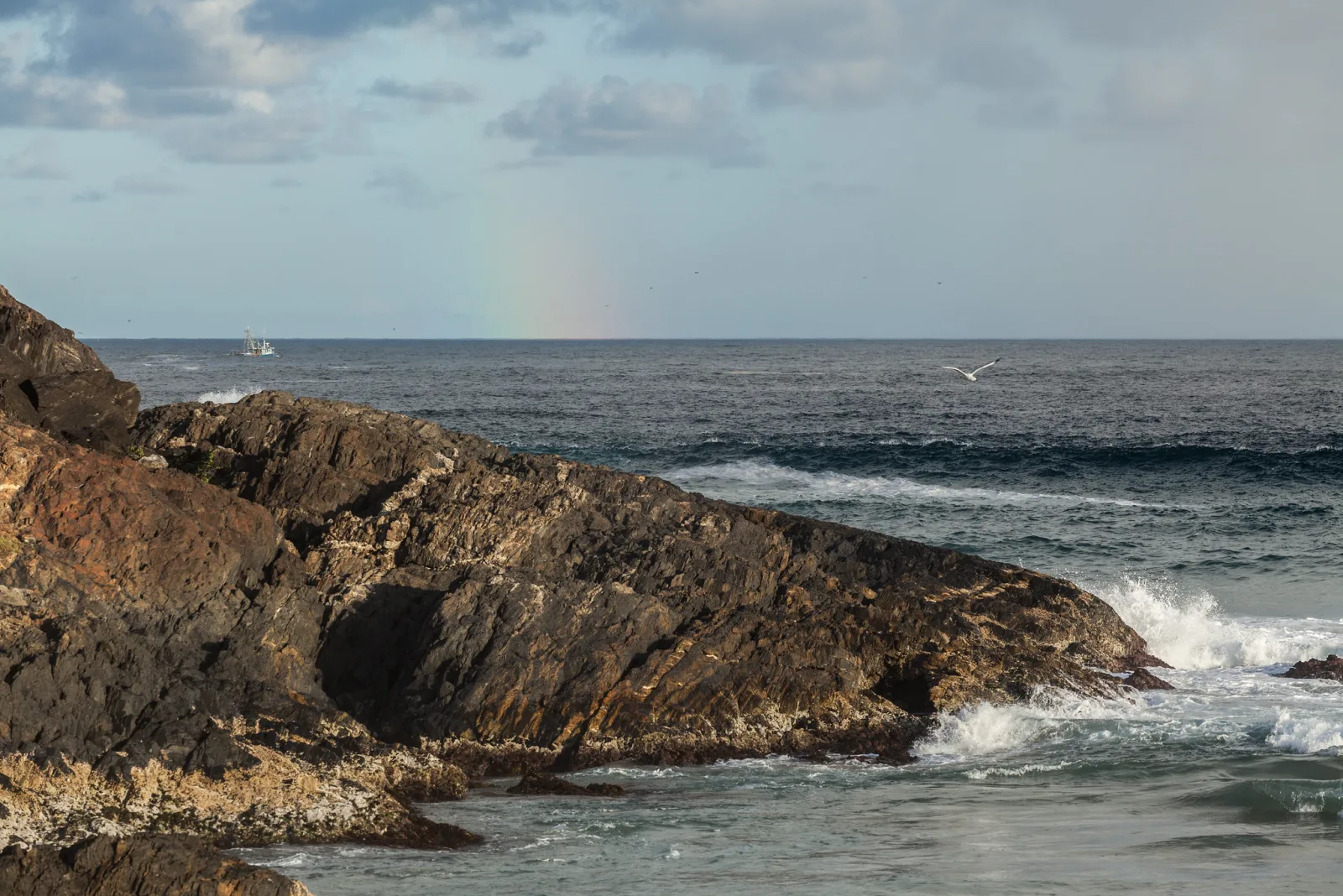
To keep both the foreground rock and the horizon sharp, use an aperture around f/8 to f/11 and focus near the hyperfocal distance. With a 16mm lens on a full frame camera at f/11, the hyperfocal distance is under a metre, so focusing there keeps everything from about 40 centimetres to infinity acceptably sharp. Stopping down beyond f/16 softens the whole image through diffraction, so avoid it unless you need a longer exposure and have no stronger filter.
Light and weather at the coast
Which way the coast faces decides when it gets its best light. A west-facing shore gets sunsets over the water, an east-facing one gets sunrises. On coasts facing other directions, the sun rises and sets along the shoreline, which gives side light across the waves.
- Side light brings out the texture of waves and rocks, because every ripple casts a small shadow.
- Backlight through the thin lip of a breaking wave makes the water glow green or blue. Look for it when the sun is low and behind the waves.
- Sunset and blue hour give soft colour and naturally long exposures, often without any filter.
- Overcast days give even light and low contrast, which suits long exposures and dark rocks. They also hide dull, featureless skies if you keep the horizon high.
- Storms bring big surf, dramatic skies and flying spray. They also bring the most danger, so keep well back and use a long lens. The guide to storm photography has more.
- Sea mist and spray haze soften distant headlands into layers, especially with the sun low and in front of you.
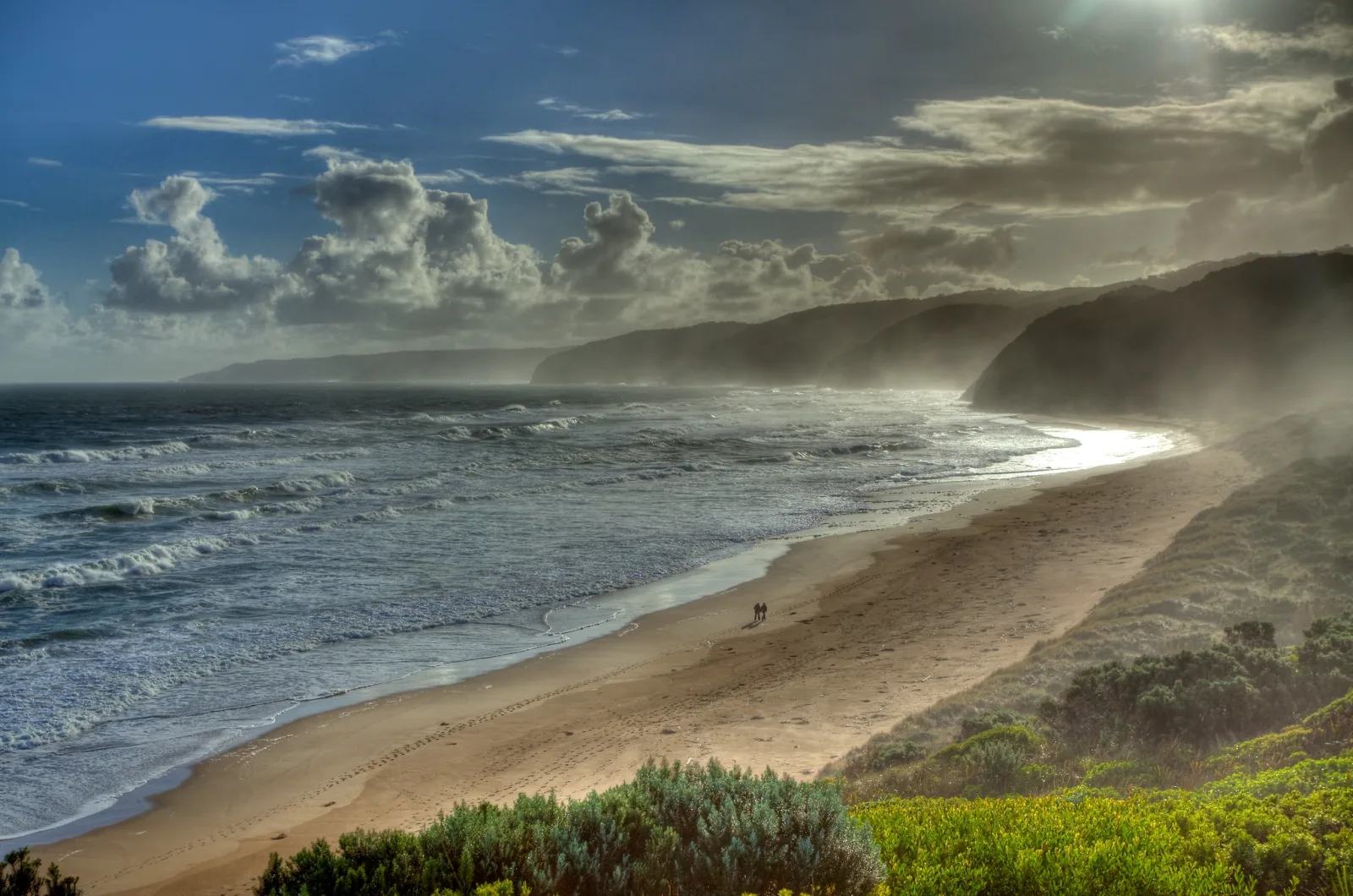
Wind matters too. An onshore wind, blowing from sea to land, makes the sea choppy and throws spray onto your lens. An offshore wind holds waves up so they break cleanly and blows spray back off their crests, which looks spectacular in frozen shots.
Salt, sand and spray: protecting your gear
Salt water is corrosive, and sand gets into everything. A little care during and after each shoot keeps equipment working for years.
- Protect the front element. A clear filter or your ND filter acts as a sacrificial surface. Wipe it often with a dry microfibre cloth, and check it before every long exposure, because a single droplet blurs part of the frame.
- Keep spare cloths in a sealed bag. A cloth that has picked up salt smears rather than cleans.
- Change lenses away from the spray, ideally in a car or with your back to the wind.
- Cover the camera with a rain cover or even a plastic bag in heavy spray.
- Clean up afterwards. Wipe the camera and lenses with a cloth dampened in fresh water, then dry them. Do not rinse or soak electronics.
- Rinse the tripod. Salt and sand destroy leg locks. Rinse the legs with fresh water, extend them fully and let them dry before storing.
For a steady base on sand, push the tripod legs down firmly and let them settle before each long exposure; retreating waves can wash sand from under the feet and blur the frame. The guide to using a tripod covers stability in more detail.
Common mistakes
- Turning your back on the waves. A larger wave arrives while you are adjusting the camera. Fix: keep the sea in view at all times and set up above the wet line.
- Arriving at the wrong tide. The rocks you planned to use are underwater, or the waves never reach them. Fix: check a tide table for the exact spot before you go.
- Spray on the lens. Soft, blurred patches appear in part of the frame. Fix: wipe the front element before every frame and check a magnified view on the screen.
- Tripod sinking in sand. Long exposures blur as the legs settle. Fix: push the legs in firmly and wait a few seconds after each wave before starting the exposure.
- Tilted horizon. The sea appears to slope. Fix: use the camera’s electronic level and correct small errors when editing.
- Empty compositions. A horizon over featureless water with nothing to anchor it. Fix: find a rock, pool, pier or stack for the foreground.
- One exposure and done. Wave shapes vary enormously from frame to frame. Fix: shoot the same composition over many waves and choose the best.
- Ignoring salt after the shoot. Leg locks seize and metal corrodes. Fix: wipe gear with fresh water and dry it the same day.
Try this
Go to a safe section of shore with rocks and waves, near sunrise or sunset. Set up on a tripod well above the reach of the waves, and choose one composition with a rock in the foreground. Then shoot the same scene at five shutter speeds: 1/1000 s, 1/60 s, 1/4 s, 1 s and as long as the light allows (use an ND filter if you have one). Take at least five frames at each speed, timing some as waves arrive and some as they drain back.
At home, pick the best frame from each speed and line them up. Decide which look suits that location and that light. You will learn more about seascapes from this one comparison than from any number of single shots.
Frequently asked questions
What shutter speed makes water look silky?
Around 1 second starts to soften waves, and 2 to 30 seconds gives a misty look. The exact result depends on how fast the water is moving and how close you are to it.
What ND filter should I buy first for seascapes?
A 6-stop filter is the most versatile, giving exposures of a second or more around sunrise and sunset. Add a 10-stop filter later if you want long exposures in daylight.
What is the best tide for seascape photography?
It depends on the location. Low tide reveals rocks and pools for foregrounds, while mid to high tide brings waves against rocks and cliffs. Visit at different tides to learn a place.
What focal length works best for seascapes?
A wide-angle lens is the usual choice, because it lets you place a rock close in front of the camera and still include the horizon. A telephoto lens is useful for isolating waves and sea stacks, and for staying safely back from rough water.
How do I keep salt spray off my lens?
You cannot stop it completely. Shoot with the wind at your back where possible, keep a dry microfibre cloth in a sealed bag, and wipe the front element before every frame.
Related guides
- Long exposure photography: the technique behind misty seas and streaked water.
- ND filters: how neutral density filters work and how to choose one.
- Planning around the sun, moon and tides: lining up light and water level.
- Surf photography: photographing surfers and big waves.
- How to photograph sunsets: getting the most from the light over the water.
- How to photograph waterfalls: the same shutter speed choices for fresh water.
- Foreground interest: building depth into wide scenes.
- Storm photography: dramatic weather, safely.