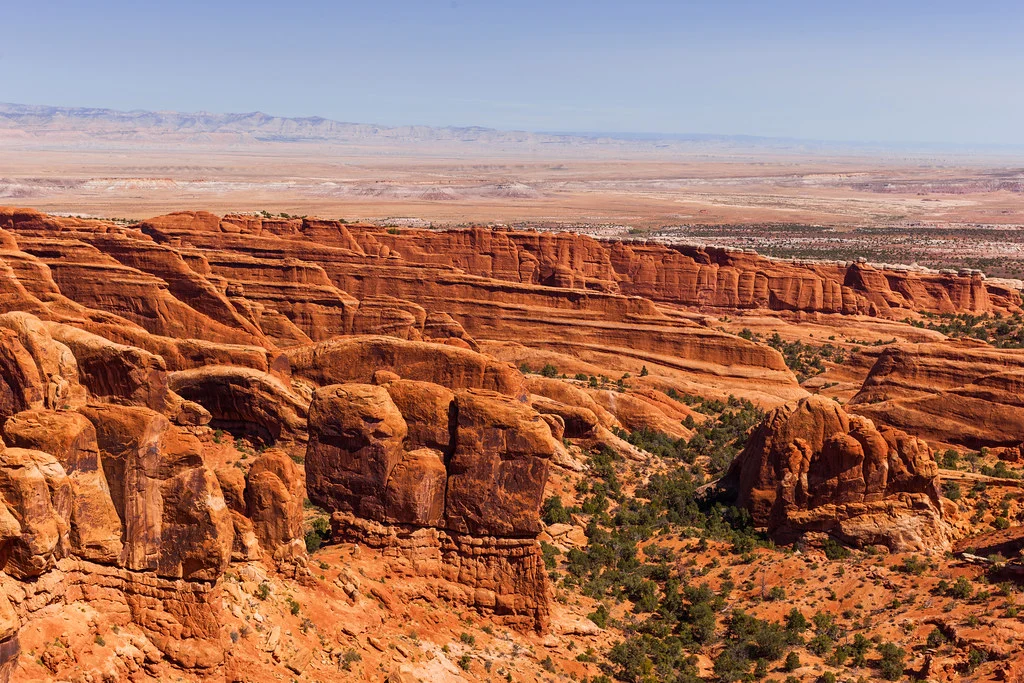
Landscape photography places unique demands on lenses that differ significantly from portrait, event, or street photography. The vast scenes, extreme depth of field requirements, and need for edge-to-edge sharpness mean that lens selection is critical to producing images that do justice to the grandeur of the natural world. This guide covers the principles behind choosing the right lens for landscape work, helping you understand why certain focal lengths, aperture ranges, and optical characteristics matter for this demanding genre.
Instead of reviewing specific models that become outdated, this guide teaches you the enduring principles of landscape lens selection so you can evaluate any lens on its own merits.
Why Wide-Angle Lenses Dominate Landscape Photography
Wide-angle lenses are the most commonly used lenses for landscape photography, and for good reason. A wide field of view allows you to capture sweeping vistas, include dramatic foreground elements close to the camera, and convey the scale and grandeur of a landscape in a way that narrower focal lengths cannot. Wide-angle lenses also exaggerate the apparent distance between near and far objects, creating a strong sense of depth that pulls the viewer into the scene.
The relationship between foreground and background is what separates compelling landscape photographs from snapshots. A wide-angle lens lets you place an interesting foreground element such as a rock, flower, stream, or leading line close to the camera while still capturing the distant mountains, sky, or horizon. This layered composition with distinct foreground, middle ground, and background creates visual depth and gives the viewer’s eye a journey through the image.
However, wide-angle lenses are not the only option for landscapes. Telephoto lenses can isolate specific elements within a landscape, compress layers of mountains or hills, and capture intimate details that wide-angle lenses overlook. The best landscape photographers use a range of focal lengths to tell different stories about the same location.
Ultra-Wide vs Standard Wide-Angle
Wide-angle lenses for landscape photography generally fall into two categories: ultra-wide and standard wide-angle.
Ultra-Wide (14-20mm on Full Frame)
Ultra-wide lenses in the 14mm to 20mm range on a full-frame camera provide an extremely expansive field of view, often exceeding 100 degrees. This dramatic perspective can create powerful landscape images with towering foregrounds and sweeping skies. Ultra-wide lenses are excellent for photographing in tight spaces like slot canyons, dense forests, and narrow valleys where you cannot step back far enough for a standard wide-angle to capture the scene.
The challenge with ultra-wide lenses is that the extreme perspective can make images look distorted or unnatural if not composed carefully. Objects at the edges of the frame stretch and distort, straight lines near the edges bow outward, and it becomes difficult to fill the frame without vast empty areas. Successful ultra-wide landscape photography requires strong foreground elements positioned close to the camera to anchor the composition and prevent the image from feeling hollow.
Standard Wide-Angle (24-35mm on Full Frame)
Standard wide-angle focal lengths from 24mm to 35mm on full frame provide a more natural-looking perspective while still capturing a generous field of view. Many landscape photographers find that 24-28mm is their most-used focal length range because it balances a wide field of view with a perspective that does not feel exaggerated or distorted. These focal lengths produce images that look closer to what the human eye sees in terms of spatial relationships, making them feel more natural and accessible.
The 24-35mm range is particularly versatile for landscape photography because it handles a wide variety of compositions, from broad scenic views to more focused environmental scenes, without requiring the extreme foreground management that ultra-wide lenses demand. If you can only bring one wide-angle lens on a landscape trip, a 24-35mm zoom or a 28mm prime is an excellent all-rounder.
Zoom vs Prime Lenses for Landscapes
The choice between zoom and prime lenses for landscapes differs from other genres because the priorities are different. For a thorough comparison of these lens types, see our prime vs zoom lens guide.
Zoom Lenses for Landscapes
Zoom lenses are the most popular choice among landscape photographers because they provide precise compositional control from a fixed tripod position. When you have carefully positioned your tripod with a specific foreground element, you need to adjust the framing without moving the camera. A zoom lens lets you fine-tune the crop from 16mm to 35mm, for example, until the composition is exactly right. With a prime lens, achieving the same adjustment would require repositioning the tripod, which changes the relationship between the foreground and background.
Popular landscape zoom ranges include 14-24mm (ultra-wide zoom), 16-35mm (wide-angle zoom), and 24-70mm (standard zoom). Many landscape photographers carry two of these zooms to cover the full range from ultra-wide to short telephoto, giving them maximum compositional flexibility.
Prime Lenses for Landscapes
Prime lenses for landscapes offer potential advantages in optical quality, particularly edge-to-edge sharpness, which matters significantly when you are shooting at f/8 to f/11 and want the entire frame to be tack sharp from corner to corner. High-quality wide-angle primes at 14mm, 20mm, 24mm, or 35mm can deliver marginally better optical performance than even the best zoom lenses, though the gap has narrowed considerably.
Primes are also lighter and smaller than equivalent zooms, which matters when you are hiking long distances to remote landscape locations. A single 24mm prime weighs significantly less than a 16-35mm zoom, and if you know that 24mm is your preferred focal length, the prime makes the hike more comfortable without sacrificing image quality.
The trade-off is the loss of compositional flexibility. You must move your tripod and camera to adjust framing, which can be time-consuming and may be impractical on cliff edges, in water, or on unstable ground.
Aperture Needs for Landscape Photography
Landscape photography has different aperture requirements than portrait or low-light photography. While portrait photographers prize lenses with f/1.4 or f/1.8 apertures for shallow depth of field, landscape photographers typically shoot at f/8 to f/16 to maximize depth of field and keep everything from the near foreground to the distant horizon in sharp focus.
The f/8 to f/11 Sweet Spot
Most lenses produce their sharpest images at apertures between f/8 and f/11. At these settings, the lens’s optical aberrations are well-controlled, diffraction has not yet become a significant factor, and the depth of field is deep enough to render most landscape scenes sharp from front to back. This is why experienced landscape photographers often refer to f/8 and f/11 as the “sweet spot” for landscape work.
When to Use f/16 and Smaller
Apertures smaller than f/11, such as f/16 or f/22, provide even more depth of field but introduce diffraction, which slightly softens the image across the entire frame. The trade-off is worthwhile when you need extreme depth of field, such as when you have a foreground element very close to the lens and a distant horizon. At f/16, the depth of field is deep enough that most wide-angle landscape compositions will be sharp throughout. Going beyond f/16 to f/22 provides marginally more depth of field at the cost of increasingly noticeable diffraction softening.
Maximum Aperture Is Less Critical
Because landscape photographers rarely shoot wide open, the maximum aperture of a landscape lens is less important than in other genres. An f/4 maximum aperture on a wide-angle zoom is perfectly adequate for landscape work and saves significant weight and cost compared to an f/2.8 version. The f/4 lens will perform identically to the f/2.8 at f/8, f/11, and f/16 where you will do most of your shooting. The f/2.8 version only matters if you also plan to use the lens for astrophotography, where the wider aperture is needed to capture dim starlight.
Filter Compatibility
Filters are essential tools for many landscape photographers, and your lens choice affects which filters you can use and how conveniently you can use them.
Circular Screw-On Filters
Most standard wide-angle lenses accept circular screw-on filters that attach to the front thread. Common landscape filters include polarizers, which reduce reflections and enhance sky contrast, and neutral density filters, which reduce light transmission for long exposures. Lenses with common filter thread sizes (67mm, 72mm, 77mm, 82mm) make it easy and affordable to find filters. Lenses with unusual or very large filter thread sizes can be expensive to equip with quality filters.
When building a lens kit, standardizing on a single filter thread size (typically 77mm or 82mm) and using step-up adapter rings for smaller lenses simplifies your filter system and reduces the number of filters you need to carry.
Ultra-Wide Lenses and Filters
Ultra-wide lenses, particularly those with bulging front elements, cannot accept standard screw-on filters because the front element protrudes beyond the lens barrel. These lenses require square or rectangular filter systems that mount in a holder attached to the lens. These systems are versatile and high-quality but add cost and bulk. If you use filters heavily, consider whether your ultra-wide lens choice is compatible with your preferred filter system before purchasing.
Weather Sealing and Build Quality
Landscape photography frequently involves exposure to harsh conditions. Rain, snow, salt spray, dust, and temperature extremes are common when photographing in the most dramatic outdoor locations. Weather-sealed lenses with gaskets at the mount, switches, and zoom/focus rings provide protection against moisture and dust infiltration.
Professional-grade landscape lenses typically offer comprehensive weather sealing, while consumer-grade alternatives may have reduced or no sealing. If you regularly shoot in challenging conditions, the added durability of a weather-sealed lens is worth the premium. If you primarily shoot in fair weather, the savings from a non-sealed lens can be redirected to other gear.
Build quality also affects reliability over time. Metal lens barrels resist wear better than plastic, and internal zoom mechanisms that do not extend the lens barrel keep dust and moisture out more effectively than extending designs. A lens that will accompany you on hundreds of hiking trips and withstand years of outdoor use should be built to last.
Focal Length Choices: The 14-35mm Range
Here is a breakdown of common landscape focal lengths and their specific applications within the wide-angle range.
- 14mm: Extremely wide, dramatic perspective. Best for star trails, astrophotography, and compositions with powerful foreground elements in tight spaces. Requires careful composition to avoid empty, unanchored images.
- 16-18mm: Very wide with slightly less distortion than 14mm. Excellent for sweeping landscapes with strong foregrounds. Popular for seascapes, mountain vistas, and waterfall compositions.
- 20-24mm: The workhorse range for landscape photography. Wide enough to capture grand scenes but controlled enough to feel natural. Versatile for everything from alpine panoramas to forest scenes.
- 28mm: Moderately wide, excellent for landscapes that include human elements or man-made structures. Natural perspective that works well for environmental scenes where extreme width would feel forced.
- 35mm: The widest focal length that still feels “normal.” Excellent for landscapes with a more intimate feeling, forest details, and scenes where context matters but dramatic width is not needed.
Telephoto Lenses for Landscapes
While wide-angle lenses dominate landscape photography, telephoto lenses play an important supporting role. Focal lengths from 70mm to 200mm and beyond allow you to isolate specific elements within a broader landscape: a single peak lit by alpenglow, a pattern of sand dunes, or layers of misty mountain ridges compressing into graphic abstractions.
Telephoto compression makes distant landscape layers appear stacked closer together, creating a sense of density and layering that wide-angle lenses cannot achieve. This compression effect is particularly dramatic in mountainous terrain, where overlapping ridges recede into the haze in progressively lighter tones.
A 70-200mm zoom or a 100-400mm zoom adds enormous creative range to a landscape photographer’s kit. These lenses are also excellent for capturing details: the texture of a cliff face, the pattern of a river delta from an overlook, or wildlife encountered during landscape outings. For more on adapting your approach to the landscape genre, visit our landscape photography settings guide.
Hyperfocal Distance: Maximizing Sharpness
Hyperfocal distance is a focusing technique that maximizes the depth of field in a landscape photograph. When you focus at the hyperfocal distance, everything from half that distance to infinity falls within the acceptable zone of sharpness. This ensures maximum front-to-back sharpness without stopping down to extremely small apertures where diffraction degrades the image.
The hyperfocal distance depends on three factors: your focal length, your aperture, and the acceptable circle of confusion for your sensor size. At 24mm and f/11 on a full-frame camera, the hyperfocal distance is approximately four to five feet. Focus at that distance, and everything from roughly two feet to infinity will appear sharp. This is a powerful technique that eliminates the guesswork of where to focus in landscape compositions with near and far elements.
Smartphone apps and printed charts can calculate hyperfocal distance for any combination of focal length and aperture. Alternatively, many landscape photographers use the one-third rule as an approximation: focus one-third of the way into the scene, which places the focus point near the hyperfocal distance in many compositions.
Modern cameras with live view or electronic viewfinders can help you verify focus visually. Zoom in on the live view display at the closest foreground element and the most distant element to confirm both are acceptably sharp before taking the shot.
Building a Landscape Lens Kit
The ideal landscape lens kit depends on your shooting style, preferred subjects, and how much weight you are willing to carry. Here are practical kit suggestions for different approaches.
- Minimalist kit: A single 16-35mm or 24-70mm zoom covers a broad range of landscape compositions. This is the best approach for long hikes where weight is critical.
- Standard kit: A 16-35mm wide-angle zoom plus a 70-200mm telephoto zoom covers the full landscape range from ultra-wide to telephoto. This combination handles virtually any landscape scenario.
- Comprehensive kit: A 14-24mm ultra-wide, a 24-70mm standard zoom, and a 70-200mm telephoto provide complete coverage with overlap. Add a 1.4x teleconverter for additional reach when needed.
- Prime shooter kit: A 20mm or 24mm wide prime plus a 50mm or 85mm for compression shots. Light, sharp, and forces creative decision-making about composition.
Evaluating Landscape Lens Quality
When evaluating a lens for landscape photography, pay particular attention to these optical characteristics that matter most for the genre.
- Corner sharpness: Landscape images frequently have important detail in the corners, such as foreground rocks or wildflowers. A lens that is sharp in the center but soft in the corners will disappoint in landscape work. Check reviews and sample images specifically for corner performance at f/8 to f/11.
- Distortion: Wide-angle lenses often exhibit barrel distortion, where straight lines near the edges bow outward. This is correctable in post-processing but adds a step to your workflow. Lenses with well-controlled distortion save you time.
- Chromatic aberration: Color fringing along high-contrast edges, such as tree branches against a bright sky, is distracting in landscape images. Modern lenses and post-processing tools handle this well, but a lens with minimal chromatic aberration produces cleaner results straight from the camera.
- Flare resistance: Landscape photographers frequently shoot toward or near the sun during golden hour. A lens with good flare resistance maintains contrast and avoids unwanted artifacts when the sun is in or near the frame. Multi-coated lens elements and well-designed lens hoods help control flare.
- Vignetting: Light falloff in the corners at wider apertures is common in wide-angle lenses. While easily corrected in post-processing, significant vignetting at landscape apertures (f/8 to f/11) is a sign of lesser optical quality.
Getting Started
If you are just beginning landscape photography, your kit zoom lens is a perfectly capable starting point. Learn the principles of composition, exposure, and working with natural light using what you already have. When you are ready to upgrade, a dedicated wide-angle zoom in the 16-35mm range is the single most impactful lens purchase for landscape work. Pair it with your existing kit zoom for telephoto compositions, and you have a versatile landscape kit at modest cost.
Remember that the most spectacular landscape photographs are made by photographers who understand light, composition, and patience far more than by those with the most expensive lenses. A photographer who knows how to find and wait for extraordinary light with a modest lens will consistently outperform someone with premium glass who shoots at midday without thought for the quality of illumination. Invest in knowledge and time in the field alongside your lens purchases, and your landscape photography will thrive.