Couple and engagement photography is one of the most rewarding genres you can specialize in. You are not just documenting two people standing together. You are capturing the energy between them, the private jokes, the way one person lights up when the other laughs. It requires a unique blend of portrait photography skills, emotional intelligence, and the ability to direct two people at once while making the whole experience feel effortless. Whether you are photographing your first couple or looking to refine your approach, this guide covers everything from the initial consultation through posing, lighting, camera settings, and post-processing.
Planning and the Pre-Session Consultation
Great couple sessions start long before anyone picks up a camera. The consultation is where you set expectations, build rapport, and gather the information you need to deliver images that feel personal rather than generic.
What to Cover in the Consultation
A structured pre-session conversation keeps things on track without feeling like an interview. You can do this over the phone, on a video call, or through a detailed questionnaire. The goal is to learn who this couple is, not just what they want their photos to look like.
- Their story. Ask how they met and what they love doing together. A couple who hikes every weekend will feel more natural outdoors than in a formal garden. These details shape every creative decision you make.
- Comfort level on camera. Some couples are naturally affectionate in public. Others barely hold hands. Knowing this upfront lets you plan a pace and approach that does not push people past their comfort zone too quickly.
- Wardrobe coordination. Advise couples to coordinate without matching. Complementary colors and similar formality levels work best. Avoid bold patterns, graphic tees, and logos. Solid colors in muted tones photograph consistently well.
- Location preferences. Give two or three location options with sample images from each. Let the couple choose. When they feel involved in the decision, they arrive more excited and invested.
- Timeline and deliverables. Clarify how long the session will run, how many final images they will receive, the turnaround time for delivery, and usage rights. Clear expectations prevent awkward conversations later. If you need guidance on structuring these agreements, review our guide on photography contracts.
- Special requests. Ask about specific shots they want, whether images will be used for save-the-dates or invitations, and if they have props or meaningful objects to include.
Building a strong client relationship starts here. If you want to go deeper on the business side of managing client expectations, our client management guide covers the full workflow from first contact through delivery.
Location Scouting
Location choice can make or break a couple session. The best locations offer variety within a small area so you can create diverse images without spending the entire session walking between spots.
What Makes a Great Couple Photography Location
- Multiple backdrops within walking distance. Look for locations with at least three distinct looks: open shade, direct light, and an interesting background element (wall, foliage, architecture).
- Open shade availability. Trees, buildings, and covered walkways all provide soft, even light that flatters skin tones and eliminates harsh shadows. At minimum, your location needs one reliable open-shade spot as a fallback if conditions are not ideal.
- Clean backgrounds. Busy backgrounds with trash cans, parked cars, and signage pull attention away from the couple. Scout specifically for areas with uncluttered backgrounds that will compress into smooth, non-distracting tones when shot with a longer focal length.
- Personal significance. Where they had their first date, the park where they got engaged, or their neighborhood. Locations with personal meaning produce more genuine emotions and make the final images more meaningful.
- Privacy and foot traffic. Couples need to feel comfortable being affectionate. Heavy pedestrian traffic makes self-conscious couples stiffer. Quieter locations or off-peak timing help significantly.
- Permit requirements. Parks, botanical gardens, and historic properties often require photography permits. Check requirements before the session. Showing up and getting turned away with clients in tow is unprofessional and avoidable.
Timing Your Location Visit
Always scout your location at the same time of day you plan to shoot. Light changes dramatically throughout the day, and a spot that looks stunning at noon might be completely in shadow during golden hour. During your scout, note where the sun falls, where the best shade is, and identify your planned sequence of shooting spots so you can move through them efficiently on session day.
For a deeper understanding of how natural light behaves throughout the day and how to use it to your advantage, see our natural light photography guide.
Posing Couples: Techniques That Create Connection
Posing couples is fundamentally different from posing individuals. You are not just making two people look good. You are making the space between them tell a story. The best couple photos convey emotion, closeness, and intimacy, and that rarely comes from stiff, side-by-side positioning. Our portrait posing guide covers general principles. Here, we focus on what is unique to working with two people in the frame.
Foundation Poses
These are your reliable starting points. Each one can be varied in dozens of ways by changing the angle, adjusting hand placement, or adding movement.
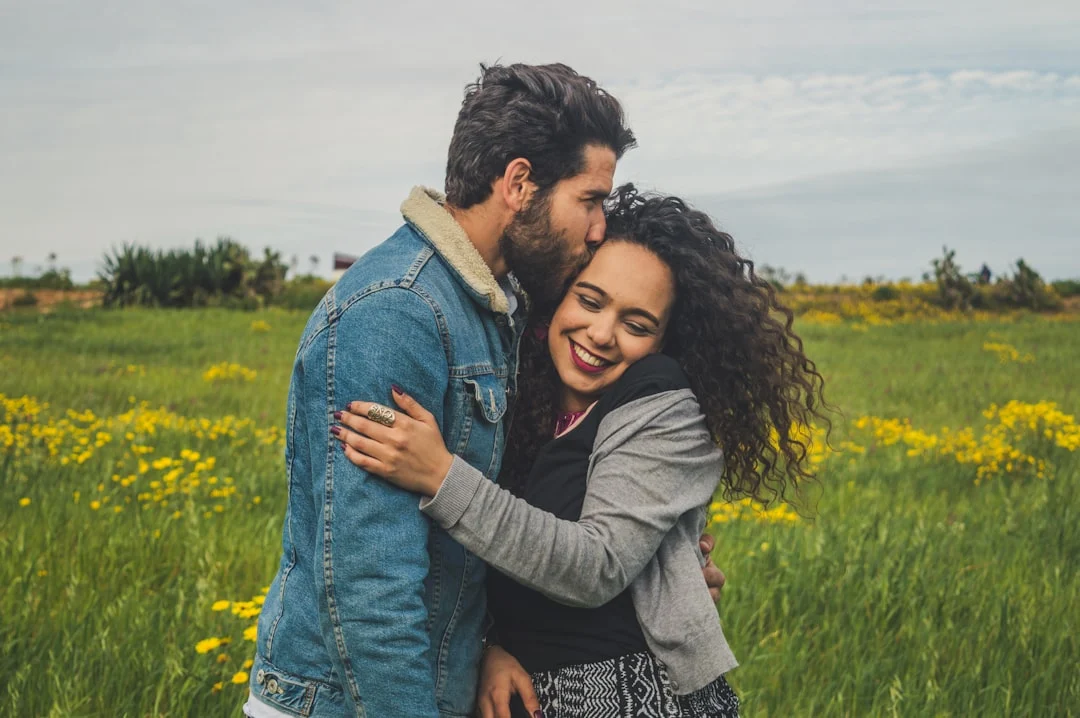
- The V (facing each other at an angle). Partners stand facing each other with bodies at roughly a 45-degree angle to the camera, toes close together. This position naturally brings faces close and creates intimacy. From here, direct them to touch foreheads, whisper, lean in, or simply look at each other.
- The embrace from behind. One partner stands behind the other and wraps arms around their waist or chest. The front partner leans back slightly into the other. Both can look at the camera, look at each other, or close their eyes. This pose works with every couple and always feels natural.
- Side by side, hip to hip. Partners stand shoulder to shoulder with the nearest arms wrapped around waists. Bodies angle slightly toward each other. It is a classic pose that works for everything from casual to formal. The key is making sure shoulders are staggered rather than rigidly aligned at the same height.
- Forehead to forehead. Partners face each other with foreheads gently touching. Eyes closed. This is one of the most intimate, emotional poses in your repertoire. It works in any light and at any location. The closed eyes make self-conscious couples feel less observed, which paradoxically produces more genuine expressions.
- The seated lean. Both partners sit on the ground, steps, or a bench. One leans against the other, or they sit back to back. Seated poses feel casual and relaxed. They also bring the couple closer to eye level for a more connected, intimate perspective when you shoot from a lower angle.
Creating Movement and Natural Interaction
Static poses have their place, but the most compelling couple images often come from movement. Movement creates natural body language, genuine expressions, and a sense of energy that posed shots struggle to match.
- Walking toward the camera. Hold hands and walk slowly toward you. Tell them to look at each other and talk. Shoot in continuous mode. The natural arm swing, laughing, and stolen glances produce authentic images that feel candid even though you directed the moment.
- The spin or twirl. One partner holds the other’s hand above their head and gently spins them. Shoot at the moment of the turn when dress, hair, or body creates dynamic motion. Use a slightly wider shot to capture the full movement.
- The lift. One partner lifts the other. This does not need to be dramatic. Even a slight lift off the ground where the lifted partner’s feet kick back creates energy and joy. Make sure both partners are comfortable with this before attempting it, and start gentle.
- The whisper and reaction. Tell one partner to lean in and whisper something funny (or romantic) to the other. Capture the listener’s genuine reaction. This technique consistently produces natural laughter and real expressions that cannot be faked.
- Dancing with no music. Ask the couple to slow dance. Most laugh at first, and that laughter is exactly what you want. As they settle in, you get relaxed, intimate images with natural movement.
Directing Couples Who Are Camera-Shy
Not every couple is comfortable with physical affection in front of a stranger with a camera. Here are strategies for working with more reserved subjects.
- Start with distance. Begin with poses where the couple is side by side rather than face to face. Walking together, sitting on a bench, leaning against a wall. Let physical closeness build gradually as they warm up.
- Give tasks, not poses. Instead of “put your hand on her cheek,” try “fix his collar for him” or “brush that hair out of her face.” Task-based direction produces natural movement and touch without the self-consciousness of a formal pose.
- Use humor relentlessly. Tell them to have a staring contest. Ask one to tell the other their worst joke. Laughter breaks tension faster than anything else and produces genuinely joyful expressions.
- Shoot through the awkwardness. Keep shooting even when the couple seems stiff. The transition from posed to natural often happens in the space between directed poses, when they think you are not paying attention. Some of your best frames will come from these in-between moments.
- Show them early wins. Five minutes into the session, show the couple a great image on your camera’s LCD. Seeing themselves look good dissolves anxiety and builds trust for the rest of the shoot.
Wondering how to get natural moments without stiff poses? Lifestyle photography covers the directed candid approach and prompts instead of poses.
Hand Placement and Small Details
Hands tell the story of a couple’s connection. Pay close attention to where hands land and how they interact.
- Fingers interlocked vs. loosely held. Interlocked fingers convey deep intimacy and commitment. A loose hand-hold feels more casual and playful. Both are valid, but choose intentionally based on the mood you are creating.
- Hand on the face or neck. One partner’s hand gently cupping the other’s face or resting on the back of their neck creates a moment of tenderness. This works especially well in close-up and detail shots.
- Avoid claw hands. When a hand rests on a partner’s back, shoulder, or waist, the fingers should be relaxed and slightly curved. Stiff, straight fingers or a tight grip look tense and unnatural.
- Ring visibility for engagement sessions. If the session is celebrating an engagement, ensure the ring is visible in several shots. Hand-on-chest poses, over-the-shoulder embraces with the ring hand showing, and dedicated detail shots of the ring on the hand are all standard expectations.
- Watch for hidden hands. When both hands disappear behind a partner’s body, the pose can look incomplete. Keep at least one hand visible and active in the frame to maintain visual interest.
Lighting for Couple Photography
Lighting couple photography adds complexity because you need to flatter two faces simultaneously. A lighting pattern that sculpts one face beautifully might cast unflattering shadows on the partner depending on their positioning. Here is how to handle it.
Natural Light Strategies
- Open shade is your best friend. Position the couple just inside the edge of shade from a building, tree canopy, or overhang. The light is soft, even, and flattering to both faces regardless of how they are positioned relative to each other. This is the single most reliable lighting setup for couple work.
- Backlight for romance. Position the couple with the sun behind them during golden hour. The warm rim light creates a romantic, dreamy quality. Expose for the faces (not the sky) and let the background blow out slightly. A lens hood prevents flare from washing out the image, though a touch of controlled flare can add to the mood.
- Side light for dimension. When the sun is lower in the sky, angle the couple so light falls across them from one side. This creates depth and dimension in the image. Position the couple so the light hits the side of both faces evenly, which usually means angling them together toward the light source rather than having one person block light from the other.
- Overcast days are underrated. Cloud cover acts as an enormous softbox, producing soft, even light with no harsh shadows. Colors appear more saturated, skin tones are consistent, and you can shoot in any direction. The only trade-off is the lack of dramatic rim light, which you can add with an off-camera flash if desired.
Struggling to expose a subject lit from behind? Backlighting in photography covers exposing for the subject versus the background, filling the shadow side and handling flare.
Using Flash with Couples
Adding flash to couple photography gives you creative control regardless of ambient conditions. The key is making it look natural rather than like a studio setup was dropped in a field.
- One off-camera flash with a modifier. A single speedlight in a softbox or through a translucent umbrella, positioned at 45 degrees and slightly above head height, creates soft light that wraps around both faces. Quick to deploy and works in nearly any location.
- Balancing flash with ambient light. Set your camera exposure for the ambient light (the background), then adjust flash power to properly expose the couple. This lets you maintain a golden-hour sky or moody evening background while keeping subjects well-lit. Start with flash at its lowest power and increase until subjects are properly exposed.
- Rim light as a separation tool. Place a bare flash behind and to one side of the couple, aimed at their backs. This creates a bright edge of light along shoulders and hair, separating them from the background. Combine with a front-facing key light or rely on ambient for the faces.
- Avoid direct on-camera flash. Flash fired from the hot shoe produces flat, harsh light that eliminates dimension and casts hard shadows. If on-camera flash is your only option, bounce it off a wall, ceiling, or portable reflector. Our photography lighting guide covers foundational principles for building more complex setups.
Camera Settings for Couple Photography
Your camera settings for couple work need to balance two priorities: keeping both subjects sharp, and creating the creamy background separation that gives professional couple portraits their signature look.
Aperture
Aperture selection depends on how the couple is positioned relative to your camera. When both faces are on the same focal plane (side by side, same distance from you), shoot wide open at f/1.4 to f/2.0 for maximum bokeh. When one partner is in front of the other, stop down to f/2.8 to f/4.0 to keep both faces sharp. When uncertain, f/2.8 is a safe default that delivers strong background separation while keeping both subjects within acceptable depth of field.
Focal Length
An 85mm lens on a full-frame camera is the classic choice for couple portraits, offering flattering compression, comfortable working distance, and excellent background separation. A 70-200mm zoom adds flexibility for tighter close-ups or wider environmental shots. A 35mm or 50mm works well for environmental portraits, though wider lenses can distort faces when used too close. Study how focal length affects your images in our focal length guide.
Wondering why a longer lens flatters faces and flattens the background? Lens compression shows what it looks like and covers faces at 35mm, 85mm and 200mm.
Shutter Speed
For static poses, follow the reciprocal rule: shutter speed at least 1/[focal length]. With an 85mm lens, that means 1/100s or faster. For movement (walking, twirling, lifts), increase to 1/250s or faster to freeze motion. In golden hour’s lower light, raise ISO to maintain adequate shutter speed rather than risking motion blur.
Focus Mode and Point Selection
Use continuous autofocus (AF-C or Servo AF) for moving poses and single-shot autofocus (AF-S or One Shot) for static poses. Always focus on the eye of the subject closest to the camera. If your camera has eye-detect autofocus, use it. When the couple is at different distances from you, focus on the person in front and ensure your aperture gives enough depth of field to keep both acceptably sharp. Missed focus on a partner’s face is the most common technical mistake in couple photography, and it cannot be fixed in post.
Curious how the camera finds an eye by itself? Eye detection AF explains how it works, when to use it and the challenges it runs into.
Shooting Mode
Aperture priority mode gives you direct control over depth of field while the camera handles exposure, making it the most efficient mode for sessions where light changes between locations. Switch to manual when using flash, shooting backlit scenarios where the meter may be fooled, or when you need consistent exposure across a series at one location.
Engagement Session Specifics
Engagement sessions share the fundamentals of general couple photography, but they serve specific purposes and come with their own expectations. Understanding these differences helps you deliver exactly what engaged couples need.
The Purpose of an Engagement Session
An engagement session is part celebration, part practice run. For the couple, it creates images for save-the-date cards, wedding websites, and guest sign-in books. For you, it is a dress rehearsal. You learn how they interact, what directions work, and who is more camera-shy. This knowledge is invaluable under the time pressure of a wedding day. Many photographers include engagement sessions in their wedding packages for this reason.
Timing Relative to the Wedding
Schedule the engagement session at least two to three months before the wedding. This allows time for save-the-date orders and printing images for the reception. It also gives you lead time to learn from the session and prepare for the wedding day.
Save-the-Date Considerations
If images will be used for save-the-dates, plan for it. Leave negative space in some compositions for text overlay. Shoot both horizontal and vertical orientations. Create images with clean backgrounds that will not compete with printed text. Ask the couple about their save-the-date design so you can compose with the final layout in mind.
The Ring
Engagement ring detail shots are expected. Photograph the ring on the hand in natural context: resting on a partner’s chest, hands clasped, or a relaxed hand on a knee. Also capture isolated ring details with a macro lens or extension tube. Soft, directional light makes gemstones sparkle. Side lighting or window light produces the best results.
Location Synergy with the Wedding
Some couples want their engagement session at the wedding venue to familiarize themselves with the space. Others prefer a different location for visual variety in their overall album. Both work well. If shooting at the venue, use it to scout angles and lighting conditions for the wedding day.
Legal and Business Details
Even though an engagement session feels casual, treat it professionally. Have a signed contract before the session that covers usage rights, delivery timelines, cancellation policies, and payment terms. If you plan to use the images in your portfolio or on social media, include that in the agreement or use a separate model release form. Being thorough with paperwork upfront lets you focus entirely on creativity during the session. For guidance on setting your rates, consult our photography pricing guide.
Editing and Post-Processing Couple Photos
Couple photography editing should enhance the mood and emotion of the images while keeping the couple looking natural. The goal is a polished, consistent look across the full gallery rather than heavy manipulation of individual images.
Developing a Consistent Edit Style
Couples expect a cohesive gallery where every image feels like it belongs in the same collection. This means establishing a consistent approach to color temperature, contrast, skin tones, and overall mood. Create presets in Lightroom based on your lighting conditions (open shade, golden hour backlight, flash-lit) so you can batch-apply a baseline edit and then fine-tune individual images. Consistency matters more than any single editing technique.
Color Grading for Mood
Color grading can dramatically shift the emotional tone of couple images. Warm tones (golden highlights, slightly amber shadows) create a romantic, nostalgic feel. Cooler tones suit moody, editorial-style work. Desaturated earth tones produce a timeless look that resists feeling dated. Whatever direction you choose, apply it consistently and avoid heavy-handed color shifts that make skin tones look unnatural. Skin should always look like skin, even in a heavily graded image.
Retouching for Couples
Keep retouching subtle. Remove temporary blemishes, stray hairs across faces, and distracting background elements. Do not reshape bodies, heavily smooth skin, or alter features beyond what is natural. Couples want to recognize themselves in the images. If you are new to post-processing, our photo editing for beginners guide covers the essential tools and techniques without overwhelming you.
Culling and Delivery
Be ruthless in your culling. Deliver only your strongest work. For a typical 60-to-90-minute couple session, delivering 40 to 80 final images is standard. Every image in the gallery should be one you are proud of. Avoid including multiple nearly identical frames. Choose the single strongest expression, the sharpest focus, and the best moment from each setup, and leave the rest on the cutting room floor.
Looking for a method to narrow a few hundred frames? Photo culling workflow covers a multi-pass method, star ratings and speed techniques.
Common Mistakes in Couple Photography
These are the errors that consistently separate average couple photos from professional ones. Avoiding them puts you ahead of most photographers working in this genre.
- Posing both people identically. Same posture, same hand placement, same angle creates stiff symmetry. Differentiate: one leans while the other stands straight, one looks at the camera while the other looks at their partner. Asymmetry creates visual interest.
- Forgetting to check both faces. It is easy to fixate on one partner’s expression and miss that the other is blinking, grimacing, or looking away. Train yourself to scan both faces in the viewfinder before pressing the shutter. Chimping (checking the LCD after shots) helps catch these issues early.
- Shooting at eye level for every image. Same angle for every frame produces a monotonous gallery. Shoot from below for a heroic feel against dramatic skies. Shoot from above on stairs or a balcony. Get low during walking shots for cinematic energy. Study composition techniques for more ideas.
- Ignoring the background. A beautiful pose is undermined by a trash can, parked car, or passerby. Scan the entire frame before pressing the shutter. A few steps left or right saves retouching time and produces cleaner images in camera.
- Focusing on the wrong eye. When one partner is closer to the camera, focus on the nearest person’s eye closest to you. If the front person’s eyes are soft and the background person is sharp, the image feels wrong even to non-photographers. Make this check automatic every time you raise the camera.
- Neglecting variety in framing. A gallery of only full-body shots from the same distance feels repetitive. Mix wide establishing shots, three-quarter crops, tight headshots, and intimate details (hands, rings, foreheads). Variety tells a richer story.
- Over-directing and killing spontaneity. There is a balance between giving enough direction and smothering natural moments. Direct a pose, shoot a few frames, then let the couple exist in the moment while you keep shooting. The transitions between poses often produce the most genuine images.
- Not communicating enough. Dead silence makes couples anxious. Talk constantly. Compliment, direct, and narrate (“that looks amazing, hold that”). Positive reinforcement keeps energy high and expressions natural.
- Rushing golden hour. Golden hour light changes minute by minute. Arrive at your backlit spot early, get the couple positioned, and shoot through the full transition from warm directional light to soft post-sunset glow. These final minutes often produce the session’s hero shots.
Session Flow: Putting It All Together
A well-paced session builds from low-pressure warmups to the most intimate and visually dramatic shots. Here is a sample structure for a 90-minute couple session.
- Minutes 0-10: Warm up. Start in open shade with easy, low-contact poses. Walking side by side, standing near each other, simple conversations. Keep your tone light. Shoot continuously so they get used to the sound of the shutter. Show them a few images early to build confidence.
- Minutes 10-30: Foundation poses. Move through your core poses: the V, the embrace from behind, side by side. Give clear direction and positive feedback. Vary your angle and distance with each pose to maximize variety.
- Minutes 30-50: Movement and interaction. Walking toward you, the spin, the whisper, dancing. This is where the real, candid-feeling moments happen. Shoot in burst mode and direct less. Let them play.
- Minutes 50-70: Golden hour magic. Move to your backlit spot as the light turns golden. Shoot silhouettes, rim-lit embraces, and sun-flare portraits. This is your most dramatic and romantic light. Use it fully.
- Minutes 70-90: Intimate close-ups and details. Tight crops on hands, the ring, foreheads touching, and close facial expressions. These quiet, intimate moments are perfect for the soft, fading light at the end of golden hour. End the session on a calm, connected note.
This is a flexible framework, not a rigid script. Adapt it to the couple’s energy, the location, and the weather. Some couples warm up in five minutes and you can move to interactive poses early. Others need 30 minutes before they relax enough for close contact. Read the room and adjust.
Try This
- Practice the V pose with friends. Recruit a willing couple (friends, family, anyone) and practice the V foundation pose. Focus on getting both faces sharp at f/2.8 while directing subtle variations: eyes open, eyes closed, foreheads touching, whispering. Shoot 30 frames and identify which micro-adjustments made the biggest visual difference.
- Scout a location at three times of day. Visit a potential couple photography location in the morning, at midday, and during golden hour. Photograph the same spot at each time. Compare the results and note where the best light falls during each window. This exercise trains you to see light changes before they happen.
- Shoot a movement sequence. Set your camera to continuous high-speed mode at 1/250s or faster. Direct a couple to walk toward you holding hands, looking at each other and talking. Shoot 50 frames in burst mode. Review the results and pick the three strongest images. Study what makes those three work: expression, body position, stride timing, and eye contact.
- Practice backlighting with a single subject. Before bringing flash to a couple session, practice the technique with a friend or family member. Position them with the sun directly behind their head during golden hour. Meter for their face using spot metering. Experiment with lens angle to control flare. Once you have this technique down with one person, adding a second is straightforward.
- Edit a mini-gallery for consistency. Take ten images from a practice session shot in different lighting conditions and edit them into a cohesive gallery. The goal is to make all ten images feel like they belong together in terms of color, contrast, and mood, even though the light changed between shots. This is the core skill of professional delivery.
Frequently Asked Questions
How long should a couple photography session last?
Plan for 60 to 90 minutes. This gives enough time to warm up (at least 15 minutes for most people), move through a variety of poses and locations, and shoot through the best light. Sessions shorter than 45 minutes rarely produce enough variety. Sessions longer than two hours risk fatigue that shows in the images.
What is the best time of day for couple photos?
The hour before sunset (golden hour) is the most popular and forgiving time for couple photography. The light is warm, directional, and flattering. It creates beautiful backlighting opportunities and makes skin tones glow. If golden hour is not available, overcast midday light works well because it is soft and even. Avoid harsh midday sun, which creates deep shadows under eyes and noses that are especially unflattering in close-up couple shots.
What lens should I use for couple photography?
An 85mm f/1.4 or f/1.8 on a full-frame camera is the most popular choice, offering flattering compression, strong background separation, and comfortable working distance. A 70-200mm f/2.8 zoom adds versatility. A 35mm or 50mm works for environmental shots and can serve as your only lens if budget is tight. A wide maximum aperture (f/2.8 or wider) is important for the shallow depth of field that characterizes professional couple portraits.
How many photos should I deliver from a couple session?
For a typical 60-to-90-minute session, delivering 40 to 80 fully edited images is standard. Quality matters far more than quantity. A gallery of 50 strong, diverse images makes a much better impression than 200 images with redundant shots and weak frames. Curate aggressively and only deliver work you would be proud to show in your portfolio.
What if one partner is much taller than the other?
Height differences are common and completely workable. Use seated poses to equalize height, or have the taller partner lean or sit lower. Embrace the difference by having the shorter partner look up for an intimate moment. The forehead-to-forehead pose works especially well because the taller partner naturally bends down, making the difference look tender rather than awkward.
How do I handle couples who do not like being photographed?
Start slow and communicate constantly. Use movement-based poses (walking, dancing) rather than static setups. Give specific, small directions rather than “act natural.” Show images on the LCD early to prove they look good. Most camera-shy couples relax significantly after 15 to 20 minutes once they realize the process is easier than expected.
Should I use a reflector for couple photos?
A reflector can fill in shadows during backlit shoots. Position a white or silver reflector in front of and below the couple to bounce light into shadowed faces. The downside is that reflectors require an assistant, struggle in wind, and add setup time. Many couple photographers prefer off-camera flash for fill because it is more controllable and self-supporting on a light stand.
Do I need a second photographer for couple sessions?
For standard couple and engagement sessions, a single photographer is sufficient. You have full creative control, the couple interacts with one person instead of two, and the session feels more intimate. A second photographer becomes valuable at weddings and large events where multiple moments happen simultaneously, but for couple sessions it is unnecessary.
Continue Learning
Couple photography draws on skills from portraiture, lighting, composition, and client management. These guides will help you strengthen each area:
- Portrait Photography Guide
- Portrait Posing Guide
- Portrait Lighting Patterns
- Natural Light Photography
- Golden Hour Photography
- Photography Lighting Guide
- Photography Composition
- Rule of Thirds
- Leading Lines
- Bokeh Explained
- Depth of Field
- Aperture Explained
- Focal Length Guide
- Flash Photography
- Off-Camera Flash
- Client Management
- Model Release Forms
- Photography Contracts
- Building Your Portfolio
- Photo Editing for Beginners
- Lightroom for Beginners
- Color Grading in Photography
- Photography Pricing Guide
- How to Start a Photography Business