Developing film at home is one of the most rewarding skills a photographer can learn. It gives you complete control over the process from the moment you press the shutter to the final negative hanging on a drying line. You no longer need to wait days for a lab to return your images or worry about someone else mishandling your work. The process is simpler than most people expect, the equipment is affordable, and the results can match or exceed what commercial labs deliver. This guide walks you through everything you need to get started, from assembling your equipment to producing clean, well-exposed negatives on your first try.
Why Develop Film at Home?
There are practical and creative reasons to develop your own film. On the practical side, home development is significantly cheaper per roll than lab processing, especially once you have the basic equipment. A single chemistry kit can process dozens of rolls. Turnaround time drops from days to about an hour. You also eliminate the risk of lost or damaged film in shipping.
On the creative side, home development opens up control that lab processing cannot offer. You can push or pull your film to adjust for exposure mistakes or to achieve specific contrast and grain characteristics. You can experiment with different developers to change the look of your negatives. You can cross-process slide film in C-41 chemistry for unusual color shifts. And you build a deeper understanding of how film photography actually works, which makes you a better photographer overall.
If you are new to film photography, our guide to choosing your first film camera covers everything you need to know about getting started with analog shooting.
Equipment You Need
The initial investment for home film development is modest. You need a few essential items, and most of them will last for years. Here is the complete list.
Developing Tank and Reels
The developing tank is a light-tight container that holds your film during processing. The two main types are Paterson (plastic) and stainless steel. Paterson tanks are easier for beginners because the reels have a ratcheting mechanism that guides the film into place. Stainless steel reels require more practice to load but are more durable and easier to clean. A standard Paterson tank holds one or two rolls of 35mm film, or one roll of 120 medium format film.
Whichever system you choose, practice loading the reel with a sacrificial roll of film in daylight before you attempt it in the dark with exposed film. This step is critical. Loading film onto a reel in total darkness is the single most difficult part of the entire process, and fumbling it can cause overlapping film, kinks, and ruined frames.
Changing Bag or Dark Room
You need total darkness to transfer your film from the canister onto the developing reel and into the tank. A changing bag is a light-tight fabric bag with arm holes that lets you do this anywhere. They are inexpensive and portable. If you have a room that can be made completely dark (no light leaks from doors, windows, or electronics), that works too. Many photographers use a bathroom or closet at night with towels stuffed under the door.
Chemistry
The chemicals you need depend on whether you are developing black-and-white or color film. Black-and-white is simpler and is where most people start.
Black-and-white chemistry requires three solutions: developer, stop bath, and fixer. The developer converts the latent image on the film into visible silver. The stop bath halts development at exactly the right moment. The fixer removes unexposed silver halides, making the image permanent and light-safe. After fixing, you wash the film with water to remove residual chemicals.
Color negative (C-41) chemistry uses a developer, bleach, fixer (or combined blix), and stabilizer. The process requires tighter temperature control than black-and-white but is still very manageable at home. Pre-mixed C-41 kits from companies like CineStill, Tetenal, and Unicolor make color development straightforward.
For a detailed comparison of different film types and how they respond to development, see our film stocks comparison guide.
Thermometer
Temperature control is important for consistent results. Black-and-white development is typically done at 20 degrees Celsius (68 degrees Fahrenheit), though some developers work at different temperatures. C-41 color processing requires 38 degrees Celsius (100.4 degrees Fahrenheit) with very tight tolerance. A good thermometer is essential. Digital thermometers with a probe are fast and accurate. Avoid cheap glass thermometers that can break inside your tank.
Measuring Cylinders and Storage Bottles
You need graduated cylinders or beakers to measure and mix your chemicals accurately. Get at least two: one for developer and one for fixer, to avoid contamination. Dark-colored storage bottles (amber or opaque) protect mixed chemistry from light degradation. Collapsible accordion-style bottles let you squeeze out excess air, which extends the life of your solutions significantly.
Additional Supplies
You will also want a bottle opener or film retriever (to open 35mm canisters), scissors, film clips or clothespins for hanging film to dry, a squeegee or clean chamois for removing water spots, and a wetting agent like Kodak Photo-Flo for the final rinse. A timer (your phone works fine) and rubber gloves round out the list.
Step-by-Step: Developing Black-and-White Film
This process covers standard black-and-white negative development using common developers like Kodak D-76, Ilford ID-11, HC-110, or Rodinal. The principles apply to all black-and-white developers, though times and dilutions vary. Always consult the Massive Dev Chart or your developer’s data sheet for specific times.
Step 1: Prepare Your Chemistry
Mix your developer, stop bath, and fixer according to the instructions. Bring all solutions to your target temperature, typically 20 degrees Celsius. Use a water bath (placing bottles in a basin of water at the correct temperature) to stabilize temperatures. Prepare enough solution to fill your tank. A standard Paterson tank for one roll of 35mm requires about 290ml of each solution.
Step 2: Load the Film in Darkness
This is the only step that requires total darkness. Inside your changing bag or dark room, open the film canister, trim the film leader, and load the film onto the reel. With a Paterson reel, feed the film into the entry guides and use the ratcheting motion to advance it. With stainless steel reels, bow the film slightly and feed it in from the center. Once the film is fully loaded, place the reel into the tank and secure the light-tight lid. From this point forward, you can work in normal room light.
Step 3: Pre-Wash (Optional)
Some photographers fill the tank with water at the developing temperature and agitate gently for one minute before pouring it out. This brings the film and tank to the correct temperature and removes the anti-halation dye from the film base. The water will come out colored (blue, purple, or green depending on the film). Pre-washing is optional for most films but recommended for consistent results.
Step 4: Develop
Pour the developer into the tank through the light-tight opening in the lid. Start your timer immediately. Tap the tank firmly on a flat surface two or three times to dislodge any air bubbles clinging to the film. Agitate according to your chosen pattern.
The standard agitation pattern is continuous inversion for the first 30 seconds, then four inversions every 30 seconds for the remainder of the development time. Consistent agitation is critical. Too little agitation causes uneven development and surge marks around sprocket holes. Too much agitation increases contrast and can cause excessive grain. Find a rhythm and stick with it.
Development times vary depending on the film, developer, dilution, and temperature. Typical times range from 5 to 15 minutes. Check the Massive Dev Chart or the manufacturer’s data sheet for the exact time for your film and developer combination.
Step 5: Stop Bath
When the timer reaches zero, pour out the developer and immediately pour in the stop bath. Agitate continuously for 30 seconds to one minute. The stop bath is a weak acid (typically dilute acetic acid) that neutralizes the alkaline developer and stops development instantly. Some photographers use plain water instead of stop bath for certain developers, particularly Rodinal. Check your developer’s recommendations.
Step 6: Fix
Pour out the stop bath and pour in the fixer. Agitate continuously for the first 30 seconds, then four inversions every minute. Fixing time depends on the fixer type and concentration. Rapid fixers typically need 2 to 4 minutes. Standard fixers need 5 to 10 minutes. Under-fixing leaves unexposed silver in the emulsion, causing the negatives to appear milky or foggy. Over-fixing can start to bleach the image. Follow the recommended time and err slightly on the generous side rather than cutting it short.
After fixing, your film is no longer light-sensitive. You can open the tank to inspect the negatives, though you should complete the washing process before handling them.
Step 7: Wash
Washing removes residual fixer from the film. Residual fixer will eventually stain and degrade your negatives, so thorough washing is essential for archival permanence. The Ilford method is efficient: fill the tank with water, invert five times, pour out. Fill again, invert ten times, pour out. Fill again, invert twenty times, pour out. This takes about five minutes and is more effective than running water alone.
Step 8: Final Rinse and Wetting Agent
For the final rinse, add a few drops of wetting agent (such as Kodak Photo-Flo) to clean water and soak the film for 30 seconds. The wetting agent reduces surface tension, allowing the water to sheet off the film evenly rather than forming droplets that leave water spots. Do not agitate during this step. Gently pull the film from the reel and hang it to dry.
Step 9: Dry
Hang the film in a dust-free environment using film clips or clothespins. Attach a weighted clip to the bottom to prevent curling. Allow the film to dry completely, which typically takes two to four hours depending on humidity. Resist the temptation to touch the film or cut it before it is fully dry. Wet emulsion is extremely fragile and scratches easily.
Once dry, cut the negatives into strips of five or six frames (for 35mm) and store them in archival negative sleeves. These sleeves protect the negatives from dust, fingerprints, and physical damage while allowing you to contact print or scan them without removing them from the sleeve.
Step-by-Step: Developing Color Negative Film (C-41)
Color development follows the same general workflow but with tighter temperature requirements. The C-41 process is standardized, which means all color negative films use the same chemistry and process times regardless of brand or speed.
Temperature Control
C-41 processing requires a developer temperature of 38 degrees Celsius (100.4 degrees Fahrenheit) with a tolerance of plus or minus 0.5 degrees. This is the single biggest difference from black-and-white processing and the main reason color development has a reputation for being difficult. In practice, maintaining temperature is straightforward if you use a water bath. Fill a basin or sink with water at 39-40 degrees and place your chemistry bottles in it. The slightly elevated water temperature compensates for heat loss when you pour solutions into the tank.
The C-41 Process
Load the film exactly as you would for black-and-white. Then follow these steps.
Developer: 3 minutes 30 seconds at 38 degrees Celsius. Agitate continuously for the first 15 seconds, then four inversions every 30 seconds. Pour out with about 10 seconds remaining to account for drain time.
Blix (bleach-fix): 6 minutes 30 seconds at 38 degrees. Agitate continuously for the first 15 seconds, then four inversions every minute. The blix removes the silver image and fixes the remaining dye image in one step.
Wash: Running water for 3 minutes at 38 degrees, or the Ilford method described above.
Stabilizer: 1 minute. The stabilizer contains a wetting agent and a formaldehyde-based (or formaldehyde-free) compound that protects the dyes. Do not rinse after the stabilizer. Hang to dry directly.
Many photographers find that C-41 is actually easier than black-and-white once you have the temperature figured out, because the times are fixed regardless of film stock. You do not need to look up different development times for every film. The understanding of ISO and how it relates to exposure applies here just as it does in digital photography.
Pushing and Pulling Film
Pushing film means underexposing it intentionally (shooting at a higher ISO than the film is rated for) and then extending the development time to compensate. Pulling film is the opposite: overexposing and shortening development. These techniques are powerful creative and practical tools.
Pushing is commonly used in low-light situations. If you are shooting ISO 400 film in dim conditions, you can set your camera to ISO 1600 (a two-stop push) and then develop the film for a longer time. Pushing increases contrast and grain while bringing shadow detail closer to a normal density. The results are grittier and more contrasty than a normally-exposed frame, which is sometimes exactly the look you want. Many classic street photography images were made by pushing Tri-X to 1600 or 3200.
Pulling is less common but useful for reducing contrast in harsh lighting conditions. If you are shooting on a bright, contrasty day and want softer, more manageable negatives, overexpose by one stop and reduce development time accordingly. Pulling gives finer grain and lower contrast.
Push and pull processing works best with black-and-white film, which is highly flexible. Color negative film can be pushed one to two stops with acceptable results, though color shifts increase with greater push amounts. Understanding the exposure triangle helps you make informed decisions about when to push or pull.
Choosing a Developer
Different developers produce different characteristics in your negatives. Here are the most popular options and what they excel at.
Kodak D-76 / Ilford ID-11: These are essentially the same formula and are considered the standard, all-purpose developers. They produce fine grain, moderate contrast, and full film speed. If you are unsure where to start, D-76 or ID-11 is the safe choice. Mix as a stock solution or dilute 1:1 for slightly finer grain and a bit more sharpness.
Kodak HC-110: A concentrated liquid developer that is incredibly versatile and long-lasting. It comes as a syrup that you dilute to various strengths. Dilution B is the most common starting point. HC-110 produces slightly more grain than D-76 but excellent sharpness and contrast. It is popular because the concentrate lasts virtually forever on the shelf.
Rodinal (Adox Adonal): One of the oldest photographic developers still in production, dating back to 1891. Rodinal is a one-shot developer that you dilute heavily (typically 1:25 to 1:100) and discard after use. It produces very sharp negatives with pronounced grain, especially at higher dilutions. Many photographers love the distinctive “Rodinal look” for its clarity and edge sharpness. It pairs beautifully with slower films like Ilford Pan F Plus or Kodak T-Max 100.
Ilford DDX: A modern liquid developer designed for pushing. If you regularly push film to higher ISOs, DDX is an excellent choice. It maintains shadow detail and controls grain better than most developers when pushing two or three stops.
Kodak XTOL: A fine-grain developer that uses ascorbic acid (vitamin C) instead of hydroquinone. It produces the finest grain of any Kodak developer, with excellent shadow detail and full film speed. Mix from powder and use within a few months, as it has a shorter shelf life than some alternatives.
Troubleshooting Common Problems
If your first rolls do not come out perfectly, do not worry. Most problems have simple causes and straightforward solutions.
Blank or clear film: The film was not exposed. Check that your camera is advancing the film properly. With manual cameras, confirm that the rewind knob rotates when you advance the lever.
Completely black film: The film was massively overexposed or the developer was contaminated with fixer. Keep your chemistry containers clearly labeled and never mix fixer into developer.
Milky or foggy negatives: Under-fixing. Return the film to fresh fixer for the full recommended time and re-wash.
Uneven development or streaks: Inconsistent agitation or air bubbles stuck to the film. Tap the tank firmly after pouring in developer and maintain a consistent agitation rhythm.
Overlapping frames or blank patches: The film was not loaded onto the reel properly. Practice loading with a sacrificial roll until you can do it smoothly and confidently in the dark.
Water spots: Use a wetting agent in the final rinse and hang the film in a dust-free area. Avoid using a squeegee aggressively, as it can scratch wet emulsion. If you get water spots, you can carefully re-wet the negatives and re-hang them with more wetting agent.
Excessive grain: Over-agitation, over-development, or using a grainy developer at high dilution. Reduce agitation frequency, check your development time, or switch to a finer-grain developer. Understanding how ISO and grain relate will help you anticipate these results.
Setting Up Your Workspace
You do not need a dedicated darkroom to develop film at home. The only part that requires darkness is loading the film onto the reel, and a changing bag handles that. Everything else can be done at a kitchen counter, in a bathroom, or anywhere with running water.
Set up your workspace with all chemistry mixed and at the correct temperature before you start. Have your timer ready, your sequence written down, and your bottles arranged in order (developer, stop, fixer). Running around looking for the fixer while your development timer is counting down is a recipe for anxiety and uneven results.
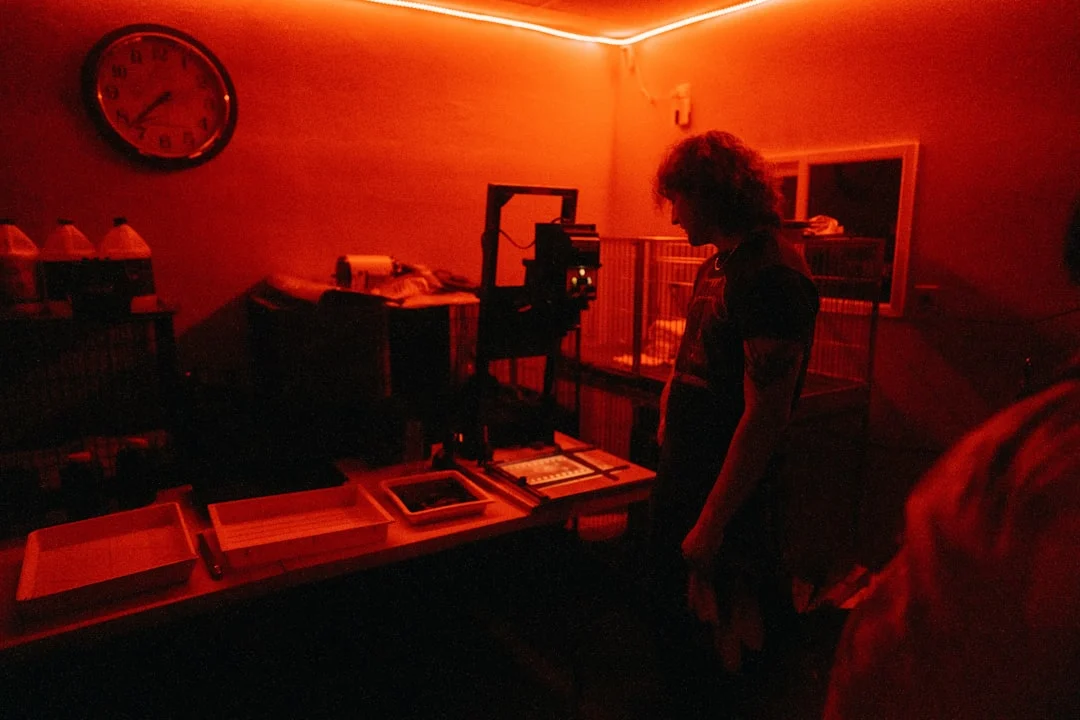
For a more permanent setup, consider building out a proper home darkroom where you can also make prints from your negatives. A full darkroom opens up the entire analog process from exposure to final print.
After Development: What Next?
Once your negatives are dry, you have several options. You can scan them to create digital files for editing, sharing, and printing. Our guide to scanning film negatives covers flatbed scanners, dedicated film scanners, and DSLR scanning setups. Scanning bridges the analog and digital worlds, letting you apply modern editing techniques to your film images.
You can also print them in a traditional darkroom using an enlarger. Darkroom printing is a separate skill with its own learning curve, but it produces physical prints with a quality and character that digital printing cannot quite replicate. Many photographers find the process meditative and deeply satisfying.
Printing from scans instead? Black and white printing covers neutral tones, paper and proofing.
For archival storage, keep your negatives in acid-free archival sleeves and store them flat in a cool, dry place. Properly stored negatives can last well over a century. Treat your negatives as original master files, just as you would treat your RAW digital files.
Common Mistakes
Not practicing reel loading. The number one cause of ruined rolls is fumbled loading in the dark. Sacrifice a cheap roll of film and practice in daylight until it becomes second nature. Then practice with your eyes closed. Then do it in the changing bag.
Ignoring temperature. A few degrees off can significantly affect development. Always measure your chemistry temperature immediately before pouring. For black-and-white, you can adjust development time to compensate for temperature variations. For C-41, keep it at 38 degrees or accept inconsistent color.
Reusing exhausted chemistry. Developers lose strength with use and age. Track how many rolls you have processed with each batch and discard the developer when it reaches its rated capacity. Weak developer produces thin, under-developed negatives. Fixer exhaustion is even more damaging, as it results in negatives that will deteriorate over time.
Rushing the drying process. Using a hair dryer, hanging film in a dusty room, or handling negatives before they are fully dry leads to dust, scratches, and marks that will show up in every scan and print. Patience at this stage saves hours of retouching later.
Skipping the wetting agent. Water spots are frustrating and sometimes permanent. The final Photo-Flo rinse takes 30 seconds and prevents the problem entirely.
Cross-contaminating chemistry. Even a small amount of fixer in your developer will ruin the developer. Use dedicated containers for each solution, label them clearly, and rinse your graduated cylinder between solutions.
Try This
Develop a test roll first. Before processing anything you care about, shoot a test roll around the house with varied exposures and subjects. Develop it using the standard process. Examine the negatives for density, contrast, and any problems. This gives you a low-stakes way to calibrate your process.
Try stand development. Dilute Rodinal at 1:100, pour it in, agitate gently for the first minute, then let the tank sit undisturbed for one hour. This technique produces remarkably even development across a wide range of scene contrast. It is a great way to handle high-contrast scenes and is nearly impossible to mess up.
Push a roll of Tri-X to 1600. Load Kodak Tri-X 400, set your camera to ISO 1600, and shoot in available light. When you develop, extend the development time according to the Massive Dev Chart push processing times. The resulting negatives will have punchy contrast and visible grain that gives images a classic photojournalistic look perfect for black-and-white photography.
Compare two developers. Shoot two rolls of the same film in similar conditions. Develop one in D-76 and the other in Rodinal. Compare the grain structure, sharpness, and tonal range. This is the fastest way to understand how developer choice affects your results and to find a combination that matches your personal style.
Try developing color at home. Once you are comfortable with black-and-white, pick up a C-41 kit and process a roll of color negative film. The process is shorter and arguably simpler than black-and-white once you have temperature control sorted out.
FAQ
Is developing film at home safe?
Yes, with basic precautions. Wear rubber gloves to avoid skin contact with chemicals. Work in a ventilated area. Do not ingest any chemicals. Photographic chemicals are no more hazardous than common household cleaners. Follow the safety data sheets provided with your chemistry for specific handling and disposal guidelines.
How much does it cost to get started?
A Paterson developing tank with reels costs about $25 to $35. A changing bag costs about $15 to $25. A basic chemistry kit (developer, stop bath, fixer) costs about $20 to $40 and will process 15 to 30 rolls depending on the brand. A thermometer runs $10 to $20. All in, you can start for under $100. The per-roll cost after the initial investment is roughly $1 to $3, compared to $10 to $20 for lab processing.
Can I develop color film at home?
Absolutely. C-41 color negative processing is standardized and works the same for all color negative films. Pre-mixed kits make it simple. The main challenge is maintaining the developer at 38 degrees Celsius, which a water bath handles effectively. E-6 slide film processing is also possible at home, though it involves more steps and tighter tolerances.
How do I dispose of chemicals?
Used stop bath and diluted developer can typically go down the drain with plenty of running water, as they are low-toxicity at working dilutions. Used fixer contains dissolved silver and should not go down the drain. Many photo labs and recycling centers accept used fixer. You can also purchase silver recovery cartridges. Check your local regulations for specific guidance.
How long do mixed chemicals last?
Shelf life varies by chemical. Stock D-76 lasts about six months in a full, sealed bottle. Diluted D-76 should be used within 24 hours. HC-110 concentrate lasts years. Rodinal concentrate lasts essentially forever. Rapid fixer lasts about two months once mixed. C-41 chemistry typically lasts 8 to 12 weeks once mixed. Always store chemistry in full, sealed bottles away from heat and light.
What film should I start with?
For your first development session, use a forgiving black-and-white film like Ilford HP5 Plus 400 or Kodak Tri-X 400. Both are tolerant of slight development errors and produce excellent results across a wide range of conditions. They are also among the most extensively documented films, so you will find development times for virtually every developer. For more recommendations, see our film stocks guide.
Camera with no working meter? The sunny 16 rule gets you a usable exposure without one.
Do I need running water?
Running water makes washing easier, but you can develop film without it. The Ilford wash method (fill, invert, dump, repeat with increasing inversions) works perfectly with a jug of clean water. This means you can develop film anywhere, even while traveling.
Can I reuse developer?
Some developers are designed for reuse (like stock D-76), with increased development time for each subsequent roll. Others (like Rodinal at working dilution or HC-110 Dilution B) are one-shot: use once and discard. One-shot developers offer more consistent results because the chemistry is fresh every time. If you reuse a developer, track the number of rolls processed and adjust times according to the manufacturer’s replenishment data.
Building Your Home Development Practice
Like any hands-on skill, home film development improves with practice. Your first rolls may have minor issues. By your tenth roll, the process will feel natural and your results will be consistent. Keep notes on every development session: film, developer, dilution, temperature, time, agitation pattern, and results. This log becomes an invaluable reference as you refine your technique and develop preferences for specific film and developer combinations.
Home development connects you more deeply to the film photography process. It transforms film shooting from a hobby that ends with dropping a roll at the lab into a complete creative practice where you control every variable. Combined with proper workflow habits and thoughtful subject choices, home development puts the full analog experience in your hands.
Taking undeveloped rolls on a trip? Travelling with film covers airport scanners and hand checks.
The chemicals are mixed. The tank is loaded. The timer is running. Welcome to the deeply satisfying world of home film development.