Photographing groups is one of the most common and most challenging tasks any photographer faces. Whether you are shooting a family reunion, a wedding party, a corporate team, or a sports team, the fundamentals are the same: you need everyone visible, everyone in focus, and at least one frame where nobody is blinking. That sounds simple until you are standing in front of 30 people who all want to be somewhere else.
Group photography requires a unique combination of technical skill, people management, and quick problem-solving. You can’t just set up a tripod and hope for the best. You need a plan for posing, a strategy for depth of field, and the confidence to direct a crowd. This guide covers everything you need to know to consistently get strong group photos, from pairs to large gatherings of 50 or more.
Choosing the Right Lens and Camera Settings
Your lens choice matters more in group photography than in almost any other genre. A focal length between 35mm and 70mm on a full-frame camera works well for most groups. Wider lenses let you fit more people in the frame without backing up too far, but anything wider than 35mm starts to distort the people on the edges. If you are shooting a large group and space is tight, a 35mm lens is your best option. For smaller groups of two to eight people, a 50mm or 85mm lens gives you more flattering proportions.
Wondering how those focal lengths differ on people? 35mm vs 50mm vs 85mm compares field of view, perspective and distortion, and background blur.
The most important camera setting for group photos is your aperture. This is where many photographers make their first mistake. Shooting wide open at f/1.8 or f/2.8 might give you beautiful bokeh for a single portrait, but in a group photo, it means only one row of people will be sharp. For a group arranged in two or three rows, start at f/5.6 and go narrower from there. For very deep groups with four or more rows, f/8 to f/11 is safer. Use a depth of field calculator or your camera’s depth of field preview button to check before you shoot.
Shutter speed needs to be fast enough to freeze any movement. People shift, children fidget, and wind blows hair. Aim for at least 1/125th of a second. If you are shooting without a tripod, 1/250th is better. Raise your ISO as needed to maintain that speed. A slightly noisy photo where everyone is sharp is always better than a clean photo with motion blur.
Arranging People: The Art of Group Posing
Good group arrangement follows a few basic principles. First, create rows at different heights. The simplest approach is to have the tallest people in the back, medium heights in the middle, and the shortest in front. But height alone is not enough. You also want to stagger people so each face is visible between the shoulders of the people in front of them. Think of it like a class photo arrangement where every single face can be seen clearly.
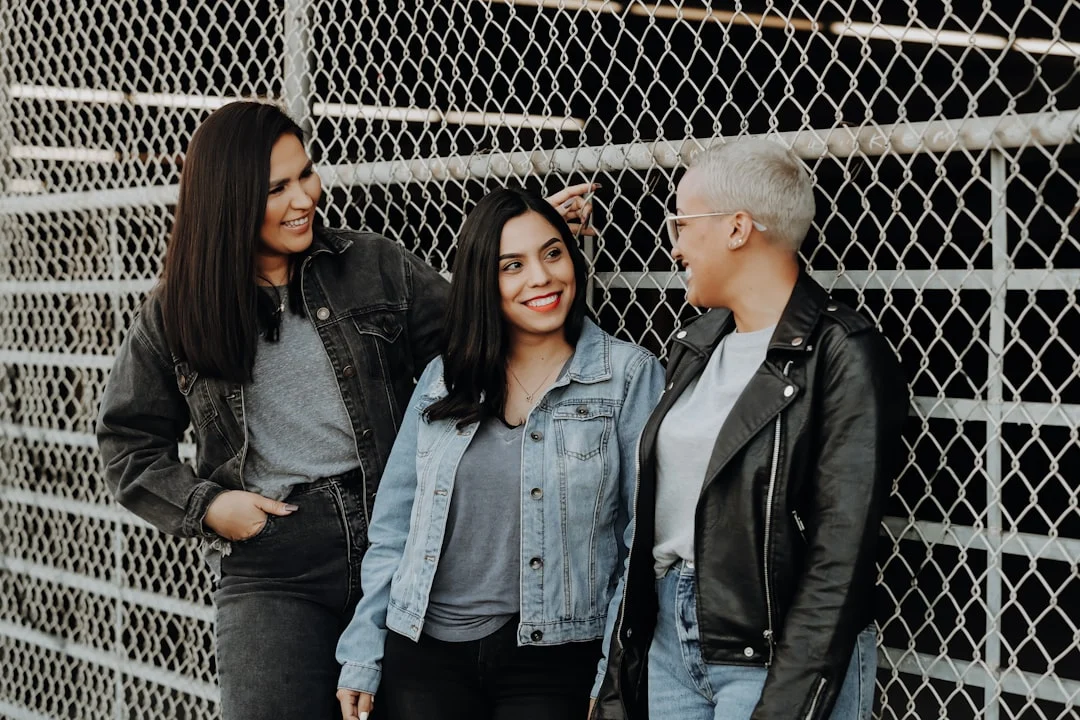
For small groups of three to five people, triangular arrangements work beautifully. Place one person slightly higher (standing while others sit, or on a step) and arrange the others around them. This creates visual interest and avoids the stiff “police lineup” look. For couples and pairs, have one person stand slightly behind and angled toward the other, with their bodies turned at about 45 degrees to the camera.
Posing three or five people? The rule of odds explains why odd groups look natural, and how to arrange them with triangles, sizes and spacing.
Physical connections between people make group photos feel natural. Ask family members to put arms around each other, lean in, or place hands on shoulders. Without physical contact, groups tend to stand with awkward gaps between them. The goal is closeness without crowding. Tell people to squeeze in tighter than feels natural, because the camera always makes gaps look bigger than they are in real life.
Use the environment to your advantage. Steps, slopes, benches, and even curbs create natural height differences. A staircase is one of the best tools for arranging a large group because it gives you instant rows at different levels. Bleachers at a sports field work the same way. If you are shooting on flat ground, bring a small step stool for the back row or have some people kneel in front.
Managing Large Groups (20+ People)
Large groups require a completely different approach than small family shots. The biggest challenge is not technical. It is getting and keeping everyone’s attention. Before you even pick up your camera, walk to the group and introduce yourself loudly and clearly. Establish yourself as the director. People need to know who is in charge, or they will wander, chat, and check their phones.
Have a plan before you arrive. If you know the group size, sketch out your arrangement in advance. For 20 to 30 people, three rows work well. For 40 or more, consider four rows or a curved arrangement that wraps slightly toward the camera. Curves work especially well because they keep the people on the edges roughly the same distance from the camera as the people in the center, which helps with focus consistency.
Recruit a helper. Having someone stand behind you to spot closed eyes, check that everyone is in the frame, and wrangle stragglers is invaluable. For wedding parties and corporate groups, ask the organizer to designate someone who knows everyone’s name to help you get people into position quickly.
Shoot from an elevated position when possible. Getting above the group, even just a few feet, makes a dramatic difference. It compresses the rows, makes everyone more visible, and creates a more flattering angle (nobody gets a double chin when they look up slightly). A sturdy ladder, a balcony, or even standing on a chair can give you the height you need.
Wondering what a higher camera position does to a subject? Photography angles and perspectives compares eye level, low angle and high angle.
Take many more shots than you think you need. With 30 people in the frame, the statistical likelihood that someone is blinking in any given photo is high. Shoot in burst mode and take at least 8 to 10 frames of each arrangement. This gives you the best chance of getting one frame where everyone looks good.
Lighting Strategies for Groups
Lighting a group evenly is one of the hardest technical challenges. The easiest approach is to use open shade. Position your group under a large overhang, a row of trees, or the shadow of a building. Open shade provides soft, even light across the entire group without harsh shadows. Make sure the shade is consistent across the whole group. If half the group is in sun and half in shade, your photo will have an exposure problem that is very difficult to fix in post-processing.
If you must shoot in direct sunlight, position the group so the sun is behind them or to the side. Backlight creates a nice rim light effect and avoids squinting. You will need to expose for the faces, which means the background may blow out slightly. A touch of fill flash can balance the exposure, but your flash needs to be powerful enough to cover the entire group. A single speedlight will not cut it for groups larger than about 10 people. For large groups in backlight, consider using two or more flashes on stands, or a more powerful strobe.
Unsure how to balance a flash against bright sun? Fill flash explains how the camera balances flash and daylight, and how far fill flash reaches.
Overcast days are a group photographer’s best friend. The clouds act as a giant softbox, providing even natural light from all directions. You do not need to worry about squinting, harsh shadows, or uneven lighting. The only downside is that overcast light can look flat, but that is easily fixed with a small contrast boost in editing.
For indoor groups, window light can work well for smaller groups. Position the group facing the windows. For larger indoor groups, you will likely need multiple flashes or continuous lights. Bounce your flash off the ceiling if it is white and reasonably low. This creates soft, even light across the group. Avoid direct on-camera flash for groups, as it creates harsh shadows and uneven exposure from front to back.
Where to Focus and Technical Precision
Knowing where to focus in a group photo is critical. A common rule is to focus about one-third of the way into the group, since depth of field usually reaches further behind the point of focus than in front of it. With two or three rows, that usually means the eyes of the people in the front row. Your depth of field at f/8 or f/11 should carry the sharpness through to the back row. If you are using back button focus, lock your focus on the front-row subjects and then recompose if needed.
Use single-point autofocus rather than zone or automatic area focus. You need precise control over where the camera locks focus. Automatic systems might grab a shoulder, a high-contrast shirt, or a background element instead of the faces where you need it.
Check your results between setups. Zoom in on your LCD screen and verify that the faces are sharp from front to back. If the back row is soft, stop down your aperture further. If the front row is soft, your focus point was likely too far back. Making these adjustments in real time saves you from discovering the problem after everyone has left.
Shoot in RAW format if your camera supports it. Group photos often need exposure adjustments, and RAW files give you much more flexibility in post-processing. You might need to lift shadows on faces, recover highlights in bright clothing, or adjust white balance across a mixed-lighting scene.
Common Mistakes in Group Photography
Shooting with too wide an aperture. This is the number one technical mistake. An aperture of f/2.8 might look great for a single portrait, but it will leave entire rows out of focus in a group. Always stop down to at least f/5.6 for two rows, and f/8 or narrower for three or more rows.
Not taking enough frames. With large groups, blinks and awkward expressions are guaranteed. If you only take two or three shots, you are gambling. Take at least 8 to 10 frames of every pose, and review them before moving on.
Letting people self-arrange. Without direction, groups will arrange themselves in a straight line with uneven spacing. You need to actively direct people into position. Be specific: “You in the blue shirt, step to your right. Everyone in the back, move closer together.” A vague “squeeze in” on its own rarely works; tell people exactly who should move where.
Ignoring the background. In the rush to arrange people, photographers often forget to check what is behind the group. Look for distracting elements like trash cans, signs, poles growing out of heads, or bright patches of light. A quick scan of the background before shooting saves editing time later. Good composition applies to group photos just as much as to any other genre.
Spot a pole sprouting from someone’s head too late? Tangents, mergers and checking the edges of the frame shows how to scan the frame before the shutter.
Failing to engage the group. Stiff, forced smiles are the hallmark of a poorly directed group photo. Get people laughing. Tell a bad joke, ask everyone to do something silly on the count of three, or have the group yell something together. The frames right after a burst of laughter often produce the most natural, genuine expressions.
Shooting from eye level with a large group. When you are at the same height as the group, the people in the back disappear behind the people in the front. Get above them. Even two feet of elevation makes a significant difference in visibility.
Try This: Practical Group Photography Exercises
Exercise 1: The Depth of Field Test. Gather a group of five or more friends or family members and arrange them in three rows. Shoot the same arrangement at f/2.8, f/5.6, f/8, and f/11. Review the results at 100% zoom on your computer screen. Note exactly where sharpness begins and ends at each aperture. This exercise builds your intuition for which aperture you need at different group depths. Understanding the exposure triangle in a practical setting like this is invaluable.
Exercise 2: The Quick Arrange Challenge. Set a timer for two minutes and practice arranging a group of eight or more people into a pleasing composition. Focus on creating height variation, staggering faces, and bringing the group close together. Do this several times, trying different arrangements: everyone standing, some sitting, using a bench or steps. The speed constraint trains you to work efficiently, which is essential at events where you have limited time.
Exercise 3: The Expression Series. With any group, take three sets of photos: one with the standard “say cheese” approach, one where you ask everyone to look serious and dramatic, and one where you try to make them genuinely laugh. Compare the three sets and notice how the energy of each approach changes the feel of the photo. This teaches you that direction and mood matter just as much as technical settings. The best group photos happen when people feel relaxed and connected, not when they are holding a forced pose.
Group photography is a skill that improves with every shoot. The more groups you photograph, the faster you will learn to read a crowd, arrange people efficiently, and anticipate problems before they happen. Start practicing with your own family gatherings and casual events. Build your confidence with small groups before tackling large ones. Before long, arranging 50 people for a group photo will feel like second nature.