You do not need a professional studio or expensive equipment to take beautiful photographs of your children. What you need is an understanding of how kids move, how light works, and how to capture genuine moments rather than forced poses. The best photos of children are not the stiff, “look at the camera and smile” shots. They are the candid, joyful, messy, authentic moments that remind you exactly what your kids were like at this age.
This guide is for parents and caregivers who want better photos of their children using whatever camera they already own. Whether you are shooting with a dedicated camera or a smartphone, the principles are the same. You will learn how to use natural light, get down to your child’s level, anticipate moments, and create a relaxed environment that produces genuine expressions. No posing charts or studio setups required.
Get Down to Their Level
The single most impactful thing you can do to improve your photos of children is to get on their level physically. Adults naturally photograph children from above, looking down at the tops of their heads. This perspective makes children look small and creates an unflattering angle that distorts proportions. It also creates a psychological distance: you are looking at them rather than being with them.
Kneel, sit, or even lie on the ground so your camera is at your child’s eye level. This perspective puts the viewer in the child’s world. You see their face straight on, make direct eye contact through the lens, and capture the world from their point of view. The background changes too. Instead of looking down at a cluttered floor, you see what the child sees: the room at their height, the sky behind them, the blur of a park stretching out beyond.
At eye level, compositions naturally improve. The child fills more of the frame. The background becomes less cluttered because you are seeing a narrower slice of the world. Foreground elements like grass or toys create depth. This one adjustment, shooting from your child’s height rather than yours, will dramatically change the quality of every photo you take of your kids.
Using Natural Light for Children’s Photos
Natural light is the best and most accessible light source for photographing children. It is soft, flattering, and free. The key is knowing where to find good natural light and how to position your child relative to it.
Indoors, the best light comes from large windows. Position your child near a window with the light falling on them from the side. Side light creates gentle shadows that add dimension to the face. Avoid having the child directly in front of the window (which creates a silhouette) or facing the window straight on (which creates flat, shadowless light). The sweet spot is about 45 degrees to the window, which gives you beautiful directional light with soft shadows.
Turn off overhead lights when shooting near windows. Mixed lighting, with warm tungsten bulbs competing with cool daylight, creates uneven color casts that are difficult to correct. Natural window light alone, especially on an overcast day when the light is soft and even, produces clean, beautiful skin tones.
Outdoors, open shade is your best friend. The area under a porch, a tree canopy, or the shadow side of a building provides soft, even light without harsh shadows or squinting. Direct midday sun creates unflattering shadows under the eyes and nose, and children will squint constantly. If you must shoot in direct sun, position the sun behind the child and expose for their face. You will get a lovely backlit glow in their hair and soft light on their features.
The golden hour, that warm light in the hour before sunset, is magical for children’s photos. The warm tones make skin glow and the soft, angled light creates a dreamy quality. If you can time an outdoor session for the last hour of daylight, your images will have a professional quality that midday sun cannot match.
Capturing Candid Moments
Children are at their most photogenic when they are not paying attention to the camera. The forced smile, the stiff pose, the blank stare at the lens, these are the enemy of good children’s photography. Your goal is to catch kids being themselves: laughing, playing, concentrating, exploring, being silly.
Step back and observe before you start shooting. Let your child get absorbed in an activity. Whether they are building with blocks, reading a book, playing in a puddle, or eating a snack, wait until they are fully engaged and then start photographing quietly. A longer focal length (50mm to 85mm on a full-frame camera, or using the zoom on your phone) lets you capture close-up expressions from a distance that does not disrupt their activity.
Create situations rather than poses. Instead of saying “stand here and smile,” give your child something to do: blow bubbles, chase butterflies, splash in a puddle, pick wildflowers, run toward the camera. Activities produce natural expressions and body language that no amount of directing can replicate. The action gives the child a focus other than the camera, and the resulting images capture genuine joy and curiosity.
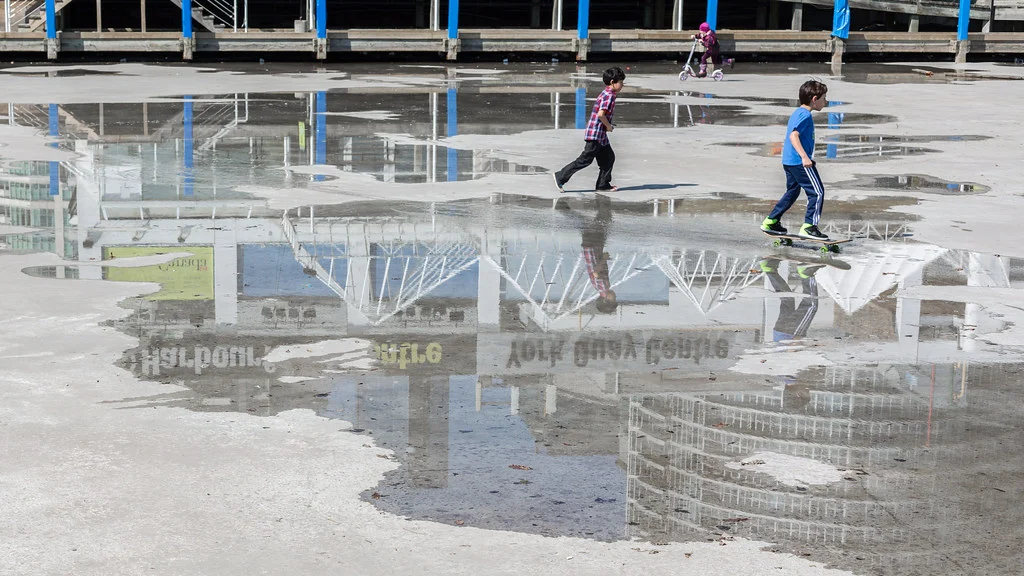
Anticipate moments rather than reacting to them. If your child is about to jump off a step, have your camera ready before they jump. If they are blowing out birthday candles, start shooting before they lean in. The moment of anticipation, the intake of breath, the crouch before the leap, is often more compelling than the moment itself. This anticipation skill improves with practice. The more you photograph your children, the better you will become at predicting what happens next.
Keep your camera accessible. The best moments happen without warning: a belly laugh during breakfast, a quiet moment of concentration while drawing, the expression when they see the first snow of winter. If your camera is in a bag in the closet, you will miss these moments. Keep your phone charged or your camera on a shelf where you can grab it in seconds.
Camera Settings That Work for Kids
Children move constantly. Even when they appear to be sitting still, they shift, wiggle, turn their heads, and gesture with their hands. Your camera settings need to account for this movement.
Use a fast shutter speed. For toddlers and babies, 1/250th of a second is a good minimum. For running, jumping, and active play, 1/500th or faster is safer. Motion blur from a slow shutter speed is the most common technical problem in children’s photos. Raise your ISO if needed to maintain a fast shutter speed. A slightly noisy photo of a sharp, laughing child is always better than a clean photo with blurred features.
For dedicated cameras, aperture priority mode works well for children’s photography. Set your aperture to f/2.8 to f/4 for a single child (this gives you a pleasantly blurred background while keeping the child sharp) and let the camera choose the shutter speed. Watch that the shutter speed does not drop too low. If it does, raise your ISO. Understanding the exposure triangle helps you make these adjustments quickly.
Use continuous autofocus (AF-C or AI Servo) rather than single-shot autofocus. Continuous focus tracks a moving subject, adjusting the focus as the child moves toward or away from the camera. Combine this with eye-detection autofocus if your camera has it. Eye detection locks focus on the child’s eyes, which is exactly where you want the sharpest focus in a portrait.
Shoot in burst mode during active moments. Children’s expressions change in fractions of a second. A burst of five to ten frames gives you the best chance of catching the perfect expression, the eyes open, the mouth in a natural smile, the peak of a jump. Review the burst afterward and keep only the best frame.
Common Mistakes When Photographing Children
Shooting from adult height. This is the most common mistake and the easiest to fix. Get down to eye level. Every time. Make it a habit until it becomes automatic.
Using direct flash. Built-in camera flash produces harsh, flat light with red-eye. It startles children and creates unflattering shadows. If you must use flash, bounce it off the ceiling or a wall. Better yet, find natural light. Flash is rarely the best option for children’s photos. The harsh light from direct flash creates an unnatural look that good window light avoids entirely.
Over-directing. “Stand here. Look at me. Smile. No, really smile. Tilt your head. Not like that.” The more directions you give, the more unnatural the child looks and the more frustrated everyone gets. Give simple, fun instructions or let the child play freely. The best expressions cannot be directed. They can only be captured.
Waiting for perfection. Messy hair, mismatched socks, food on the face, these “imperfections” are what make children’s photos authentic and charming. Do not spend 20 minutes getting everything perfect before shooting. The child’s patience will be gone and the resulting photos will show it. Capture the beautiful mess of childhood as it is.
Forgetting the details. Tiny hands, chubby feet, the way they hold a crayon, the curl at the back of their neck. These details change so quickly. Photograph the small things as well as the whole child. In ten years, these detail shots will be among your most treasured images.
Cluttered backgrounds. A beautiful expression is ruined when a pile of laundry or a cluttered shelf is visible behind the child. Before you shoot, scan the background quickly. Move to a cleaner angle, open your aperture wider to blur the background, or physically move distracting objects out of the frame. A simple background keeps the focus on your child. Good composition applies to family photos just as much as to professional work.
Try This: Children’s Photography Exercises
Exercise 1: The Window Light Session. On an overcast day, position your child near the largest window in your home, playing with a favorite toy or reading a book. Turn off all other lights. Kneel down to their level and photograph them as they play, paying attention to how the window light falls across their face. Take 20 to 30 photos over 10 minutes without giving any directions. Let them be absorbed in their activity. Review the results on your computer and notice which angles of light produce the most flattering results. This exercise teaches you to see and use natural light in your own home.
Exercise 2: The Action Freeze. Take your child to a park and photograph them during active play: running, jumping, swinging, climbing. Set your camera to a fast shutter speed (1/500th or faster) and continuous autofocus. Shoot in burst mode. The goal is to capture sharp images of a moving child. Review the burst sequences and notice which frames catch the peak of the action, the highest point of a jump, the widest smile during a swing. This exercise builds your timing and your ability to handle fast-moving subjects.
Exercise 3: The Detail Collection. Over the course of a week, photograph 10 details of your child’s life at this age: their hands, their shoes, their favorite stuffed animal, the way they sleep, how they hold a spoon, a close-up of their eyelashes. Use shallow depth of field to isolate each detail. At the end of the week, arrange these 10 detail images together as a collection. This exercise shifts your focus from the big picture to the small, fleeting details that define childhood and disappear so quickly. These detail-focused images create a more complete visual memory of your child’s life than posed portraits alone.
The photographs you take of your children today will become irreplaceable memories tomorrow. You do not need professional equipment or formal training to capture beautiful images of your kids. You need good light, the right perspective (their eye level, not yours), patience to wait for genuine moments, and the habit of having your camera ready. Start with these fundamentals and your family photos will improve immediately. Your children will not be this age forever. Document the beautiful chaos while it lasts.