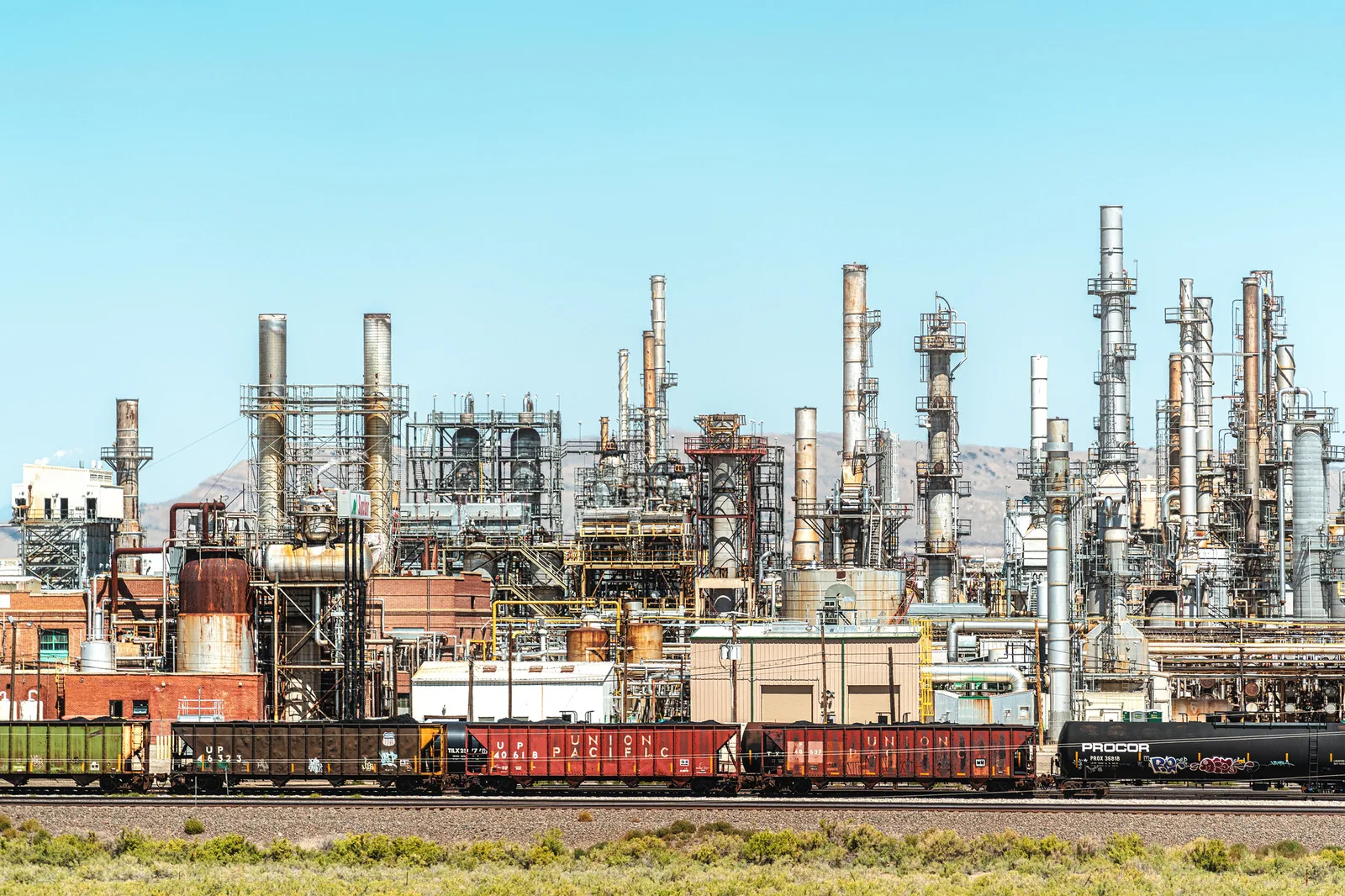
Industrial places have a raw, powerful beauty. Towers and pipes of a refinery glitter at dusk, smokestacks send plumes of steam into a winter sky, cranes stand like giant sculptures over a port and long freight trains roll past factories and grain elevators. These are places built for work, not for looks, yet their shapes, scale and light make some of the most striking pictures you can take. Industrial photography reveals the hidden structure of the world that keeps everything running.
This guide covers why industrial scenes make great subjects, finding them safely, refineries and plants, smokestacks and steam, factories and warehouses, cranes, ports and construction, rail yards and grain elevators, power lines and utilities, pattern, shape and scale, industry at night, people at work, settings, phones and editing. For closed and forgotten places, see the guide to urban exploration photography, and for weathered metal up close, see the guide to rust photography.
Why industrial scenes make great subjects
Industrial sites are full of the things that make pictures strong.
- Bold shapes. Towers, tanks, pipes, chimneys and cranes make strong geometric forms.
- Pattern and repetition. Rows of tanks, stacks of containers and bundles of pipes repeat across the frame.
- Scale. Industrial structures are huge, and showing their size creates a sense of awe.
- Dramatic light. Steam, smoke, floodlights and glowing towers at night add mood.
- Story. Industry speaks of work, history, power, change and the way people shape the land.
Many celebrated photographers have treated industrial sites with the same care as natural landscapes, finding grace and stillness in places most people pass without a glance. Their pictures show that a refinery or a power plant can be as visually compelling as a mountain, and often more surprising.
Finding industrial scenes safely
Most industrial sites are private, active and potentially dangerous, so the best pictures are usually made from outside.
- Shoot from public land. Roads, bridges, parks, overlooks and riverbanks often give excellent views.
- Use a longer lens. A telephoto lens brings distant structures close from a safe, legal spot.
- Respect fences and signs. Never enter restricted areas or climb fences.
- Carry little. A small bag and a single lens look less alarming to security and are easier to manage near traffic.
- Be polite if approached. Security staff may ask what you are doing. Explain calmly, show your pictures if asked and move on if requested.
- Look for tours. Some factories, mills and plants offer public tours or open days with photography allowed.
Industrial areas are often near busy roads and rail lines. Stay well back from traffic and tracks, wear something bright and be aware of trucks and machinery moving around you.
Refineries and plants
Refineries and chemical plants are among the most spectacular industrial subjects. Their maze of towers, tanks, pipes and walkways looks almost like a city of metal.
- Compress the layers. A long lens from a distance stacks towers and pipes into dense, layered patterns.
- Show the whole site. A wide view from a hill or overlook shows its size and its place in the land.
- Look for steam. Plumes of steam catch the light and add movement and mood.
- Find details. Valves, ladders, gauges and painted numbers make lovely close pictures through a long lens.
Plants look especially dramatic at dusk and at night, when thousands of lights switch on and the towers glow against a darkening sky. The guide to lens compression explains how longer lenses stack distant layers together.
Smokestacks and steam
Smokestacks and cooling towers are iconic industrial forms. Tall stacks against a plain sky make simple, bold pictures, and the plumes of steam rising from them change shape with every moment. Cold mornings make steam thicker and more visible, and low sun lights it in warm colors. A huge cooling tower with a small car or person in front shows its scale. Try both color and black and white, since steam and stacks often look most powerful in simple tones.
Mines and quarries
Mines and quarries carve the land into terraces, pits and pools of strangely colored water. From an overlook, a quarry can look like a giant staircase or an abstract painting, with bands of stone, roads spiraling down and tiny trucks for scale. Many quarries are active and dangerous, so view them only from public overlooks or on organized tours. Old flooded quarries are often turned into parks, where the cliffs and clear water make lovely, quiet scenes.
Factories and warehouses
Factories and warehouses have their own quiet character. Long walls, rows of windows, saw tooth roofs, loading bays and painted lettering make strong graphic pictures.
- Straight on. Photograph a factory wall square on for a flat, graphic, almost abstract picture.
- Rows of windows. Repeating windows make patterns, especially when one is lit or broken.
- Painted words. Faded names and numbers on brick add history.
- Loading bays. Rows of doors, ramps and trucks show the rhythm of work.
Old brick mills and factories often have beautiful details, such as arched windows, iron frames and tall chimneys. Many have been turned into homes, shops or museums, which can make them easier to visit and photograph.
Cranes, ports and construction
Ports and construction sites are full of giant machines and constant movement.
- Cranes against the sky. Tall cranes make striking lines and shapes, especially at sunset.
- Container stacks. Colorful containers stacked in rows make bold patterns of color.
- Ships. Huge cargo ships beside cranes show the scale of global trade.
- Construction. Steel frames, scaffolding and concrete pumps show buildings taking shape.
Look up through a tangle of crane arms and cables for an abstract view, or step back to show a skyline of cranes over a growing city. Construction changes quickly, so returning to the same site over weeks or months makes an interesting series. Photograph from the same public spot each time, and the pictures become a time lapse of a building rising.
Rail yards and grain elevators
Railways and grain elevators are classic subjects of industrial and rural landscapes alike.
- Freight trains. Long lines of cars passing factories add movement and color.
- Rail yards. Rows of tracks, switches and parked cars make strong leading lines and patterns.
- Grain elevators. Tall concrete or wooden elevators rise above flat land like cathedrals of the plains.
- Silos and tanks. Groups of round silos make repeating shapes.
Never walk on or near active tracks. Photograph from public crossings, bridges or roads, and keep well back. The guide to train photography has more on photographing railways safely.
Power lines and utilities
Power lines, transmission towers, wind turbines, substations and water towers are often seen as eyesores, but they can make beautiful pictures.
- Transmission towers. Their lattice shapes look like giant figures marching across the land.
- Lines and wires. Power lines make strong diagonal and curving lines against the sky.
- Wind turbines. Rows of turbines on hills or plains make clean, graceful shapes.
- Water towers. Often painted with the name of a town, they are landmarks of small places.
Simplify the frame by placing these structures against plain sky, fog or sunset color. Silhouettes of towers at dusk can be especially graphic. A line of towers carrying wires over a hill toward the setting sun makes a simple, poetic picture about connection and distance.
Pattern, shape and scale
Industrial photography is often about seeing shapes and patterns clearly.
- Fill the frame with repetition. Tanks, pipes, containers and windows make powerful patterns. See the guide to pattern and repetition.
- Isolate shapes. A single tank, stack or tower against plain sky makes a clean, minimalist picture.
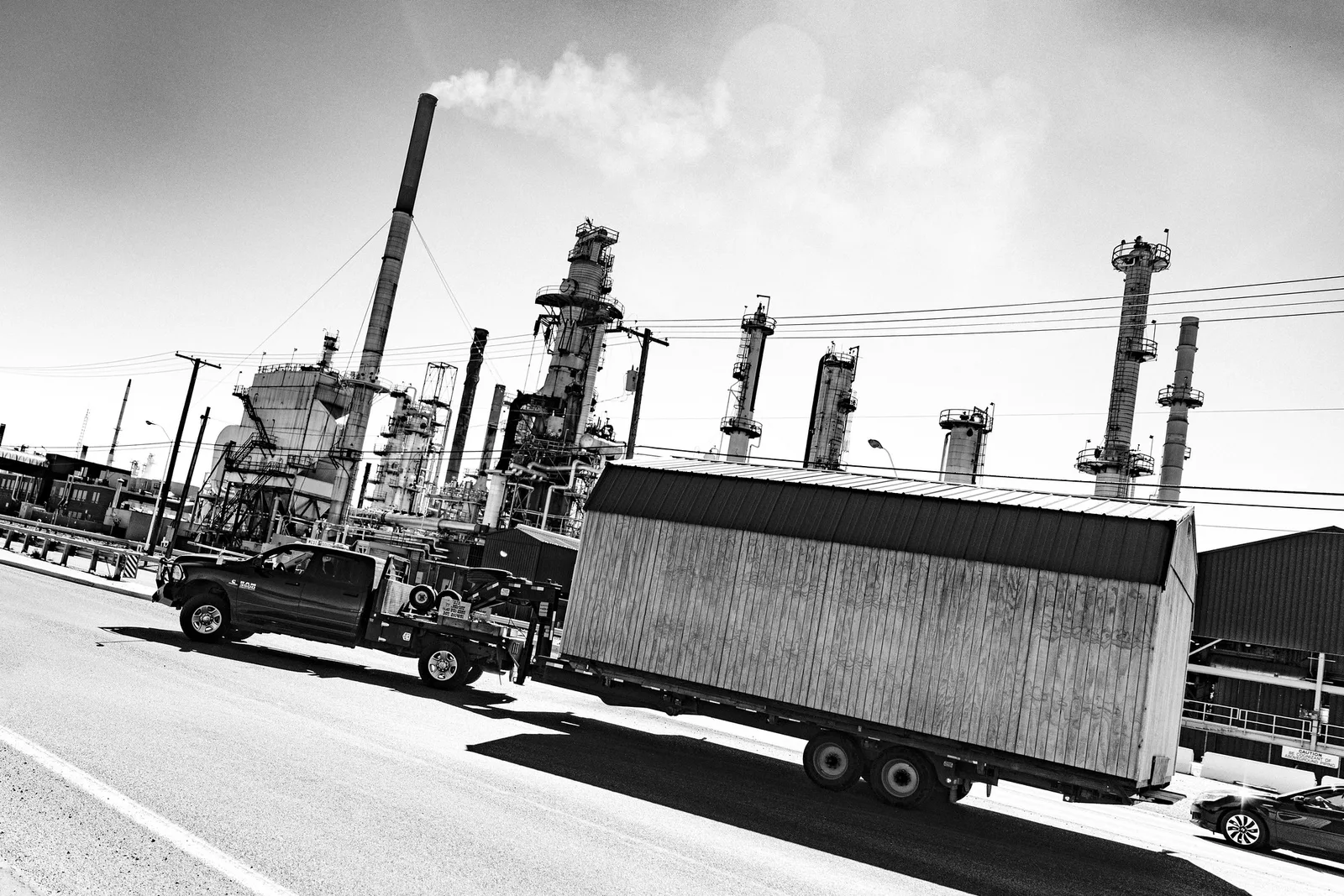
- Show scale. Include a person, car or truck to show how huge the structures are. The guide to scale explains why this works.
- Use lines. Pipes, rails and power lines lead the eye through the frame.
Industrial scenes can look cluttered at first. Take time to find the angle where the chaos resolves into a clear arrangement of lines and shapes.
Industry in fog and weather
Weather turns industrial scenes into something mysterious. Fog softens towers and cranes into gray silhouettes that fade into the distance, with each layer paler than the last. Snow outlines pipes and rooftops in white, and steam mixes with low cloud on cold days. Storm clouds behind a refinery or a line of transmission towers add drama and tension. These moody days are often the best time to photograph places that look plain in bright sun.
Industry at night
Industrial sites are often at their most spectacular after dark. Refineries glow with thousands of lights, steam is lit from below and floodlit cranes stand out against the sky.
- Start at blue hour. The sky keeps some color, which contrasts with the warm and white lights.
- Use a tripod. Long exposures give clean, detailed night pictures.
- Use reflections. Rivers, canals and wet roads double the lights.
- Capture steam. Lit steam and smoke glow and swirl in long exposures.
Choose a safe, public spot, and be aware of your surroundings. Night views of industry can feel futuristic, almost like scenes from science fiction. Try several exposure lengths, since shorter ones keep steam detailed while longer ones smooth it into a soft glow.
Ready to photograph glowing industrial scenes? The guide to night photography covers tripods, exposure and night light.
People at work
People bring industrial scenes to life and give them human meaning. Workers on a dock, welders in a shower of sparks or a farmer loading grain show the people behind the machines.
- Ask permission. Always ask before photographing workers, and follow site rules.
- Show hands and tools. Close pictures of hands and tools tell a story without faces.
- Keep scale. Small figures in front of huge machines show both size and human effort.
- Be respectful. Work can be dangerous. Never distract people operating machinery.
Organized tours and open days are good chances to photograph people at work, since permission is often already in place.
Abandoned industry
Closed factories, silent mills and rusting plants carry a different kind of power. Broken windows, peeling paint, machines frozen in place and plants growing through concrete tell stories of work that has ended and towns that have changed. Photograph these places from public land, and never enter closed buildings without permission, since they can hide collapsing floors, sharp metal and hazardous materials. A wide view of a silent plant under a gray sky can say a great deal about change and time.
Drawn to closed and forgotten places? The guide to urban exploration photography covers how to approach them safely and respectfully.
Settings for industrial photography
- Distant sites. Use a telephoto lens and f/8 for sharp, compressed scenes.
- Wide views. Use f/8 to f/11 for sharpness from near to far.
- Night. Use a tripod, ISO 100 to 400 and exposures of several seconds.
- Handheld in low light. Raise the ISO and keep the shutter fast enough to avoid blur.
- White balance. Industrial lights can be orange, green or blue. Choose a setting that keeps the mood you want.
Using a phone
Phones work well for industrial scenes from a distance with the telephoto lens, and for wide views of structures. Use night mode for glowing plants, and rest the phone on a railing or car roof for stability. Tap to set exposure on bright lights to keep them from washing out.
Editing industrial photos
Industrial pictures often suit strong, graphic edits. Increase contrast and clarity a little to bring out structure, and lower highlights to keep detail in lights and steam. Black and white suits many industrial scenes, turning metal, steam and sky into rich tones. The guide to black and white photography explains how to convert with care. For color, cool blue tones can emphasize a futuristic feel, while warm tones suit sunset and rusty sites.
Want to see industry through a master’s eyes? The profile of Edward Burtynsky shows how industrial landscapes can become powerful art.
Common mistakes
- Trespassing. Stay on public land and respect fences and signs.
- Cluttered frames. Industrial scenes are busy. Simplify with a longer lens or a cleaner angle.
- No sense of scale. Include something familiar to show size.
- Harsh midday light. Flat light hides shape. Shoot at dawn, dusk or night.
- Ignoring safety. Watch for traffic, trains and machinery.
- Photographing workers without asking. Always ask first.
Try this: a 10-minute industrial study
From a safe, public spot near an industrial site, take four pictures.
- A wide view showing the whole site in its setting.
- A telephoto view compressing towers or tanks into a pattern.
- A single shape isolated against the sky.
- A picture with something that shows scale, such as a truck or person.
Compare the four, and notice how each one tells a different story about the same place. Choose the strongest, and think about what made it work: the light, the lens, the angle or the moment. Return at dusk to see how the site transforms when its lights come on.
Frequently asked questions
Is it legal to photograph industrial sites?
Photographing from public land is generally allowed, but rules vary. Never enter private or restricted areas, and follow signs.
What lens is best for industrial photography?
A telephoto lens for distant sites and compressed patterns, and a wide lens for close, dramatic views of structures.
When is the best time to photograph industry?
Dusk and night, when lights glow and steam is lit, or cold mornings for thick plumes of steam.
Should industrial photos be in color or black and white?
Both work. Black and white emphasizes shape and texture, while color suits glowing night scenes and painted structures.
How do I show the scale of a huge industrial structure?
Include something familiar, such as a person, car or truck, and step back far enough to show the whole structure.
Can I photograph industrial sites with a phone?
Yes. Use the telephoto lens for distant structures and night mode after dark, and steady the phone on something solid.
For terms such as compression, telephoto, scale and long exposure, see the photography glossary.