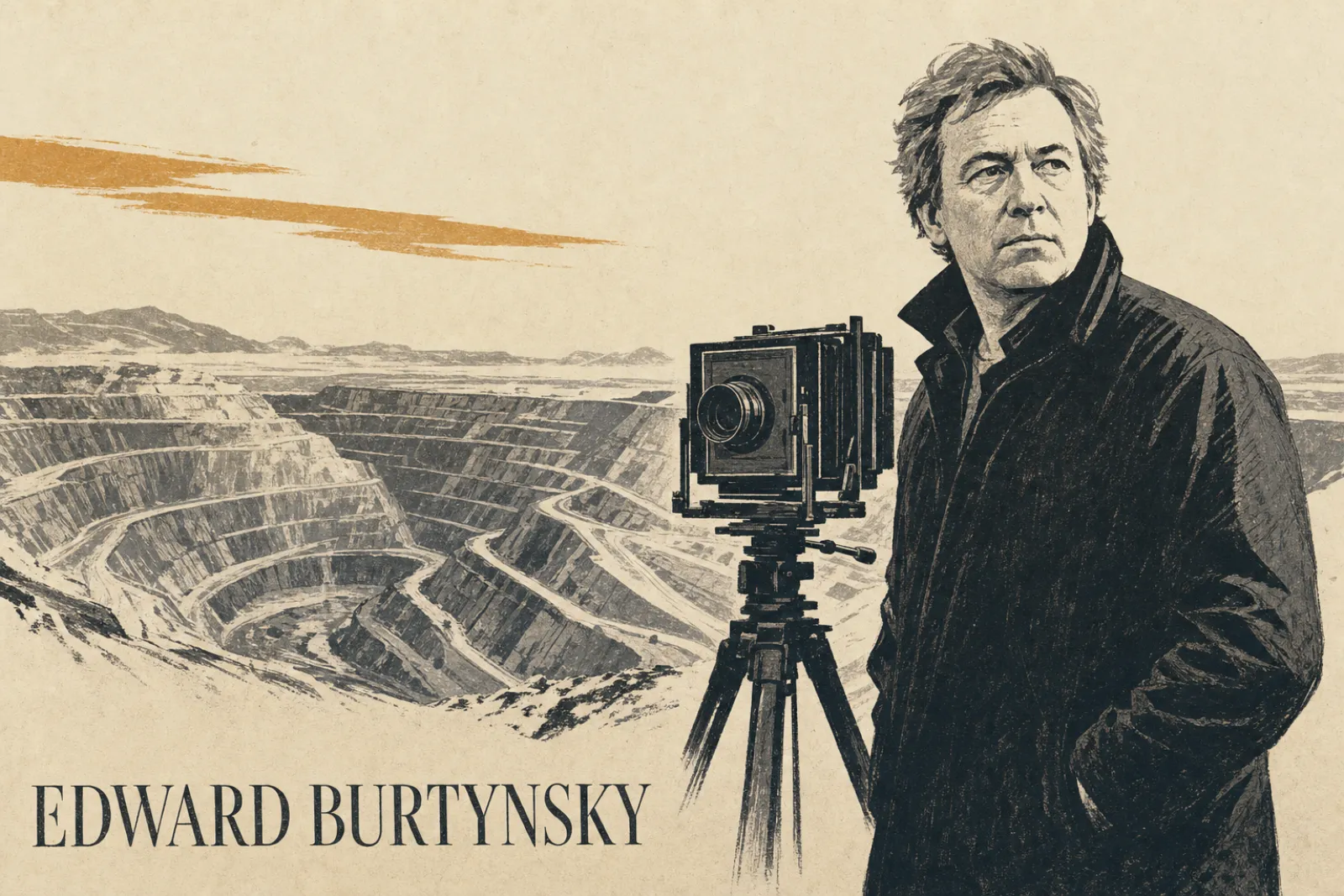
Edward Burtynsky, born in 1955 in St. Catharines, Ontario, is a Canadian photographer of industrial landscapes. From the early 1980s he photographed mines, quarries, oil fields, factories, shipbreaking yards and dams in Canada, the United States, Europe, India, Bangladesh and China, and printed the results very large. He is known for showing, in fine detail and from a high viewpoint, what the extraction of raw materials does to the surface of the earth.
Burtynsky named three American photographers as influences: Ansel Adams, Edward Weston and Carleton Watkins. He took up their tool, the large sheet film camera, and their subject, the land. What he changed was the kind of land. He described his theme as nature transformed through industry, and for about thirty years he pointed the camera at worked ground instead of wilderness. Only in the last part of his Water project, in British Columbia and Iceland, did he turn to untouched country.
St. Catharines, a darkroom at eleven and Toronto Image Works
His father, Peter Burtynsky, was a Ukrainian immigrant who worked at the General Motors plant in St. Catharines. When Edward was eleven his father bought a darkroom and cameras from a widow. The boy was given two rolls of Tri-X film and started photographing events and portraits at the local Ukrainian community centre, charging 50 cents a picture. His own biography points to two early sights that shaped his later subject: the General Motors plant, and ships passing through the Welland Canal.
He studied graphic design at Niagara College in Welland, Ontario, from 1974, then took a degree in photographic arts at Ryerson Polytechnical Institute in Toronto, finishing in 1982. In 1985 he founded Toronto Image Works, a darkroom rental facility, custom photo lab and training centre. A gallery space was added in 1986.
Mines, quarries, ships and oil
An early body of work, Breaking Ground: Mines, Railcuts, Homesteads, was made in Canada and the United States from 1983 to 1985. The quarries came next. He first went to Barre, Vermont, in 1991, after a quarryman told him about the workings there, and made about six trips. He photographed the marble quarries of Carrara, Italy, in 1993, those of Makrana, India, in 2000, and those of Portugal in 2006. He regarded the Portuguese pictures as the end point of fifteen years of quarry work. He spoke of the quarries as landscape seen as architecture, like pyramids and cubes turned inside out.
Other series followed the same logic of going to where materials come from and where they end up. Tailings (1995 to 1996) looked at mine waste in Canada. Urban Mines (1997 to 1999) looked at metal recycling in Canada, and Tire Piles, from the same years, was made in the United States. Shipbreaking (2000 to 2001) showed retired ships being taken apart in Bangladesh. He said he intended it as a study of humanity and of the skill it takes to dismantle such vessels. Oil ran from 1999 to 2010 and covered oil fields, refineries, highways and the culture of the car, in Canada, the United States, Azerbaijan and China.
How does a subject pursued for years stay organised and keep moving? How to build a long-term photography project covers planning, research and seeing it through.
China, Water and the Anthropocene
The China series, dated 2004 to 2006, took in steel works, factories and workers’ dormitories in Guangdong province, old state industry being torn down, the recycling of electronic waste, shipyards and the Three Gorges Dam. It was the centre of Manufactured Landscapes, a 2006 documentary about his work directed by Jennifer Baichwal. The film has very little narration and leaves viewers to draw their own conclusions.
Water (2009 to 2013) was organised in six parts: Distressed, Control, Agriculture, Aquaculture, Waterfront and Source. It ranged from the dry Colorado River Delta to stepwells in India and untouched country in Iceland. With it came the film Watermark (2013), which Burtynsky directed with Baichwal. The Anthropocene project (2014 to 2018) combined photographs with film, virtual reality and scientific research on human influence on the earth. Its film, Anthropocene: The Human Epoch, was directed with Baichwal and Nicholas de Pencier and first shown at the Toronto International Film Festival in September 2018. The book African Studies was published in 2023.
He received the TED Prize in 2005, was made an Officer of the Order of Canada in 2006, and received the International Center of Photography’s Infinity Award for Art in 2008, the Governor General’s Award in Visual and Media Arts in 2016 and an Honorary Fellowship of the Royal Photographic Society in 2020. Museums that have collected his prints include the National Gallery of Canada, the Museum of Modern Art in New York and Tate Modern in London.
Can photographs of damaged places change what people do? What is conservation photography explains the aims and methods of pictures made for the environment.
How Burtynsky made size and detail do the work
The pictures depend on a few clear choices that can be studied and practised.
- A big negative. Until 2007 he used a field camera with 4×5 inch sheet film, which is large format. Later work was made with a high resolution digital medium format camera. Both record enough detail for a viewer to walk up to the print and find single workers, trucks and tools.
- A high viewpoint. He raised the camera with elevated platforms and natural high ground, and later with drones, helicopters and aeroplanes. From above, the ground tilts up to fill the frame and the horizon can be reduced or left out. Aerial photography without a drone and drone photography cover the two ways of getting up there.
- Something of known size. A quarry face means little until a ladder or a person appears on it. That is the principle of scale, and he applied it to sites far larger than anything in daily life.
- Very large prints. His film work was printed from 18 by 22 inches up to 60 by 80 inches. At that size the first reading is of shape and colour, and the second, from close up, is of small facts.
- Meaning left open. He wrote that he looked for subjects rich in detail and scale yet open in their meaning, and described the pictures as a dialogue between attraction and repulsion. The photographs do not tell the viewer what to think.
Why do rows of identical things hold the eye? Patterns and repetition in photography shows how to find repeated forms and where to break them.
The work sits between two traditions. It is landscape photography in its tools and its patience, and documentary photography in its purpose.
How should a very large photograph be shown? How to display large photo prints on your walls covers size, viewing distance and hanging.
Series to look for
- Breaking Ground: Mines, Railcuts, Homesteads (1983 to 1985). The early work in Canada and the United States, where the theme of cut and excavated land first appeared. It is the starting point for everything later.
- Quarries (1991 to 2006). Vermont, Carrara, Makrana and Portugal. Look for the idea he stated himself: stone removed in blocks leaves a space that reads like a building in reverse.
- Shipbreaking (2000 to 2001). Very large retired ships being dismantled in Bangladesh. He meant it as a study of the people and the skill involved, so look for the workers as well as the hulls.
- Oil (1999 to 2010). Oil fields, refineries and roads treated as one subject. The series follows a single material from the ground to the car.
- China (2004 to 2006). Factories, dormitories, recycling yards, shipyards and the Three Gorges Dam, where about 1.13 million people had to be moved. The film Manufactured Landscapes follows him at work on this series.
- Water (2009 to 2013). Six sections on how water is used, controlled and lost, much of it photographed from the air. The final section, Source, shows untouched landscapes in British Columbia and Iceland.
Try this: one worked place from above
This takes about twenty minutes with a camera or phone. No drone is needed.
- Find a place where people have rearranged the ground or stacked things on it: a car park, a building site seen from the public street, a container yard, an allotment garden, a recycling depot.
- Get as high as you safely and legally can: a footbridge, an upper floor window, the top level of a parking garage, a hill.
- Tilt the camera down until there is no sky in the frame.
- Wait until one person or vehicle is in the picture, small, to give the size of everything else.
- Make five frames. Change only where the edges of the frame fall.
Look at the result large on a screen. Check whether the frame works first as a pattern and second as a record of what is there.
Questions people ask about Edward Burtynsky
What camera did Edward Burtynsky use?
Up to 2007 he photographed with a large format field camera on 4×5 inch sheet film. After that he used a high resolution digital medium format camera. He also worked from raised platforms, drones, helicopters and aircraft.
What is Manufactured Landscapes?
It is the title of a 2006 Canadian documentary by Jennifer Baichwal that follows Burtynsky photographing factories and the Three Gorges Dam in China. It won Best Canadian Film at the Toronto International Film Festival. The same title was used for a touring exhibition of his work from the National Gallery of Canada in 2003.
Were Burtynsky’s photographs meant as protest?
By his own account they were not a simple statement for or against. He wrote of attraction and repulsion together, and of people wanting comfort while knowing the world pays for it. He described the subjects he looked for as open in their meaning, which leaves the interpretation to the viewer.
Where did Edward Burtynsky study photography?
He studied graphic design at Niagara College and then photographic arts at Ryerson Polytechnical Institute in Toronto, where he completed his degree in 1982. The institution was later renamed Toronto Metropolitan University.
Burtynsky is one of the photographers in the A to Z of photographers.