Minimalist photography is the art of saying more with less. By stripping a scene down to its most essential elements, you create images that are clean, powerful, and immediately impactful. Minimalism is not about taking photos of empty spaces, it is about being intentional with every element in the frame, removing distractions until only what matters remains. This guide covers the principles of photographic minimalism, practical techniques for simplifying your compositions, and approaches to minimalism across different genres.
What Is Minimalist Photography?
Minimalist photography follows the principle that less is more. A minimalist image typically features a single subject or a small number of elements, generous negative space, a limited color palette, and clean, uncluttered composition. The goal is to communicate clearly and directly, giving the viewer’s eye a clear path and an unambiguous focal point.
Minimalism in photography draws from the minimalist art movement of the 1960s, which emphasized simplicity, geometric forms, and the removal of everything non-essential. In photographic practice, this translates to a deliberate process of elimination: asking “what can I remove from this frame?” rather than “what can I add?”
The Power of Negative Space
Negative space, the empty area surrounding your subject, is the defining element of minimalist photography. It is not wasted space; it is an active compositional tool that gives your subject room to breathe, creates visual rest for the eye, emphasizes the subject through isolation, establishes scale and context, and adds a sense of calm and openness to the image.
In minimalist photography, the negative space often occupies the majority of the frame, sometimes 80 percent or more. A lone figure walking across a vast snowy field, a single boat on an empty ocean, or a bird against a clear sky all use negative space to amplify the impact of a small subject.
The key is that negative space should feel intentional, not accidental. A well-composed minimalist image places the subject with precision relative to the surrounding emptiness. The negative space itself should be clean and uniform, a smooth sky, a calm sea, a blank wall, so it reads as deliberate rather than as a boring background you failed to fill.
Simplifying Your Scenes
The biggest challenge in minimalist photography is learning to simplify. Our natural tendency is to include too much, more context, more elements, more information. Minimalism requires you to resist that impulse and make deliberate choices about exclusion.
- Change your perspective. Move around your subject and look for angles that eliminate background clutter. Shooting upward against the sky removes ground-level distractions. Shooting straight down onto a clean surface isolates objects. Moving closer fills the frame with just your subject.
- Wait for simplicity. Street scenes, beaches, and public spaces simplify naturally if you wait for people to move out of the frame or for traffic to clear. Patience is a minimalist photographer’s greatest virtue.
- Use a longer lens. Telephoto lenses compress perspective and narrow the field of view, making it easier to isolate subjects and exclude surrounding clutter. A 70-200mm lens is an excellent tool for minimalist photography.
- Shoot in fog, mist, or snow. Atmospheric conditions naturally simplify scenes by obscuring detail and reducing everything to simple forms. Fog is the minimalist photographer’s best friend, it softens backgrounds, mutes colors, and strips scenes down to essential shapes.
- Look for clean backgrounds. Plain walls, open sky, calm water, and uniform surfaces make excellent backdrops for minimalist images. Train yourself to notice clean backgrounds wherever you go.
Minimalist Composition Techniques
Composition in minimalist photography follows the same fundamental principles as all photography, but with amplified importance because every element carries more visual weight when there are fewer of them.
- Rule of thirds with purpose. Placing your subject at a rule-of-thirds intersection point with empty space filling the remaining frame is a classic minimalist composition. The asymmetry creates tension and interest that centered compositions sometimes lack.
- Centered subjects. Contrary to the usual advice against centering, minimalist photography often works beautifully with a centered subject. When there is nothing else in the frame, perfect symmetry can feel deliberate, powerful, and meditative.
- Leading lines in isolation. A single line, a road vanishing to a point, a horizon cutting across the frame, a railing leading the eye, becomes enormously powerful in a minimalist composition. Remove everything except the line and your subject, and the eye follows the path with absolute clarity.
- Geometric simplicity. Look for clean geometric shapes: circles, triangles, squares, arcs. Minimalist images built on strong geometric foundations feel structured and intentional. Architecture, industrial design, and modern interiors are rich sources of geometric minimalism.
- Extreme crops. Do not be afraid to crop aggressively in post. A wider shot that contains distracting elements may hide a powerful minimalist image within it. Crop until only the essentials remain.
Color Minimalism
Color plays a crucial role in minimalist photography. A limited, intentional color palette strengthens the minimalist effect, while a busy mix of colors adds visual noise that works against simplicity.
- Monochromatic palettes. Images dominated by shades of a single color, blue sky and blue water, a white room with white furniture, golden sand extending in every direction, feel inherently minimal because color variation is eliminated.
- A single accent color. One strong color against a neutral background is a foundational minimalist technique. A red door on a white wall, a yellow flower in a green field, or a person in a bright jacket against gray concrete. The single color element becomes the undeniable focal point.
- Muted and desaturated tones. Reducing saturation in post-processing pushes images toward a quieter, more restrained palette that complements minimalist composition. Soft pastels and gentle earth tones feel calmer than vivid, saturated colors.
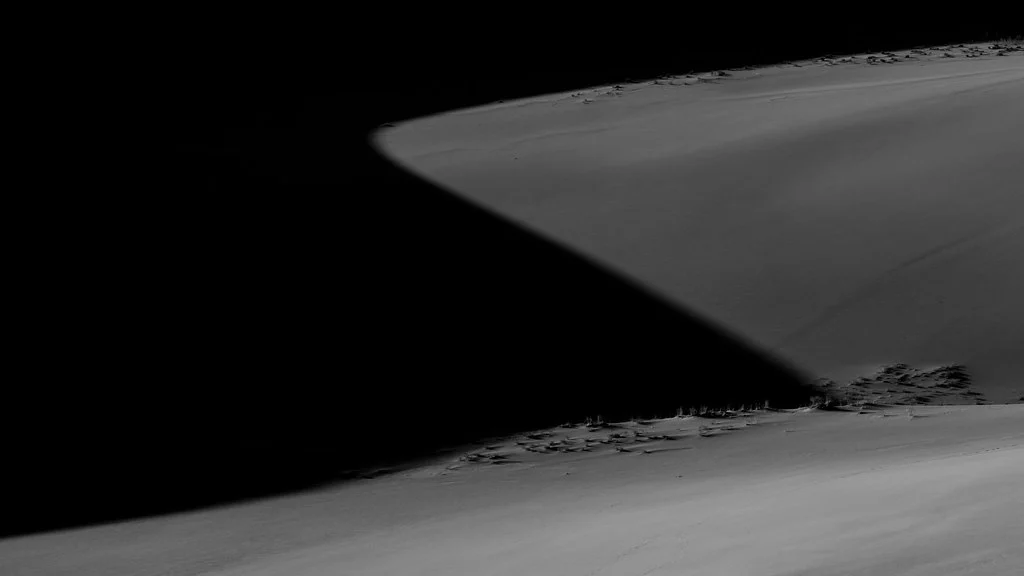
- Black and white. Monochrome is the ultimate color simplification. Removing color entirely forces the viewer to engage with form, texture, tone, and composition. Many of the most iconic minimalist photographs are in black and white.
Minimalism Across Genres
Architectural Minimalism
Modern architecture is a natural match for minimalist photography. Clean lines, geometric facades, uniform materials, and deliberate negative space are built into the design. Look for buildings with repetitive patterns, stark contrasts between light and shadow, and smooth surfaces. Shoot on overcast days for even lighting or use harsh sunlight to create bold geometric shadows.
Landscape and Nature Minimalism
Nature offers minimalist opportunities throughout the year. Fog-shrouded lakes, snow-covered plains, smooth sand dunes, lone trees in open fields, and calm ocean horizons all provide naturally simplified scenes. Long exposure photography is especially useful for landscape minimalism, a 30-second exposure smooths water and blurs clouds, transforming a busy ocean into a silk-smooth surface that reads as pure negative space.
Portrait Minimalism
Minimalist portraits strip away environmental context to focus entirely on the person. Use a plain background (a white wall, open sky, or studio backdrop), simple clothing, and minimal props. Direct the viewer’s attention to expression, gesture, or a single defining detail. High-key lighting (bright, even, low-contrast) is a classic minimalist portrait technique.
Street Minimalism
Minimalist street photography requires patience and a keen eye for geometry. Look for lone figures against clean walls, stark shadows on pavement, simple architectural elements, and moments where a busy scene momentarily simplifies. Shooting from above (bridges, overpasses, upper floors) can simplify street scenes by reducing them to flat graphic elements.
Post-Processing for Minimalism
Post-processing is your final opportunity to strip away distractions and refine the minimalist vision.
- Crop ruthlessly. Remove anything that does not serve the image. If cropping eliminates a distracting element and strengthens the composition, do it without hesitation.
- Clone out distractions. Small elements that break the clean background, a stray bird, a distant person, a power line, can be removed with the healing brush or clone stamp. The goal is a clean, uninterrupted negative space.
- Simplify the tonal range. Push highlights up and pull shadows down to create a high-key or low-key look. High-key minimalism (bright, airy, washed-out) and low-key minimalism (dark, moody, shadow-dominated) are both effective approaches.
- Desaturate selectively. If a distracting color element remains in the frame, desaturate just that color using HSL adjustments. Or desaturate everything except your subject’s color for a selective color effect.
- Adjust white balance for mood. Slightly cool white balance adds a sterile, contemplative feel that complements minimalist architecture. Warm white balance adds softness and intimacy to minimalist nature images.
Common Mistakes to Avoid
- Confusing minimal with empty. A minimalist image needs a strong subject or focal point. An image with nothing interesting in it is not minimalist, it is just empty. Negative space should serve the subject, not replace it.
- Ignoring composition because it is “simple.” Minimalist compositions require more precision, not less. When there are only one or two elements in the frame, their placement matters enormously. A slightly off-center subject or a crooked horizon is far more noticeable in a minimal frame.
- Including too much. The most common mistake is not going far enough. If you think your image is minimal, try removing one more element. Can you crop tighter? Can you change your angle to eliminate something? Push toward simplicity until the image stops working, then pull back one step.
- Making every image look the same. Minimalist photography can become repetitive if you rely on the same formula (lone object, centered, white background). Vary your approach: experiment with different color palettes, compositions, subjects, and genres to keep your minimalist work fresh.
- Over-processing. Heavy-handed editing, extreme contrast, aggressive sharpening, or artificial-looking color grading, adds visual noise that works against the minimalist aesthetic. Keep your editing as restrained as your composition.
Frequently Asked Questions
Do I need special equipment for minimalist photography?
No. Minimalist photography is about seeing and composing, not about gear. Any camera, including a smartphone, can create minimalist images. That said, a telephoto lens (70-200mm or similar) is useful for isolating subjects, and a tripod helps with long exposure techniques that smooth water and clouds into clean negative space.
How do I find minimalist scenes?
They are everywhere once you start looking. Clean walls, open skies, bodies of water, modern buildings, parking lots, and even your own home contain potential minimalist compositions. The key is training your eye to see simplicity amid complexity. Start by photographing single objects against plain backgrounds, and gradually expand to finding minimalist moments in busier environments.
Is minimalist photography always black and white?
Not at all. While black and white is a natural fit for minimalism because it removes the complexity of color, minimalist photography works beautifully in color, especially with limited, intentional palettes. A single bright color against a neutral background, or a scene bathed in one dominant hue, can be just as powerful as monochrome. The goal is simplicity, whether that means simple tones or simple colors.
How is minimalist photography different from abstract photography?
While they can overlap, minimalist photography typically features recognizable subjects (a person, a building, a tree) presented with maximum simplicity. Abstract photography focuses on patterns, textures, shapes, and colors divorced from their original context, the subject may not be identifiable at all. A minimalist photo of a lone person on a beach is simple but representational. An abstract close-up of paint peeling on a wall may also be visually simple, but its intent is different.
Continue Learning
Minimalist photography sharpens your compositional eye and teaches you the discipline of exclusion, skills that improve every genre of photography. Explore these related guides:
- Negative Space in Photography
- Composition Techniques
- Leading Lines Guide
- Long Exposure Photography
- Black and White Photography
- Landscape Photography Guide
- Photography Masterclass