Why Camera Settings Matter for Indoor Photography
Indoor photography presents a unique set of challenges that many photographers underestimate. The light is dimmer than it appears to your eyes, the color temperature varies wildly between different light sources, and the spaces are often cramped. Your camera’s automatic modes frequently struggle indoors, producing blurry, noisy, or color-shifted images. Understanding the right settings for indoor shooting transforms frustrating results into consistently sharp, well-exposed photos.
Whether you are photographing a family gathering, a corporate event, real estate interiors, or products for an online store, this guide covers the exact aperture, shutter speed, and ISO settings you need for every common indoor situation.
Quick Reference: Indoor Photography Settings Cheat Sheet
| Scenario | Aperture | Shutter Speed | ISO |
|---|---|---|---|
| Window Light Portrait | f/1.8 – f/2.8 | 1/200s | 400 – 1600 |
| Indoor Event/Party | f/2.8 – f/4 | 1/200s | 1600 – 6400 |
| Real Estate Interior | f/8 – f/11 | 1/2s – 2s (tripod) | 100 – 400 |
| Product Photography | f/8 – f/11 | 1/125s (flash) or tripod | 100 |
| Indoor Sports/Gym | f/2.8 – f/4 | 1/500s+ | 3200 – 12800 |
| Restaurant/Ambient | f/1.8 – f/2.8 | 1/60s – 1/125s | 1600 – 3200 |
| Church/Ceremony | f/2.8 – f/4 | 1/125s – 1/200s | 1600 – 6400 |
The Core Challenge: Indoor Light Is Weaker Than You Think
Your eyes are remarkably good at adapting to dim light. A well-lit living room feels bright to you, but your camera disagrees. A typical indoor environment provides 100 to 500 lux of light, while a sunny outdoor scene provides 50,000 to 100,000 lux. That means indoor scenes are roughly 100 to 1,000 times dimmer than outdoor daylight.
This massive light difference is why indoor photos taken in auto mode often come out blurry (the camera chose a too-slow shutter speed), noisy (the camera cranked ISO to compensate), or both. Understanding how to manage the exposure triangle in low light is the key to indoor photography.
The Indoor Exposure Strategy
In low-light indoor situations, your priority order should be:
- Open the aperture wide (f/1.4 to f/2.8) to let in as much light as possible.
- Set minimum shutter speed (1/200s for people, 1/500s for action, 1/60s for still objects with stabilization).
- Raise ISO as needed to achieve proper exposure at your chosen aperture and shutter speed.
This order prioritizes getting enough light and freezing motion over keeping ISO low. A sharp photo at ISO 3200 is infinitely better than a blurry photo at ISO 400.
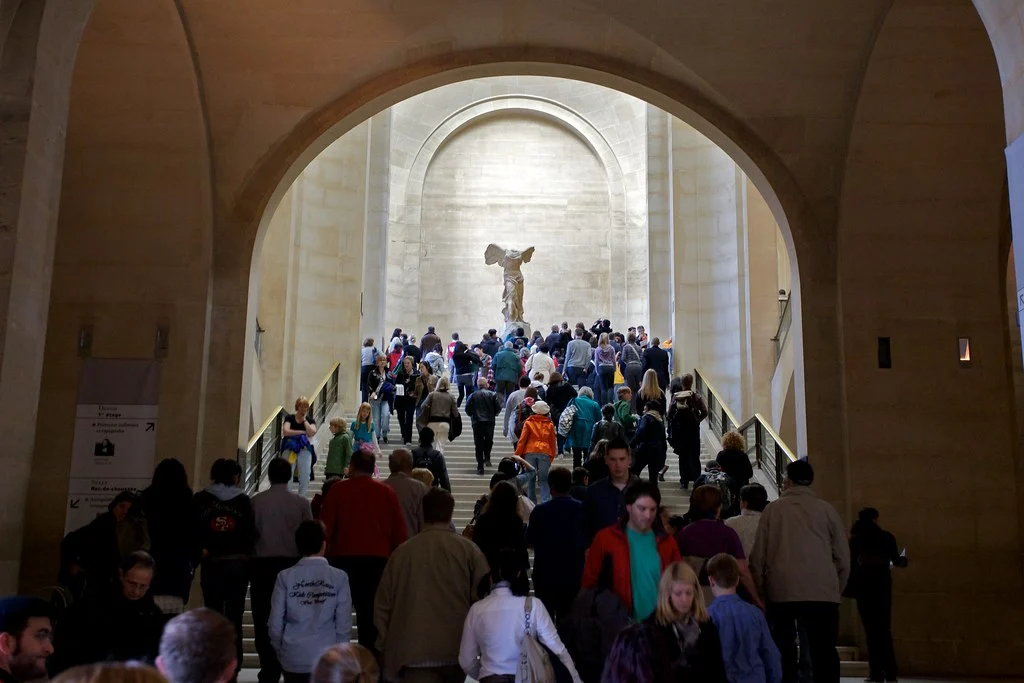
Heading into a dim church or museum where flash is not allowed? Photographing Museums, Churches and Interiors covers handheld bracing and settings for dim interiors.
Aperture for Indoor Photography
Indoors, aperture serves two purposes: controlling depth of field and gathering enough light. In most indoor situations, you will want to shoot with a wider aperture than you would outdoors.
Wide Aperture (f/1.4 to f/2.8)
For portraits, events, and general indoor shooting, open your aperture as wide as your lens allows. f/1.4 to f/2.8 lets in the most light, which keeps ISO manageable and shutter speed fast enough to freeze movement. The shallow depth of field also helps separate your subject from cluttered indoor backgrounds.
The trade-off is that shallow depth of field means precise focus is critical. At f/1.4 indoors, your depth of field may be only 2 to 3 inches deep. Eye AF becomes essential for portraits. For group photos, you will need to stop down to f/4 or f/5.6 to keep everyone in focus, which means higher ISO.
Struggling to keep the eyes sharp at wide apertures? Eye Detection AF explains how it works and when to use it for portraits.
Narrow Aperture (f/8 to f/11)
For product photography, real estate interiors, and any situation where you need everything in focus, use f/8 to f/11. This requires either a tripod (for slow shutter speeds in ambient light) or flash (which provides its own powerful light source). Without a tripod or flash, f/8 to f/11 indoors will require extremely high ISOs that degrade image quality.
Shutter Speed for Indoor Photography
Your shutter speed must be fast enough to freeze both your subject’s movement and any camera handshake. The minimum usable shutter speed depends on what you are photographing:
- Still subjects with stabilization: 1/30s to 1/60s. Your lens or body stabilization can compensate for hand movement, but only if the subject is also still.
- People (posed, casual): 1/125s to 1/200s. People shift, blink, and gesture even when standing still.
- Children or active subjects: 1/250s to 1/500s. Kids move constantly and unpredictably.
- Indoor sports: 1/500s to 1/1000s. Fast action requires fast shutter speeds regardless of light conditions.
The reciprocal rule also applies indoors: your shutter speed should be at least 1/focal length when shooting handheld. With a 50mm lens, use 1/50s or faster. With an 85mm lens, use 1/100s or faster. Image stabilization lets you go 2 to 3 stops slower for static subjects.
ISO: Managing Noise Indoors
ISO is where indoor photography forces the hardest trade-offs. You almost always need higher ISO indoors than you would like. The key is knowing your camera’s limits and accepting appropriate noise levels.
Know Your Camera’s Acceptable ISO Ceiling
Test your camera at various ISOs and determine the highest ISO where you find the image quality acceptable. For most modern cameras, that ceiling is somewhere between ISO 3200 and ISO 12800. Full-frame cameras generally handle high ISO better than crop-sensor cameras, but even entry-level crop sensors produce usable images at ISO 3200.
Once you know your ceiling, set it as the maximum in your Auto ISO settings. This prevents the camera from going higher than you are comfortable with.
Auto ISO: Your Best Friend Indoors
Auto ISO combined with Manual mode is the ideal indoor shooting setup. Set your aperture (for depth of field), set your minimum shutter speed (for motion freeze), and let the camera adjust ISO to maintain proper exposure. As you move between brighter and darker areas of a room, the camera seamlessly adjusts ISO while your aperture and shutter speed stay consistent.
Set the Auto ISO range to something like ISO 100 to ISO 6400 (or your camera’s acceptable ceiling). Set the minimum shutter speed to 1/200s for people or 1/500s for action.
Want the Auto ISO setup worked through? Auto ISO covers how it picks values, the minimum shutter speed setting and the maximum ISO ceiling.
Dealing with Indoor White Balance
Indoor white balance is notoriously tricky because most indoor environments have mixed lighting: warm tungsten lamps, cool fluorescent overheads, daylight from windows, and LED lights that can be any color temperature. Your camera’s Auto White Balance (AWB) does its best, but it can shift between shots as you change composition, creating inconsistent color across a set.
Strategies for Accurate White Balance
- Shoot RAW: This is the most important white balance strategy. RAW files let you adjust white balance in post-processing with zero quality loss. You can try different settings on your computer and pick the one that looks best.
- Custom white balance: Use a gray card or white balance target. Hold it in the scene, take a reference photo, and set your camera’s custom white balance from that image. This gives the most accurate colors but needs to be redone whenever the lighting changes.
- Kelvin preset: If you know the light source, set a specific Kelvin temperature. Tungsten bulbs are approximately 2700K to 3000K. Fluorescent lights are approximately 4000K to 4500K. Daylight from windows is approximately 5500K. This gets you close quickly.
- Auto White Balance + RAW: For events and situations where you move between different lighting zones, use AWB and fine-tune in post. This is what most professional event photographers do.
The Mixed Lighting Problem
The hardest indoor white balance challenge is mixed lighting: a room with warm tungsten lamps and cool daylight from windows. Your subject’s face may be lit by warm light from one side and cool light from the other. No single white balance setting can correct both simultaneously.
Solutions: (1) Turn off one light source if possible, creating consistent lighting. (2) Use flash to overpower the ambient light with a known color temperature. (3) Accept the mix and correct in post by brushing different white balance adjustments onto different parts of the image.
Seeing bands or uneven brightness across frames under indoor lights? Flicker and Banding Under Artificial Light explains why lights flicker and which shutter speeds avoid it.
Scenario-Specific Settings
Indoor Portraits with Window Light
| Setting | Value | Why |
|---|---|---|
| Aperture | f/1.8 – f/2.8 | Let in maximum light; create background blur |
| ISO | 400 – 1600 | Depends on window brightness and time of day |
| Shutter Speed | 1/200s | Freeze subject movement |
| White Balance | Daylight or Auto (shoot RAW) | Window light is natural daylight |
| Subject Position | 2-4 feet from window, facing it or at 45 degrees | Soft, directional light wraps around the face |
Window light is the best free natural light source for indoor portraits. A large window on an overcast day produces soft, even illumination similar to a professional softbox. Place your subject 2 to 4 feet from the window, facing it or at a 45-degree angle. Use a white foam board on the shadow side to fill in dark shadows. Turn off all room lights to avoid mixed color temperatures.
Events, Parties, and Gatherings
| Setting | Value | Why |
|---|---|---|
| Aperture | f/2.8 – f/4 | Wide enough for light; narrow enough for small groups |
| ISO | 1600 – 6400 | Events are often dimly lit |
| Shutter Speed | 1/200s minimum | People move, gesture, and dance |
| Flash | Bounce flash off white ceiling/wall when possible | Creates soft, natural-looking light |
| Drive Mode | Continuous | Capture candid moments between poses |
Bounce flash transforms indoor event photography. Instead of pointing the flash directly at your subject (which creates harsh, flat light and red-eye), angle the flash head up toward a white ceiling. The light bounces off the ceiling and falls on your subject from above, mimicking a large, soft overhead light. The result looks natural rather than “flashy.”
If the ceiling is too high (above 10 feet), too dark, or colored, bounce flash will not work well. Use a flash diffuser attachment, or aim the flash at a nearby white wall. As a last resort, use direct flash with a diffuser dome. The key principle: larger light source = softer light.
Real Estate and Interior Photography
| Setting | Value | Why |
|---|---|---|
| Aperture | f/8 – f/11 | Everything must be sharp from foreground to background |
| ISO | 100 – 400 | Low noise for clean, professional results |
| Shutter Speed | 1/2s – 2s (tripod required) | Long exposure compensates for narrow aperture and low ISO |
| White Balance | Custom or Auto (correct in post) | Mixed indoor lighting requires careful correction |
| Focal Length | 16mm – 24mm (full frame) | Wide angle shows the room, but avoid extreme distortion |
Real estate photography demands sharp, bright, inviting images. Always use a tripod, which allows low ISO and optimal aperture regardless of light level. Turn on all the lights in the room. Open curtains and blinds. Shoot from corner positions at about waist height for the most flattering room perspective.
For the most professional results, shoot brackets (one exposure for the room, one for the window view) and blend them in post-processing. This preserves detail in both the bright window and the darker room interior.
Unsure how to set up the bracketed frames? Bracketing in Photography covers how exposure bracketing works, auto bracketing on your camera and bracketing for HDR.
Product Photography
| Setting | Value | Why |
|---|---|---|
| Aperture | f/8 – f/11 | Sharp detail throughout the product |
| ISO | 100 | Maximum quality for commercial use |
| Shutter Speed | 1/125s with flash; any speed on tripod | Flash freezes everything; tripod allows any ambient exposure |
| White Balance | Flash (5500K) or Custom | Accurate product colors are essential for e-commerce |
Product photography requires absolute accuracy in color and detail. Use continuous lights or flash with softboxes for even illumination. A simple two-light setup with white backgrounds produces clean, professional results. For small products, a light tent or light box provides even, shadow-free illumination with minimal equipment. For detailed guidance, see our product photography guide.
Indoor Sports and Gym
| Setting | Value | Why |
|---|---|---|
| Aperture | f/2.8 (or widest available) | Maximum light gathering for fast shutter speeds |
| ISO | 3200 – 12800 | Gym lighting is often dim; accept noise for sharpness |
| Shutter Speed | 1/500s – 1/1000s | Freeze fast athletic movements |
| Focus Mode | Continuous AF (AF-C / AI Servo) | Track moving athletes |
| Drive Mode | Continuous High | Burst shooting captures peak action moments |
Indoor sports photography is one of the most demanding scenarios. The combination of fast action and dim lighting pushes cameras to their limits. A fast lens (f/2.8 or wider) is almost essential. Set your camera to Continuous AF with dynamic area or tracking mode to follow athletes as they move across the court or field.
Using Flash Effectively Indoors
Flash solves many of the problems of indoor photography. It adds light where natural light is insufficient, freezes motion, and gives you control over both the quality and direction of illumination.
Bounce Flash Basics
The single most important flash technique for indoor photography is bouncing. Tilt your flash head up toward a white ceiling (or sideways toward a white wall) instead of pointing it directly at your subject. The light spreads across the ceiling and falls on your subject as a large, soft light source. The result is natural-looking illumination with gentle shadows.
For bounce flash settings, start with: camera in Manual mode, f/4, ISO 800, 1/200s, flash on TTL (through-the-lens auto). Take a test shot and adjust. If the subject is too dark, increase flash power compensation (+1 EV). If the background is too dark, raise ISO or slow the shutter speed to let in more ambient light.
Balancing Flash with Ambient Light
The most natural-looking flash photos balance flash with ambient (room) light. If your flash overpowers all the ambient light, the image looks “flashy” with a dark background. If you let in more ambient light (by slowing the shutter speed or raising ISO), the background stays visible and the flash fills in the foreground.
A technique called “dragging the shutter” uses a slower shutter speed (1/30s to 1/60s) to expose the background with ambient light while the flash freezes the subject. The flash burst is so brief (1/1000s or faster) that it freezes the subject even at slow shutter speeds. This creates images where the subject is sharp and the ambient environment is visible and warm.
Want to control how much of the room shows behind the flash? Dragging the Shutter covers choosing a shutter speed for the background you want and front versus rear curtain.
Common Indoor Photography Mistakes
1. Using Too Slow a Shutter Speed
The number one indoor photography mistake is motion blur from a slow shutter speed. Your camera’s auto mode will happily select 1/15s or 1/8s, which looks fine on the tiny LCD but reveals blur at full size. Always check your shutter speed and maintain the minimums for your subject type.
2. Leaving ISO Too Low
Many photographers are afraid of noise and keep ISO at 100 or 200 indoors, leading to blurry photos from slow shutter speeds. Modern noise reduction (both in-camera and in software) is excellent. Raise ISO confidently. A sharp photo at ISO 6400 is always better than a blurry photo at ISO 200.
3. Direct On-Camera Flash
Pop-up flash and direct speedlight create harsh, unflattering light: deep shadows behind the subject, shiny foreheads, red-eye, and a “deer in headlights” look. Always bounce your flash off a ceiling or wall, or use a diffuser.
4. Ignoring Mixed Lighting
Shooting under both tungsten lights and fluorescent lights (or daylight and tungsten) creates color casts that Auto White Balance cannot fully correct. Whenever possible, use a single light source type. Turn off overhead fluorescents when shooting by window light. Use flash to overpower mixed ambient.
5. Not Using Available Light Strategically
Many photographers set up in the middle of a room with no regard for where the light is coming from. Look for the strongest, most directional light source in the room (usually a window) and position your subject relative to it. Even in a dimly lit space, one good window can provide beautiful portrait lighting.
Frequently Asked Questions
Can I take good indoor photos without flash?
Absolutely. Use a wide-aperture lens (f/1.4 to f/2.8), raise ISO as needed, and position your subjects near the best available light source (windows, open doors). Window light produces some of the most beautiful indoor photos. A fast prime lens (50mm f/1.8 is affordable and excellent) is the single best investment for no-flash indoor photography.
What is the best lens for indoor photography?
A 35mm f/1.4 or 50mm f/1.8 is ideal for most indoor situations. The wide aperture lets in plenty of light, and the focal length is versatile enough for both portraits and room shots. For events, a 24-70mm f/2.8 zoom provides flexibility. For tight spaces, a 24mm or 35mm prime works well.
How do I avoid orange/yellow casts in indoor photos?
Most indoor lighting is warm (tungsten or warm LED), which creates an orange cast. Set your white balance to Tungsten (approximately 3200K) to neutralize it. Better yet, shoot RAW and adjust in post-processing. If using flash, gel the flash with a CTO (Color Temperature Orange) gel to match the room lighting, then set white balance to Tungsten. This corrects both the flash and ambient light simultaneously.
Should I use image stabilization indoors?
Yes, image stabilization (IS/VR/IBIS) helps for handheld indoor shooting with static subjects. It compensates for camera shake and can gain you 2 to 4 stops of shutter speed. However, it does not freeze subject movement. If your subject is a moving person, you still need a fast shutter speed (1/200s or faster) regardless of stabilization.
Try This: Practice Exercises
Exercise 1: The ISO Noise Test
Set up a still life or photograph a willing subject indoors. Take the same photo at ISO 400, 1600, 3200, 6400, and 12800 (adjusting shutter speed to maintain the same exposure). Compare the images at 100% zoom on your computer. Identify the highest ISO where the image quality is still acceptable to you. This is your personal ISO ceiling, and knowing it gives you confidence to push ISO when needed.
Exercise 2: Bounce Flash Comparison
Photograph the same subject with flash in three ways: (1) direct flash pointed straight at the subject, (2) flash bounced off the ceiling, and (3) flash bounced off a side wall. Compare the shadow quality, skin tones, and overall look. You will immediately see why bounce flash produces dramatically better results.
Exercise 3: Window Light Exploration
Choose a room with one large window. Photograph a subject at different positions relative to the window: facing the window (flat front light), at 45 degrees (classic portrait light), at 90 degrees (dramatic side light), and with the window behind them (backlight/silhouette). Observe how the same room produces completely different moods depending on your subject’s position relative to the light.
Related Resources
- Understanding ISO – Managing noise in low-light indoor conditions
- Aperture Guide – Depth of field control for indoor subjects
- Flash Photography Guide – How flash works, TTL versus manual, bounce flash, and flash exposure compensation
- Natural Light Photography – Make the most of window and ambient light
- Photography Lighting – Complete lighting guide for all situations
- White Balance Guide – Solve indoor color temperature problems
- The Exposure Triangle – How aperture, shutter speed, and ISO interact
- Portrait Settings Guide – Detailed settings for indoor and outdoor portraits
- Food Photography Guide – Indoor food photography techniques