Few animals look as ancient and powerful as a bison standing in open grassland. Their dark shaggy shapes, steaming breath on cold mornings and slow, heavy movement make them wonderful subjects for beginners, and in many parks and preserves they are easier to find than almost any other large wild animal. The challenge is not finding bison but photographing them well and safely.
This guide covers where and when to find bison, why distance matters so much, how to work with light, dust and frost, how to photograph herds and single animals, the behavior worth watching for, settings and editing. For broader wildlife skills, see the guide to wildlife photography, and for settings across many animals, see the best camera settings for wildlife.
Why bison make great subjects
Bison combine size, character and setting in a way few animals can match, which is why so many people want to photograph them.
- They are big and visible. A bison is easy to spot across a valley, so you spend more time photographing and less time searching, which is ideal when you are still learning.
- They move slowly most of the time. Grazing bison give you time to think about composition, light and background instead of rushing every frame.
- They live in beautiful places. Bison are usually found in wide grasslands, river valleys and mountain meadows, so the landscape around them is part of the picture.
- They have texture and mood. Thick winter coats, curved horns, frosty backs and clouds of breath give bison pictures a strong, timeless feel.
Because they are so visible, bison also teach patience in a gentle way. You can watch one animal for half an hour, learn its rhythm and wait for a better moment without worrying that it will vanish into the trees.
Where to find bison
Wild and semi-wild bison live mostly in protected areas: large national and state parks, grassland preserves and wildlife refuges. Some ranches also raise bison, and a few allow visitors or can be photographed from public roads. Before a trip, read the park or preserve website for herd locations, road conditions and viewing rules, and ask rangers or staff where animals tend to gather.
Within a park, bison tend to gather where grass is good: river valleys, open flats, gentle hillsides and the edges of lakes. In winter they often stay near thermal areas or windswept slopes where snow is thinner. Roads through these areas usually offer pullouts where you can stop safely and watch from a distance. The guide to photographing national parks has more advice on planning a park visit.
Learning the herd’s routine
Herds move during the day, often grazing in one area in the morning, resting in the middle of the day and moving to water or new grass in the afternoon. Spend the first visit simply watching and noting where they go. On later visits you can be in position before they arrive, with the light where you want it, rather than chasing them along the road.
Safety and distance come first
Bison look slow and calm, but they are large wild animals that can run faster than a person and can turn without warning. Many parks set minimum distances, often around twenty-five yards or more, and that distance is a minimum, not a target. Treat every bison as unpredictable.
- Use a long lens instead of your feet. A telephoto lets you fill the frame from far away. If the animal looks at you, stops eating or moves away, you are too close.
- Never get between bison. Avoid standing between a cow and her calf, between a herd and water or between a bull and other animals.
- Watch the tail. A raised tail, pawing, head shaking or snorting are warning signs. Back away slowly.
- Stay near your vehicle. In many parks the car is the safest place to photograph from. Pull fully off the road and keep the engine off to reduce vibration.
- Give them the road. Bison often walk along roads. Stop, wait and let them pass. Never honk, crowd or follow them.
Distance also makes better pictures. Bison that feel safe keep grazing, rolling and walking naturally, and those relaxed moments are the ones worth having. The guide to telephoto photography explains how longer lenses help at a respectful distance.
When to go
Bison are active all day, but light changes everything. Early morning and the last hour before sunset give warm, low light that brings out texture in their coats and turns dust and breath into glowing clouds. Midday light is harsh and flat on dark fur, but it can still work for herd patterns from a distance or under thin cloud.
Each season has its own character:
- Spring brings orange calves, often called red dogs, playing near their mothers, along with patchy shedding coats.
- Summer is the rut in many regions, with bulls bellowing, wallowing in dust and following cows. It is dramatic but calls for extra distance.
- Autumn offers golden grass and calmer animals in thick fresh coats.
- Winter gives the most atmospheric pictures: frost on backs, snow on faces and breath steaming in the cold. See the winter photography guide for exposure and battery tips.
Hoping to catch bison in warm first light? The guide to golden hour photography explains how to plan around the best light of the day.
Exposing for dark fur
Bison are mostly dark brown, and dark subjects fool camera meters. When a bison fills much of the frame, the camera tries to make it a middle gray and overexposes the scene, washing out the sky and grass. When a bison stands against snow, the opposite happens and the animal turns into a black shape.
Check your histogram and highlight warnings after the first few frames. For a large dark animal against grass, dialing in a little negative exposure compensation often keeps detail in the bright areas. Against snow, add positive compensation so the snow stays white and the fur keeps some detail. If the eye is lost in shadow, wait for the head to turn toward the light rather than brightening the whole frame. The guide to exposure compensation explains how this works.
Finding the eye
A bison’s eye is small and dark and sits inside a mass of dark fur, so it can be hard to see. Yet a picture with a visible catchlight in the eye feels alive, while one without it can look like a dark rock. Wait for moments when the animal lifts its head and the light catches the eye, and focus there. Back-button focus or a single focus point placed on the eye helps your camera find it.
Light, dust and breath
Some of the best bison pictures are about atmosphere rather than the animal alone. Low sun behind a herd lights up dust kicked up by hooves, creating a warm haze that glows gold. On cold mornings, backlight turns breath into bright clouds and outlines the fur with a rim of light.
To work with backlight, position yourself so the sun is behind or beside the animals, shade the lens with your hand or a hood and expose for the bright areas. The bison may become near silhouettes, which can be beautiful when the shapes are clear and separate. Side light, from the left or right, is the best choice for texture, showing every curl in the coat and the shape of the horns.
Bison that roll in dry dirt, called wallowing, throw up big dust clouds. These moments are fast, so keep the camera ready and use a short burst. A wallowing bull in low evening light is one of the classic pictures of open country.
Herds and single animals
A herd offers two kinds of pictures: the pattern of many animals and the portrait of one. Try both on every outing.
Photographing the herd
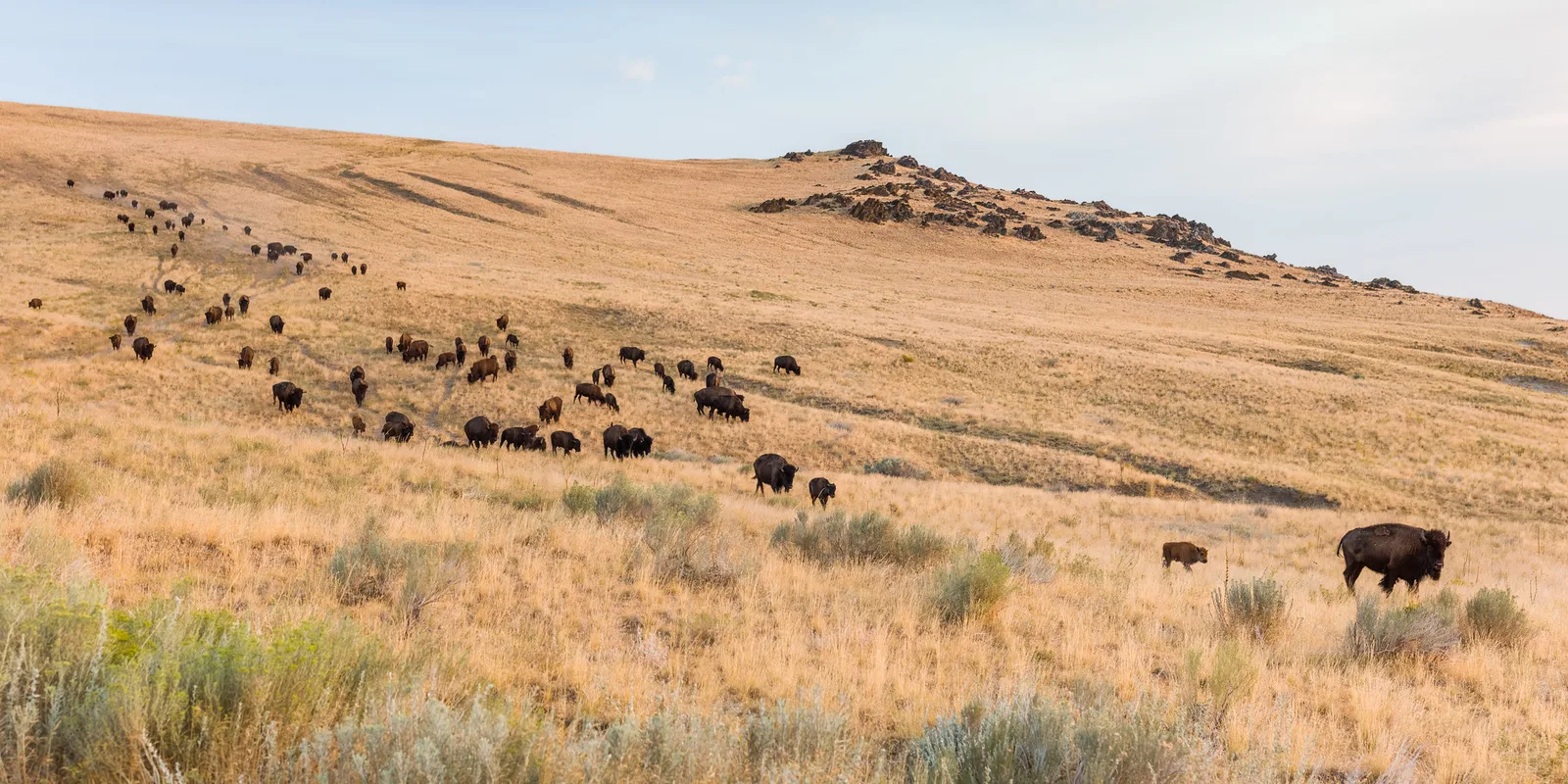
Herds moving across a hillside or along a river make natural lines. Look for a higher viewpoint so the animals separate and the line of bodies leads the eye through the frame. The guide to leading lines shows how to use these shapes. Odd numbers of animals in a small group often feel more balanced, as explained in the guide to the rule of odds. Wait for gaps between animals to even out so legs and heads do not merge into one dark mass.
Photographing one bison
For a portrait, pick one animal with a clean background, such as open grass, a distant hillside or snow. Get as low as safety allows, ideally from a car window or a pullout lower than the animal, so the bison towers in the frame. Fill the frame with the head and shoulders, or show the whole body with a little space in front of the face so it has room to look into.
Bison in the landscape
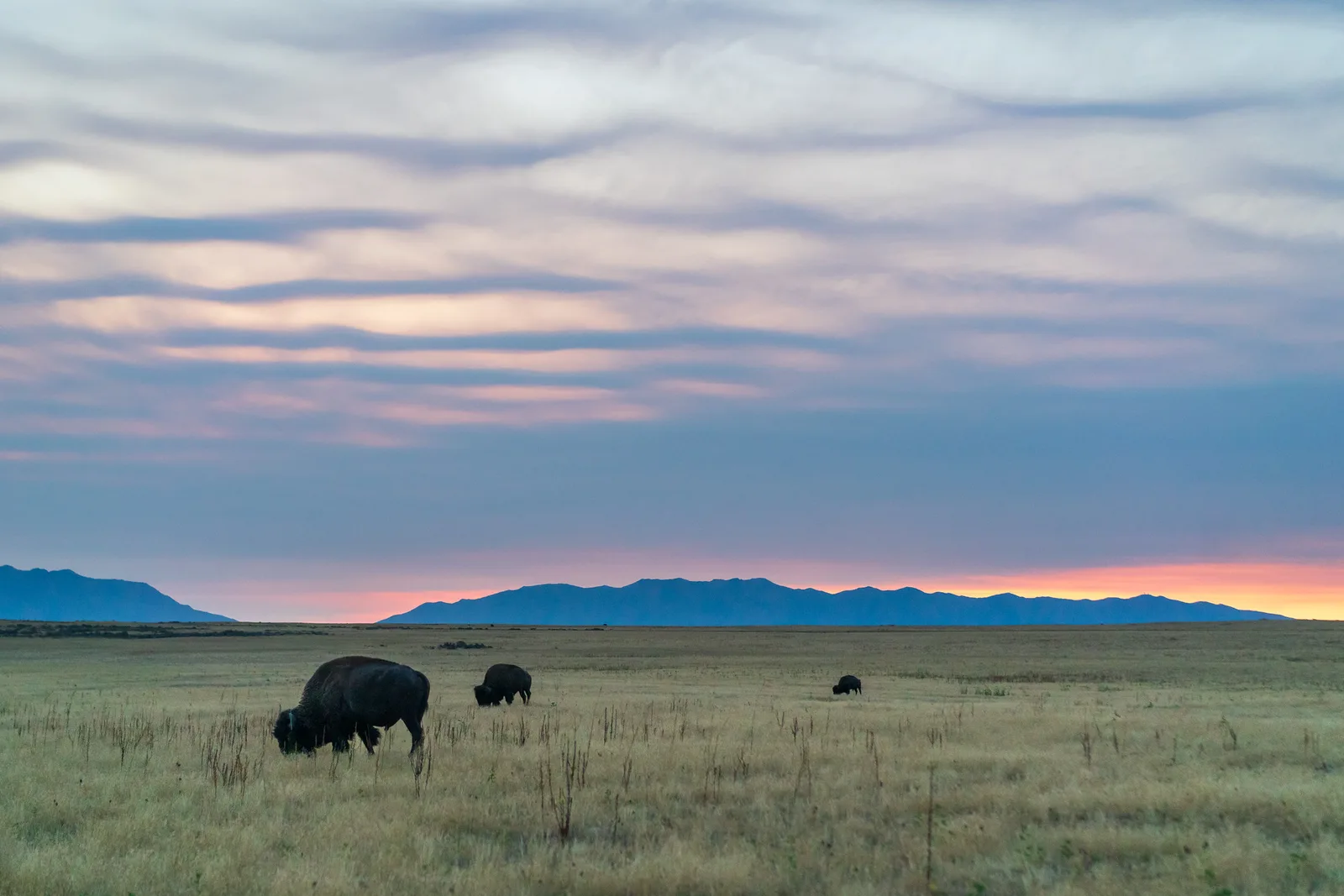
Because bison are so large and so tied to open country, they work beautifully as a small part of a big scene. A single animal on a ridge against storm clouds, a herd under a pink evening sky or bison spread across a snowy valley tell a story about space and wildness that a close portrait cannot.
Use a shorter lens or zoom out and place the animal on a third of the frame, with the landscape filling the rest. Watch the horizon, keep it level and make sure the animal stands clear of trees and rocks behind it. Leave room in front of the bison in the direction it faces or walks. The guide to landscape photography helps with composing wide scenes.
Behavior worth watching for
Patience turns ordinary bison pictures into memorable ones. Watch for these moments, and keep the camera ready when you see the signs.
- Wallowing. A bison drops and rolls in the dirt, often after pawing the ground. Dust flies, and the animal rises covered and shaking.
- Calves with mothers. Young calves nurse, play and run in short bursts. Keep extra distance from mothers.
- Bulls during the rut. Bellowing, head swinging and sparring are dramatic but need the most distance of all.
- Snow feeding. In winter, bison sweep snow aside with their heads to reach grass, leaving frosted faces.
- River crossings. Herds wading through water create splashes and reflections.
- Shaking off. After rain, snow or dust, a bison shakes its whole coat in a quick spray.
Use a short burst for action and a slow, careful single frame for calm grazing. Over time you will learn to anticipate each behavior.
Settings for bison
Bison move slowly, so settings can be forgiving, but these give a good start:
- Shutter speed: 1/500 second for grazing and walking animals, 1/1000 second or faster for running, wallowing or sparring.
- Aperture: a wide aperture such as f/5.6 to blur the background for portraits, f/8 to f/11 for herds and landscapes so more is sharp.
- ISO: auto ISO with a sensible upper limit, so the camera keeps your chosen shutter speed in changing light.
- Focus: continuous autofocus with a single point or small zone on the eye or head.
- Drive: a short burst for action.
- Support: a beanbag on the car window or a monopod keeps a long lens steady.
Shoot in raw if your camera allows it. Dark fur against bright sky or snow has a wide range of tones, and raw files give more room to recover both.
Editing bison photos
Keep editing simple and natural. Lift shadows gently to show detail in the coat, bring highlights down in the sky or snow and add a little clarity or texture to fur if it helps. Avoid pushing color too far: bison should stay a warm dark brown, not orange or gray. Crop to give the animal room to look into, and straighten the horizon. For wide scenes, a subtle graduated adjustment can balance a bright sky with darker grassland.
Want a clear routine for editing your wildlife pictures? The guide to photo editing for beginners walks through the basic steps in order.
Ethics and responsibility
Bison have survived great losses, and many herds exist only because of careful protection. Photograph them in a way that respects that. Follow park rules, keep your distance, never feed or bait animals and never try to move a bison for a better picture by making noise or walking toward it. Stay on roads and paths where asked, and park only in pullouts so traffic and other visitors can pass safely.
If other photographers are crowding an animal, step back rather than joining in. A respectful picture taken from far away is worth more than a close one that put you, the animal or other people at risk. Share what you have learned about safe viewing when friends ask how you got the shot.
Curious about photographing other large animals in the wild? The guide to safari photography covers vehicles, long lenses and dust in open country.
Common mistakes
- Getting too close. The biggest mistake, and a dangerous one. Use a longer lens or crop instead.
- Losing the eye. A bison with no visible eye looks like a dark shape. Wait for the head to turn toward the light.
- Blown skies and snow. Dark fur fools the meter. Check the histogram and adjust exposure compensation.
- Merged animals. In herds, bodies overlap into one dark mass. Wait for gaps or find a higher viewpoint.
- Shooting from standing height every time. A lower angle makes bison look more powerful.
- Only taking close portraits. Step back and include the land, sky and weather that make bison country special.
- Leaving at midday and missing the evening. The best light often comes in the last hour, so plan to stay.
Try this: a 10-minute bison study
Next time you find a herd from a safe pullout, give yourself ten minutes and three tasks:
- Minutes one to three: watch without shooting. Notice which animals are moving, where the light falls and what is behind them.
- Minutes four to six: photograph one animal with a clean background, focusing on the eye and leaving room in front of the face.
- Minutes seven to ten: zoom out and make one picture that shows the herd or a single animal small in the landscape.
At home, compare the close and wide pictures. Many people find the wide one tells more about the place and the animal than expected.
Frequently asked questions
How close can I get to bison?
Follow the minimum distance set by the park, often twenty-five yards or more, and stay farther if the animal reacts to you. A long lens or crop is always safer than moving closer.
What lens is best for bison?
A telephoto zoom reaching 300mm or more works well for portraits. A shorter zoom is useful for herds and landscapes, since bison are large and often close to roads.
What is the best season for bison photography?
Each season offers something different. Spring has calves, summer has the rut in many places, autumn has golden grass and winter has frost and steam.
Can I photograph bison from my car?
Yes, and it is often the best option. Pull fully off the road, turn off the engine and rest the lens on a beanbag or folded jacket on the window frame.
Why do my bison photos look too bright or too dark?
Dark fur fools the camera meter. Use exposure compensation and check the histogram, especially when the animal fills the frame or stands against snow.
How do I photograph bison in snow?
Add positive exposure compensation so the snow stays white, protect batteries from the cold and look for breath, frost and snow on faces.
For terms such as telephoto lens, exposure compensation, histogram and burst mode, see the photography glossary.