Photography theory is a set of ideas about what a photograph is, how it produces meaning and what it does to the people in front of and behind the camera. You do not need it to take a sharp picture, but a handful of its ideas, from the photograph as a trace of the real to Barthes’ punctum and Berger’s point about context, will change what you notice, what you keep and how you present your work. Each idea below comes with the practical habit it leads to.
Why theory helps someone who takes pictures
Most photography advice is about making: exposure, light, composition. Theory is about what happens after the shutter closes, when a stranger looks at the result. That is where many good-looking photographs fail. They are well made but say little, or they say something the photographer never intended.
The writers here were not giving tips, and several of them were not photographers at all. But each noticed something true about how photographs work, and a true idea about the medium is a tool. If the visual literacy guide teaches you to read a picture element by element, theory explains why those elements carry the weight they do. It also gives you better language for critique, because “this has a strong punctum” or “the frame is doing the talking here” is more useful than “I like it.”
Everything below is paraphrased. The original books are short and readable, and worth your time once you know what to look for in them.
The photograph as a trace of the real
The philosopher Charles Sanders Peirce sorted signs into three kinds. An icon resembles its subject, as a drawing of a tree resembles a tree. A symbol stands for its subject by agreement, as the word “tree” does. An index is physically caused by its subject, as smoke is caused by fire or a footprint by a foot. Peirce pointed out that a photograph is an index as well as an icon: light actually travelled from the scene and changed the film or sensor. Later, the critic Roland Barthes described the essence of a photograph as the viewer’s certainty that the thing in it was really there in front of a camera at some moment.
That physical connection is why photographs are believed in a way paintings are not. A viewer who sees a photograph of a flooded street assumes a street really flooded. This belief is the raw material of every photograph you make, and three habits follow from it:
- Treat trust as something you can spend. Obvious manipulation breaks the viewer’s belief and with it most of the picture’s power. If you composite or heavily alter an image, you are making a different kind of picture, and you should present it as one.
- Look for traces in the world. Footprints in snow, a worn step, a shadow on a wall, a handprint on glass: pictures of traces double the effect, because they show evidence of evidence.
- Remember that time passes. Every photograph of a person or place records something that will change. Family snapshots gain weight for exactly this reason, and so does a plain picture of your street.
Szarkowski’s five qualities of a photograph
The curator John Szarkowski put together an exhibition and book called The Photographer’s Eye that tried to describe what is distinctly photographic about photographs, whether made by a famous artist or an unknown amateur. He grouped his observations under five headings. They make an excellent checklist, because each is a decision you actually control.
The thing itself
Photography deals with the actual world, and the world is stranger and more detailed than anything a photographer could invent. Szarkowski noted that photographers learned to respect this, and that viewers tend to take a photograph for the thing itself. Takeaway: before you reach for effects, ask whether the subject is interesting enough on its own. Often the strongest move is to show a real thing very clearly.
The detail
A photographer can rarely tell a whole story in one frame, because the camera only records fragments. What photography does instead is isolate details that come to stand for something larger: a clenched hand, a single shoe on a road. Takeaway: when a scene is too big or complicated to explain, find the one detail that carries its meaning, and fill the frame with it.
The frame
A painter starts with an empty canvas and adds. A photographer starts with the whole world and subtracts. Choosing the edges is the central act of photography, because the frame creates relationships that did not exist before: two strangers become a pair, a sign becomes a comment on the person under it. Takeaway: before pressing the shutter, trace the four edges of the viewfinder with your eye and ask what each one cuts, includes or joins. The framing guide covers the mechanics.

Time
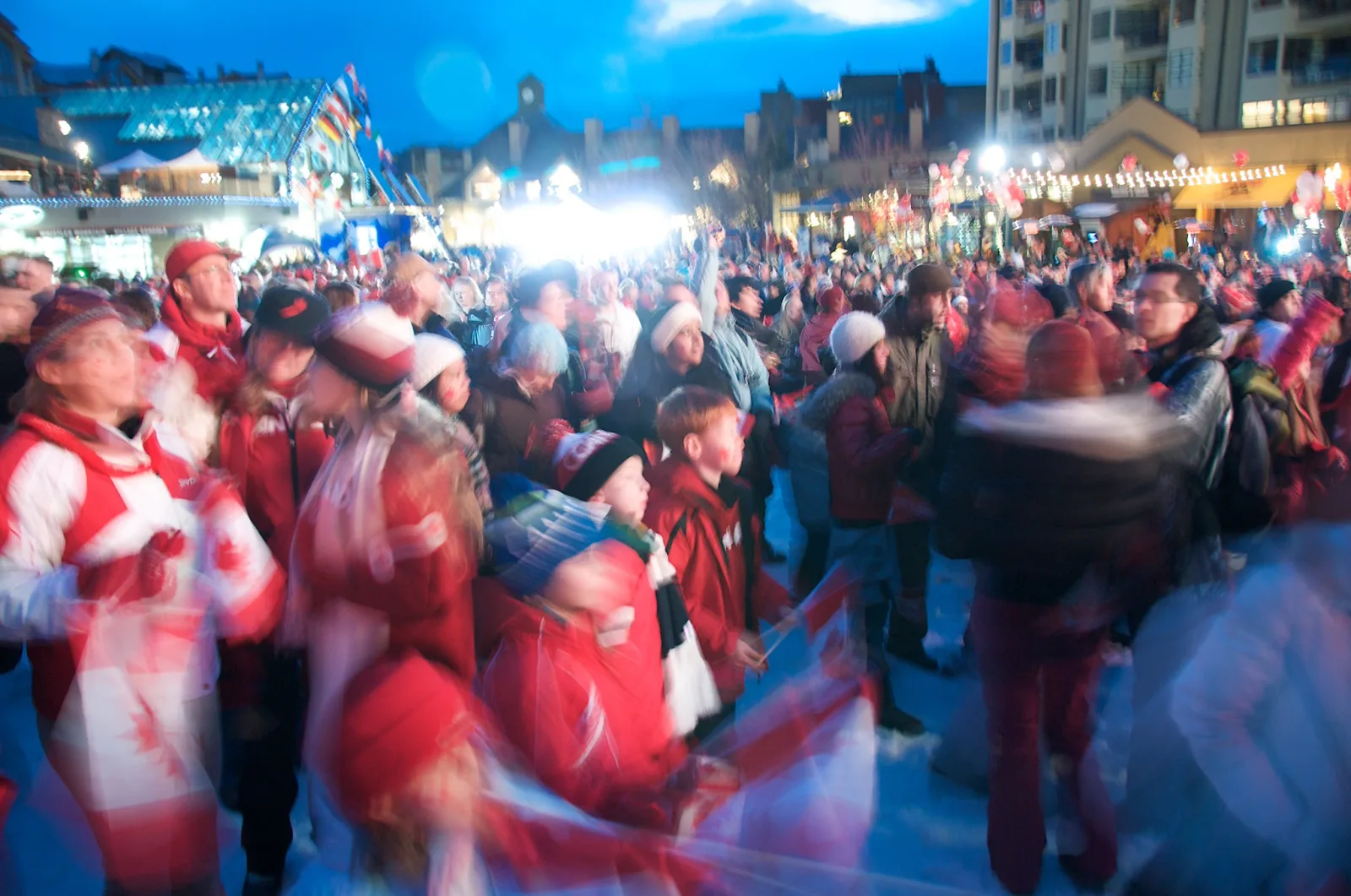
Every photograph describes a slice of time, from a thousandth of a second that freezes a splash to many seconds that turn traffic into streaks of light. Photography revealed moments no one had seen, and also the particular look of time passing. Takeaway: treat shutter speed as a statement about time, not only an exposure setting. Ask whether your subject is best shown as a frozen instant, the peak of a gesture (the idea behind the decisive moment), or as a flow.
Vantage point
Photographers discovered that the world looks different from unusual positions: high above, very low, too close, from behind. Where you stand is a choice of meaning, not just of convenience. Takeaway: never accept the first spot you happened to arrive at. Move before you zoom. The photography angles guide shows how height and direction change the way a subject reads.

Studium and punctum: why some details stick
In his short book Camera Lucida, Roland Barthes tried to explain why a few photographs affected him deeply while most merely interested him. He named two elements.
The studium is the general, cultural interest a photograph offers: the subject, the history, the information, the skill. It is what you appreciate politely. You might find a news photograph of a market or a street protest interesting because of what it shows and when it was made. The studium is shared; most educated viewers will respond to it in similar ways.
The punctum is a detail that pierces a particular viewer, often something small and unplanned: a pair of shoes, a crooked finger, a necklace. Barthes insisted that the punctum is personal and usually not intended by the photographer. Later in the book he describes a second kind of punctum, time itself: the ache of knowing that the person in an old photograph is going to die, or has.

You cannot manufacture a punctum, but you can make room for one:
- Do not clean every frame to sterility. The incidental detail you are tempted to clone out may be the thing that makes the picture live. Remove distractions that pull the eye for no reason, but keep details that feel specific and human.
- Edit for your own punctum. When culling, notice which frames you keep returning to and find the detail that holds you. That detail tells you what your pictures are really about.
- Ask viewers what they remember. Show a set of pictures, take them away, and ask what someone recalls. The answers are rarely the main subject, which is exactly the point.
The psychology of photography guide looks at the related question of why images trigger emotion and memory in the first place.
Sontag: what the camera does to looking
Susan Sontag’s essays collected in On Photography are sceptical about the medium. She argued that photographing something is a way of taking possession of it, turning experience into an object you can collect. She observed that tourists often use the camera to manage the unease of being somewhere unfamiliar, and that photographing an event can be a way of taking part in it while remaining outside it. She also worried that a constant flow of images of suffering could dull the viewer’s response. In a later book, Regarding the Pain of Others, she questioned parts of that last claim and argued that such images still have a role, even if they cannot by themselves make us understand.
You do not have to agree with Sontag to use her questions. They are practical ethics for anyone with a camera:
- Are you looking, or collecting? At a festival or a famous view, put the camera down for five minutes first. You will see more, and the pictures you then make will be chosen rather than grabbed.
- What is your relationship to the person in front of you? Photographing someone in distress, a stranger in a poor neighbourhood or a person from a different culture raises questions of consent and dignity. The photography ethics guide goes into detail.
- What will this image do when it is seen? A picture of suffering can inform, move, exploit or simply numb. Context, caption and audience decide which, and that leads directly to Berger.
Berger: context changes meaning
John Berger’s Ways of Seeing, first a television series and then a small book, starts from the idea that seeing comes before words, yet what we know and believe shapes what we see. His most famous demonstration uses a painting of a wheatfield with birds by Vincent van Gogh. You look at it first with no caption. Then you are told it was the last picture he painted before he killed himself, and the same image suddenly reads differently. Nothing in the picture changed; only its context did.
Berger applied the same thinking to photographs. In a later essay he distinguished private photographs, which stay within the lives of the people who know the subject and so keep their meaning, from public photographs, which are cut loose from their original context and can be made to mean almost anything by whoever publishes them.
For a photographer, this is the most usable idea in theory, because you control the context:
- Captions change pictures. Write two different captions for the same image and notice how each changes what a viewer sees. Then write the true one carefully. The guide to writing photo captions covers how.
- Sequence changes pictures. An image placed after a picture of a wedding reads differently from the same image placed after a picture of a funeral. When you build a photo essay or sequence pictures for a book or website, you are writing with context.
- Public images escape you. Once a photograph is shared, anyone can re-caption it. Consider how an image of a person could be misused before publishing it.
Truth and the edited frame
Put Peirce and Berger together and you reach the central tension of the medium: a photograph is physically connected to reality, yet every photograph is also a set of choices. Even an unedited file is an argument. The frame excludes, the moment selects, the lens and viewpoint shape relationships between things.
A concrete example: shoot a crowd on a beach from far away with a long focal length, and people at very different distances appear packed together, because their distances from each other are small compared with their distance from you. The picture is not faked, yet it can suggest a crowding that someone walking among them would not feel. Step closer with a wide lens and the same beach looks spacious. Both are real; neither is the whole truth.
The practical answer is to know which agreement you are working under and honour it:
- Documentary and news work: viewers expect the picture to represent what happened. Adjust exposure, colour and contrast only as far as a darkroom printer would have, never add or remove content, and caption accurately. Photojournalism covers the norms.
- Personal and travel work: viewers assume a reasonable honesty. Removing a stray bit of litter is usually accepted; adding a moon that was not there, without saying so, is not.
- Illustration and fine art: anything goes, as long as you do not present the result as a record. The retouching ethics guide discusses where the lines usually fall.
Common mistakes
- Using theory as decoration. Dropping “punctum” into a caption does not deepen a picture. Fix: use each idea as a question you ask while shooting or editing, not as a label you add afterwards.
- Trying to design a punctum. Planting a quirky object in a staged scene usually reads as a gimmick. Fix: shoot real situations generously and find the punctum later, in the edit.
- Assuming an unedited photo is neutral. Framing, timing and lens choice already shape the meaning. Fix: before publishing, ask what the picture implies that was not true on the scene, and adjust the caption or selection.
- Taking a single theorist as gospel. Sontag, Barthes and Berger disagreed with each other and with themselves. Fix: read them as sharp observers raising questions, not as rulebooks.
- Ignoring context after the shoot. Many photographers think carefully about the frame and then post it with no caption in a random order. Fix: decide the caption, the neighbouring images and the audience as deliberately as the exposure.
Try this
Five qualities, one walk (30 minutes). Walk a single street or park and make exactly five photographs, one for each of Szarkowski’s qualities:
- The thing itself: one ordinary object shown as clearly and plainly as possible.
- The detail: one fragment that suggests a larger story about the place.
- The frame: one picture where the edges create a relationship between two things that were not connected before.
- Time: one picture where the shutter speed is the point, frozen or blurred.
- Vantage point: one picture from a position you would normally never stand in.
At home, look at the five together. Write one caption for the strongest image, then a second, misleading caption, and notice how much the words shift what you see. Finally, name the small detail in any of the five that holds your eye longest. That is your punctum, and a clue to what you should photograph more.
Frequently asked questions
Do I need to read photography theory to be a good photographer?
No. Many excellent photographers never read it. But the ideas are shortcuts to things experienced photographers learn slowly: that the frame creates meaning, that captions and context change pictures, and that small details carry emotion.
Which photography theory book should I read first?
Szarkowski’s The Photographer’s Eye is the most practical, because it is mostly pictures grouped by the five qualities. Berger’s Ways of Seeing is the quickest to read. Barthes’ Camera Lucida and Sontag’s On Photography are more demanding and more personal, and they reward a second reading.
What is the difference between studium and punctum in simple terms?
The studium is why a photograph interests you in general. The punctum is the small detail that gets to you personally. One is shared by most viewers; the other is individual and usually accidental.
Is it dishonest to crop or edit a photograph?
It depends on what the viewer is led to believe. Cropping to tighten a composition is normal. Cropping or editing to change what happened, such as removing a person from a news picture, is dishonest in documentary work. The test is whether the edit changes the facts the picture seems to report.
Related guides
- Visual Literacy in Photography: a step-by-step method for reading any photograph.
- How to Critique Photography: a framework for turning these ideas into useful feedback.
- The Psychology of Photography: why images move viewers, from attention to memory.
- Photography Etiquette and Ethics: the everyday ethics behind Sontag’s questions.
- Photography Movements: how groups of photographers turned beliefs like these into distinct styles.
- How to Write Photo Captions: putting Berger’s point about context into practice.
- How to Create a Photo Essay: building meaning through selection and sequence.