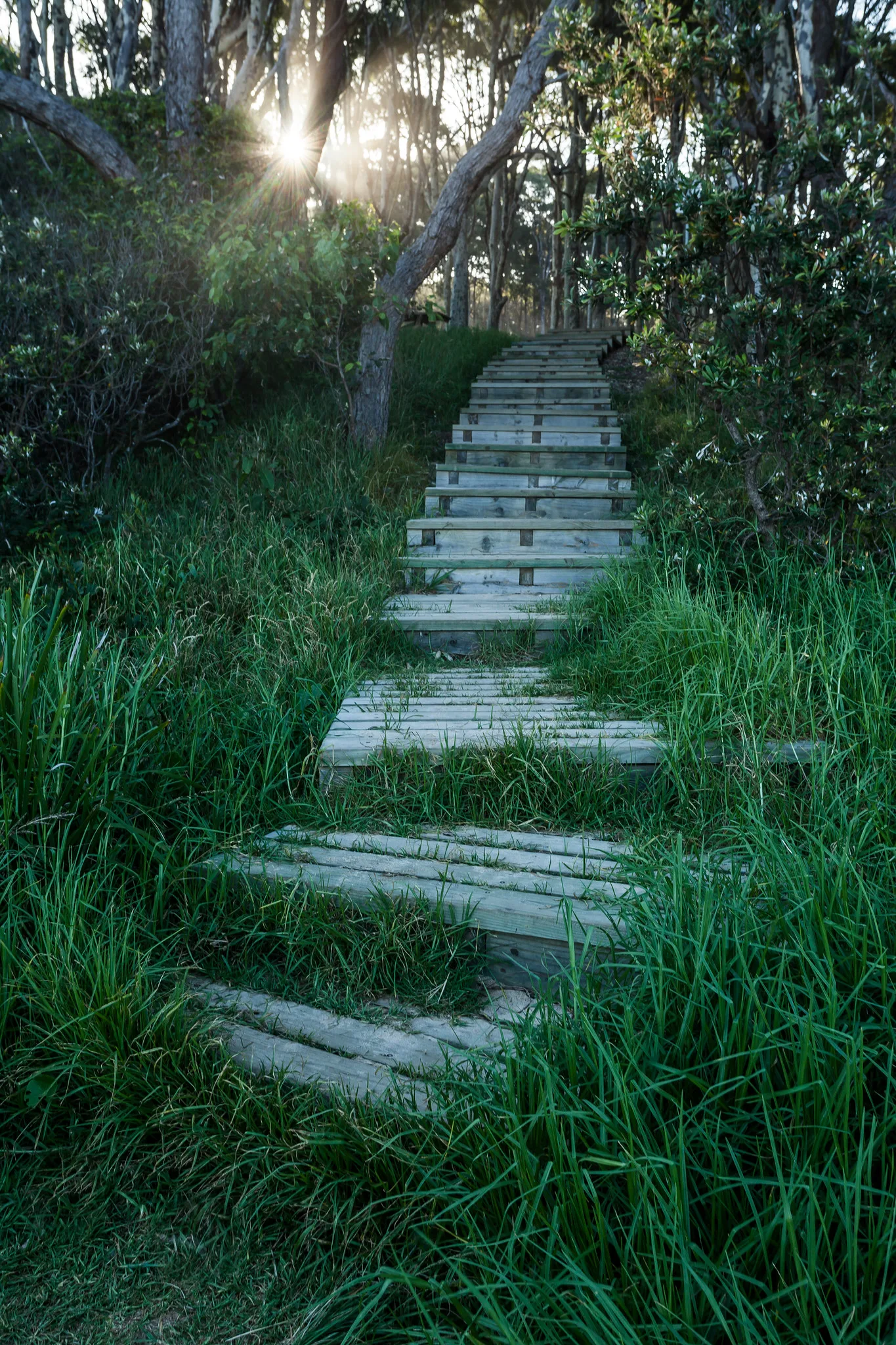
Stairs are one of the most rewarding subjects in architecture and everyday life. A spiral staircase coiling like a seashell, a grand flight of stone steps sweeping up to a doorway, a narrow stairwell glowing with light at the bottom and a rough wooden path climbing through the grass all make striking pictures. Stairs are full of rhythm, line and shadow, and they carry a natural sense of movement, leading the eye up or down and suggesting a journey.
This guide covers why stairs make great subjects, spiral staircases, looking up and looking down, stairs as leading lines, grand and public stairs, stairwells and fire escapes, outdoor steps and paths, light and shadow, people on stairs, black and white and abstracts, settings, phones and editing. For indoor spaces, see the guide to interior photography, and for balanced, mirrored compositions, see the guide to symmetry.
Why stairs make great subjects
Stairs bring together many of the building blocks of strong composition.
- Repetition. Step after step makes a natural rhythm that the eye loves to follow.
- Lines. Handrails, edges and walls make strong leading lines.
- Curves. Spiral and curved stairs make graceful, flowing shapes.
- Light and shadow. Each step catches light on top and casts shadow below, creating bold stripes.
- Story. Stairs suggest movement, ambition, arrival, mystery and discovery.
Stairs are found everywhere: in homes, offices, stations, museums, parks, hillsides and old towns. They range from humble concrete steps to grand works of design, and each offers new ways to see. Learning to photograph stairs teaches you to see line, pattern and light more clearly in every subject.
Spiral staircases
Spiral staircases are among the most photographed architectural features in the world, and for good reason. Their curves create hypnotic, shell like shapes that seem to pull the viewer in.
- From below. Stand at the bottom in the center, point the camera straight up and capture the spiral winding toward the skylight.
- From above. Look down from the top over the rail, and the spiral becomes a coil descending into the depths.
- Center precisely. Line up the center of the spiral with the center of the frame for perfect symmetry.
- From the side. A side view shows the curve of the handrail and the steps fanning out.
A wide lens fits more of the spiral into the frame. Hold the camera very level when shooting straight up or down, and use the grid lines to center it. Spirals also suit the golden spiral, a curving guide explained in the guide to the golden ratio.
Finding spiral stairs
Spiral stairs are often found in lighthouses, towers, old castles, churches, museums, libraries, hotels and grand public buildings. Many are open to visitors, and some are famous enough to have queues. Visit early or late to avoid crowds, and ask staff whether photography is allowed. Even small spiral stairs in shops and homes can make lovely pictures when photographed from directly below or above. Watch for a patterned floor at the bottom, which can become the center of the spiral.
Looking up and looking down
The direction you look changes everything.
- Looking up. Stairs rising above you feel grand, imposing and aspirational. A low angle makes them look even taller.
- Looking down. Stairs falling away below feel dramatic, mysterious or even dizzying.
- Straight on. Facing a flight of stairs head on shows the full rhythm of the steps.
- From the side. A side view shows the zigzag profile of the steps, which makes a bold graphic shape.
Try every direction at the same staircase, and you will be surprised how different each picture feels. Stairwells in tall buildings, seen from the top floor looking down, can make remarkable geometric patterns.
Stairs as leading lines
Stairs are natural leading lines. They pull the viewer’s eye along the steps, up toward a doorway, down toward a street or along a path to a view.
- Lead to something. Let the stairs point toward a door, a light, a person or a landmark.
- Use handrails. Railings make strong lines that converge toward the top or bottom.
- Center the stairs. A central flight with symmetrical walls creates a powerful pull.
- Use diagonals. Shooting from the side turns the stairs into a strong diagonal across the frame.
A stairwell that leads to a lit doorway, or a path of steps that climbs toward the sun, gives the viewer a destination. That sense of journey is what makes stair pictures so engaging. Even a plain set of concrete steps can feel meaningful when it leads toward something bright or unknown.
Want to make stairs and other lines guide the eye? The guide to leading lines explains how to use them in any scene.
Stairs and depth
Because stairs climb or fall away from the camera, they are one of the easiest ways to add depth to a picture. The near steps look large, the far steps look small and the eye travels through the space between them. Include something in the foreground, such as a railing post or the first step, to strengthen the effect, and let the far end of the stairs fade into soft light or shadow.
Want more ways to make flat pictures feel deep? The guide to depth in photography explains how lines, layers and scale create space.
Grand and public stairs
Grand stairs in public places, such as museums, libraries, government buildings, churches, stations and parks, make impressive pictures.
- Show the scale. Include people, kept small, to show the size of a grand flight of steps.
- Use symmetry. Many grand stairs are symmetrical, so center the camera for a formal view.
- Find details. Carved balustrades, brass rails, mosaic tiles and worn stone edges add character.
- Visit at quiet times. Early mornings give empty stairs, while busy times give life and movement.
Inside museums and churches, look for stairs as part of the architecture, and follow the rules about photography. The guide to museum and church photography covers how to photograph these spaces respectfully.
Stairwells and fire escapes
Stairwells and fire escapes have a gritty, urban character.
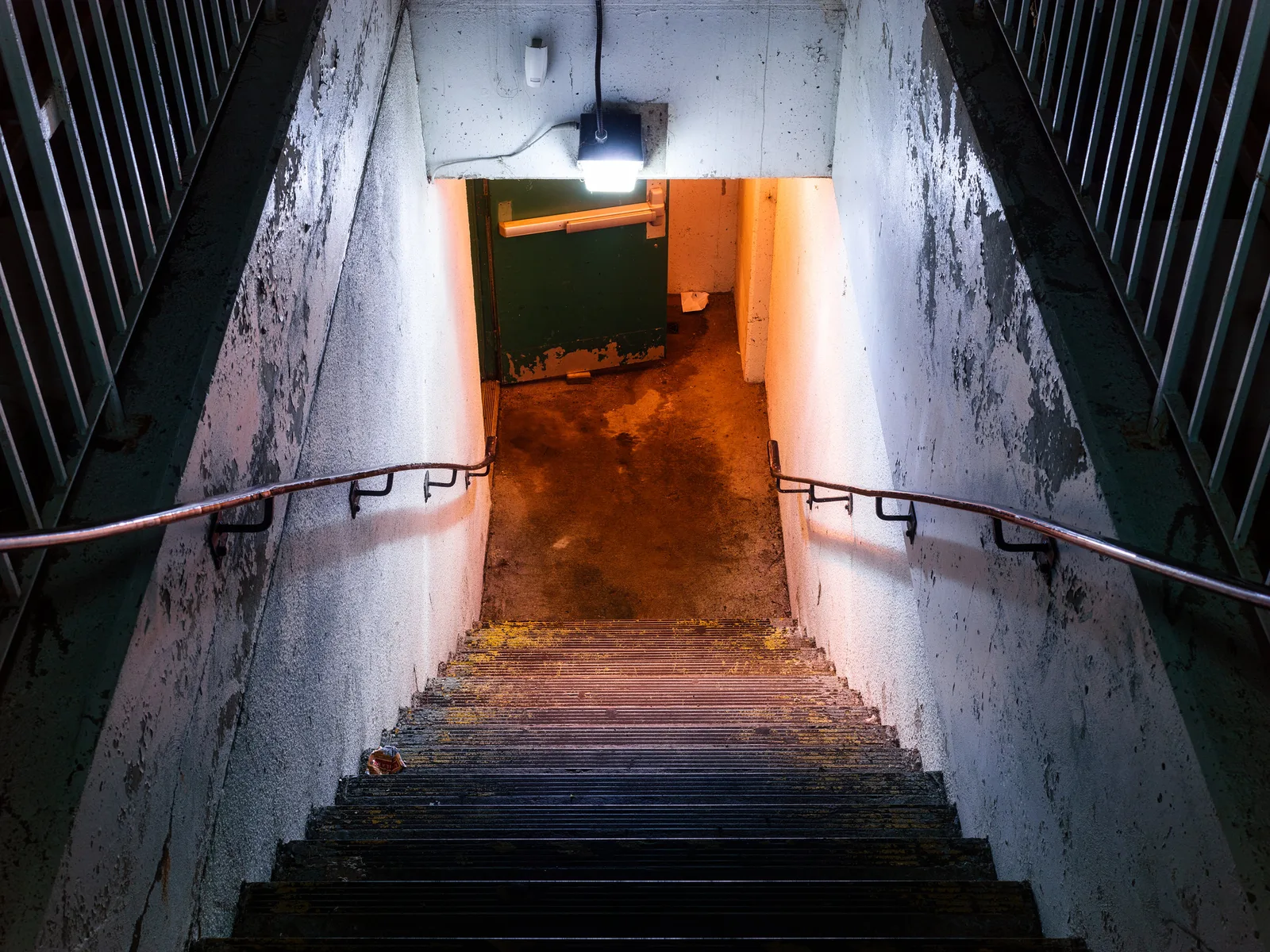
- Stairwells. Concrete walls, metal rails and pools of light make moody, cinematic pictures.
- Fire escapes. Zigzag metal stairs on brick buildings make bold graphic patterns, especially against the sky.
- Underground stairs. Steps leading down to stations and parking garages suggest mystery.
- Night. Lit stairwells glow in dark buildings, and fire escapes cast strong shadows under streetlights.
Stay in public spaces, and never climb fire escapes or enter private buildings. Urban stairs are great subjects for street photography, especially with a passing figure.
Escalators and glass stairs
Escalators and glass staircases in stations, malls and airports offer a sleek, graphic look. Moving escalators make long diagonal lines, and a slow shutter speed turns riders into soft streaks while the steps and rails stay sharp. Glass stairs and open steel frames catch reflections and let light pour through, creating layered, airy pictures. Look for views from a balcony or the top of the escalator, where lines converge in the distance. Keep strangers small and general, and stay out of the flow of people.
Outdoor steps and paths
Steps outdoors connect people with the landscape. A rough path of wooden steps up a dune, stone steps climbing a hillside village, a stairway up a cliff to a viewpoint and steps leading down to a beach all suggest adventure.
- Use the climb. Shoot from the bottom so the steps rise toward the view or the sky.
- Use the descent. Shoot from the top so the steps lead down toward water or a valley.
- Include nature. Grass, flowers, moss and trees around the steps soften the scene.
- Use golden light. Low sun at the top or bottom of the steps adds warmth and glow.
Old stone steps in villages and towns are especially charming, worn smooth by centuries of feet. Steps on hiking trails and beaches make lovely pictures of journeys. The guide to hiking photography has more ideas for trail pictures.
Steps in old towns
Hillside towns are often built on stairs, with narrow lanes of steps climbing between houses. Painted steps, potted plants on every landing, cats on the steps and laundry overhead make wonderful, lively pictures. Look for curves where the stairs turn a corner out of sight, which adds mystery and invites the viewer to imagine what lies beyond.
Light and shadow on stairs
Light is what makes stairs come alive.
- Side light. Light from the side across the steps creates bold stripes of light and shadow.
- Shafts of light. A beam of sun falling across a dim stairwell makes a dramatic spotlight.
- Shadows of railings. Handrails and balusters cast repeating shadows across the steps.
- Light at the end. A bright doorway at the top or bottom of the stairs draws the eye.
Shadows on stairs are transformed by the shape of the steps, breaking into zigzags that make striking abstract patterns. Wait for the moment when the light falls just right. In many buildings, the sun moves across a stairwell window for only an hour or so each day, so note the time and come back.
Fascinated by the patterns shadows make? The guide to shadow photography shows how to find and use them.
People on stairs
A person on a staircase adds story, scale and life.
- A single figure. One person walking up or down a grand flight of stairs makes a strong, simple picture.
- Wait for the moment. Frame the stairs and wait for someone to step into a pool of light.
- Use motion blur. A slow shutter speed blurs moving people while the stairs stay sharp.
- Portraits. Stairs make great places for portraits, with natural seating and leading lines.
Respect privacy. Keep strangers small and general, or ask before photographing them closely. Friends and family make easy, willing subjects for staircase portraits.
Stairs at night
Stairs take on a different mood after dark. Lamps on each landing make pools of light down a stairwell, outdoor steps glow under streetlights and lit staircases in glass buildings shine like lanterns. Use a tripod or a steady railing, keep the ISO low where you can and let the exposure run long. A single figure climbing toward a lit doorway at night makes a quiet, cinematic scene.
Black and white and abstracts
Stairs are perfect for black and white and abstract pictures.
- Black and white. Without color, stairs become pure line, shape and tone.
- Close crops. Fill the frame with a few steps and their shadows for a graphic abstract.
- Repeating patterns. Rows of steps make strong patterns.
- Odd angles. Tilt or rotate the camera for unexpected, dynamic compositions.
Spiral staircases seen from above or below often look best in black and white, with the curves of light and shadow as the subject. The guide to black and white photography explains how to see in tones.
Settings for staircase photography
- Aperture. Use f/8 to f/11 for sharpness through a long flight of steps.
- Wide lens. Use a wide lens to fit spirals and stairwells into the frame.
- ISO. Raise it indoors to keep the shutter fast enough for handheld shots.
- Focus. Focus about one third up the stairs for good depth of field.
- Level. Use grid lines and a level to keep verticals straight.
Using a phone
Phones are great for stairs, especially spirals. Use the ultra wide lens for stairwells, turn on grid lines to center spirals and hold the phone flat and level when pointing straight up or down. Night mode helps in dim stairwells.
Editing staircase photos
Straighten verticals and center spirals carefully in editing. Add contrast to strengthen light and shadow, and use black and white for graphic stairs. Crop tightly to remove distractions and emphasize repetition. Wide lenses can stretch the edges of the frame, so correct perspective distortion if lines bend or lean.
Common mistakes
- Off center spirals. Spirals look best perfectly centered. Take time to line them up.
- Leaning verticals. Keep the camera level unless tilting on purpose.
- Flat light. Stairs need light and shadow. Look for side light or shafts of sun.
- Leading nowhere. Give the stairs a destination, such as a door or a light.
- Blocking others. Stairs are for walking. Do not block them with tripods or bags.
- Unsafe positions. Never lean far over railings for a view.
Try this: a 10-minute stair study
Find any staircase near you, and take five pictures in ten minutes.
- A view from the bottom looking up.
- A view from the top looking down.
- A side view showing the zigzag profile.
- A close crop of a few steps and their shadows.
- A picture with a person on the stairs, if one is willing.
Compare the five, and notice how the same stairs can feel grand, mysterious, graphic or human depending on the angle. Choose the strongest, and return at a different time of day to see how light changes it.
Frequently asked questions
How do I photograph a spiral staircase?
Stand in the center at the top or bottom, use a wide lens, point straight up or down and center the spiral carefully.
What lens is best for staircase photography?
A wide lens for spirals and stairwells, and a standard lens for straight flights and details.
How do I keep stairs from looking distorted?
Hold the camera level, step back if possible and correct perspective in editing.
Can I use a tripod on stairs?
Only where allowed and when it will not block others. In busy places, brace the camera on a railing instead.
How do I photograph stairs in a dark stairwell?
Raise the ISO, open the aperture and brace the camera on a railing. Look for a pool of light to make the focus of the picture.
How do I make a staircase look grand?
Shoot from a low angle at the bottom, use symmetry and include a small person to show scale.
For terms such as leading lines, symmetry, perspective and depth of field, see the photography glossary.