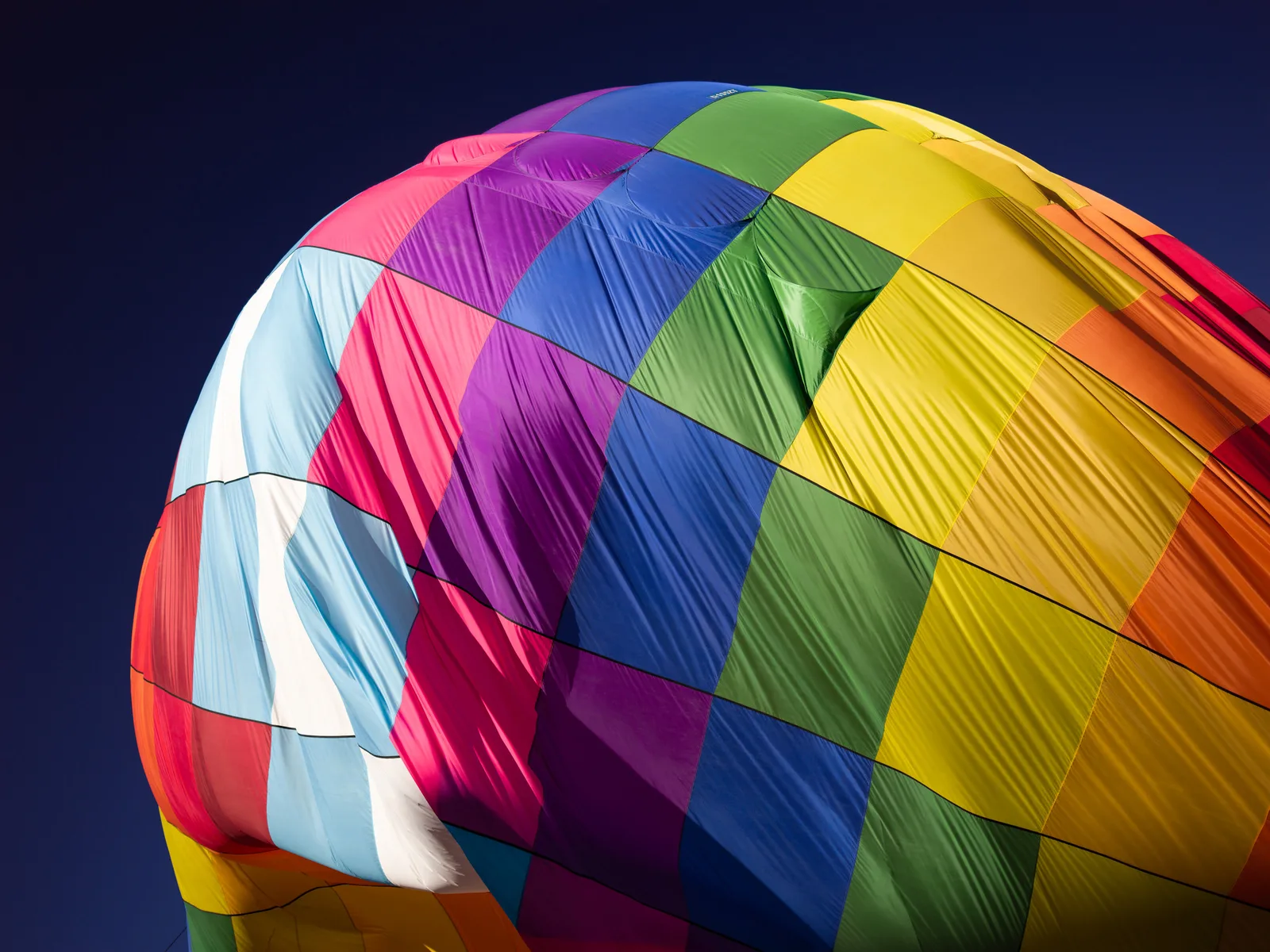
Few sights lift the spirits like hot air balloons. Huge, colorful and silent except for the roar of the burners, they rise slowly into the morning sky and drift over fields, towns and rivers. They are a joy to photograph from the ground, from a hilltop or from the basket itself, and they reward a little planning with some of the most cheerful pictures you will ever make.
This guide covers how to plan for balloon flights, what to photograph at a launch, how to photograph balloons in the sky and in the landscape, festival mass ascensions and night glows, the right settings and what to expect if you take a flight. If you are curious about photographing the land from above more generally, see the aerial photography guide.
Why balloons make wonderful subjects
Hot air balloons combine several things that make photographs work, all at once.
- Color. Balloon envelopes come in bold stripes, patterns and shapes. Against a clear blue or soft dawn sky, they stand out instantly. The guide to color in photography explains why bright colors on plain backgrounds are so striking.
- Scale. A balloon is enormous up close and tiny in a big sky. You can play with both, from frame-filling close-ups to small dots over a vast landscape.
- Light. Most flights happen at sunrise or in the evening, when light is low, warm and beautiful.
- Movement and drama. Inflation, lift-off and landing are full of action, and the burner flame glows inside the envelope.
- Joy. Crowds, crews and passengers are usually in high spirits, which makes for happy pictures of people as well.
Balloons are also forgiving subjects. They move slowly, they are usually easy to see and they stay in the sky long enough for you to try several ideas in one flight.
Planning for balloon flights
Balloons only fly in calm conditions, which is why most flights happen just after sunrise and sometimes in the early evening. Wind, rain and storms keep them on the ground.
- Find out when and where. Balloon festivals publish schedules, and local balloon companies often fly from the same fields. Some areas are known for regular flights over farmland, valleys or towns.
- Arrive early. Launches often start before sunrise. Arriving in the dark lets you find a spot and watch the inflation from the start.
- Check the forecast. Flights are often canceled at short notice for wind. Have a backup day if you can.
- Watch the wind direction. Balloons drift with the wind. Knowing which way it blows helps you predict where they will go and where to stand for the light.
- Plan for the sun. At sunrise, balloons between you and the sun glow from behind, while balloons with the sun behind you are lit from the front. Both work, but they give very different pictures. The guide to golden hour photography explains why early light is so special.
Dress for cold mornings, even in summer, and bring a flask of something hot. Early starts and open fields can be chilly.
At the launch field
The launch is where balloons come to life, and it is often the most exciting part of the day for photographers.
- Inflation. Crews unroll the envelope on the ground and fill it with cold air from a large fan. Standing near the open mouth of the balloon, you can look inside the huge, glowing fabric. Ask the crew where it is safe to stand.
- The burners. When the pilot fires the burners to heat the air, the envelope rises and the flame lights the inside. In low dawn light, this glow is spectacular. Expose for the bright fabric so it does not burn out.
- Crews at work. Ground crews hold ropes, steady baskets and help passengers in. Their teamwork makes good candid pictures. The guide to candid photography covers capturing natural moments.
- Lift-off. The moment a basket leaves the ground is quick. Be ready with a fast shutter speed and burst mode.
- Close details. Wicker baskets, burner frames, ropes and the patterns of the envelope fabric all make strong close-ups, like the one at the top of this page.
Always follow crew and festival instructions. Launch fields are busy, ropes and baskets move suddenly and burners are very hot. Stay behind barriers, do not touch equipment and never stand downwind of an inflating balloon.
Want to catch the moment of lift-off without blur? The guide to burst mode explains how to capture fast action in a quick sequence.
Balloons in the sky
Once in the air, balloons become shapes against the sky. The challenge is to make them more than colorful dots.
- Fill the frame. A telephoto lens lets you fill the frame with a single balloon as it rises, showing its colors and patterns in detail. See the guide to the telephoto lens.
- Use groups. Several balloons at different heights create depth and rhythm, especially when their colors contrast.
- Use the rule of odds. Three or five balloons in a frame often feel more balanced than two or four.
- Leave space. A single balloon in a wide sky feels peaceful and free. Place it off center, with space in the direction it drifts.
- Look up from below. Standing under a balloon as it lifts off shows the basket, the burner flame and the huge envelope above.
- Use silhouettes. With the sun behind them, balloons become dark shapes against a bright sky.
A plain blue sky is good, but a few clouds or a soft sunrise sky makes balloons stand out even more.
Balloons in the landscape
The most memorable balloon pictures often show balloons as part of a bigger scene.
- Find a high point. A hill above a valley can put you level with balloons drifting past, with the landscape below.
- Include foreground. Trees, fields, fences, rooftops or a river in the foreground give the picture depth and place. The guide to foreground interest explains how.
- Look for reflections. Balloons over a lake or river at dawn may reflect in the calm water.
- Use scale. Tiny balloons over huge fields or mountains show the size of the land. See the page on scale.
- Follow them. Some photographers follow balloons by road, stopping where they drift over interesting places. Never stop in unsafe spots or trespass on farmland.
Festivals and mass ascensions
Balloon festivals bring dozens or even hundreds of balloons together. When many launch at once, the sky fills with color.
- Go wide and tight. A wide lens captures the whole field of balloons rising. A telephoto picks out patterns and individual shapes in the crowd of envelopes.
- Look for special shapes. Many festivals include balloons shaped like animals, houses or characters. These make fun, lighthearted pictures.
- Photograph the crowd. Spectators looking up, children pointing and people taking pictures tell the story of the event.
- Move around. Festival fields are big. Walking to different spots gives you different angles and backgrounds.
The guide to festival photography has more on crowds, color and events.
Festivals also offer chances to meet pilots and crews. Many are happy to talk about their balloons, and a short conversation can lead to a portrait in front of a basket or an invitation to photograph the inflation up close.
Night glows
Many festivals hold night glows, when balloons stay tethered on the ground and pilots fire their burners in unison after dark. The envelopes light up like giant lanterns.
- Arrive before dark to find a spot with a clear view.
- Raise the ISO and use a wide aperture, because burners fire in short bursts.
- Time the burn. Watch the rhythm of the burners and press the shutter as they fire. Burst mode helps.
- Expose for the glowing balloon, not the dark sky. Check the histogram to avoid blown highlights.
- Try blue hour. A glow just after sunset, with color still in the sky, often looks best.
Settings for balloons
| Situation | Shutter speed | Aperture | Notes |
|---|---|---|---|
| Balloons in the sky | 1/500 | f/8 | Auto ISO; sharp from envelope to basket |
| Lift-off | 1/1000 | f/5.6 | Burst mode for the moment it rises |
| Inside the envelope | 1/250 | f/8 | Expose for the bright fabric |
| Night glow | 1/60 to 1/125 | f/2.8 to f/4 | Higher ISO; shoot as burners fire |
| From the basket | 1/500 | f/8 | Brace on the basket edge |
Bright skies can fool the meter into underexposing balloons, so use exposure compensation to brighten if colors look dark.
Photographing from the basket
A balloon flight is one of the most peaceful ways to see the land from above. It is also a wonderful place for pictures, because the basket drifts with the wind and feels almost still.
- Keep gear simple. Space is tight, so bring one camera with a standard zoom, and a strap.
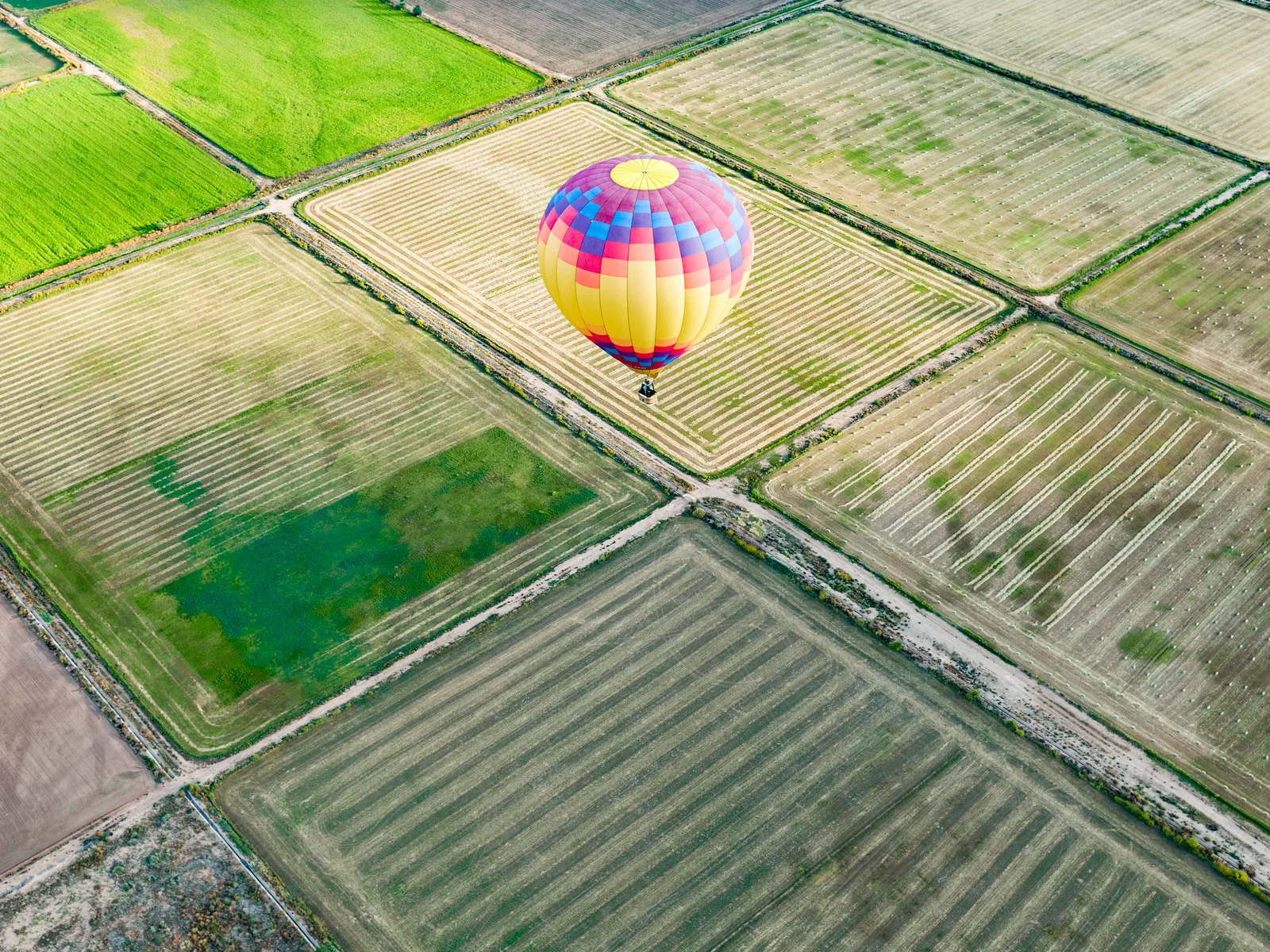
- Photograph other balloons. Nearby balloons with the landscape below make the best pictures, like the second photo on this page.
- Look straight down. Fields, rivers, roads and the shadow of your own balloon make graphic patterns.
- Include the basket. The edge of the basket, the burner or a fellow passenger shows where you are.
- Listen to the pilot. Follow safety instructions, especially for landing, when you will need to put the camera away and hold on.
Interested in more pictures from above? The aerial photography guide covers flights, settings and composing from height.
Telling the story of a flight
A balloon flight has a natural beginning, middle and end, which makes it perfect for a short series of pictures. Thinking about the whole story helps you avoid a memory card full of nearly identical balloons in the sky.
- The dark field: trucks arriving, headlamps, crews unloading baskets in the blue light before dawn.
- Inflation: the envelope spread on the grass, the fan roaring, the first glow of the burner inside the fabric.
- Lift-off: the basket leaving the ground, passengers waving, the crew letting go of the ropes.
- In the air: the balloon against the sky and over the landscape, alone or with others.
- The chase: the ground crew following by road, watching the sky from a field gate.
- Landing: the basket bumping down in a field, the envelope sighing to the ground and the crew packing it away.
Many crews end a flight with a small celebration, and pictures of tired, happy faces in a sunny field are often the ones people treasure most. Choose six to ten of your best frames, one or two for each part, and the set will read like a little story. The guide to visual storytelling explains how pictures work together in a sequence.
Want to tell an event story with a strong set of pictures? How to create a photo essay covers choosing and ordering images.
Editing balloon photos
Balloon pictures usually need only light editing, because the colors are already strong.
- Balance the sky and the balloon. Lower highlights to keep detail in a bright sky, and lift shadows gently if the balloon is backlit.
- Keep colors natural. Envelopes are vivid already. Too much saturation makes reds and oranges lose detail and look artificial. The page on vibrance and saturation explains the difference.
- Warm the dawn gently. A small shift in white balance can bring back the warmth you saw at sunrise without turning the whole scene orange.
- Straighten the horizon in landscape views, especially pictures taken from a drifting basket.
- Crop for impact. A tighter crop can turn a small balloon in a big frame into a stronger picture, or remove a distracting car or sign at the edge of the field.
Common mistakes
- Arriving late. The balloons have already gone. Fix: arrive before sunrise and watch inflation.
- Dark balloons against a bright sky. Fix: use exposure compensation or expose for the balloon.
- Small dots in a big sky. Fix: use a longer lens or include the landscape on purpose.
- Standing in the wrong place. Fix: ask crews where to stand and stay behind barriers.
- Blurred night glows. Fix: raise ISO and shoot as burners fire.
- Ignoring people. Fix: include crews, passengers and spectators to tell the story.
Try this: a 10-minute launch challenge
- Minutes 1 to 2: Photograph a balloon being inflated, showing its size on the ground.
- Minutes 3 to 4: Move close and make a detail picture of the basket, burner or fabric.
- Minutes 5 to 6: Photograph a crew member at work.
- Minutes 7 to 8: Capture lift-off with a fast shutter speed and burst mode.
- Minutes 9 to 10: Step back and make a wide picture of balloons rising over the landscape.
Frequently asked questions
What time do hot air balloons fly?
Most flights are just after sunrise, when air is calm and cool. Some take place in the early evening. Wind and rain often cancel flights.
What lens is best for balloon photography?
A standard zoom covers launches, and a telephoto zoom is useful for balloons in the sky. A wide lens works for inflation and mass ascensions.
How do I photograph a night glow?
Raise the ISO, use a wide aperture and press the shutter as burners fire. Expose for the glowing envelope.
Can I photograph balloons with a phone?
Yes. Tap to expose on the balloon rather than the bright sky, use burst mode for lift-off and use the zoom for distant balloons.
How close can I get at a launch?
It depends on the event. Some festivals let visitors walk among the balloons, while others keep spectators behind a rope line. Always follow crew and staff instructions, and keep well clear of ropes, baskets and burners.
Is it worth taking a balloon flight for photography?
For many people it is a once-in-a-lifetime experience, and the views are superb. The basket drifts gently, which makes sharp pictures easy, but you cannot choose where you go, so think of it as a gift of surprises rather than a planned shoot.
What should I do if the flight is canceled?
Cancellations are common, because pilots only fly in calm, safe weather. Use the morning to photograph the landscape in early light, and try again on another day.
For terms such as burst mode, exposure compensation, histogram and silhouette, see the photography glossary.