Candid photography means photographing people who are not performing for the camera: they are busy with something else, so their expressions and posture are their own. To take candid photos, keep the camera out and set in advance (around 1/250 second, Auto ISO, a 35mm to 85mm lens), stay in one place long enough to stop being interesting, watch for the moments people are absorbed in a task or in each other, and press quietly.
This guide is a general method that works at home, at parties, on holiday and in public. It sits between street photography, which is about strangers in public places, and lifestyle photography, which is about lightly directed client sessions. It goes further than either on one question: how to make people stop noticing you, and what to do with the camera once they have.
What makes a photo candid (and what does not)
A candid photo is defined by the subject’s attention, not by secrecy. If the person’s mind is on the cards in their hand, the child on their lap or the story being told across the table, the picture is candid, even if they know perfectly well that you have a camera. If their mind is on how they look to the lens, the picture is posed, even if nobody asked them to pose.
That definition clears up three common confusions:
- Candid does not mean hidden. Most good candids of family and friends are taken by someone the subjects can see. They simply stopped caring.
- Candid does not mean random. You still choose the light, the background and the instant. The subject is unposed; the photograph is not accidental.
- Eye contact does not automatically make it posed. A glance at the camera in the middle of a laugh is still candid. A held smile for the camera is not.
| Posed | Prompted | Candid | |
|---|---|---|---|
| Who decides what happens | The photographer | The photographer starts it, the subject finishes it | The subject |
| Subject’s attention | On the camera | On an activity you suggested | On their own activity |
| Can you repeat it | Yes | Roughly | No |
| Best for | Records of who was there, formal portraits | People who freeze when watched | Character, relationships, atmosphere |
| Main risk | Stiff, identical expressions | Looks staged if overdone | Missed focus, messy backgrounds, half-blinks |
How people stop noticing the camera
People react to a camera for a short time and then get bored of it. The whole craft of candid work is getting past that short time without spending it on bad frames. Four habits do most of it.
Have the camera out from the start
A camera that appears suddenly is an event. A camera that has been on your shoulder or on the table since you arrived is furniture. Take it out as you walk in, take a few unimportant frames of the room, and let everybody get their reaction over with in the first ten minutes. The frames you want come after that.
Stay still and stay put
Movement draws the eye. A photographer circling a room is watched; one sitting in the same chair for fifteen minutes is forgotten. Choose a position with good light and a clean background, settle there, and let people move through your frame. In public the same rule applies: stand in one doorway or sit on one bench and you become part of the street within a few minutes.
Lower the camera between frames
A lens held at the eye for a long time is a stare. Raise the camera, take one to three frames, lower it, and look somewhere else. A screen that tilts lets you compose with the camera at chest height, which removes the most recognisable signal of all: a face hidden behind a camera pointing straight at someone.
Be quiet and be boring
Turn off the focus beep and the focus assist lamp. Use the quiet or electronic shutter if your camera has one. Turn off the flash: a flash announces every frame and resets everyone’s awareness of you. Dress like everyone else in the room, and do not check the screen after every shot, because people read that as “a picture of me was just taken”.
Look for absorption, not for smiles
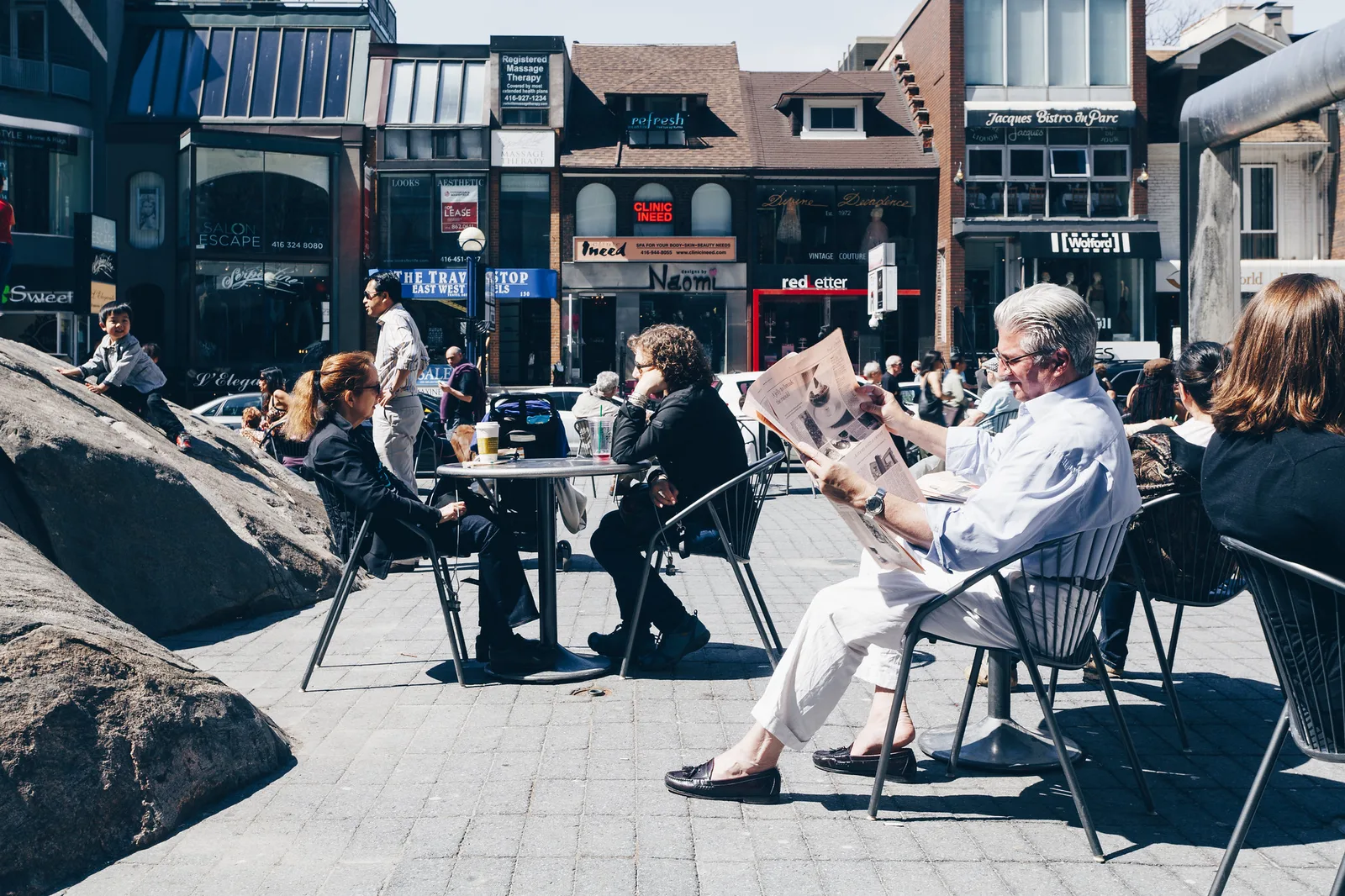
The easiest candid subject is a person concentrating. Concentration holds a face and body in a natural position for seconds at a time, which gives you room to compose and focus. Reading, cooking, playing an instrument, fixing something, choosing fruit at a stall, tying a shoe, watching a match: all of these keep attention away from you.
Good candid moments tend to fall into a small number of types. Knowing them helps you recognise one a second before it peaks:
- Concentration: eyes down, hands busy, tongue between teeth.
- Reaction: the face just after a joke, a gift, a goal or a piece of news. In a conversation, watch the listener: their reaction is often the better frame, and they are looking at someone else.
- Connection: a hand on a shoulder, two heads leaning together, a shared look.
- Transition: the moment after a posed photo ends, when everyone relaxes and laughs. This is one of the most reliable candids there is, so keep shooting for five seconds after you say “got it”.
- Rest: someone alone at a window, on a step or at the edge of a party, thinking.
Timing the exact instant within those moments is a subject of its own. The guide to the decisive moment covers anticipation, gesture and when to use burst mode. The short version for candids: press slightly before the laugh peaks, and take two or three frames, because blinks and half-formed expressions ruin a large share of single frames of people.
Settings that let you react in under a second
A candid moment gives you one or two seconds. Any setting you have to change in that time is a missed picture, so the aim is a camera that needs nothing but a press.
The most forgiving setup is aperture priority with Auto ISO and a minimum shutter speed set in the Auto ISO menu. You choose the aperture for the depth you want, the camera holds the shutter speed at or above your minimum, and ISO rises as far as it has to. If your camera has no minimum shutter speed option, use manual exposure with Auto ISO instead: set the aperture and shutter speed yourself and let ISO float.
| Situation | Minimum shutter speed | Aperture | Auto ISO ceiling | Focus |
|---|---|---|---|---|
| People seated and talking indoors | 1/125 | f/1.8 to f/2.8 | As high as you find acceptable, often 6400 or more | Continuous with eye or face detection |
| People walking, gesturing, cooking | 1/250 | f/2.8 to f/5.6 | 3200 to 6400 | Continuous with face detection |
| Children playing, dancing, games | 1/500 or faster | f/2.8 to f/4 | 6400 or more indoors | Continuous with tracking |
| Outdoor daylight, street or market | 1/250 to 1/500 | f/5.6 to f/8 | 1600 | Continuous, or a preset distance |
| Dim evening room, candles, lamps | 1/60 to 1/125 for still subjects | Widest available | Highest you find acceptable | Single point on the nearest eye |
Two points about that table. Let ISO climb before you let the shutter speed fall below what the movement needs: a sharp, noisy frame of a real expression beats a clean, blurred one. And hands move faster than faces: at 1/60 a talking person’s face is usually sharp and their hands are smeared, which is sometimes attractive and sometimes not (see motion blur). Also, with a 50mm lens at f/1.8 from two metres, the sharp zone is well under 20 centimetres deep, so with two people at different distances stop down to f/4 or accept that one will be soft.
Focus without fuss
Use continuous autofocus so focus follows people as they lean and turn, with eye detection if the camera offers it. In a group, detection may pick the wrong face, so learn the control that switches between faces or fall back to a single point you place yourself. In bright light outdoors, a preset focus distance with a small aperture removes focusing altogether; that method is explained in the guide to zone focusing.
Silent shutter: useful, with two catches
An electronic shutter makes no sound, which matters in quiet rooms and ceremonies. On many cameras it reads the sensor line by line, so fast movement can look bent, and some artificial lights that flicker can leave dark bands across the frame. Take a test frame under the room’s lighting. If you see bands, switch back to the mechanical shutter or try a slower shutter speed.
Focal length decides how close you stand
Focal length is less a question of optics here than of where you have to be. Each range puts you at a different distance from people and produces a different kind of picture. The figures below are full-frame equivalents.
| Focal length | Distance for one person, waist up | What the picture feels like | Trade-off |
|---|---|---|---|
| 24 to 28mm | About 1 metre | Inside the action, lots of setting | You are very close; faces near the edges stretch |
| 35mm | About 1.5 metres | Sitting at the same table | Backgrounds need care because so much is included |
| 50mm | About 2 metres | Across the table, natural proportions | Tight in small rooms |
| 85mm | About 3 metres | Across the room, soft background | People walk between you and the subject |
| 135 to 200mm | 5 to 7.5 metres | Observed from a distance, flattened | Needs faster shutter speeds; can feel detached |
A long lens is the obvious choice for candids, and it works well at events, across gardens and for shy children, because you are far enough away to be ignored. Its pictures look observed from outside the group, though, and a long lens pointed across a room is more conspicuous than a small one used nearby. A 35mm or 50mm equivalent used from inside the group makes the viewer feel present, but only once people have stopped noticing you.
Candids of family and friends at home
Home is the hardest place for exposure and the easiest for access. Rooms are dim, backgrounds are cluttered, and the people know you well enough to pull faces. A little preparation solves most of it.
- Find the light before the moment. Work out which seat, counter or patch of floor gets window light, and photograph what happens there. Light from the side of a window gives faces shape; the guide to natural light explains how to read it.
- Clear one background. You cannot tidy a whole house, but you can move the laundry basket and the bright plastic bottle out of the one direction you will be shooting.
- Keep the camera on a shelf, switched on and set. A camera in a bag in another room takes no candids.
- Photograph routines. Breakfast, homework, bath time, the dog being fed, a grandparent doing a crossword. Routines repeat, so you get a second chance tomorrow in the same light.
- Get to eye level. Kneel or sit for children and for people on sofas. A standing adult’s view down onto a child reads as a snapshot.
Children get used to a camera faster than adults if it is always around and never followed by “smile”. Two pages go further on this: how to photograph your kids and photography for parents.
Candids at parties, weddings and other events
Events are generous to candid photographers: people are dressed up, emotional, occupied with each other and expecting cameras. The difficulty is knowing where to stand.
- Face the audience during the main action. While everyone photographs the cake, the speech or the first dance, turn around for two frames of the people watching. Reactions are the candids nobody else gets.
- Work the edges. The doorway where guests arrive and hug, the bar, the kitchen, the children’s table and the smokers’ step all produce unguarded moments.
- Shoot the minutes around posed groups. People assembling for a group photo, and collapsing out of it, are more themselves than in the group photo.
- Do not use flash for candids if you can avoid it. Raise ISO and open the aperture instead. If the room is too dark, bounce the flash off a ceiling so it is less of an interruption.
If you are a guest at a wedding with a hired photographer, stay out of their sightlines and out of the aisle. For paid coverage, the guides to event photography and wedding photography cover shot lists, timelines and client expectations.
Candids while travelling
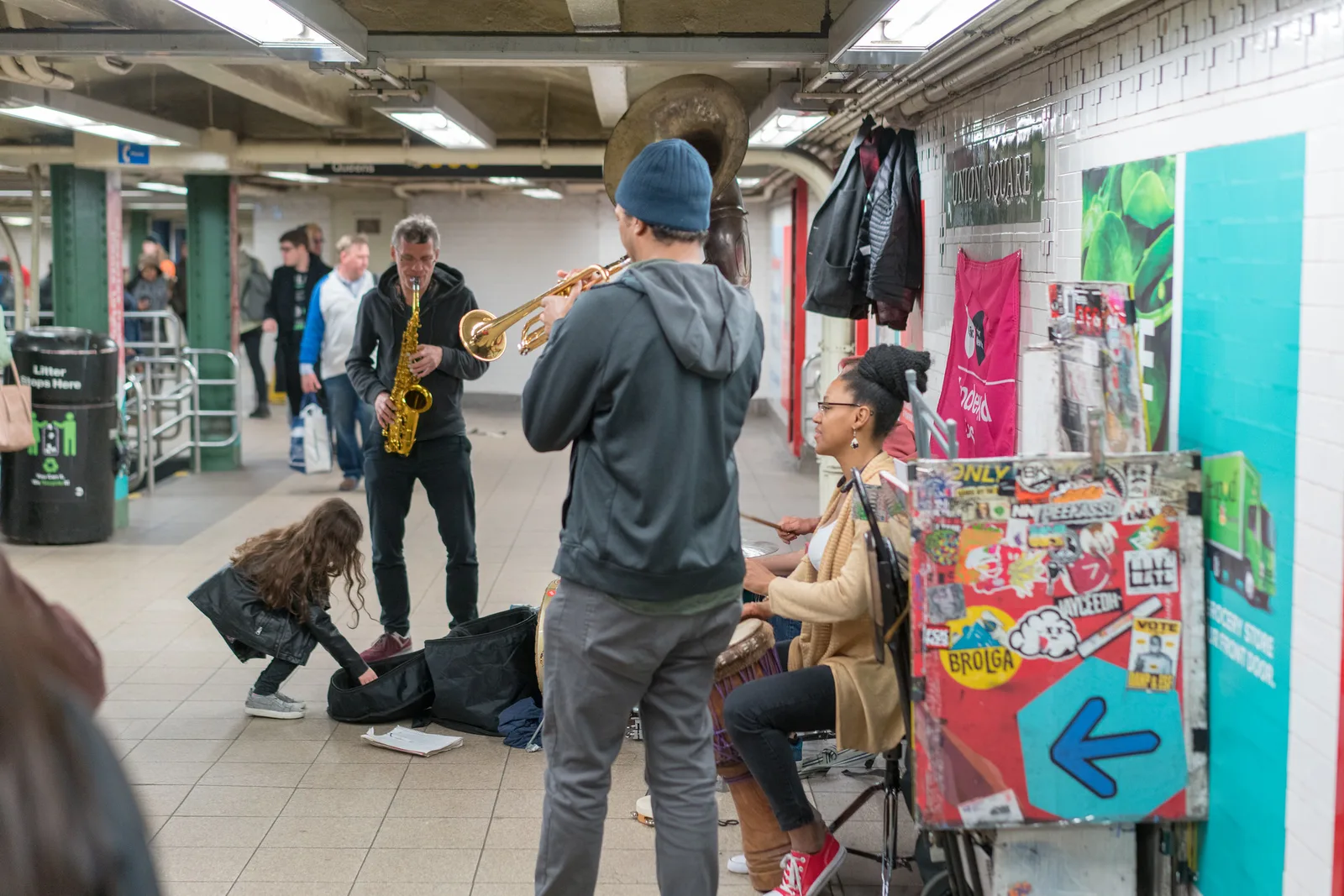
Travel candids are mostly pictures of people doing their ordinary work and leisure in places that are unfamiliar to you: a stallholder weighing vegetables, a card game in a square, musicians on a bridge. The method is the same as at home, with less time to become invisible.
Markets, cafe terraces, stations, waterfronts and festivals are good places because people there are busy and already surrounded by strangers. Sit down, order something, put the camera on the table and wait ten minutes. Include the setting: a candid of a person with no sense of place could have been taken anywhere, so step back or use a wider lens and let the stall, the street or the river into the frame.
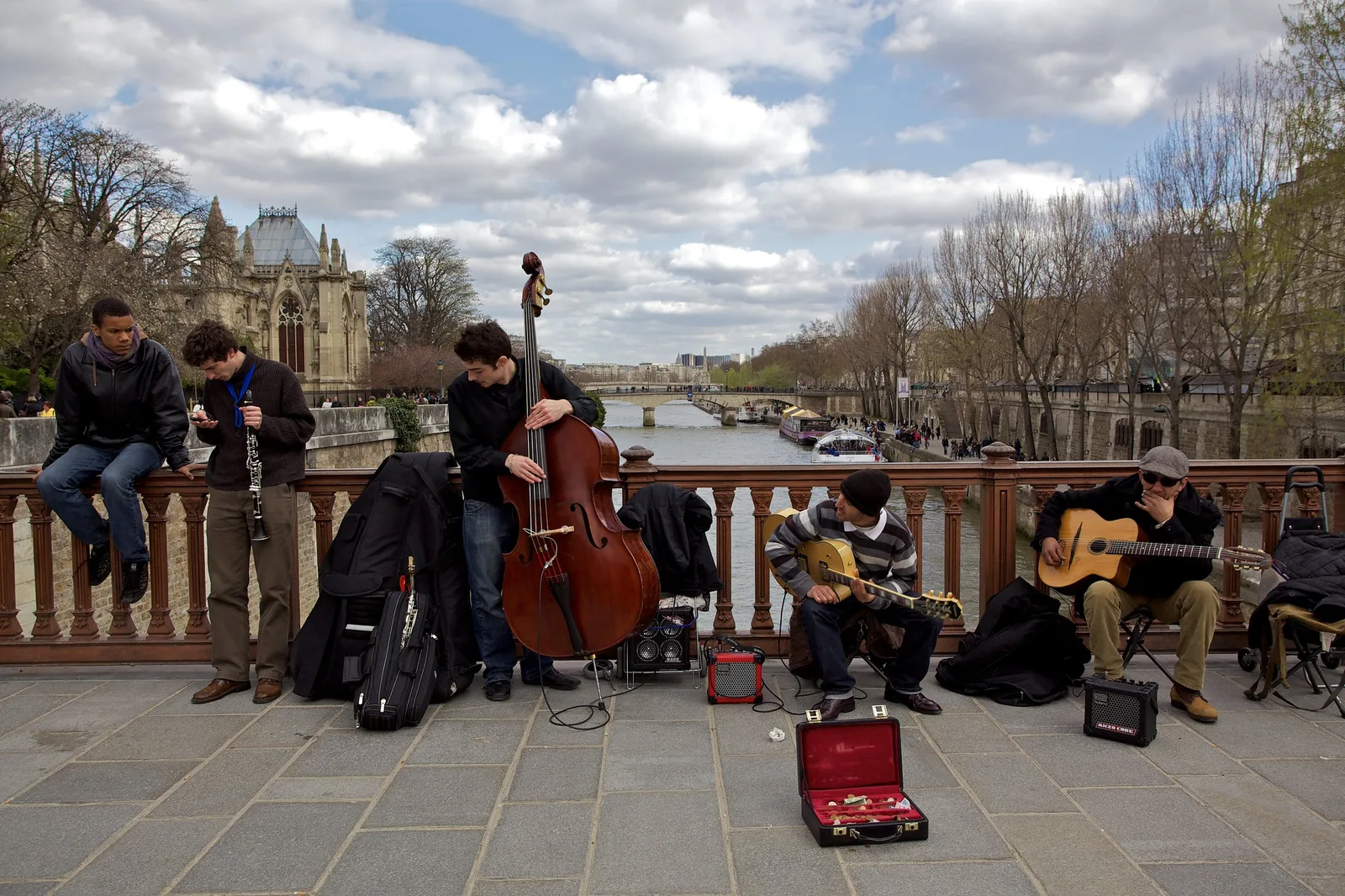
Performers and vendors are working in public and are usually comfortable being photographed, but they are also earning a living. Putting a coin in a busker’s case or buying something from a stall before you photograph is fair, and it often gets you a nod that makes the next ten minutes easier. In places where customs differ from your own, read the guide to cultural sensitivity in photography first, and see travel photography for the wider subject.
When people freeze: give them something to do
Some people cannot ignore a camera. They stiffen, perform or hide. Waiting them out is one answer; the faster one is to move their attention on purpose. This is the “prompted” column of the first table, and it produces pictures that are honestly candid in expression even though you started the action.
- Hand them a task. Ask them to pour the tea, light the candles, show you how the coffee machine works or find a song. Hands with a job relax the shoulders and the face.
- Ask a real question. “How did you two meet?” or “What was this street like when you were small?” People think with their whole face, and they look at the person they are talking to, not the lens.
- Point them at each other. Ask one person to tell another a story. You are no longer part of the conversation.
- Take the posed picture first. Give the performer the frame they want, say thank you, and keep the camera up. What follows is usually better.
Consent, respect and sharing
Unposed does not mean unaccountable. A candid photograph shows someone as they did not arrange to be seen, and that is a responsibility.
- Family and friends: the camera is fine, the upload is the question. Ask before posting, and delete on request without argument. Never share frames of someone eating, crying, asleep or undressed unless they have seen and approved them.
- Children who are not yours: ask a parent before photographing, and again before sharing.
- Strangers in public: rules on photographing and publishing pictures of people differ from country to country, so check the local position before you travel. Whatever the law allows, stop if someone signals they do not want to be photographed, and if someone notices you, smile, show them the picture and offer to delete it.
- Commercial use: using a recognisable person to advertise something generally needs their written permission. The guide to model release forms explains the idea; ask a qualified professional about your own case.
If you would like eye contact and a conversation with a stranger, that is a different picture with a different method: see street portraits. The wider principles are in photography etiquette and ethics.
Common mistakes
- Announcing the picture. Saying a name or “look here” turns a candid into a pose. Fix: say nothing, and take the frame you see.
- Bringing the camera out only for the big moment. Everyone turns to look. Fix: have it out from the first minute.
- Shutter speed too slow indoors. Faces are soft and you blame the focus. Fix: set a 1/125 minimum for seated people and 1/250 for movement, and let ISO rise.
- One frame per moment. A blink or a half-expression spoils it. Fix: take two or three frames, then lower the camera.
- Ignoring the background. A lamp grows from a head, or a bright window pulls the eye. Fix: choose your position for the background first, then wait for the person.
- Hiding at the far end of a long lens all day. Every picture looks distant. Fix: spend part of the time close, with a 35mm or 50mm view, once people are used to you.
- Sharing without asking. Trust goes, and so does the next candid. Fix: show people the pictures and let them veto.
Try this
Choose a fifteen minute stretch at home or with friends when people will be busy: cooking a meal, a board game, tea after lunch. Before it starts, set aperture priority, f/2.8 or your widest aperture, Auto ISO and a 1/125 minimum shutter speed, turn off the beep and flash, and pick one seat with window light behind your shoulder. For the first five minutes take nothing that matters; just let the camera be seen. For the next ten, stay in the seat and collect one frame of each type: concentration, reaction, connection and rest. Lower the camera after every two or three frames. Afterward, count how many frames have someone looking at the lens in the first five minutes compared with the last five. The difference is how long it takes that group to forget you.
Frequently asked questions
What is the difference between candid and posed photography?
In a posed photo the subject arranges themselves for the camera, usually at the photographer’s direction. In a candid photo the subject’s attention is on something else, so the expression and posture are unarranged. Many good sets mix both.
What are the best camera settings for candid photos?
Aperture priority with Auto ISO and a minimum shutter speed of 1/125 for seated people or 1/250 for movement is a reliable start. Use f/1.8 to f/2.8 indoors and f/5.6 to f/8 outdoors, with continuous autofocus and face or eye detection.
How do you take candid photos of someone who always poses?
Take the posed frame they offer, then keep the camera up for the seconds after. If that fails, give them a task or ask a question that needs a real answer, so their attention moves from the lens to the job or the person.
What lens is best for candid photography?
A 35mm or 50mm equivalent suits close work at home and while travelling, once people are used to you. An 85mm to 200mm lens suits events and shy subjects because it lets you stand back, at the cost of a more distant feel.
Can you take good candid photos with a phone?
Yes. A phone is the least noticeable camera there is. Turn off the shutter sound and flash where allowed, hold the shutter for a burst when movement is fast, and move closer instead of using heavy digital zoom, which costs detail.
Related guides
- The decisive moment: anticipation, gesture and timing in depth.
- Street photography: candid work among strangers in public places.
- Zone focusing: presetting focus so you never wait for autofocus.
- Lifestyle photography: prompted sessions for families and brands.
- Street portraits: asking a stranger and directing a quick portrait.
- Documentary photography: staying with people long enough to tell a longer story.
- How to photograph your kids: light, height and settings for the fastest subjects in the house.
- Photography etiquette and ethics: consent, respect and sharing.