Try It Yourself: Camera Simulator
For moon and astro shots, use long exposures (15s+), wide apertures (f/2.8), and moderate ISO (1600). Practice in the simulator.
Why Photographing the Moon Is Trickier Than You Think
The moon looks enormous and brilliant to the naked eye, but photographing it reveals a surprising truth: it is a very small, very bright object against a very dark sky. This combination fools both your camera’s automatic settings and your own expectations. Auto mode will overexpose the moon into a featureless white blob while underexposing everything else. But with the right technique, you can capture stunning lunar detail, from crater rims to maria plains to the delicate glow of earthshine.
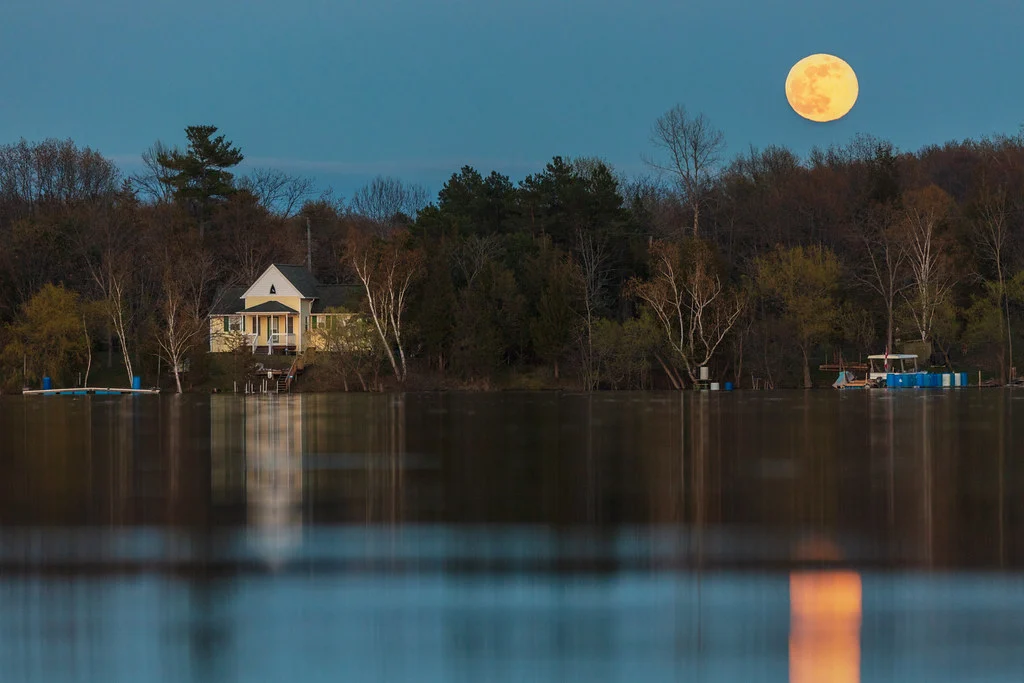
This guide covers two fundamentally different approaches: photographing the moon in detail (tight telephoto shots showing surface features) and photographing the moon in a landscape (where the moon is part of a larger scene). Each requires different settings, different gear, and different techniques.
The Looney 11 Rule: Your Starting Point
The moon is illuminated by direct sunlight. Check out our solar eclipse photography for more details. This is the key insight that most beginners miss. The moon’s surface in full sunlight is approximately as bright as a sunlit scene on Earth. This means you can use the “Looney 11” rule as your starting point:
Set your aperture to f/11, your shutter speed to 1/ISO.
At ISO 100: f/11, 1/100s. At ISO 200: f/11, 1/200s. This produces a well-exposed moon with visible surface detail. It sounds counterintuitively fast for a night shot, but remember: the moon itself is sunlit. The dark sky around it is irrelevant for exposing the lunar surface.
Settings for Detailed Moon Photography
For close-up shots that show craters, mountains, and the maria (dark plains), you want maximum detail and the longest focal length you can manage.
| Setting | Value | Why |
|---|---|---|
| Mode | Manual (M) | Auto modes are fooled by the dark sky surrounding the bright moon |
| Aperture | f/8 – f/11 | Sweet spot for lens sharpness; f/11 per the Looney 11 rule |
| Shutter Speed | 1/125s – 1/250s | Fast enough to freeze atmospheric shimmer and prevent motion blur |
| ISO | 100 – 200 | The moon is bright enough for low ISO; keeps image clean |
| Focal Length | 300mm – 600mm+ (the longer the better) | The moon is small; telephoto magnification shows surface detail |
| Focus | Manual, using Live View at maximum zoom | Autofocus can struggle with the moon’s bright-dark contrast edge |
| White Balance | Daylight | The moon is lit by sunlight; daylight WB gives natural color |
| File Format | RAW | Maximum detail recovery for subtle surface features |
Adjusting for Moon Phase
The Looney 11 rule works for a full moon, but other phases require slight exposure adjustments:
- Full moon: f/11, 1/ISO. Standard brightness, evenly lit surface.
- Gibbous (3/4 illuminated): Open 1/3 to 2/3 stop (f/10 or f/9) or slow shutter by 1/3 stop.
- Quarter moon: Open 1 full stop (f/8) or double the exposure time.
- Crescent moon: Open 1.5 to 2 stops (f/5.6 to f/8).
The partly illuminated phases (quarter and crescent) are actually the most photogenic because the low-angle sunlight casts long shadows across craters and mountains, revealing dramatic surface texture that a full moon’s direct lighting flattens.
How Much Focal Length Do You Need?
The moon occupies approximately 0.5 degrees of the sky. On a full-frame sensor, the moon is roughly:
- At 200mm: About 1.8mm on the sensor. Very small. Only fills about 5% of the frame width.
- At 400mm: About 3.6mm. Fills about 10% of the frame. Starting to show good detail.
- At 600mm: About 5.4mm. Fills about 15% of the frame. Good surface detail visible.
- At 1000mm+ (with teleconverter): Large enough to fill a significant portion of the frame with excellent detail.
On a crop sensor camera, multiply these sizes by 1.5x (most APS-C sensors). A 400mm lens on a crop sensor gives you the equivalent framing of 600mm on full frame, making crop sensors advantageous for moon photography.
Even at 200mm, you can crop heavily in post-processing and get acceptable results for web sharing. For print-quality detail, 400mm or longer is recommended.
Settings for Moon-in-Landscape Photography
Photographing the moon as part of a landscape scene is a completely different challenge. You now have two subjects at vastly different brightness levels: the bright moon and the much darker landscape.
| Setting | Value | Why |
|---|---|---|
| Mode | Manual (M) | You need independent control of exposure for this high-contrast scene |
| Aperture | f/5.6 – f/8 | Balance between depth of field and light gathering |
| Shutter Speed | Varies (see scenarios below) | Depends on whether you are blending exposures or shooting during twilight |
| ISO | 100 – 800 | As low as possible for the landscape exposure |
| Focal Length | 100mm – 300mm for a large moon; 24mm – 70mm for context | Longer focal lengths make the moon appear larger relative to the landscape |
| Focus | On the landscape; the moon will be at infinity too | If both moon and landscape are distant, both will be in focus at f/8 |
The Exposure Dilemma
The moon is incredibly bright compared to the nighttime landscape. If you expose for the moon, the landscape is black. If you expose for the landscape, the moon is a white circle with no detail. There are three solutions:
1. Shoot during twilight. The 15 to 30 minutes after sunset (or before sunrise) when the moon is low on the horizon is the ideal time. The sky and landscape are still partially bright, reducing the contrast ratio. The moon is also dimmer near the horizon due to atmospheric scattering. This natural balance lets you capture both moon detail and landscape in a single exposure.
Not sure when twilight light is at its best? Blue hour photography covers when the blue hour happens, camera settings for it and the subjects that suit it.
2. Shoot during a moonrise/moonset with a telephoto. Use a long focal length (200mm+) to compress the scene. The moon appears much larger when shot with a telephoto lens alongside a distant landmark. Time this for moonrise/moonset during twilight for the best results.
3. Exposure blend two shots. Take one exposure for the moon (fast shutter, low ISO) and one for the landscape (slower shutter, higher ISO). Combine them in Photoshop. This produces the most controlled results but requires careful alignment.
Making the Moon Look Big
The moon appears small in photos taken with wide-angle lenses because a 24mm lens shrinks everything. To make the moon appear large in a landscape photo, use a telephoto lens (200mm or longer) from a great distance, with the moon positioned next to a distant landmark (a mountain, building, or tree). Telephoto compression makes both the moon and the landmark appear closer together and larger in the frame.
Plan these shots with a moon phase/position app to know exactly when and where the moon will rise or set relative to your chosen landmark. Even a degree or two off will place the moon in the wrong part of the sky.
Need to know exactly where the moon will rise? Planning a photo around the sun, moon, tides and weather explains azimuth and elevation, the two numbers that place light in the sky.
Focusing on the Moon
Precise focus is critical for detailed moon photography. The moon is a small target, and even slight misfocus is immediately obvious in the fine surface details.
Manual Focus with Live View
Switch to manual focus. Activate Live View and zoom in to maximum magnification (10x on most cameras). Point at the moon and slowly adjust the focus ring until the lunar edge (the terminator line between light and dark) is sharpest and crater details are crisp. Take a test shot and check at 100% zoom on the LCD.
Focus Peaking
If your camera has focus peaking (most mirrorless cameras do), enable it. Focus peaking highlights in-focus edges with a colored overlay, making it easy to see when the moon’s craters and terminator are at their sharpest.
Atmospheric Seeing
The Earth’s atmosphere bends and distorts light, causing the moon to shimmer. This effect, called “seeing,” limits the detail you can capture regardless of your lens quality. Some nights the atmosphere is steady (good seeing) and you can resolve fine craters. Other nights the atmosphere boils (poor seeing) and the moon looks soft no matter what you do.
Higher elevations, cold temperatures, and nights following clear, calm weather tend to produce the best seeing. If the moon looks “wobbly” in your Live View, the atmosphere is turbulent and you should focus on getting the sharpest possible frame rather than expecting tack-sharp detail.
Planning Your Moon Photography
Successful moon photography requires planning. The moon’s position, phase, and rise/set time change daily.
Moon Phase Planning
- Full moon: Rises at sunset, sets at sunrise. Good for moonrise/moonset landscape photos during twilight. Surface is evenly lit (less dramatic for detail shots).
- Quarter moon (first or third quarter): The terminator line (shadow edge) creates dramatic lighting across the surface, revealing craters and mountains. Best for detailed surface photography.
- Crescent moon: Less surface detail, but earthshine (light reflected from Earth illuminating the dark side) creates a beautiful, ghostly glow. Best photographed during twilight when the sky has color.
- Waning vs. waxing: Waxing (growing) moons are best photographed in the evening. Waning (shrinking) moons are best in the early morning before dawn.
Moon Position Apps
Use a planning app that shows the moon’s exact position in the sky at any time and date. These apps let you visualize where the moon will be relative to landmarks, so you can plan compositions in advance. Popular options include PhotoPills, The Photographer’s Ephemeris, and Sun Surveyor.
Equipment Tips for Moon Photography
Teleconverters for Extra Reach
A 1.4x teleconverter turns a 300mm lens into a 420mm lens, at the cost of one stop of light and slight softness. For moon photography, the light loss is irrelevant (the moon is bright), and the extra reach significantly improves the amount of detail you can capture. A 2x converter doubles your focal length but adds 2 stops of light loss and more noticeable softness. Use the highest quality teleconverter you can afford.
Want more reach than your longest lens? Teleconverters compares 1.4x and 2x, how much sharpness you lose and what happens to autofocus.
Tripod Stability
At high magnifications, any vibration is magnified. Use a sturdy tripod, a remote trigger or 2-second timer, and mirror lock-up (on DSLRs) to eliminate all vibration sources. If it is windy, shield the tripod with your body or add weight to the center column hook.
Crop Sensor Advantage
For once, a crop sensor camera is arguably better than full frame for this specific task. The 1.5x crop factor gives you extra effective reach for free. A 400mm lens on a crop sensor produces the same framing as a 600mm lens on full frame.
Common Moon Photography Mistakes
1. Using Auto Exposure
The camera’s metering system sees a small bright object against a large dark background and overexposes dramatically. The moon becomes a featureless white circle. Always use Manual mode with the Looney 11 rule as your starting point.
2. Too Slow a Shutter Speed
The moon moves across the sky faster than you think. At high magnifications, even a 1-second exposure produces noticeable motion blur as the moon trails across the sensor. At 500mm, keep your shutter speed at 1/125s or faster for sharp results. The moon is bright enough for these fast shutter speeds at low ISO.
3. Not Enough Focal Length
At 50mm on a full-frame camera, the moon is a tiny white dot. You need at least 200mm for the moon to be recognizable, and 400mm+ for meaningful surface detail. If your longest lens is shorter than 200mm, focus on moon-in-landscape compositions rather than detailed surface shots.
4. Expecting a Huge Moon in a Wide-Angle Shot
Your eyes perceive the moon as large because your brain exaggerates bright objects against dark backgrounds. A camera does not. The moon at 24mm is tiny. To get a “big moon” image, you must use a telephoto lens with a distant subject for scale. This is physics, not a camera limitation.
5. Shooting at the Wrong Phase
A full moon is the most photographed but the least detailed because the light hits the surface straight on, eliminating shadows that reveal texture. Quarter phases (half-illuminated) show the most dramatic surface features because the low-angle sun casts long shadows across craters.
Frequently Asked Questions
Can I photograph the moon with a kit lens?
A typical kit lens (18-55mm on a crop sensor) will only show the moon as a small bright dot. You can capture moon-in-landscape compositions at these focal lengths, especially during twilight. For surface detail, you need at least a 200mm lens, and ideally 400mm or more.
Why does the moon look small in my photos when it looked huge to my eyes?
This is called the “moon illusion.” Your brain perceives the moon as larger when it is near the horizon with objects for comparison (trees, buildings). A camera records the moon at its actual angular size (about 0.5 degrees), which is quite small relative to the frame at wide and normal focal lengths. Use a telephoto lens (200mm+) to make the moon appear large in photos.
How do I photograph a lunar eclipse?
During a total lunar eclipse, the moon turns a deep red as Earth’s shadow covers it. The eclipsed moon is much dimmer than a normal full moon. Settings vary by eclipse phase: start with Looney 11 for the uneclipsed portion, then gradually open up as the shadow progresses. During totality, try f/4, 1 to 2 seconds, ISO 800 to 1600. The exact settings depend on the eclipse’s depth and atmospheric conditions.
Planning for an eclipse night? How to photograph a lunar eclipse covers why exposure swings so far, planning timing and moon position, and choosing a focal length.
What is the best time to photograph the moon?
For detailed surface shots: any time the moon is above the horizon and at a quarter phase. For moon-in-landscape: during moonrise or moonset, ideally during twilight when the sky still has color. Full moons during twilight (the night of the full moon at sunset) provide the classic “big moon over landscape” opportunity.
Can I stack moon photos for better detail?
Yes. Take 50 to 100 identical frames and stack them in dedicated astronomy software (RegiStax, AutoStakkert). The software aligns the frames and averages them, reducing noise and atmospheric shimmer while revealing sharper detail than any single frame. This is a standard technique in lunar and planetary photography.
Try This: Practice Exercises
Exercise 1: Looney 11 Calibration
On the next clear night with a visible moon, set up your camera on a tripod with your longest lens. Start at exactly f/11, ISO 100, 1/100s. Take a photo and review it. The moon should be well-exposed with visible surface detail. Then take shots at f/8 and f/16 for comparison. This calibrates your expectations and gives you confidence in the starting settings.
Exercise 2: Quarter Moon Detail Session
Wait for a first or third quarter moon. Set up at your longest focal length and focus carefully using Live View. Take 20 frames, checking focus between every 5 shots. Compare them at 100% zoom. You will notice that some frames are sharper than others due to atmospheric seeing variation. Pick the sharpest 3 to 5 frames. This teaches you that taking multiple frames and selecting the best is essential for high-resolution moon photography.
Exercise 3: Moonrise Landscape
Plan a moonrise landscape shoot using a planning app. Find a night when the full moon rises during twilight. Arrive early at a location with a compelling landmark on the eastern horizon. Shoot the moonrise at 100mm to 200mm as the moon appears behind or beside the landmark. The twilight sky will provide enough ambient light to expose both the landscape and the moon in a single frame. This exercise combines planning, timing, and technical skills.
Related Resources
- Night Photography Hub – Complete guide to shooting after dark
- Night Photography Settings – General settings for all night scenarios
- Astrophotography Guide – Stars, Milky Way, and deep-sky techniques
- How to Photograph Stars – Detailed star photography settings
- How to Photograph Northern Lights – Aurora settings
- Focal Length Guide – Understanding telephoto compression for moon shots
- Tripod Guide – Stability for high-magnification photography
- The Exposure Triangle – How aperture, shutter speed, and ISO interact