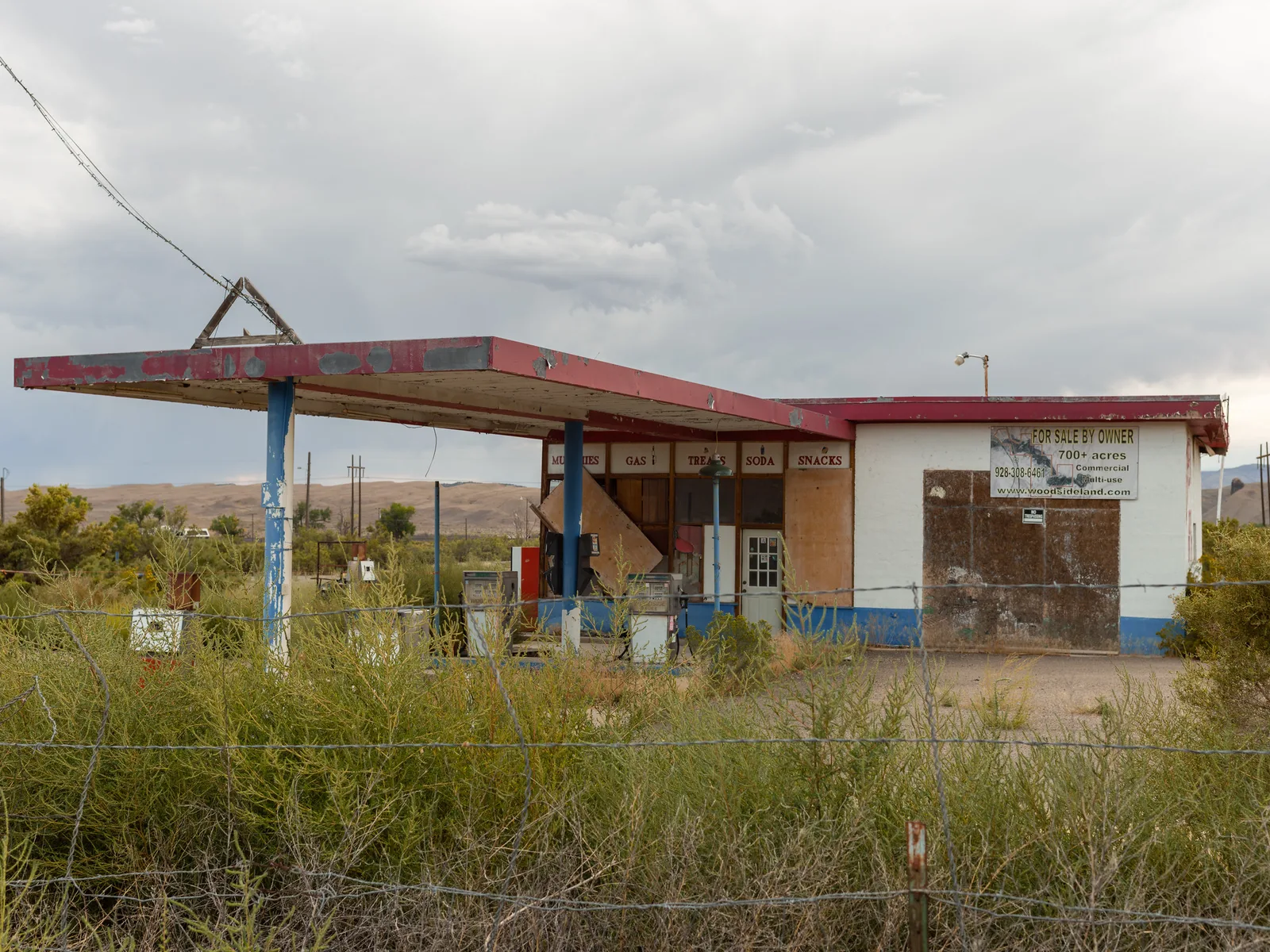
Gas stations are some of the most overlooked subjects on the road, and some of the most photogenic. A brightly lit canopy glowing over an empty forecourt at night, a faded station sinking into the weeds of a desert highway, a row of vintage pumps outside a small town garage and a classic car pulled up for fuel all capture something about travel, distance and everyday life. Gas stations are places of pause between one place and the next, and pictures of them carry that feeling of the open road.
This guide covers why gas stations make great subjects, stations at night, old and abandoned stations, pumps and details, signs and color, cars and people, stations in the landscape, composition, safety and etiquette, settings, phones and editing. For life on the highway, see the guide to road trip photography, and for glowing lettering after dark, see the guide to neon sign photography.
Why gas stations make great subjects
Gas stations combine bold design, strong light and quiet stories.
- Bright light at night. Canopies light up like stages, making them glow against dark skies.
- Bold color. Painted canopies, pumps and signs use strong reds, blues, yellows and greens.
- Clean shapes. Flat canopies, rows of pumps and simple buildings make graphic, geometric compositions.
- Nostalgia. Old stations and vintage pumps recall a time of road trips and roadside culture.
- Loneliness and pause. An empty station on a dark road can feel quiet, cinematic and a little mysterious.
Many celebrated photographers have found beauty in roadside places like these, treating ordinary scenes as worthy subjects. A gas station seen with care can say as much about a place as a famous landmark, and you will find one in almost every town and along almost every highway. That makes gas stations an easy subject to practice with whenever you travel, even on short drives close to home.
Gas stations at night
Night is when gas stations come alive for photographers. The canopy lights flood the forecourt with bright, even light, while the sky and surroundings fall into darkness.
- Start at blue hour. The deep blue sky contrasts beautifully with the warm or white light of the canopy.
- Step back. Show the whole station from across the road, with the canopy glowing in the dark.
- Use symmetry. Stand in line with the center of the canopy so the pumps and lights balance.
- Wait for a car. A single car at a pump adds story and a sense of scale.
- Look for weather. Rain, fog and snow add atmosphere, with reflections on wet pavement and haze around the lights. Falling snow under a bright canopy makes an especially magical scene.
A lonely lit station on an empty road is one of the classic images of night photography, with a cinematic, slightly mysterious feel. Use a tripod or a steady surface for long exposures, and keep the ISO low for clean shadows.
Want to make more of glowing scenes after dark? The guide to night photography covers exposure, tripods and night light.
Light trails at the pumps
Cars arriving and leaving leave streaks of headlights and taillights in long exposures. Set the camera on a tripod across the road, use an exposure of several seconds and let traffic pass between you and the station. The glowing canopy stays sharp while the moving lights become ribbons of red and white. Try different exposure lengths to see how the trails change, and keep well back from the road.
Old and abandoned stations
Old and abandoned gas stations are full of character and history. Faded paint, rusty pumps, broken signs and weeds growing through cracked concrete tell stories of roads that have changed and towns that have quieted.
- Show the setting. Include the empty road, the desert, the fields or the small town around the station.
- Look for details. Old price boards, faded lettering, rusty hinges and broken windows add texture.
- Use soft light. Overcast skies give a quiet, melancholy mood, while golden hour warms the faded colors.
- Frame through foreground. Weeds, fences and wire in front of the station add depth and a sense of neglect.
Photograph from public places, and never enter closed buildings or private land without permission. Abandoned buildings can be unsafe, with broken floors, glass and hazardous materials.
Drawn to forgotten places? The guide to urban exploration photography covers how to photograph them safely and respectfully.
Small town garages
Small towns often have family run garages and stations with real personality: hand painted signs, a bench out front, a soda machine, stacked tires and a mechanic’s bay with the door rolled up. These places feel lived in and local, and they tell the story of a community as much as a road. Photograph the whole front of the building straight on, then look for small details like a hand lettered sign or a dog asleep in the shade. Always ask before photographing the people who work there, and many will be happy to chat. The guide to small town photography has more ideas for main streets and local life.
Pumps and details
Gas pumps, especially old ones, make wonderful subjects on their own.
- Vintage pumps. Rounded tops, glass globes, round dials and chrome nozzles are full of charm.
- Rows of pumps. Lined up under a canopy, pumps make a neat repeating pattern.
- Nozzles and hoses. Close details of hoses coiled on hooks make simple, graphic pictures.
- Numbers and dials. Old mechanical dials and painted numbers add a sense of time.
Use a wide aperture to blur the background behind a single pump, or a smaller one to keep a whole row sharp. Rusty, faded pumps suit close pictures that show texture. The guide to rust photography has more ideas for weathered metal.
Signs and color
Gas station signs are tall, bold and colorful, designed to be seen from far away.
- Tall signs against the sky. A sign on a pole against a stormy or sunset sky makes a striking picture.
- Faded signs. Sun bleached and peeling signs carry nostalgia.
- Color blocks. Canopies and walls painted in bold bands make graphic, minimal frames.
- Night glow. Lit signs and price boards glow at dusk.
Keep the focus on color, shape and mood rather than on any particular company. Crop or angle so logos are not the main subject, and look for the universal feel of a roadside stop. The guide to sign photography has more on photographing signs of all kinds.
Cars and people
Cars and people bring gas stations to life.
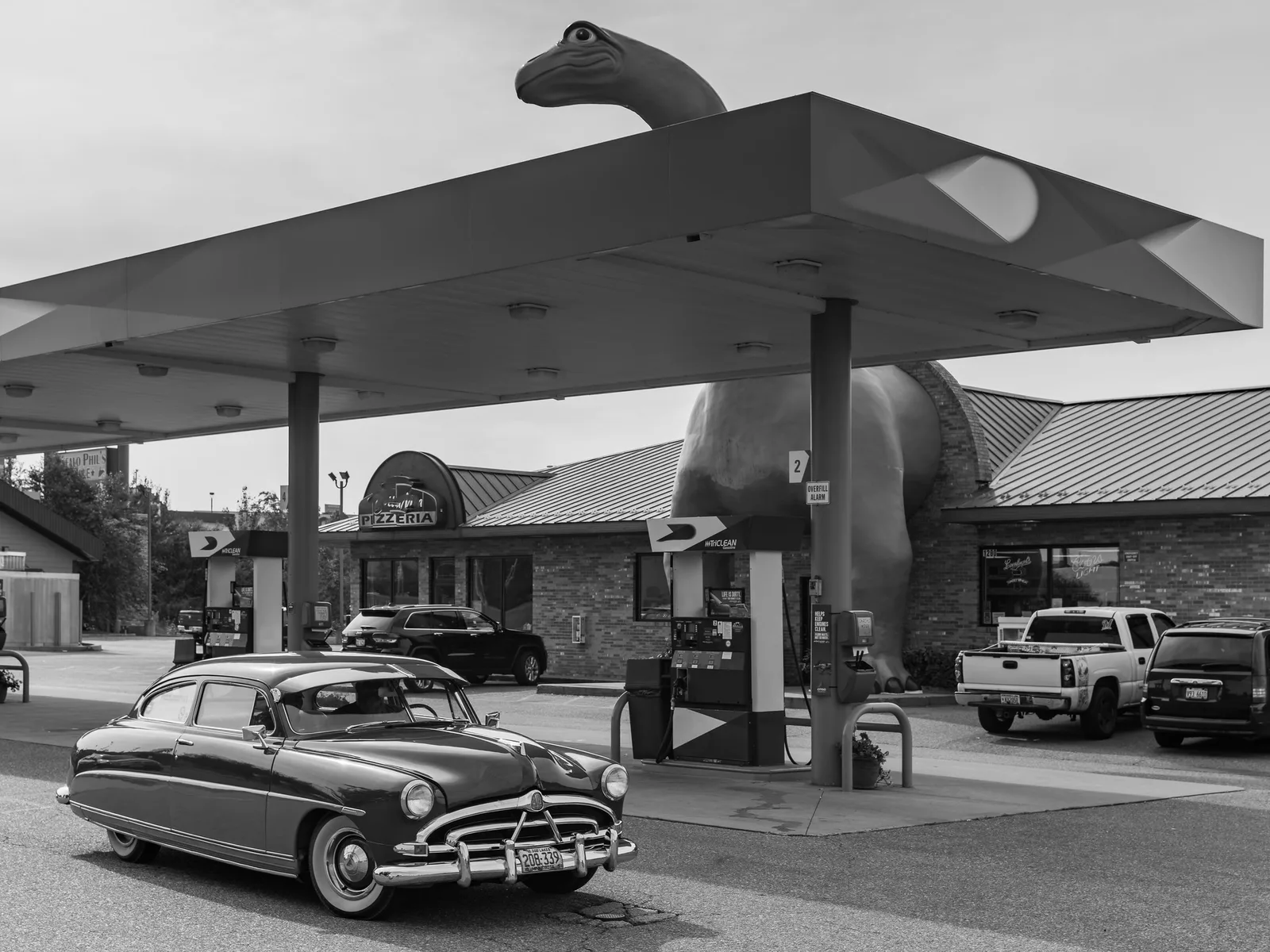
- Classic cars. A vintage car at an old pump makes a timeless scene.
- Road trip vehicles. A loaded car, a camper van or a motorcycle at the pump suggests a journey.
- Your own trip. Photograph your travel companions stretching, cleaning the windshield or buying snacks.
- Small figures. A person under the bright canopy at night, kept small, adds a quiet human touch.
Respect privacy. Avoid close pictures of strangers and their license plates without permission, and keep people small and general. Your own car and companions make the easiest and most relaxed subjects.
Stations in the landscape
A gas station in a vast landscape says a lot about distance and isolation. A single station on a long desert road, a garage at the edge of a small town or a station under huge prairie skies all show how small these stops are in the land around them.
- Go wide. Include plenty of sky and land around the station.
- Use the road. Let the highway lead toward the station as a leading line.
- Use weather. Storm clouds, sunset color or fog add drama.
- Use a longer lens. From far away, a telephoto lens can compress the station against distant mountains.
These pictures often work well in a road trip series, mixing stations with motels, diners and long stretches of empty road.
Telling a road story
Gas stations work beautifully as chapters in a longer story. Photograph every stop on a long drive the same way, such as a wide view from across the road at whatever time you arrive, and you will build a record of the journey and the changing land. Stations in the mountains, the desert and the plains will look surprisingly different. Add a few details, such as receipts, snacks, maps and the view through the windshield, and the series becomes a personal documentary of the trip.
Planning a long drive? The guide to road trip photography covers how to tell the story of a journey.
Stations in every season
Seasons change the mood of a roadside stop. Summer brings heat haze, long golden evenings and dusty cars. Autumn adds colorful trees behind the canopy and fallen leaves on the forecourt. Winter brings snowbanks, icicles hanging from the canopy edge and warm light spilling onto snowy ground. Spring brings storms and fresh green fields around country stations. Each season gives the same simple building a new character, so a station you pass often is worth photographing more than once.
Composition ideas
- Symmetry. Center the canopy and pumps for a balanced, formal look. See the guide to symmetry.
- Minimalism. Show a single pump or canopy against a plain sky with lots of empty space.
- Framing. Shoot through a car window or the gap between pumps.
- Low angles. Get low to make the canopy loom overhead.
- Reflections. After rain, puddles reflect the lights of the canopy.
Look for the simple, graphic shapes that make gas stations so distinctive: the flat line of the canopy, the vertical poles, the boxes of pumps. Simplify the frame until those shapes are clear, and the picture will feel strong and deliberate.
Safety and etiquette
Gas stations are busy working places, so photograph with care.
- Stay out of the way. Do not block pumps, entrances or traffic.
- Ask permission. If you want to photograph on the property, ask the staff first. Some stations do not allow photography.
- Shoot from public places. A sidewalk or the far side of the road gives a safe, wide view.
- No flash near pumps. Flash is unnecessary and can distract drivers.
- Watch traffic. Stay off the road, and wear something bright at night.
- Be quick and polite. Buy something, say thanks and move on.
Settings for gas station photography
- Night, tripod. Use ISO 100 to 400, f/8 and exposures of one to several seconds.
- Night, handheld. Raise the ISO to 1600 to 3200, open the aperture and keep the shutter at 1/60 or faster.
- Daytime. Use f/8 for sharp scenes and a low ISO.
- White balance. Canopy lights can look green or blue. Adjust white balance to keep whites clean, or embrace the color for mood.
- Exposure. Bright canopies can overexpose. Use exposure compensation to darken if needed.
Using a phone
A phone works well for gas stations. Use night mode after dark, hold steady against a car roof or post and tap to set exposure on the canopy. Wide lenses suit whole stations, and portrait mode suits pumps and details. Stay safe, and never use a phone near pumps if signs ask you not to.
Editing gas station photos
Balance the bright canopy against the dark sky by lowering highlights and lifting shadows a little. Correct color casts from mixed lights, or push them gently for a cinematic look. Straighten verticals and horizons, and crop for strong geometry. Black and white suits old stations and classic cars, while rich color suits glowing night scenes. The guide to cinematic photography has ideas for moody color.
Common mistakes
- Arriving after blue hour. Once the sky turns black, the station loses its setting. Arrive as the lights come on.
- Blown out canopies. Bright lights overexpose. Darken the exposure.
- Green color casts. Some lights look sickly. Adjust white balance.
- Cluttered frames. Bins, signs and cars clutter the scene. Simplify with angle and crop.
- Logos as subjects. Keep brands in the background, and focus on mood and design.
- Unsafe positions. Stay off the road and out of the way of cars.
- Trespassing at abandoned sites. Stay on public land and respect closed buildings.
Try this: a 10-minute station study
At dusk, find a gas station you can see safely from across the road.
- Take one wide picture of the whole station as the lights come on.
- Take one centered, symmetrical picture of the canopy.
- Take one long exposure with traffic passing in front.
- Take one close detail of a pump, sign or light.
Compare the set, and notice how blue hour changes the mood as the sky darkens. Return on a rainy night to see how reflections transform the same scene. Over time, try the same exercise at stations in different towns, and you will start to see how much each one reveals about its place.
Frequently asked questions
When is the best time to photograph a gas station?
Blue hour, just after sunset, when the canopy lights are on and the sky still holds deep blue color.
Is it legal to photograph gas stations?
Photographing from public places is generally fine. Ask permission before photographing on private property.
How do I fix the green color of station lights?
Adjust white balance in the camera or in editing, using a white surface as a reference.
How do I photograph an abandoned gas station safely?
Stay on public land, do not enter buildings and watch for glass, nails and unstable structures.
How do I avoid showing brand names?
Angle the camera, crop or use shallow focus so logos are not the main subject.
What lens is best for gas station photography?
A wide or standard lens suits whole stations, and a telephoto lens suits stations in big landscapes and close details.
Can I photograph gas stations with a phone at night?
Yes. Night mode handles the bright canopy and dark sky well. Hold the phone steady against something solid.
For terms such as blue hour, white balance, long exposure and symmetry, see the photography glossary.