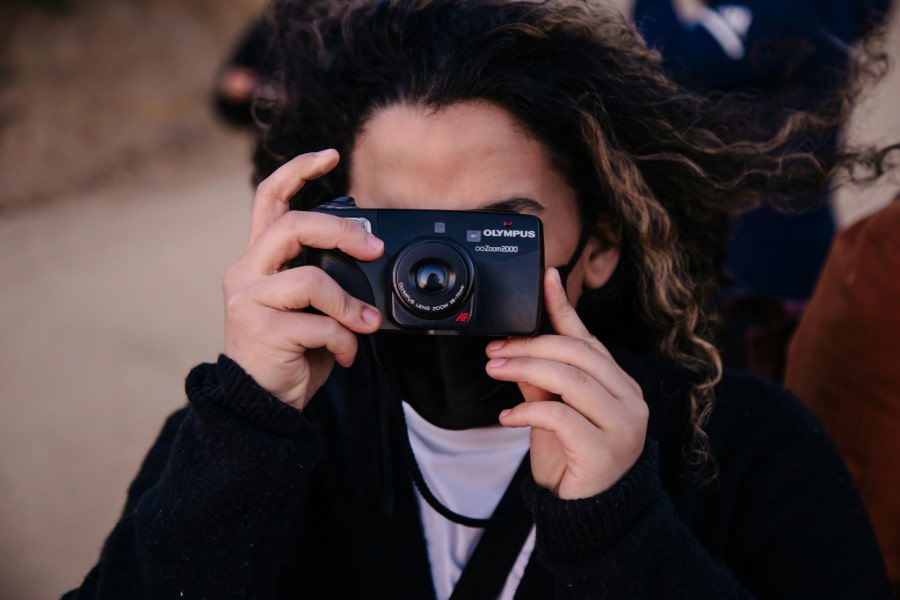
Photography has a unique language filled with phrases and terms that can be unfamiliar to beginners. Here’s a guide to some of the most common photography lingo and what each phrase or term means, helping you better understand the language of photography.
Slang & Culture
- Bokeh
The aesthetic quality of the out-of-focus areas in an image. It’s not just about how much blur there is, but how smooth and pleasing the blur circles appear. - Chimping
Checking each shot on the camera’s LCD immediately after taking it. While it helps verify exposure and focus, it can also distract you from capturing spontaneous moments. - Dust Bunnies
Dark spots that appear on images caused by dust particles settling on the camera’s sensor. They are most visible when shooting at narrow apertures (e.g., f/16). - Fast Glass
Lenses with a very wide maximum aperture (e.g., f/1.2, f/1.4, f/1.8), allowing for faster shutter speeds in low light. - G.A.S. (Gear Acquisition Syndrome)
The compulsive urge to buy new cameras, lenses, and accessories, often under the false belief that better gear will instantly improve one’s photography. - Glass
Slang for lenses. Photographers often say “invest in good glass” rather than “buy good lenses.” - Grip and Grin
A slang term for staged, uninspired photos where two people (usually at an event or award ceremony) shake hands and smile directly at the camera. - Nifty Fifty
Refers to a 50mm prime lens known for its versatility, affordability, and natural perspective. - Pixel Peeping
Zooming in to check every pixel for sharpness, noise, or detail. Useful for image quality checks but can detract from assessing overall composition. - SOOC (Straight Out Of Camera)
An image that has not been edited or processed in software like Lightroom or Photoshop. - Spray and Pray
Taking a rapid series of shots and hoping one turns out well. Often used in fast-action photography but leads to many images to review later. - TFP (Time for Print / Trade for Portfolio)
An arrangement where a photographer and a model work together for free, with the agreement that both parties receive the resulting photos for their portfolios. - The Holy Trinity
A set of three zoom lenses that cover most professional needs, typically a 14-24mm, 24-70mm, and 70-200mm, all with a constant f/2.8 aperture. - Uncle Bob
A colloquial term (usually at weddings) for a guest who brings their own professional-grade camera and gets in the way of the hired photographer, often blocking shots or distracting subjects.
Seeing dark spots on your own files? How to clean your camera’s sensor shows how to confirm it is sensor dust, then clean with a blower, brush or swab.
Technical & Exposure
- Aspect Ratio
The relationship between width and height in an image, like 4:3 or 16:9. Aspect ratio affects the composition and presentation of a photo. - Back Button Focus
Setting focus to a button on the back of the camera instead of the shutter button, improving control and speed in action photography. - Blown Out
Parts of a photo that are overly bright and lack detail, appearing pure white. This happens when exposure is too high and details cannot be recovered in editing. - Chromatic Aberration (Fringing)
A common optical problem where a lens fails to focus all colors to the same point, resulting in purple or green fringes around high-contrast edges. - Clipping
When data is lost in the highlights (pure white) or shadows (pure black). On a histogram, the graph usually “climbs the wall” on the far left or right. - Compression
The effect created by telephoto lenses that makes background elements appear closer to the subject, often used for portraits and wildlife. - Crushed Blacks
Shadow areas that have been darkened so much that all detail is lost, resulting in flat, pure black patches. - Diffraction
A reduction in sharpness that occurs when using very small apertures, such as f/22, which can soften fine details in high-resolution images. - ETTR (Expose to the Right)
A technique where you overexpose the image slightly (without clipping highlights) to push the histogram to the right. This maximizes the signal-to-noise ratio, resulting in cleaner shadows when corrected in post-production. - Exposure Triangle
Refers to the three core elements of exposure: aperture, shutter speed, and ISO. Adjusting any affects the final exposure of an image. - Focus Breathing
A phenomenon where the focal length of a lens appears to change slightly as you adjust the focus ring. It’s distracting in video but can also affect composition in focus stacking. - Histogram
A graph showing the distribution of tones in an image, from shadows (left) to highlights (right), helpful for assessing exposure accuracy. - Hyperfocal Distance
The specific focus distance that provides the maximum depth of field, keeping everything from half that distance to infinity acceptably sharp. - Inverse Square Law
A physics principle stating that light intensity drops off rapidly as the distance from the source increases. Doubling the distance from the light source quarters the light intensity. - Prime Lens
A lens with a fixed focal length, like 35mm or 85mm, often sharper and with a wider maximum aperture than zoom lenses. - Reciprocity Failure
Originally a film term, but relevant for very long exposures. It refers to the point where the linear relationship between light intensity and exposure duration breaks down, requiring more exposure time than the math would suggest. - Sunny 16 Rule
A rule of thumb for exposure without a light meter: On a sunny day, set your aperture to f/16 and your shutter speed to the reciprocal of your ISO (e.g., ISO 100, 1/100s). - Zone Focusing
A focusing technique where you preset a focus range, allowing for faster reaction times, especially in street or action photography. - Zoom Lens
A lens with a variable focal length, like 24-70mm, offering versatility without the need to change lenses.
Want to try back button focus yourself? Back button focus covers how to set it up and the common mistakes, and zone focusing shows how to pre-focus and shoot without autofocus.
Lighting & Studio
- Blue Hour
The time just before sunrise and after sunset when the sky takes on a blue hue, offering cool, even lighting for atmospheric photos. - Catchlight
The small light reflection in a subject’s eyes, which adds life and depth to portraits. Positioning a light source correctly enhances catchlights. - Fill Light
A secondary light source used to lighten shadows created by the main (key) light, reducing contrast. - Flag
A black board or cloth used to block light from hitting specific areas of the scene or to prevent lens flare. - Gobo (Go-Between Object)
A stencil or template placed in front of a light source to project a specific pattern or shape onto the background or subject. - Golden Hour
The period shortly after sunrise and before sunset when the light is soft and warm, perfect for portraits and landscapes. - Hard Light
Light that creates sharp shadows and high contrast, usually from a direct light source like the sun or a flash, often adding drama. - High Key
A style of lighting that is bright and lacks strong shadows, often resulting in a blown-out white background. - Lens Flare
An effect caused by light scattering within the lens, creating streaks or spots. It can be an unintended issue or used creatively for atmospheric shots. - Low Key
A style of lighting that emphasizes shadows and contrast, often with a dark or black background. - Rim Light
Lighting positioned behind the subject that illuminates their outline/edges, separating them from the background. Also called a hair light or kicker. - Scrim
A translucent material used to diffuse and soften harsh light, often placed between the sun (or a strobe) and the subject. - Soft Light
Light that produces gentle, diffused shadows and is ideal for flattering portraits. Achieved with cloud cover, diffusion panels, or bounced light. - Spill
Unwanted light falling where it isn’t intended, often controlled using barn doors or flags.
Want to see how these light terms combine on a face? Portrait lighting patterns covers loop, Rembrandt, split and butterfly lighting, and catchlight shows how to create them.
Technique & Composition
- Bracketing
Taking the same shot multiple times with different settings (usually exposure) to ensure at least one is correct or to combine them later (HDR). - Dragging the Shutter
Using a slow shutter speed combined with flash. The flash freezes the subject, while the slow shutter allows the ambient background light to bleed in. - Focus Stacking
Taking multiple images at different focus distances and blending them in post-processing to achieve a depth of field that is impossible with a single shot (common in macro and landscape). - Forced Perspective
A technique that uses optical illusion to make objects appear larger, smaller, closer, or farther away than they actually are (e.g., holding up the Leaning Tower of Pisa). - Leading Lines
Visual lines within an image that guide the viewer’s eye toward the main subject, often adding depth. Created by paths, roads, or architectural elements. - Leading Room
The space left in front of a moving subject or where a subject is looking, providing balance and direction in the composition. - Negative Space
The empty space around the main subject. Using negative space can create a sense of minimalism, isolation, or scale. - Panning
A technique where the camera follows a moving subject, keeping it in focus while blurring the background for a sense of motion. - Rule of Thirds
A composition guideline dividing the frame into nine parts. Placing subjects along these lines or intersections creates a balanced, visually engaging photo. - Shooting Wide Open
Using the lens’s widest aperture to let in the most light, creating a shallow depth of field for blurred backgrounds. - Stopping Down
Narrowing the aperture to reduce light intake and increase depth of field, making more of the scene appear in focus.
Curious how these techniques are actually done? Focus stacking shows how to shoot and merge a stack, and forced perspective photography covers classic setups and distance ratios.
Post-Processing
- Artifacts
Visual distortions or noise in an image, often caused by aggressive JPEG compression or over-editing. - Banding
Visible steps or lines in a gradient (like a blue sky) where the color transition should be smooth. This often happens when pushing 8-bit files too hard. - Dodge and Burn
A technique (originating from the darkroom) of selectively lightening (dodging) and darkening (burning) specific areas of an image to guide the eye and add depth. - Reticulation
A film photography term describing a cracked or wrinkled effect from rapid temperature changes during processing, giving images a textured look. - Vignetting
A reduction of an image’s brightness or saturation toward the periphery compared to the image center. It can be an optical flaw or an artistic choice to draw attention to the center.
Want to try dodge and burn on your own images? Dodging and burning shows how in Lightroom and Photoshop, for portraits and landscapes.
Video & Audio
- Dead Cat
A furry microphone cover used to reduce wind noise in outdoor audio recording, commonly used in videography.
Getting familiar with photography lingo can help you understand technical aspects of the craft more deeply and connect with other photographers. Keep this guide handy, and soon you’ll be fluent in the language of photography!
See also Photography Glossary