
Photojournalism examples are photographs that report something real, then reward a close look at how they do it. For each picture, ask what story it tells, when the shutter was pressed, what sits inside the frame, and what the caption must add. This page teaches that way of reading, through written analysis of well known news pictures and ordinary scenes you can practice with.
The overview of photojournalism covers what the work is, its history, and the ethical rules that hold it together. This page stays with the pictures themselves. It does not republish famous copyrighted news photographs. It describes how those pictures work, points you to the photographer guides already on this site, and uses everyday scenes to show the same habits of timing, framing and context.
What to look for in a news photograph
A useful example is not just a dramatic picture. It is a picture you can take apart. Four questions keep that work honest and specific.
| Question | What you are really asking |
|---|---|
| Story | What is happening, and why should a stranger care? |
| Timing | Why this instant, and not a second earlier or later? |
| Framing | What was included, what was left out, and from where was it seen? |
| Context | What must the caption add so the picture is not misunderstood? |
Story comes first because a news photograph has a job. It has to report. That does not mean it has to be a war or a disaster. A market stall, a flooded street, or a tired worker at the end of a shift can all carry a story if the picture is clear about what is going on. If you cannot say the story in one plain sentence, the example is not teaching you much yet.
Timing is the instant the shutter was pressed. In some pictures that instant is obvious: a splash, a handshake, a train arriving. In others it is quieter, a pause in a face or a gap in a crowd. Either way, the photographer had to be ready before it happened. Shutter speed is part of that readiness, but it is not the whole of it. Position and patience matter as much as the number on the dial.
Framing is the set of choices that turn a scene into a rectangle. Distance, height, and what sits at the edges all change the meaning. A wide view can show cause and setting. A tight view can isolate one fact. Neither is automatically better. The question is whether the frame serves the story. The guide to framing in photography is useful here, and so is the wider page on composition, as long as you remember that a news picture is not only a design problem.
Context is everything the photograph cannot say by itself. Names, places, causes, and what happened just out of view belong in the caption. An example that is shown without a caption is only half an example. When you study a well known picture, read the caption as carefully as you read the image.
Want the definition, history and ethics before you study individual pictures? Start with the photojournalism overview, then come back to the examples.
How famous pictures work
The best known photojournalism examples are famous because they are clear, not because they are mysterious. You can learn from them without putting the copyrighted prints on this page. Look the pictures up in a book, a museum, or the photographer’s official archive when you want to see the print itself. What follows is a way to read a few of them, then apply the same questions to work you make.
A face, two children, and a camp: Dorothea Lange
Dorothea Lange‘s photograph often called Migrant Mother shows a woman in a pea pickers’ camp, one hand raised to her cheek, two children turned into her shoulders. The story is not only hardship. It is a parent holding a family together in a place that has already failed them. The timing is a pause, not an action: she is thinking, and the children have hidden their faces. The framing is tight enough that the camp almost disappears, which is why the caption has so much work to do. Without the place, the crop, and the facts of the camp, a viewer can turn the picture into a general symbol and lose the actual people. That tension between a strong face and a complete context is one of the most useful lessons in the whole tradition.
Being close when it happens: Robert Capa
Robert Capa‘s best known war pictures are often slightly imperfect: a falling soldier from the Spanish Civil War, or the grainy, tilted frames from the American landing on Omaha Beach. The lesson is not that blur is stylish. The lesson is that the photographer was close enough, and early enough, for the instant to be visible at all. Timing here is physical. If you wait for a clean background, you miss the thing you came to report. When you study these frames, ask what would have been lost if the camera had been farther back, and what the softness or tilt still leaves unambiguous.
Scale, access and a single frame: Margaret Bourke-White
Margaret Bourke-White made pictures of industry, war and daily life that often depend on access and scale. A worker or a line of people can be small in a huge space, or a single figure can be set against a dam, a factory, or a ruined street. The story is frequently about systems as much as about one face. Framing does the reporting: where she stood decided whether you see a person, a process, or both. When an example has this kind of scale, check the edges. The environment is not decoration. It is part of the sentence the picture is speaking.
A story that needs more than one picture: W. Eugene Smith
Some of the most important photojournalism examples are not single icons. They are essays. W. Eugene Smith built long sequences in which an establishing picture, a close detail, a moment of work, and a quieter aftermath all have jobs to do. One frame can win attention. A set can explain a life or a place. If you only collect isolated “great shots,” you miss this habit. The guide to a photo essay is the practical companion to that idea, and building a photo story or series goes further on order and variety.
Other photographer pages on this site are worth reading in the same way, including Lewis Hine, Weegee, Lee Miller, Josef Koudelka and James Nachtwey. In each case, use the four questions. Do not stop at admiration.
Timing: being ready when something changes
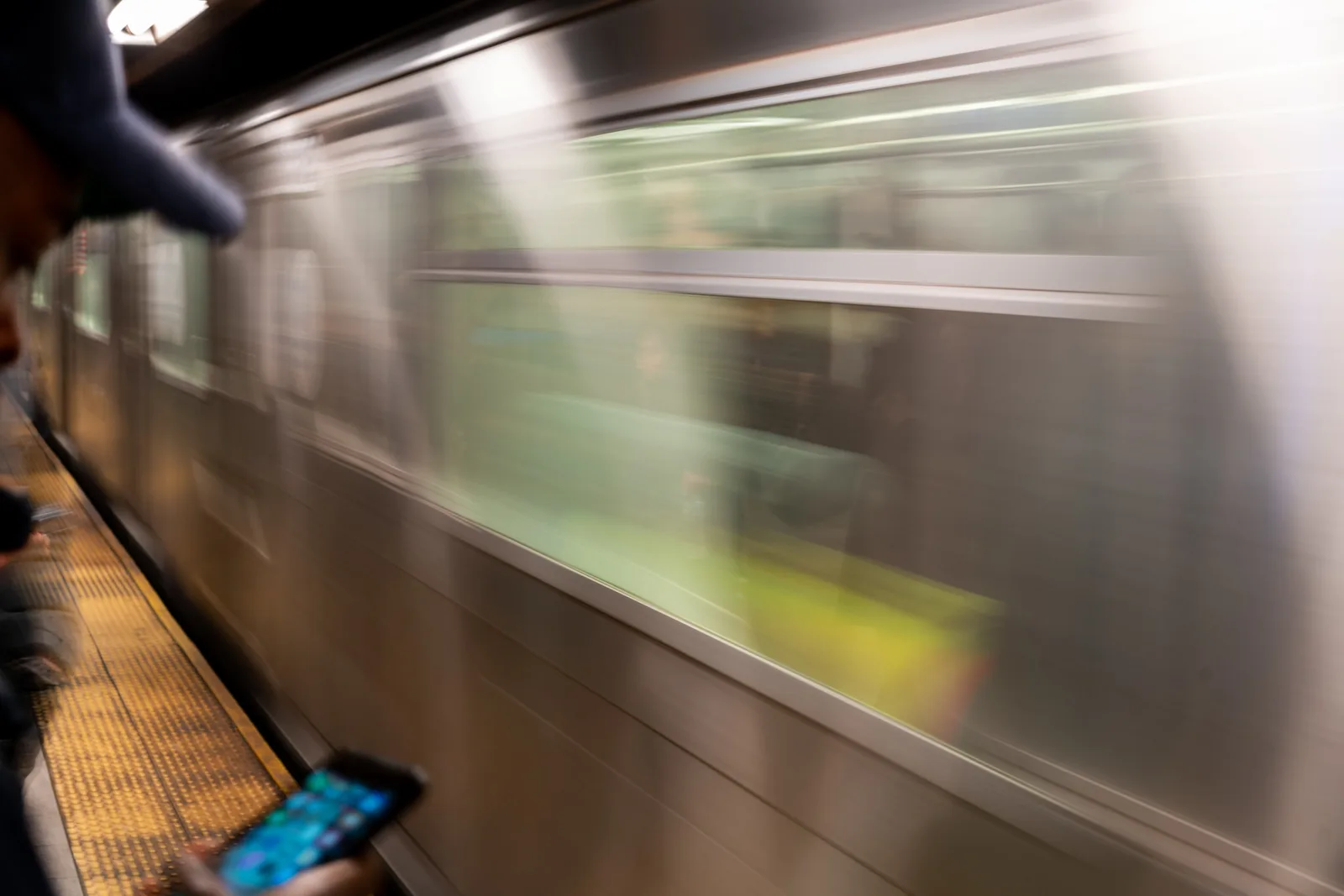
Timing is easier to see in an ordinary place than in a famous battle picture, because you can still go and try it. On a subway platform, a train is either approaching, present, or gone. A long shutter speed, here about a second, turns the train into a streak and leaves the person on the platform more solid. A short shutter speed would freeze both. Neither picture is the only honest one. Each reports a different fact: waiting, or the train as a moving object. The photographer had to choose before the train arrived.
That is the habit to steal from the well known examples. The photographer was in position, with a decision already made about shutter speed, before the change happened. Anticipation matters more than reflexes. Watch a doorway, a counter, or a platform for a few minutes and you will start to feel the rhythm: who is about to move, where the gap will open, when the light will hit a face. Street photography trains some of the same muscles, though its aims are not always journalistic.
When you study an example, try to name the change. Was it a gesture, a collision of two paths, a shift in weather, a pause? If you cannot name it, you may be looking at a pleasant picture that does not actually turn on timing. That is useful to notice too.
Framing: what stays in and what is left out
The antique stall at the top of this page makes the point without a person in the frame. Books stacked in a window, a gold mirror, a landscape painting, teacups, candles and small figurines report a kind of street market and a kind of taste. The photographer stood close enough that you can read object after object, and still wide enough that the shop window remains as a setting. One step back would have added pavement and passersby. One step in would have made a still life of the teacups alone. Either change would have told a narrower or a looser story.
Famous news pictures use the same kind of choice, often under more pressure. A tight frame can honor one person and hide the cause. A wide frame can show the cause and shrink the person to a shape. When you read an example, ask who benefits from the crop. Then ask what a second frame from a different distance would have added. Visual storytelling is largely this work of deciding what the viewer is allowed to see.
Height and angle matter as well. Looking slightly down on a stall or a bed can feel factual, like an inventory. Looking up at a speaker or a monument can feel like power. Neither angle is a trick by itself. It becomes a problem only when it sneaks in a judgment the facts do not support. The page on photography angles will help you notice the habit in your own pictures.
Context, captions and the facts a picture cannot show
A photograph is strong at showing what something looked like and weak at naming it. It cannot tell you the town, the date, or what happened a minute earlier. That is why photo captions are part of the example, not an afterthought. A fair caption adds who, what, where and when, and it does not argue for a conclusion the frame does not support.
This is also where photography ethics and retouching ethics meet the study of examples. If a picture has been cropped to remove an inconvenient detail, or lightened in a way that changes the weather or the mood of a crowd, the example has been altered. When you read a historic picture, learn whether the published version was cropped, and whether later prints changed the edges. The honest version of an example includes that history.
Documentary photography shares the same duty to the facts, even when it is not made for a news desk. If you are comparing examples from news and from longer documentary work, keep the caption test in both cases: would a careful reader be misled?
Need the caption to carry the facts the picture cannot show? How to write photo captions walks through a clear, fair caption, including what to put in the file.
Practicing with ordinary scenes
You do not need a press pass to practice the habits these examples teach. You need a public place, a little time, and the refusal to stage what you find. A shop window, a bus stop, a market, a station platform, or a weather change on your own street will do. The point is not to imitate a war photograph. The point is to report what is actually there, clearly.
Build a tiny set, the way an essay photographer would, even if you only have fifteen minutes. Make one picture that establishes the place. Make one picture of a telling detail. Make one picture in which something changes: a person arrives, a shutter is pulled down, a train passes, a light shifts. Then write a two-sentence caption for each frame. If the captions all say the same thing, your pictures are repeating themselves. If a caption has to do all the work, the picture is vague.
Edit with a light hand. Straighten a horizon, set a fair brightness, and stop. The page on photo retouching ethics is the standard to keep, even when the pictures will only be seen by you. You are training the same honesty the famous examples are praised for.
Ready to turn a handful of clear pictures into a short story? How to create a photo essay shows how to order establishing shots, details and a close.
Common mistakes
Studying only the icons, then copying their poses. Fix: use the famous pictures to learn questions, not costumes. If you find yourself asking someone to turn their face and hold a hand to a cheek, you have left photojournalism and started a portrait session. The example taught you about framing and context, not about a pose to reuse.
Showing the picture and skipping the caption. Fix: treat the caption as part of the work. If you cannot write who, what, where and when, you do not yet understand the example, and you should not publish your own picture as reportage.
Cropping until the cause disappears. Fix: make a second, wider frame every time you make a tight one. Compare them later. Keep the version that tells the story, even if the tighter one looks more dramatic.
Staging a “news” moment because the real one was messy. Fix: wait, or come back, or admit that this was not the picture. A set-up scene presented as a found one breaks the trust that gives this kind of photograph its meaning.
Cleaning the file until it looks like advertising. Fix: keep the weather, the dirt, and the color of the actual light. Technical cleanup that changes what happened is not a small edit. It is a different picture.
Confusing a single striking frame with a finished piece of reporting. Fix: when the story is larger than one instant, make the set. An establishing picture and a detail will often do more work than one more close-up of the same face.
Try this: a 15 minute news walk
Pick one ordinary public place you can reach quickly: a shopfront, a station, a park entrance, or a market aisle. Stay in that one place for fifteen minutes. Do not chase events down the street.
- Before you raise the camera, write one sentence: what is happening here?
- Make one establishing picture that a stranger could use to recognize the place.
- Make one detail picture of an object, sign, or surface that supports that sentence.
- Wait for a change, even a small one, and photograph it without asking anyone to repeat it.
- Write a two-sentence caption for each of the three pictures, with who, what, where and when as far as you honestly know them.
Then look at the set as if you were a reader. Is the story in the pictures, or only in your notes? If you had to keep just two frames, which two would still report the place? That short edit is the same kind of judgment used on a news desk, and it is the best way to make the famous examples useful rather than distant.
Frequently asked questions
What are some examples of photojournalism?
Any photograph that reports a real event or situation, with a fair caption, can be an example. The well known ones include Lange’s Migrant Mother, Capa’s war pictures, Bourke-White’s magazine work, and Smith’s long essays. Everyday examples work too: a weather story, a local market, a transit delay, a public meeting. The test is reporting, not fame.
Can famous news photographs be reused on a website?
Usually not, unless you have permission or a clear legal basis. The famous examples are almost always copyrighted. You can describe them, link to a photographer’s own page or a museum, and learn from their structure. You should not paste the scans onto your own site and call that study.
How do you analyze a photojournalism example?
Ask what story it tells, why the shutter was pressed at that instant, what the frame includes and leaves out, and what the caption must add. Then ask what a second picture from a different distance or a minute later would have changed. Write the answers in plain sentences. If you cannot, keep looking.
Is street photography the same as photojournalism?
No. They share public places, quick timing, and an interest in unposed life, and street photography is good practice. Photojournalism has a reporting job and a caption that has to be accurate. A street photograph can be suggestive or open ended. A news photograph should not leave the facts to guesswork.
Do photojournalism examples have to come from wars or disasters?
No. Conflict pictures are often the ones people remember, but work, weather, daily life, and public process are all legitimate subjects. In fact, practicing on quieter scenes is how you learn timing and framing before you are in a difficult place. The ethics still apply.
Can a phone take a photojournalistic picture?
Yes. The duty is to the facts, the timing, the frame and the caption, not to a particular kind of camera. A phone is enough for a clear, honest picture of something in front of you. What it cannot replace is being there, waiting, and writing down what the picture does not show.
Related guides
- Photojournalism is the overview of the practice, its history and its rules.
- Photojournalism as a career is for readers who want the work itself, not only the pictures.
- Documentary photography covers longer, slower reporting with the same duty to the truth.
- How to create a photo essay shows how to build a story from more than one frame.
- Photo captions teach the words that keep an example accurate.
- Photography ethics and retouching ethics are the standards behind every honest example.
- Visual storytelling helps you think about what a sequence of pictures can say.