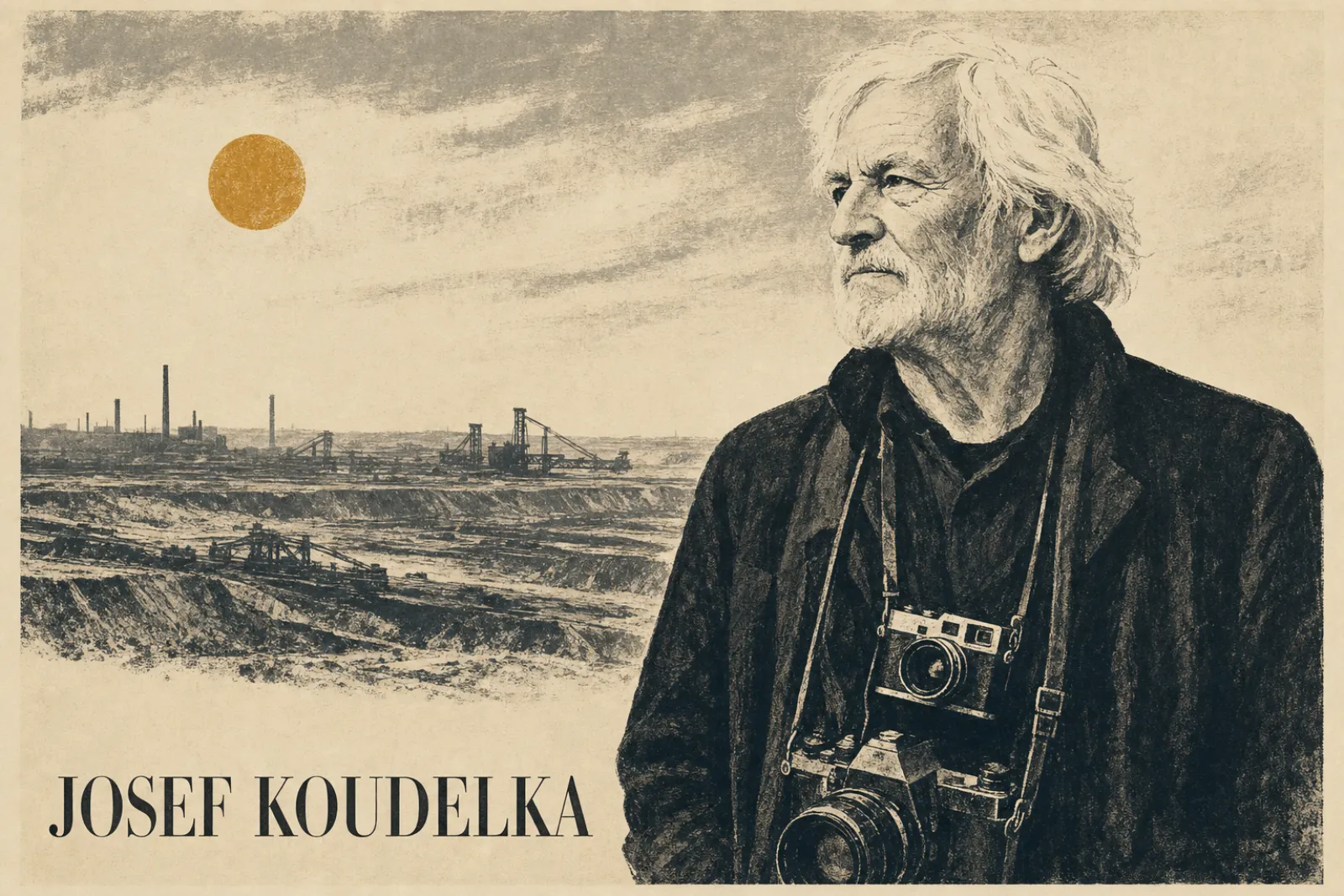
Josef Koudelka is a Czech born photographer, later a French citizen, who trained as an aeronautical engineer and left engineering for the camera in 1967. He worked in black and white across Europe, on long projects of his own. Three bodies of work carry his name: a nine year study of Roma communities, his pictures of the 1968 invasion of Prague, and wide panoramas of land damaged by industry and conflict.
Koudelka was born on 10 January 1938 in Boskovice, Moravia, and made his first pictures as a student with a 6×6 Bakelite camera. His degree was in engineering, not photography. His training was the stage, where he learned to work fast and close. The Czech art historian Anna Farova supported him, and Henri Cartier-Bresson became a friend and backer. Elliott Erwitt, then president of Magnum, arranged for him to stay at the London flat of David Hurn, where he lived and used the darkroom for years. Through the 1970s and 1980s he sustained his own projects through grants and awards.
From the engineering office to the theatre and the Roma camps
Koudelka started at the Czech Technical University in Prague in 1956 and took his engineering degree in 1961, the year of his first exhibition. He worked as an aeronautical engineer in Prague and Bratislava and photographed in his spare time. Theatre magazines gave him commissions, and he became a regular at Prague’s Theatre Behind the Gate, photographing productions with a Rolleiflex. He moved among the actors during rehearsal instead of sitting in the stalls, and that habit of standing inside the action stayed with him.
In 1962 he began photographing Roma communities, first in Slovakia, Moravia and Bohemia and later in rural Romania, Hungary, France and Spain. He kept at it until 1971. He travelled with a rucksack and a sleeping bag and spent very little. The pictures were shown in Prague in 1967, and in the same year he gave up engineering. The work is documentary photography built over years of return visits, and it reads that way: the photographer is inside the homes and the gatherings, close to the people, and plainly not on a first visit.
Wondering how a project gets from a first visit to a finished body of work? How to create a photo essay covers planning, variety of shots, editing and sequence.
Prague, August 1968, signed P.P.
Koudelka came back from photographing in Romania two days before Warsaw Pact forces entered Czechoslovakia in August 1968. He went into the streets of Prague and photographed the tanks, the soldiers and the crowds who confronted them, climbing onto the vehicles and standing among the protesters. The negatives were smuggled out of the country and reached Magnum, and the pictures ran in The Sunday Times Magazine credited only to “P.P.”, for Prague Photographer, to protect him and his family.
In 1969 the Overseas Press Club gave its Robert Capa Gold Medal to the anonymous Czech photographer. Koudelka was not publicly named as the author until 1984. The complete set was published as a book, Invasion 68: Prague, in 2008. The pictures sit on the border between photojournalism and personal witness: he had no editor, no deadline and no brief.
Exile, statelessness and the long frame
In 1970 Koudelka left Czechoslovakia on a three month working visa, went to England and applied for political asylum. He was stateless for years. He became an associate member of Magnum in 1971 and a full member in 1974. His first book appeared in 1975 in two editions, Gitans: la fin du voyage from the French publisher Robert Delpire and Gypsies from Aperture in New York.
Through the 1970s and 1980s he moved around Western Europe by season, photographing Roma gatherings, festivals and the places in between. That work became Exiles in 1988, with an essay by the poet Czesław Miłosz. He took French citizenship in 1987 and went back to Czechoslovakia for the first time in 1990.
In 1986, while taking part in a French government photographic mission, he began using a panoramic camera, and the land itself became his subject: ground that had been mined or scarred by industry and conflict. From 1990 to 1994 he photographed the Black Triangle, the wasted industrial landscape at the foot of the Ore Mountains in Bohemia. A compilation of the panoramas was published as Chaos in 1999. Wall, in 2013, gathered pictures made from 2008 to 2012 along the barrier in the West Bank, and Ruines followed in 2020. His awards include the Prix Nadar in 1978, the Grand Prix National de la Photographie from the French Ministry of Culture in the late 1980s, the Grand Prix Henri Cartier-Bresson in 1991 and the Hasselblad Award in 1992.
How a Koudelka picture holds together
The first choice is distance. The theatre taught him to work alongside the people he photographed, and in the Roma pictures and in Prague he is within a few steps of everyone in the frame. Close range means the nearest figure is large, the room or street spreads out behind, and the viewer stands where he stood.
Want to know what a wide view does when you are that close? How to use a wide-angle lens explains why near things grow, far things shrink and edges stretch.
The second choice is time. Nine years on one subject meant he could wait for a picture instead of taking the first one offered. In exile he returned by season to the same kinds of gatherings and festivals, year after year. Timing in his pictures is less about speed than about being there often enough. The page on the decisive moment makes a related point, that the peak of a scene can be quiet and that anticipation matters more than reflexes.
The third is tone. Koudelka’s work is in black and white. Without colour, a picture has to rest on shape, contrast and the placing of light against dark, and a crowded scene has to be organised by those alone.
The fourth is the shape of the frame. The panoramic camera gave him a picture far longer than a normal frame, and he used it for mined ground, walls and ruins. A very long aspect ratio forces a decision about what runs the length of the frame, such as a road, a wall or a horizon, and what interrupts it. His panoramas came from a camera built for the format, a different thing from a stitched panorama assembled from several frames, though the compositional problem is the same.
Curious how land without people can still carry a story? Landscape photography covers light, foreground and the placing of the horizon.
The last choice is the book. Gypsies, Exiles and Chaos each gathered the work of many years, and the order of the pictures does as much work as any one of them. Photo book design looks at sequence, pacing and layout.
Photographs and books to look for
- Gypsies (photographed 1962 to 1971, published 1975). His first book and the work of nine years. In each picture, ask how far he was from the nearest person and how much of the room or yard he kept in the frame.
- Invasion 68: Prague (photographed 1968, published 2008). He was on the tanks and in the crowd, not across the street. Notice where he must have been standing for each frame, and how close that put him to both soldiers and protesters.
- Exiles (1988). Made while he was stateless and moving around Western Europe. Read it as a sequence and watch how the order of the pictures builds a feeling that no single frame states.
- Black Triangle (1990 to 1994). Panoramas of the industrial landscape below the Ore Mountains, made after his return to Czechoslovakia. Follow the one line that runs the length of each frame and see what cuts across it.
- Chaos (1999). The compilation of his panoramic work from 1986 onward. Compare it with Gypsies to see what changes when the frame gets long and the subject becomes land.
- Wall (2013). Panoramas made from 2008 to 2012 along the barrier in the West Bank. The wall is at once the subject and the line that organises the picture.
Try this: one place, three distances, black and white
Give yourself 20 minutes and one small public place: a market stall row, a playground edge, a bus shelter. Set the camera or phone to black and white and to its widest view. Do not zoom.
- Take five frames from across the street, where most people would stand.
- Halve the distance and take five more. Put one person or object large at one side and let the place fill the remainder.
- Halve it again, until the nearest thing is about two metres away, and take five more. Keep the camera level.
- Turn the phone to panorama crop, or crop one frame afterwards to a strip about three times as wide as it is tall. Find the one line that crosses the whole strip.
Compare the three distances. The closest set will feel different in kind, and the long crop will show whether the scene had a line strong enough to carry it.
Questions people ask about Josef Koudelka
Why were the Prague 1968 photographs published anonymously?
Koudelka and his family were still in Czechoslovakia, and naming him would have put them at risk. The pictures were credited to “P.P.”, for Prague Photographer, and the 1969 Robert Capa Gold Medal was awarded to an unnamed Czech photographer. He was first publicly credited in 1984.
What camera did Josef Koudelka use?
He began with a 6×6 Bakelite camera as a student and used a Rolleiflex for his theatre work in Prague. From 1986 he worked with a panoramic camera for his landscapes. He photographed in black and white throughout.
When did Koudelka join Magnum Photos?
He left Czechoslovakia in 1970, after his Prague negatives had already reached Magnum. He became an associate member in 1971 and a full member in 1974.
What is Koudelka’s book Gypsies about?
It is a record of Roma communities, photographed from 1962 to 1971 in Czechoslovakia and then in Romania, Hungary, France and Spain. It was published in 1975 in French and American editions, and a revised edition followed decades later.
Koudelka is one of many photographers profiled in the A to Z of photographers.