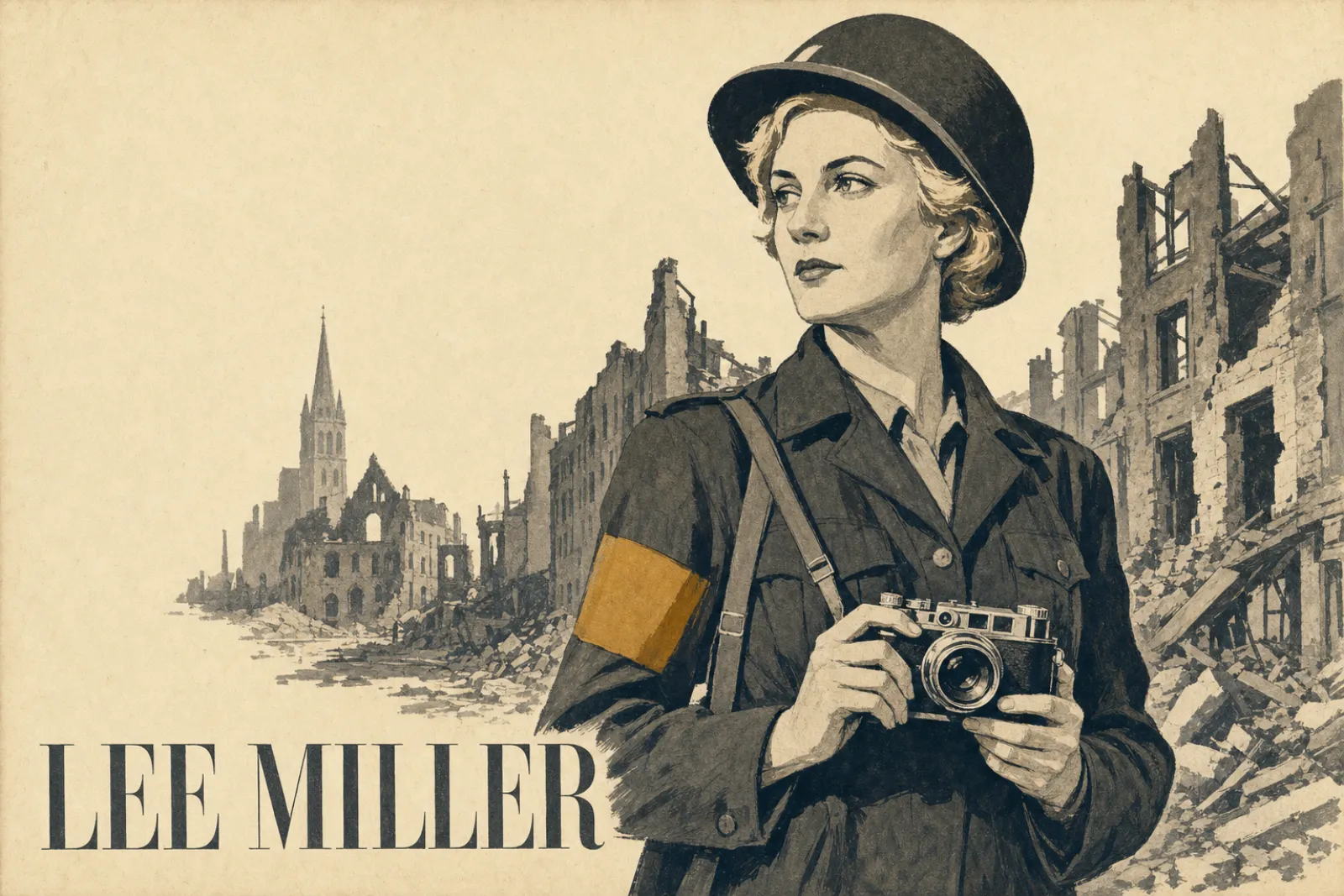
Lee Miller (1907 to 1977) was an American photographer who worked in Paris, New York, Cairo and London, and then across Europe as a war correspondent. She made Surrealist studio pictures, fashion pages for Vogue and desert views in Egypt. She is best known for the photographs and reports she sent to Vogue in 1944 and 1945, from the siege of Saint-Malo to the liberated camps at Buchenwald and Dachau.
Miller stood on both sides of the camera. In New York in the late 1920s she was a model, photographed by Edward Steichen among others. In 1929 she went to Paris and became the student, model and partner of Man Ray. From him she took the Surrealist habit of looking for the strange inside the ordinary, and she kept it when her subject changed from studio portraits to bombed streets. Her war pictures can be set beside those of Don McCullin, who covered later wars for a British magazine audience.
From the model’s chair to her own studio
Miller was born in Poughkeepsie, New York, on 23 April 1907. Her father was a keen amateur photographer who put a darkroom into the family home, and she had a Kodak Brownie as a child. She went to Paris in 1925 to study stage design, then returned to New York and studied at the Art Students League. In March 1927 she appeared on the cover of Vogue in a drawing by Georges Lepape, and for two years she was one of the most sought after models in the city.
In 1929 she moved to Paris to learn photography from Man Ray. She worked in his studio and darkroom, and by 1930 she had a studio of her own in Montparnasse, and her pictures began to appear in French Vogue. The two of them worked out how to use the Sabattier effect, which they called solarisation, as a controlled technique. She also acted in Jean Cocteau’s film The Blood of a Poet.
Miller left Paris in 1932 and opened Lee Miller Studios, Inc. at 8 East 48th Street in New York, which she ran with her younger brother Erik. The studio made portraits and advertising pictures, and the dealer Julien Levy showed her work at his gallery. In 1934 she closed it, married the Egyptian businessman Aziz Eloui Bey and moved to Cairo.
Wondering how a studio portrait is lit and posed in the first place? Portrait photography covers light, lenses and working with a sitter.
Egypt, London and the Blitz
In Cairo Miller at first put the camera away. She took it up again for her own pleasure, and on long trips into the desert she made some of her most Surrealist pictures: plain views of sand, rock and villages, framed so that they look slightly impossible. In 1937 she met the British Surrealist painter Roland Penrose in Paris. In 1939 she left Egypt and joined him in London, shortly before the war began.
She offered her services to British Vogue and became one of its main photographers. She shot fashion in the studio and on location in a city under air attack, and she photographed the damage itself. Her pictures of the Blitz appeared in the 1941 book Grim Glory: Pictures of Britain Under Fire, and the Museum of Modern Art in New York included her in its exhibition Britain at War the same year. These pictures treat wreckage the way a Surrealist treats a found object. They are odd, exact and sometimes funny.
Vogue’s correspondent at the front
At the end of 1942 Miller was accredited as a war correspondent with the United States forces, working for Condé Nast. Her first stories, in 1943, were about American army nurses and other women in uniform in Britain. After D-Day in 1944 she crossed to France. She was sent to Saint-Malo having been told the town was already liberated, and found a siege still going on. She stayed and photographed it. She went on to the liberation of Paris, the fighting in Luxembourg and Alsace, and into Germany.
In April 1945 she entered Buchenwald and then Dachau, often working alongside David E. Scherman of Life magazine. She sent her film and her written report to London with a plea to her editor, Audrey Withers, to believe that what she had seen was true. Vogue published the pictures. On 30 April 1945, the day she visited Dachau, Scherman photographed her in the bath of Hitler’s apartment in Munich. She then photographed the aftermath of the war in Austria, Hungary and Romania, and returned to London in February 1946.
How does reporting with a camera differ from making pictures for yourself? The photojournalism page sets out what the job asks of a photographer.
Miller married Penrose in 1947, and their son Antony was born that year. In 1949 the family moved to Farleys House in Chiddingly, East Sussex. She kept working for Vogue until the early 1950s, then turned her energy to cooking and photographed only now and then. She died at Farleys on 21 July 1977.
How Miller’s pictures are built
She put a frame inside the frame. In Portrait of Space the desert is seen through a torn fly screen. Miller shot through something, so that the opening becomes part of the subject. This is the oldest trick in framing, and she used it to make the viewer aware of looking.
She looked for the wrong thing in the right place. Fashion in a bombed city, a face hidden behind a fire mask, a pair of combat boots on a dictator’s bathmat. The pictures work by juxtaposition: two things that do not belong together, held in one frame without comment.
She used the darkroom as a second camera. Solarisation comes from briefly exposing a partly developed print or negative to light. Some tones reverse, and a thin dark line appears along the edges of the figure. Miller used it on portraits and, as late as 1942, on a fashion picture made in the Vogue studio in London. It belongs to the family of alternative processes that depend on a wet darkroom.
She stayed plain when the subject was terrible. The camp photographs were made as evidence, and she begged her editor to believe them. Miller had spent fifteen years learning how to make a picture strange. Here she did the opposite and let the facts carry it. Knowing when to stop composing is part of the ethics of photographing people who are suffering.
She wrote as well as photographed. Vogue ran her pictures with her own text, so picture and word were made by the same witness. The words say what the camera cannot, and the pictures prove the words.
Want to know what a caption should say and what it should leave to the picture? Writing photo captions walks through it.
Photographs to look for
- Woman with hand on head (Coiffure), Paris, 1931. A studio picture from her Paris years. The title names what to look at: a head and a hand, treated as shapes before they become a person.
- Portrait of Space, near Siwa, Egypt, 1937. The desert seen through a torn fly screen. Notice the three layers: the screen, the hole, the far horizon. The landscape is the background of its own picture.
- Fire Masks, Downshire Hill, London, 1941. Made in the street where she lived during the Blitz, it shows the protective masks issued to fire watchers. It is a wartime information picture and a Surrealist portrait at once, because the masks remove the faces.
- David E. Scherman dressed for war, London, 1942. A portrait of her colleague in a gas mask. See how she lets equipment take over the figure, a joke with something serious under it.
- The siege of Saint-Malo, 1944. A set of pictures made over five days at the front, in a town she had been told was already liberated. Look at how the set moves between the wide view of the fighting and the people caught in it.
- Lee Miller in Hitler’s bathtub, Munich, 30 April 1945. Taken by Scherman and carefully staged. Her combat boots, muddy from Dachau that morning, stand on the bathmat, and a portrait of Hitler is propped on the edge of the tub. The objects in the frame were placed to carry meaning.
Curious how pictures like the Saint-Malo set are put into an order that tells a story? How to create a photo essay explains the building blocks.
Try this: a portrait of space
Take 15 minutes and one rule: every picture must be shot through something. Use a window with a torn blind, a gap in a fence, a car windscreen, a doorway, a hole in a hedge.
- Find an opening with a view behind it. Stand so that the opening fills about a third of the frame.
- Make three pictures: one focused on the opening itself, one focused on the far view, one from a step to the side so the two no longer line up.
- Repeat with two more openings. Do not include any people.
- Look at the nine frames together. Pick the one where the near layer changes how the far layer reads, and work out why.
Questions people ask about Lee Miller
Did Lee Miller invent solarisation?
No. The effect was already known as the Sabattier effect. Miller and Man Ray rediscovered it in his Paris darkroom around 1929 to 1930 and turned an accident into a method they could repeat, which is why it is linked with both of them.
Who took the photograph of Lee Miller in Hitler’s bathtub?
David E. Scherman, a Life photographer who worked alongside her, took it on 30 April 1945 in Hitler’s apartment in Munich. Miller had been at Dachau earlier that day.
What happened to her photographs after she died?
Her family found about 60,000 negatives, prints and documents stored in the attic at Farleys House. Her son Antony Penrose built the Lee Miller Archives from them and published the biography The Lives of Lee Miller in 1985. In 1992 he edited Lee Miller’s War, a book of her wartime pictures and writing.
Is the film Lee about her?
Yes. Lee, directed by Ellen Kuras with Kate Winslet in the title role, is based on Antony Penrose’s biography and concentrates on her years as a war correspondent.
Lee Miller is one of many photographers in the A to Z of photographers.