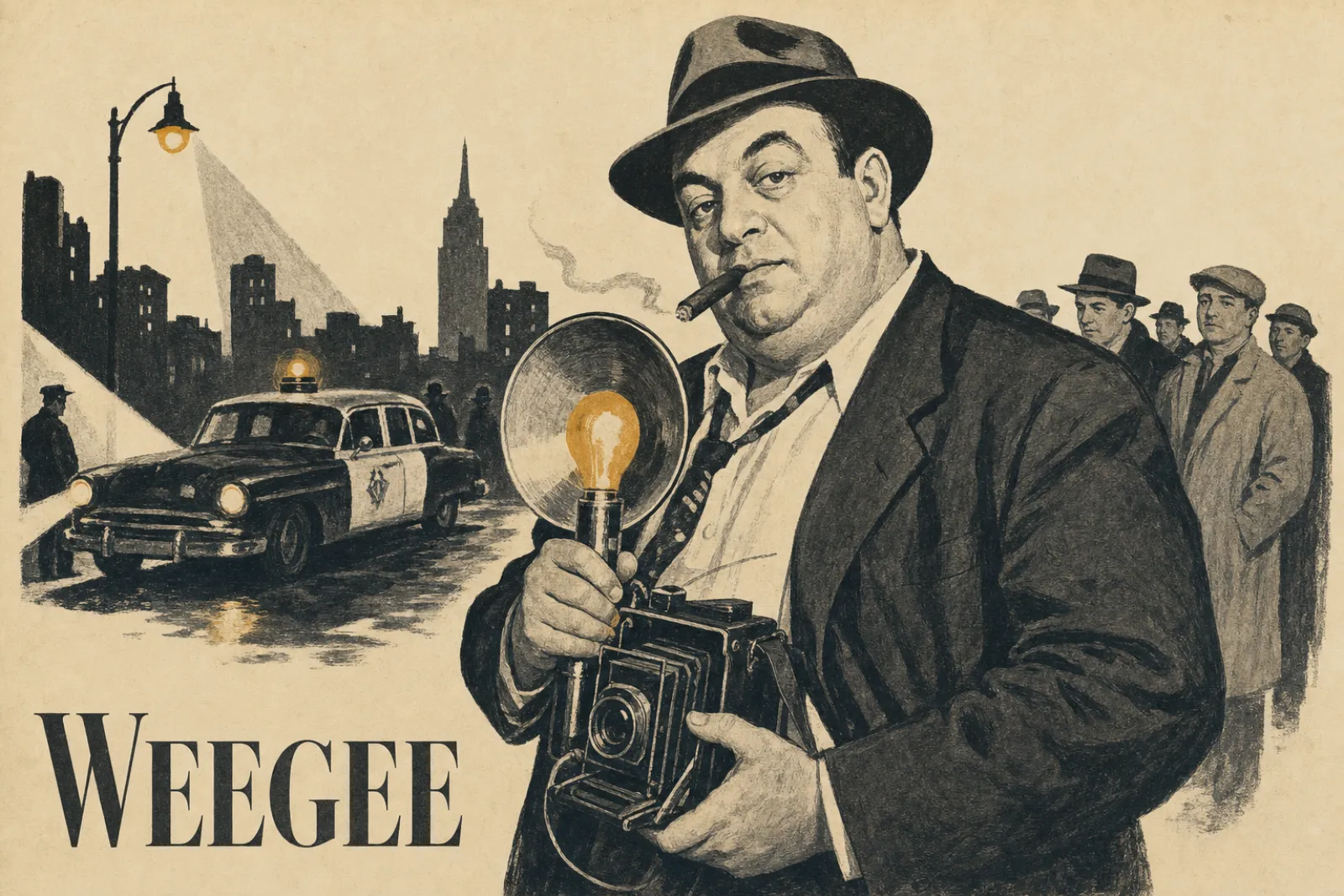
Weegee was the working name of Arthur Fellig (1899 to 1968), a freelance news photographer who covered New York City at night from the mid 1930s to the mid 1940s. He photographed murders, fires, arrests, car crashes and the crowds that gathered to watch them, with a press camera and a flashbulb. He is known for the 1945 book Naked City, which gathered a decade of those newspaper pictures between covers.
Weegee was self-taught and came up through picture agency darkrooms, not art schools. His pictures were made to sell to the next day’s papers. All the same, the Museum of Modern Art in New York acquired five of his prints in 1943 and exhibited them, and his work was included in a later exhibition at the same museum organised by Edward Steichen. For another photographer who made the city after dark his subject, in a very different manner, see Brassaï.
From the Lower East Side to the darkroom
He was born Usher Fellig on 12 June 1899 in Złoczów, then in Austria-Hungary and now Zolochiv in Ukraine. His family emigrated to New York when he was ten, and his first name became Arthur. Accounts of his childhood place him on the Lower East Side of Manhattan. He left school at 14 and took whatever photographic work he could find.
From the mid 1920s he worked as a darkroom technician at Acme Newspictures, a picture agency, developing and printing other photographers’ work. In 1935 he left to freelance. He based himself around Manhattan police headquarters, waited for news of a crime or an accident, and sold prints to whichever papers would buy them, among them the Herald Tribune, the Daily News and the Post.
The name Weegee is usually explained as a phonetic spelling of Ouija, after the fortune telling board, because he seemed to know where trouble would happen before it did. Another account traces it to his years as a squeegee boy drying prints in darkrooms. He encouraged the first version and claimed a kind of second sight.
A police radio in the car
The explanation for his timing was practical. In 1938 he became the first freelance news photographer in New York to get permission to install a police radio in his car. He heard the calls as the police did and often arrived as they did. He carried his camera equipment in the trunk of the car. The often repeated story that he developed his pictures in a darkroom in the trunk is disputed.
From 1940 to 1945 he also worked for PM, a liberal New York daily, where he developed his own way of combining photographs with text. In 1941 the Photo League gave him an exhibition under the title Murder Is My Business. In 1943 the Museum of Modern Art included his work in its exhibition Action Photography.
Naked City was published in 1945. It gathered a decade of his New York pictures with his own text, and it made his name outside the newspaper trade. Hollywood bought the rights, and the title was used for the 1948 film The Naked City. A second book, Weegee’s People, followed in 1946.
Want to know how news photographers work and what rules they follow? Photojournalism covers the history, the ethics and the skills.
Hollywood, distortions and the later years
The book ended the career it recorded. With assignments from magazines such as Life and Vogue, Weegee gave up the police beat. He moved to Hollywood in 1947, worked on films, and began the series he called Distortions, in which he used distorting lenses, mirrors and prisms to turn the faces of film stars and politicians into caricatures. Naked Hollywood appeared in 1953.
He returned to New York in 1952, lectured, wrote, and published an autobiography, Weegee by Weegee, in 1961. He worked as stills photographer on Stanley Kubrick’s film Dr. Strangelove, released in 1964. He died in New York on 26 December 1968. In 1993 his companion Wilma Wilcox gave his archive of about 16,000 photographs and 7,000 negatives to the International Center of Photography in New York.
One camera setting and a flashbulb
Weegee’s method is one of the simplest in the history of photography, and that is why it is worth studying.
The camera. He used a 4×5 inch Speed Graphic, the standard American press camera of the period, which takes one sheet of film at a time. The page on large format photography explains what a negative that size gives you.
The settings. Most of his best known pictures were made with the camera preset: aperture f/16, shutter 1/200 second, focus fixed at ten feet, and a flashbulb. With everything set in advance there was nothing to adjust at the scene. He stood about ten feet from the subject, raised the camera and fired. This is zone focusing in its plainest form: choose a distance and an aperture in advance, and anything near that distance is sharp.
The light. A single flash on the camera lights whatever is close and almost nothing else. Light from a small source falls off quickly with distance, as the page on the inverse square law explains, so a subject at ten feet is bright and a wall at forty feet goes black. In Weegee’s pictures this turns a cluttered street into a figure against darkness. The flash isolates the subject for him.
The turn of the camera. He photographed the event and he also photographed the people watching it. In several of his strongest pictures the onlookers are the whole subject, and their reactions tell the story.
Working unseen. Later he used infrared film with an infrared flash, which let him photograph people in the dark without drawing attention. The guide to infrared photography covers how that part of the spectrum records.
The caption. He gave his pictures titles and short texts of his own, such as Their First Murder, and the words changed how the pictures were read. The guide to writing photo captions covers what a caption owes the viewer.
New to flash? Flash photography for beginners covers how flash works and when to use it.
Want to photograph a city at night without a press pass? Night street photography covers settings, light sources and safety after dark.
Photographs to look for
- Afternoon Crowd at Coney Island (21 July 1940). A summer beach packed with people from the front of the frame to the back, a mass of bodies and limbs. There is no single subject. The crowd is the subject, and the picture is a lesson in how to fill the frame.
- Their First Murder (1941). Made in Brooklyn on 8 October 1941 after a man was shot near a school as pupils were leaving. The camera faces the crowd, not the victim. Look at each face in turn: the children and adults pressed together do not all react in the same way. The flash drops the background into darkness.
- The Critic (22 November 1943). Two society women in furs and tiaras arrive at the opening night of the Metropolitan Opera while a poorly dressed woman beside them looks on. It is a study in juxtaposition, and it was later revealed that the picture had been staged: the third woman had been brought from a bar on the Bowery.
- Naked City (1945). Read the book as a book. Pictures of crime and fires sit beside pictures of nightclubs, lovers and crowds at the beach, and the sequence makes a portrait of a city, not a catalogue of disasters.
- Distortions (from the late 1940s). Caricature portraits of celebrities made with distorting lenses. They show how far he moved from news work once he left the police beat.
Try this
This takes 15 minutes after dark, outdoors or in a large dim room, with a camera or phone that has a flash and a friend or an object such as a bicycle or a chair.
- Stand three metres, about ten feet, from the subject. Pace it out.
- Turn the flash on. If your camera allows, set f/8 or smaller and focus once at that distance, then leave the focus alone.
- Take one frame with a wall close behind the subject, within a metre.
- Move the subject, or yourself, so the nearest thing behind it is at least ten metres away. Stay three metres from the subject. Take the same frame.
- Compare the two. In the first the background is lit. In the second it is black and the subject stands alone.
That black background is the look of a Weegee picture, and it comes from distance, not from editing. Photograph only people who have agreed to it. The guide to photography ethics covers consent and what to publish.
Questions people ask about Weegee
What was Weegee’s real name?
He was born Usher Fellig in 1899, in a town that is now Zolochiv in Ukraine. His first name was changed to Arthur after his family emigrated to New York, and he worked as Arthur Fellig before adopting the name Weegee.
How did Weegee get to crime scenes so fast?
He worked from around Manhattan police headquarters, and from 1938 he had official permission to carry a police radio in his car. He heard the calls at the same moment the police did. The idea that he could foresee crimes was part of his legend, and it is the usual explanation for his name.
What camera did Weegee use?
A 4×5 inch Speed Graphic press camera with flashbulbs. For most of his news pictures it was preset to f/16 at 1/200 second and focused at ten feet.
Was The Critic staged?
The picture shows opera patrons arriving at the Metropolitan Opera on 22 November 1943, watched by a shabbily dressed woman. It later came out that the scene had been set up and was not a chance encounter. The picture is still one of his best known.
More photographers, with the lessons each one teaches, are in the A to Z of photographers.