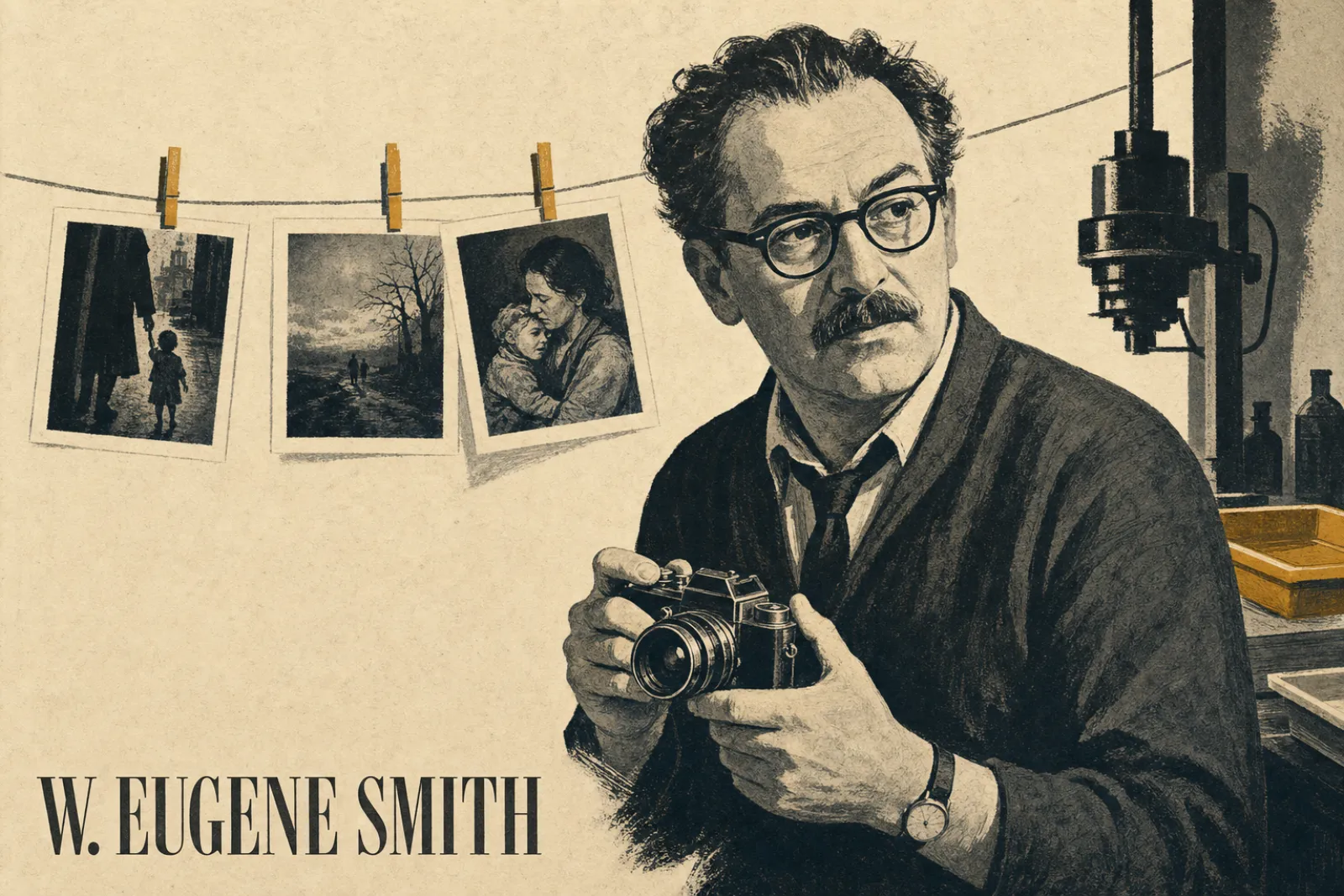
W. Eugene Smith (1918 to 1978) was an American photojournalist who worked from the late 1930s to the 1970s, mainly for Life magazine and later on his own long projects in Pittsburgh, New York and Japan. He photographed in black and white on 35mm film and printed his own pictures with great care. He is known for building the magazine photo essay into a serious form, in stories such as Country Doctor, Spanish Village and Minamata.
Smith belonged to the generation that made the picture magazines of the 1940s and 1950s, and he fought with them constantly over how his work was laid out. He joined the Magnum cooperative in 1955 after leaving Life. Edward Steichen gave one of his photographs the closing place in The Family of Man in 1955, an exhibition that also included Wynn Bullock. What Smith reacted against was the idea that a photographer supplies raw pictures and an editor decides what they mean. He wanted control of the selection, the order and the print.
Wichita, the Pacific war and a wound on Okinawa
William Eugene Smith was born in Wichita, Kansas, on December 30, 1918. He was photographing for local newspapers while still a teenager. In 1936 he went to the University of Notre Dame on a photography scholarship, left after about a year and moved to New York. He worked for Newsweek and was dismissed for refusing to give up his small 35mm camera for a larger format. He then freelanced through the Black Star agency and began working for Life in 1939.
During the Second World War he was a correspondent in the Pacific for the Ziff-Davis magazines and then for Life, following the American advance through Saipan, Guam, Iwo Jima and Okinawa. In 1945 he was seriously wounded by mortar fire on Okinawa. The recovery took two years and repeated surgery.
In 1946, during that recovery, he photographed his two small children walking out of a dark stand of trees into a bright clearing. He called it The Walk to Paradise Garden, and the site has a short page on the story behind The Walk to Paradise Garden.
The Life essays: a doctor, a midwife, a village
Back at Life, Smith made the essays his name rests on. For Country Doctor, published on September 20, 1948, he spent 23 days in Kremmling, Colorado, following Dr. Ernest Ceriani, the only physician for about 2,000 people spread over 400 square miles. The pictures show him treating a girl who had been kicked in the head by a horse, tending an elderly patient’s ear, a boy with a dislocated elbow being carried into the hospital, and surgery. It was a story about one man’s ordinary working days, told at length.
Spanish Village followed on April 9, 1951. Smith photographed Deleitosa, a poor farming village in Extremadura, under the rule of Francisco Franco. Nurse Midwife, published on December 3, 1951, followed Maude Callen, a nurse and midwife in South Carolina. A Man of Mercy, on Albert Schweitzer and his clinic at Lambaréné in Gabon, ran on November 15, 1954. Smith disagreed with how that essay was laid out and resigned from the magazine.
Want to build a story from pictures yourself? How to create a photo essay covers planning, the variety of shots a story needs, and editing and sequencing.
Pittsburgh, a jazz loft and Minamata
In 1955, newly at Magnum, Smith was commissioned by the editor Stefan Lorant to make about a hundred photographs of Pittsburgh. The job was expected to take about a month. He stayed far longer, exposed well over ten thousand negatives, and spent more than two years trying to shape them into one enormous essay, supported by Guggenheim Fellowships in 1956 and 1957.
From 1957 to 1965 he lived in a loft building at 821 Sixth Avenue in Manhattan where jazz musicians came to play through the night. He photographed them, making roughly 40,000 pictures there, and wired the building with microphones, leaving about 4,000 hours of tape.
His last major work was made in Japan. In 1971 he and his wife, Aileen Mioko Smith, moved to Minamata, a fishing town where a chemical company’s waste had poisoned the sea with mercury, and lived among the affected families. In January 1972 he was beaten by company employees while accompanying protesters, and his eyesight was damaged. Life published the story on June 2, 1972, and the book Minamata followed in 1975. He taught at the University of Arizona in his last year and died in Tucson on October 15, 1978.
Asking what separates this from news photography? Documentary photography explains long term projects, working in the field and the ethical questions that come with them.
How Smith built a story and then built the print
Smith’s method had two halves, one with the camera and one in the darkroom. Both are teachable.
- Stay until you are furniture. Twenty three days with one doctor. Years in one fishing town. He lived where his subjects lived, so that people stopped performing for the camera. This is the core habit of photojournalism done in depth.
- Use a small camera in the light that is there. He insisted on 35mm when editors wanted bigger negatives, because a small camera let him work close, fast and quietly in dim rooms. The trade is grain and thin negatives, which is the daily problem of low light photography.
- Shoot for the layout. An essay needs a scene setter, close details, portraits, action and a closing picture. Smith made all of these on purpose and argued about their order on the page. The same thinking is set out in photo sequencing.
- Print dark, then lift the light out. His prints are heavy with black, and faces and hands emerge from it. James Karales, who printed for him on the Pittsburgh project, described making dozens of small work prints from one negative before a final 11 by 14 inch print. Smith burned areas down under the enlarger, then used a chemical bleach to brighten small areas and separate figures from the dark. Some prints took days. The basic steps are in darkroom basics, and the idea carries over to digital dodging and burning.
- Direct when you judge it honest. Smith did not hold to a strict rule against intervention. He sometimes asked people to repeat or arrange an action, and he retouched. In the picture of a wake from Spanish Village he darkened the eyes of two women who had looked at the camera and bleached in new highlights so that they appear to look down. The photograph of Tomoko and her mother was made with the mother’s agreement and arranged with her.
That last point is where Smith is still argued over. News organisations do not accept that kind of alteration, and he knew it and did it anyway, on the grounds that he understood his subject. A reader can admire the prints and still disagree.
Where is the line between a strong print and a false one? Photo retouching ethics sets out the standards used in journalism and how they differ from other fields.
Essays and photographs to look for
- The Walk to Paradise Garden (1946). His two children walk hand in hand from dark woods toward a bright clearing. Notice how the contrast between the shadowed foreground and the light beyond carries the meaning. It is a study in backlighting.
- Country Doctor (1948). Look at the range of distances across the essay, from views that place the doctor in his town to close pictures of him at work on a patient. Each picture adds a different kind of information.
- Spanish Village (1951). Daily life in Deleitosa, including the picture of a family and friends gathered around a villager who has died. Look at where each woman’s eyes are directed, knowing that the print was worked to get them there.
- Nurse Midwife (1951). An essay about one woman’s work caring for her community. Watch how often Maude Callen is shown in the act of doing something, not posing.
- Pittsburgh (begun 1955). A portrait of a whole city, drawn from thousands of negatives. It is worth looking at as an unfinished edit, a lesson in how hard it is to stop.
- Minamata (1971 to 1975). Protest, family life and illness in one town. The picture of Tomoko being bathed by her mother was made in the family’s bathing room with a very wide lens. It was withdrawn from circulation in the late 1990s out of respect for the family’s wishes, and that decision is part of its history.
Try this: fifteen minutes with one person at work
Ask someone who is doing a task with their hands, such as cooking, repairing a bike or gardening, if you may photograph them for 15 minutes. Use a phone or any camera. No flash.
- For the first three minutes, do not shoot. Watch, and let them forget you.
- Then make exactly five pictures, one of each kind: the whole place, the person at full length in it, the hands, the face, and one picture that could end the story.
- Change your distance for every frame by walking, not by zooming.
- Afterward, put the five in an order and look at them as a strip. Swap two and see what changes.
- Darken the edges of your strongest frame so the eye goes to one bright area.
The constraint is five frames of five kinds. It forces you to think about what a story needs before you press the shutter.
Photographing people you do not know well? Photography etiquette and ethics covers consent, truthfulness and how to share pictures fairly.
Questions people ask about W. Eugene Smith
What is W. Eugene Smith best known for?
He is known for the long photo essays he made for Life between 1948 and 1954, especially Country Doctor, Spanish Village, Nurse Midwife and A Man of Mercy, and for Minamata, his study of mercury poisoning in Japan published as a book in 1975.
Why did W. Eugene Smith leave Life magazine?
He resigned in late 1954 after a disagreement over how the magazine laid out his essay on Albert Schweitzer. He had long wanted more say over which pictures ran and in what order. He joined Magnum the following year.
What camera did W. Eugene Smith use?
He worked with 35mm cameras throughout his career and lost his early job at Newsweek for refusing to switch to a larger format. The photograph of Tomoko and her mother at Minamata was made with a Minolta 35mm camera and a 16mm lens.
What is the W. Eugene Smith Memorial Fund?
It was set up in 1980, two years after his death, to support photographers working in the tradition of humanistic photography. His own archive is held at the Center for Creative Photography at the University of Arizona in Tucson.
Smith is one of the photographers in the A to Z of photographers, and he is quoted on the photography quotes page.