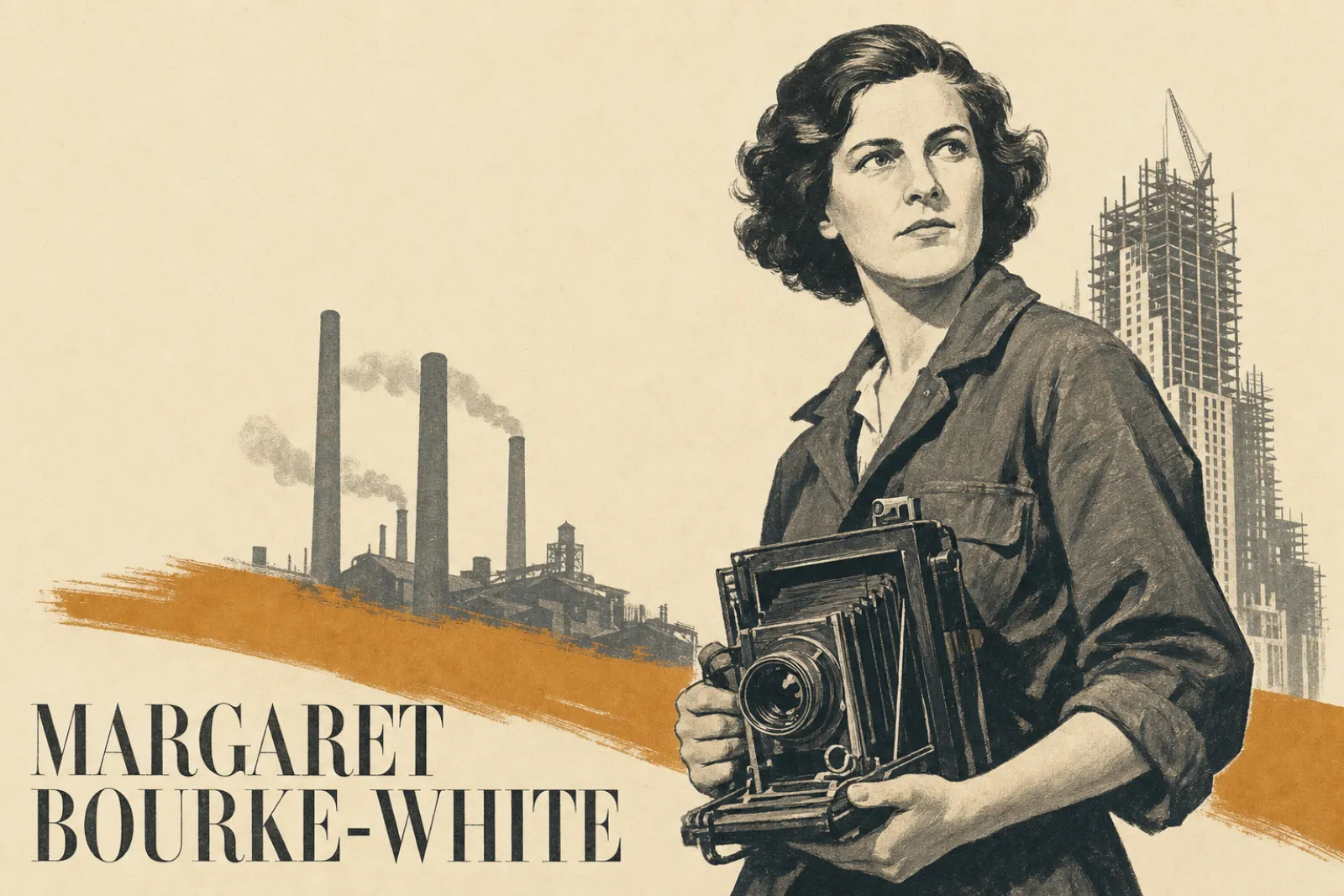
Margaret Bourke-White (1904 to 1971) was an American photojournalist who worked for Fortune and Life magazines from 1929 into the 1950s. She began with steel mills and skyscrapers, then photographed the Depression, the Soviet Union, the Second World War, the partition of India and apartheid South Africa. She is known for the photograph of Fort Peck Dam on the cover of the first issue of Life in November 1936.
Bourke-White was born in the Bronx, New York, on 14 June 1904. She studied photography in the early 1920s under Clarence H. White, a leading teacher of the period, and took a degree in biology at Cornell University in 1927. She started as a commercial photographer of buildings and factories, and it was industry, not people, that first made her name. At Life she worked beside Alfred Eisenstaedt, whose pictures also ran in the first issue. In the 1930s she turned to the drought and rural hardship of the Depression, a subject she shared with Dorothea Lange.
Steel mills and skyscrapers in Cleveland
After Cornell she opened a studio in Cleveland, Ohio, and made a living from architecture and industry. Her breakthrough was a set of pictures made inside the Otis Steel mill. The film of the time was not sensitive to the red and orange glow of molten metal, so a pour that looked brilliant to the eye came out nearly black. She solved it by having assistants hold magnesium flares that lit the scene with white light. The steel pictures brought her national attention.
The publisher Henry Luce hired her in 1929 for his business magazine, Fortune. For Fortune she photographed industry across the United States, and in 1930 she travelled to the Soviet Union, where she was the first foreign photographer given official access to photograph Soviet industry. Her book Eyes on Russia followed in 1931. She kept a studio high in the Chrysler Building in New York, a tower she had photographed while it was being built.
Want to photograph buildings and structures with the same weight? Architectural photography covers perspective, light and composition.
From machines to people: the 1930s
In 1934 Fortune sent her to photograph the drought on the Great Plains, and her attention began to move from machinery to the people who lived with its consequences. In 1936 Luce hired her as one of the first four staff photographers of Life. Her picture of Fort Peck Dam in Montana, a New Deal project on the Missouri River, was the cover of the first issue, dated 23 November 1936.
With the novelist Erskine Caldwell she travelled through the American South photographing sharecroppers. Their book You Have Seen Their Faces (1937) paired 75 of her photographs with his text. The two married in 1939 and divorced in 1942, and made two more books together, North of the Danube (1939) and Say, Is This the U.S.A. (1941). Her work in this period belongs to the history told in photography and social movements.
During the Louisville flood of 1937 in Kentucky, Bourke-White photographed a line of Black residents waiting for relief in front of a billboard that carried the words “World’s Highest Standard of Living”. Life published it on 15 February 1937. It is one of the clearest examples of juxtaposition in documentary work.
War, India and South Africa
Bourke-White was in Moscow in 1941 when Germany attacked the Soviet Union, the only foreign photographer in the city, and she photographed the bombardment from the American embassy. She went on to cover the war in North Africa, Italy and Germany. She survived the torpedoing of her ship in the Mediterranean and became the first woman to fly on an American combat bombing mission.
In the spring of 1945 she travelled with General George Patton’s army into Germany and photographed the Buchenwald concentration camp at its liberation. Life published her camp photographs on 7 May 1945. She wrote about what she had seen in Dear Fatherland, Rest Quietly (1946).
Life then sent her to India. In 1946 she photographed Mohandas Gandhi beside his spinning wheel, and in 1947 she photographed the violence and mass migration that came with the partition of India and Pakistan. She interviewed Gandhi a few hours before he was assassinated in January 1948. Her book on the period, Halfway to Freedom, was published in 1949. She then photographed South Africa under apartheid, including gold miners deep underground in Johannesburg, and covered the Korean War.
The first symptoms of Parkinson’s disease appeared in 1953. Her last essay for Life ran in 1957. She published an autobiography, Portrait of Myself, in 1963, and died in Stamford, Connecticut, on 27 August 1971.
Curious how a working news photographer operates? Photojournalism covers its history, its ethics and the skills it demands.
How she made industry and events look monumental
She photographed structure. Her industrial pictures are built from repeated forms: rows of pipes, ranks of piers, lines of machines. Repetition gives order and scale to subjects that would otherwise read as clutter. The guide to patterns and repetition shows how to find and frame it.
She put a small figure in a big frame. In the Fort Peck picture small human figures stand at the foot of the concrete piers. Without them the piers could be any size. With them, the structure is enormous. The page on scale in photography explains how a reference object works.
She cropped close and chose her viewpoint. She filled the frame with the subject and cropped tightly, so that it seemed to continue beyond the picture, and she looked for unusual camera positions. At Fort Peck the camera is low and the piers rise above it. Camera angles explains why a low angle makes a subject seem powerful.
She brought her own light. From the magnesium flares at Otis Steel to the thousands of flashbulbs she carried to the Soviet Union, she did not accept the light she found if it could not record the subject. That took planning, assistants and heavy equipment. On one Soviet trip her kit weighed about 600 pounds and included five cameras and 22 lenses. The principles are the same ones covered in flash photography.
She thought in sequences. Life was built on the picture story, several photographs laid out with captions to explain one subject, and her assignments were shot to be laid out that way.
Want to build a story from several pictures? How to create a photo essay covers planning, variety and sequencing.
Photographs to look for
- Fort Peck Dam, Montana (1936). The first Life cover. The concrete spillway piers stretch across the frame like ancient monuments, tightly cropped. Find the small figures at the base and see how they set the scale.
- At the Time of the Louisville Flood (1937). A queue of flood victims under a billboard advertising prosperity. Notice that the picture needs no caption to make its point: the words on the billboard do the work.
- You Have Seen Their Faces (1937). Her book with Erskine Caldwell on Southern sharecroppers. It pairs 75 photographs with text. Look at how picture and words work together on the page, a subject taken further in the guide to photo captions.
- The Living Dead at Buchenwald (1945). A group of survivors, young and old, looking out from behind barbed wire at the soldiers who had freed them. The framing is plain and the wire stands between the men and the viewer. Life published her camp pictures in May 1945 but did not print this frame until December 1960.
- Gandhi at his spinning wheel (1946). Gandhi sits beside the wheel he used every day. The object tells the viewer what he stood for, which makes this a model environmental portrait.
- Gold miners, Johannesburg (1950). Miners in helmets photographed more than a mile underground, sweating heavily in the heat of the tunnel. The men, not the mine, are the subject.
Try this
Spend 15 minutes with one large built object: a bridge, a pylon, a water tower, a crane, a multi-storey car park.
- Make one frame from where you first stand, at standing height, with the whole object in view.
- Walk in until the object no longer fits in the frame. Crouch and point the camera up. Crop so that repeating parts, such as beams, cables or columns, run out of the edges.
- Wait for a person to walk into the frame near the base, or ask someone to stand there. Take the picture when they are small and clearly separate from the structure.
- Compare the first frame with the last. The object has not changed. Its apparent size has.
Questions people ask about Margaret Bourke-White
What is Margaret Bourke-White famous for?
She photographed the cover of the first issue of Life magazine in 1936 and was one of its original staff photographers. She is also known for her industrial photographs, her coverage of the Second World War including the liberation of Buchenwald, and her portrait of Gandhi at his spinning wheel.
What firsts did Margaret Bourke-White achieve?
She was the first foreign photographer permitted to photograph Soviet industry, in 1930, and the first woman to fly on an American combat bombing mission in the Second World War. She was also the first woman photographer hired by Life.
How did Margaret Bourke-White photograph inside steel mills?
The film of the 1920s could not record the red and orange glow of molten steel. She had assistants light the scene with magnesium flares, which gave off a bright white light the film could register.
When did Margaret Bourke-White stop photographing?
She developed Parkinson’s disease from 1953. Her last photo essay for Life appeared in 1957, and she retired formally from the magazine in 1969. She died in 1971.
More photographers, with the lessons each one teaches, are in the A to Z of photographers.