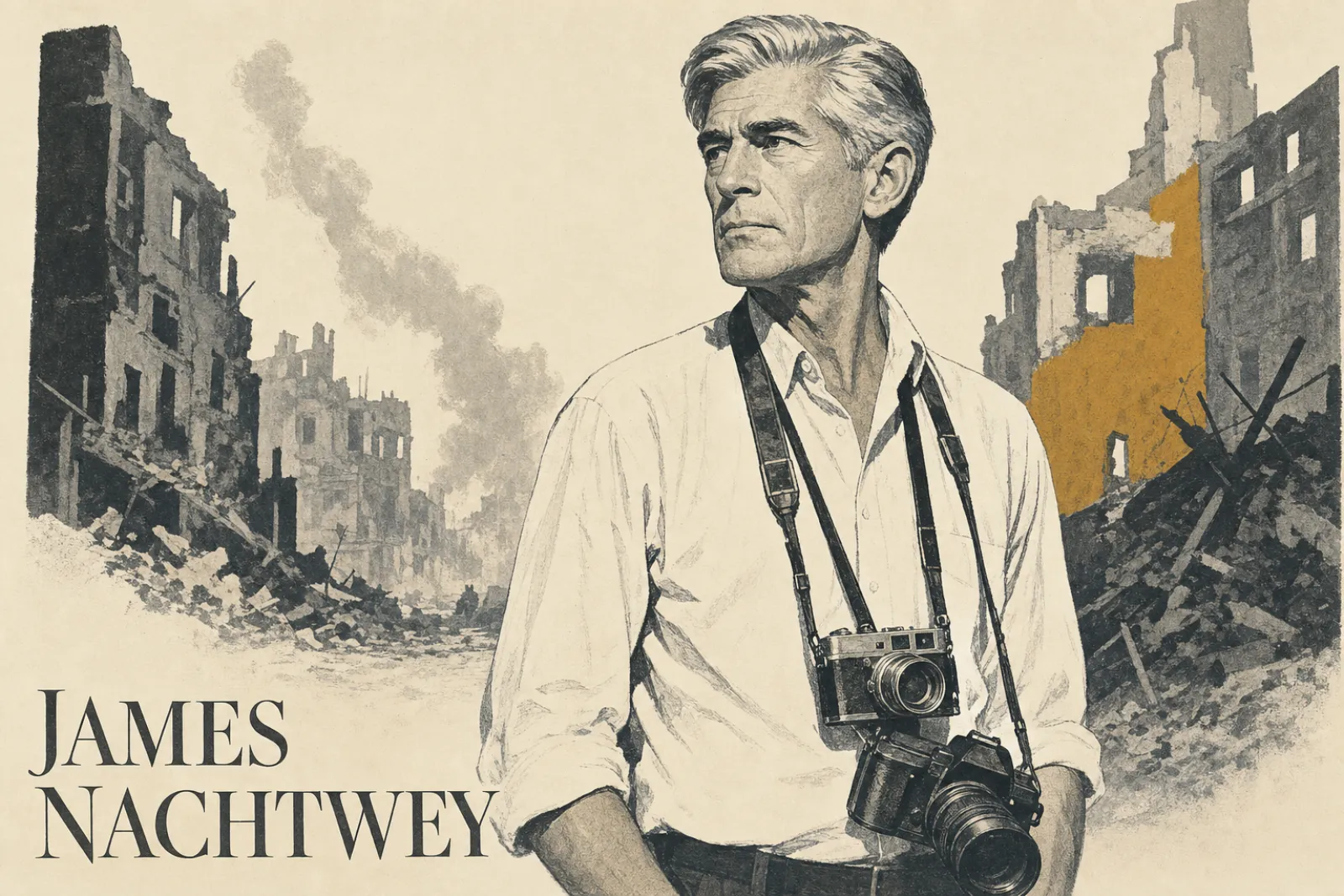
James Nachtwey (born 1948) is an American photojournalist who photographed wars, famines and epidemics around the world from 1981 onward, most often for Time magazine. He worked in Central America, the Middle East, Africa, the Balkans, Asia and New York on 11 September 2001. He is known for pictures made at very short range of people at the worst moment of their lives, composed with unusual care and published to bring pressure for change.
Nachtwey has said that pictures of the Vietnam War and the American civil rights movement made him want to be a photographer. He trained himself. His work follows the line of the concerned photojournalist, in which W. Eugene Smith is the usual reference point, and he received the grant in humanistic photography that carries Smith’s name. Among British photographers the nearest comparison is Don McCullin, who covered the wars of the two decades before him.
From Dartmouth to a newspaper in New Mexico
Nachtwey was born in Syracuse, New York, on 14 March 1948 and grew up in Massachusetts. He studied art history and political science at Dartmouth College from 1966 to 1970 and graduated with honours. After college he taught himself photography, and spent a period working in the Merchant Marine.
His first job as a photographer came in 1976, at the Albuquerque Journal in New Mexico. Four years on a daily paper gave him the routine skills of the trade: working fast, in any light, on any subject, to a deadline. In 1980 he moved to New York to freelance for magazines and joined the Black Star agency.
Asking what a newspaper or magazine photographer does all day? Photojournalism as a career describes the work and how people enter it.
Northern Ireland 1981, then thirty years of assignments
His first foreign assignment was Northern Ireland in 1981, during the IRA hunger strike. From then on he went wherever there was conflict. He worked in El Salvador, Nicaragua and Guatemala, in Lebanon, the West Bank and Gaza, and in Afghanistan, Sri Lanka, the Philippines and South Korea. In 1984 he became a contract photographer for Time. He was with Black Star until 1985 and a member of Magnum Photos from 1986 to 2001.
The 1990s took him to Somalia, Sudan, Rwanda, South Africa, Bosnia, Chechnya, Kosovo and Romania. When magazines would not pay for a story he thought mattered, he paid for it himself, as he did with the orphanages of Romania and the famine in Somalia. His photograph of a mother in Somalia in 1992 and his portrait of a survivor in Rwanda in 1994 were each named World Press Photo of the Year. He won the Robert Capa Gold Medal five times, in 1983, 1984, 1986, 1994 and 1998.
His book Inferno gathered work from this decade, including Romania, Somalia, Sudan and Bosnia. In 2001 he left Magnum and was one of the founders of the agency VII, where he remained until 2011. On 11 September 2001 he was in New York and photographed the attack on the World Trade Center and its ruins. The same year Christian Frei released War Photographer, a Swiss documentary that followed him at work and was nominated for an Academy Award.
Wounded in Iraq, and a turn toward disease
In 2003, while working in Iraq for Time, Nachtwey was riding in a United States Army vehicle with the correspondent Michael Weisskopf when a grenade was thrown in. Both were wounded. He recovered and photographed the aftermath of the Indian Ocean tsunami at the end of 2004.
Alongside war he reported on public health. His pictures of AIDS in Africa ran in Time and were shown to members of the United States Congress. In 2007 he was awarded the TED Prize and used it to photograph and publicise extensively drug-resistant tuberculosis, known as XDR-TB. His other honours include the Dan David Prize in 2003, the Heinz Award in 2006, the Dresden Peace Prize in 2012 and the Princess of Asturias Award for Communication and Humanities in 2016. A large exhibition of his work, Memoria, was shown at the Maison Européenne de la Photographie in Paris.
Wondering how a set of pictures on one subject is planned and shaped? How to create a photo essay lays out the parts and the order.
How Nachtwey’s pictures are made to work
He worked inside the subject’s space. Nachtwey photographed from an arm’s length or two, in the same room, trench or hospital ward as the people in the picture. The viewer is put where he stood. Working this near means gaining acceptance first, and it means the frame is full of the person and little else, the idea behind filling the frame.
The composition is strict, and hidden. He has put the effect of a picture on the viewer ahead of its design. Yet the frames are carefully built. A near figure, often cut by the edge, sets the scale. The main subject sits behind it. The background closes the story. This kind of layered composition gives depth and holds the eye without drawing attention to itself.
He kept edges and backgrounds clean. Even in chaos the important shapes are separated: a hand against a pale wall, a face against sky. Checking the border of the frame for collisions is covered in tangents and mergers.
He waited for a gesture that carries the meaning. A hand reaching, a body bent to lift, a look between two people. The news event supplies the place. The gesture supplies the picture. The page on the decisive moment explains how timing and anticipation work.
He was slow and quiet. War Photographer was filmed partly with a tiny video camera fixed to his own camera, so the film shows what he saw and how he moved: steadily, close in, without rushing the people in front of him. Calm is a working method. It makes the photographer less of a threat.
Tone does the work, not colour. Study his pictures for where the light and dark fall. Removing colour removes distraction and can join pictures from different places into one body of work. Black and white photography explains what changes when colour goes.
The picture is tied to a purpose. His photographs were made to be published, with facts attached, in front of readers and lawmakers who could act. That is the difference between photojournalism and a private project, and it is why a full, accurate caption travels with every frame.
Thinking about consent and dignity when the subject is someone in distress? Photography etiquette and ethics sets out the questions to ask before and after the picture.
Photographs and projects to look for
- Bardera, Somalia, 1992. A mother carries her dead child, wrapped in a shroud, to a grave for famine victims. It was named World Press Photo of the Year. Notice that one act of mourning stands for the whole famine.
- Nyanza, Rwanda, 1994. A portrait of a man at a Red Cross hospital who had survived an attack by a militia. It was also named World Press Photo of the Year. The picture records what was done to him and still treats him as a person, a lesson in how a portrait can carry evidence and dignity together.
- Inferno. A large book of the 1990s work, covering famine and war in Romania, Somalia, Sudan, Bosnia and elsewhere. Look at how long he stays with each place, so that every section reads as one sustained report.
- New York, 11 September 2001. Pictures of the attack on the World Trade Center and of the ruins afterward. He was in the city that day, and the set became one of his best known bodies of work. Look at how a reporter used to distant wars handled one at home.
- The sulphur miners of Ijen, East Java. Seen in War Photographer. Men work at a sulphur mine. Watch in the film how near he stays to them.
- XDR-TB. The tuberculosis project that followed the 2007 TED Prize. These are pictures of patients and of the people caring for them, and they show his method applied to a subject with no front line.
Curious how long projects like these are held together over months or years? Planning a long-term photography project covers scope, schedule and editing.
Try this: three layers at arm’s length
This takes 20 minutes in any busy place where you have permission to photograph: a kitchen at meal time, a market stall, a workshop, a team warming up.
- Use the widest lens setting you have and do not zoom. Stay within two metres of the nearest person the whole time.
- Build each frame from three layers: something near and partly cut by the edge, a main subject in the middle distance, and a background that says where you are.
- Before each press, run your eye round the four edges. If two shapes touch or overlap badly, move your feet, not the lens.
- Wait for a hand or a look to connect two of the layers, then take one frame.
- Stop at twelve frames. Choose the one where all three layers can be read at a glance.
Questions people ask about James Nachtwey
Which agencies and magazines did James Nachtwey work for?
He became a contract photographer for Time in 1984. He was with the Black Star agency from 1980 to 1985, a member of Magnum Photos from 1986 to 2001, and a founding member of VII from 2001 to 2011.
What is the film War Photographer about?
It is a 2001 documentary by Christian Frei that follows Nachtwey on assignment in Kosovo, Indonesia and the West Bank. Small video cameras mounted on his own camera show his view as he works. It was nominated for an Academy Award for best documentary.
Was James Nachtwey injured while working?
Yes. In 2003 he was wounded by a grenade in Iraq while travelling with American soldiers for Time. In 2014 a bullet grazed him while he was photographing political protests in Thailand.
What did James Nachtwey do with the TED Prize?
He received the prize in 2007 and asked for help to document a story and share it widely. The result was a body of photographs on XDR-TB, a drug-resistant form of tuberculosis, released worldwide to raise awareness of the disease.
James Nachtwey is one of many photographers in the A to Z of photographers.