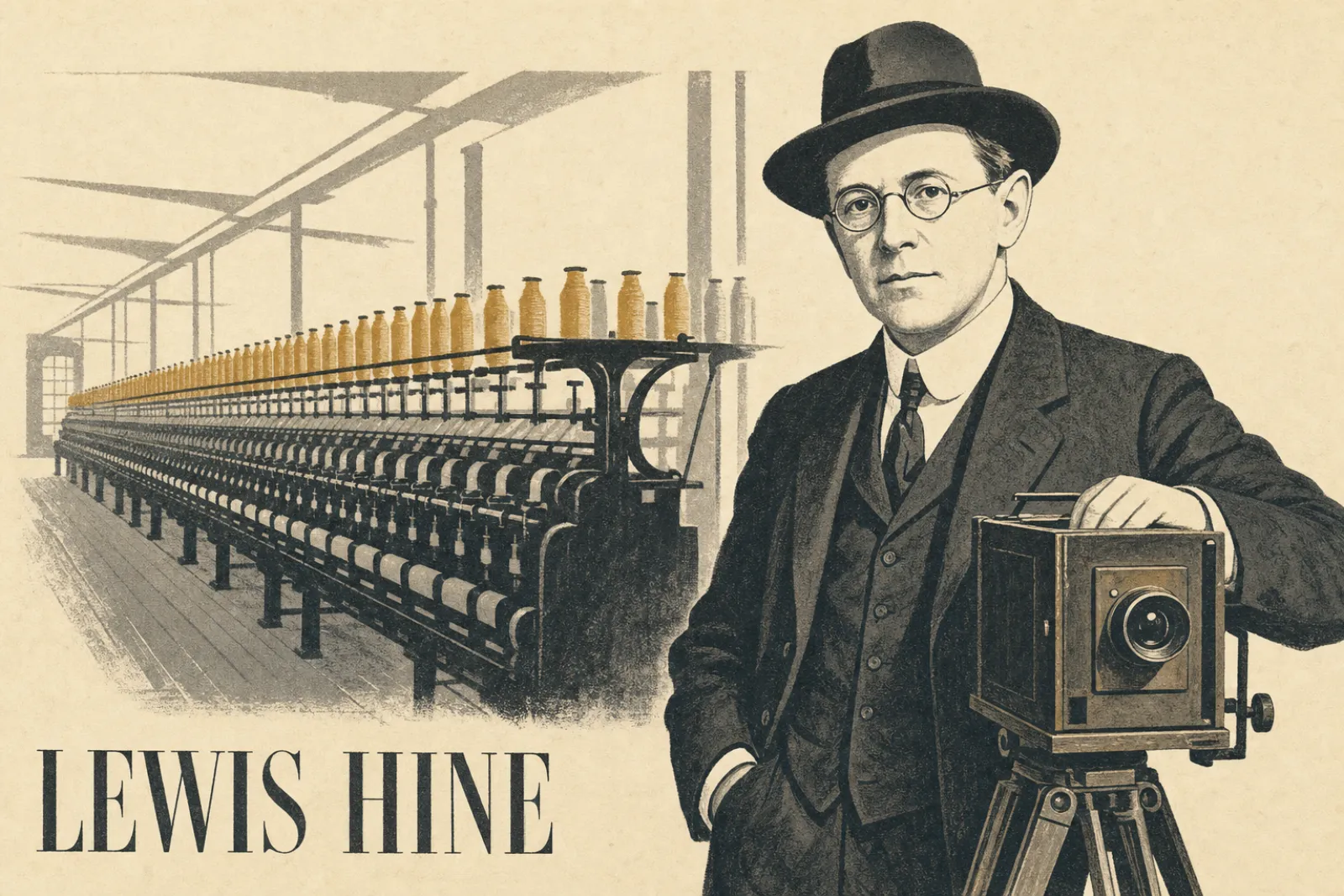
Lewis Hine (1874 to 1940) was an American photographer who trained as a teacher and a sociologist and used a camera to argue for reform. Working mostly in the United States between 1904 and the late 1930s, he photographed immigrants arriving at Ellis Island, children working in mills, mines and canneries, and the men who built the Empire State Building. He is known above all for the child labor pictures he made for the National Child Labor Committee.
Hine came to photography from the classroom, not from an art school or a portrait studio. He took up the camera as a teaching tool at the Ethical Culture School in New York and treated it as evidence from then on. That set him apart from the soft, painterly art photography of the same years. One of his pupils at the school was Paul Strand, who first visited the 291 gallery on a field trip with Hine’s class. The purpose behind his pictures, showing real conditions to people who would never otherwise see them, runs on through later documentary photography, including the work of Dorothea Lange.
From an Oshkosh factory to a New York classroom
Hine was born in Oshkosh, Wisconsin, on 26 September 1874. His father died in 1892, and Hine went to work in a furniture upholstery factory. He took university extension courses, studied at the University of Chicago, and in 1901 moved to New York to teach nature study and geography at the Ethical Culture School. Frank Manny, the school’s superintendent, had invited him. Hine completed a master’s degree in pedagogy at New York University in 1905 and also studied sociology at Columbia.
At the school he began photographing with and for his students. Starting in 1904 he took classes to Ellis Island and photographed the people arriving there. Between 1904 and 1909 he made more than 200 plates of immigrants. The work convinced him that a photograph could teach, and that it could teach adults as well as children. In 1907 he photographed the steel districts of Pittsburgh for the Pittsburgh Survey, a study backed by the Russell Sage Foundation.
Ten years inside the mills, mines and canneries
In 1908 Hine left teaching to work as a photographer for the National Child Labor Committee, and he stayed with that work for about a decade. He travelled the country photographing children at work in cotton mills, coal mines, canneries, glass factories and on city streets selling newspapers. Factory managers did not want these pictures made. Hine got through the door by posing as a fire inspector, a postcard seller, a Bible salesman or an industrial photographer sent to record the machinery. He was often threatened by foremen and factory police.
The photographs were only half the record. Once inside, Hine drew the children into conversation and wrote down what they told him, sometimes with his hand hidden inside his pocket. Names, ages, heights and time on the job went into the captions. His equipment was a hand held wooden box camera that made 4×5 and 5×7 inch negatives on glass plates and on film.
How much should a caption say? How to write photo captions covers the who, what, where and when that turn a picture into a record.
The committee used his pictures in exhibitions and publications. A federal Children’s Bureau was created in 1912. In 1916 Congress passed the Keating-Owen Act, which set minimum ages for factory and mine work, although the law was later ruled unconstitutional. Lasting federal limits came with the Fair Labor Standards Act of 1938. More than 5,000 of Hine’s child labor photographs are held by the Library of Congress.
Can photographs really change a law? The intersection of photography and social movements looks at how pictures have been used to push for reform.
Work portraits and the Empire State Building
In 1918 Hine went to Europe to photograph Red Cross relief work in France and the Balkans. After the war his subject shifted. He had spent years showing what work did to people. Through the 1920s and early 1930s he made what he called work portraits, pictures that stressed the skill and worth of the person operating the machine. The Art Directors Club of New York gave him a medal in 1924.
In 1930 he was commissioned to photograph the construction of the Empire State Building. He photographed the workers on the frame as it rose. For some views he was swung out in a specially designed basket about 1,000 feet above Fifth Avenue. A selection of these and other work portraits appeared in 1932 as Men at Work, a picture book.
The 1930s were hard for him. He photographed for the Tennessee Valley Authority in 1933 and was chief photographer for the National Research Project of the Works Progress Administration from 1936 to 1937, but commissions dried up. Roy Stryker turned down his repeated requests to join the Farm Security Administration’s photography project. Hine lost his house and applied for welfare. He died on 3 November 1940. His son Corydon gave the prints and negatives to the Photo League. After the League closed in 1951 the Museum of Modern Art declined the collection, and it went to George Eastman House.
How a Hine photograph makes its case
Hine’s pictures look simple. They are built from a small number of firm choices.
- The subject looks back. Hine asked people to look straight into the lens, which was unusual at the time. A child who meets the viewer’s eye is a person, not a statistic. It is the oldest lesson in portrait photography, used here for an argument.
- The height of the camera matters. A lens held at an adult’s standing height looks down on a child. The camera angle decides whether the viewer meets a small subject on equal footing.
- The workplace stays in the frame. The children are photographed where they worked, in the mills, mines and canneries, and not taken aside to be posed somewhere neutral. Each picture is an environmental portrait in which the setting carries the evidence.
- Words finish the picture. Height, age and months on the job sit in the caption. The photograph proves the child was there. The caption says who, where and for how long.
- One picture is never the whole case. Hine photographed the same trades in state after state. The weight of his work comes from repetition, which is how a photo essay or a long project builds its argument.
- The record is exact. Names, ages and places were noted on the spot, so that each picture could stand as evidence. Accuracy of that kind still governs photojournalism.
His methods also raise a question that has not gone away. He entered workplaces under false pretences and photographed children who could not meaningfully agree to it, in order to protect them. Compare his approach with August Sander, who also photographed working people, but as a posed catalogue of a society made with the sitters’ cooperation.
Where is the line between witness and intrusion? Photography etiquette and ethics sets out the questions of consent that come with photographing strangers.
Photographs to look for
- The Ellis Island photographs (1904 to 1909). More than 200 plates of newly arrived immigrants, made over repeated visits with his classes. Look at them beside the child labor pictures that followed and notice what stays the same in how people face the camera.
- Sadie Pfeifer, Lancaster Cotton Mills, South Carolina (30 November 1908). Hine’s caption records that she was 48 inches high and had worked half a year, and calls her one of the many small children at work in the mill. Read the picture and the caption together and notice what each supplies.
- Breaker boys, South Pittston, Pennsylvania (1911). Boys sorting coal at an anthracite breaker. Breaker boys sat over the chutes and picked slate out of the coal as it passed. Here the group, not a single face, carries the argument.
- Little Lottie, Bayou La Batre, Alabama (1911). A young oyster shucker at the Alabama Canning Company. Hine’s caption calls her a regular worker and adds that she spoke no English. Look at how little he adds: the child, the place of work and a caption that names both.
- Power house mechanic working on steam pump (1920). One of the best known of the work portraits. A young man with a wrench bends to his work on the machine. Compare its deliberate design with the urgency of the child labor pictures.
- Icarus, Empire State Building (1930). A construction worker on a cable, high on the unfinished building. The title turns a working man into a figure from myth.
Try this: one worker, one caption
This takes about 20 minutes and practises Hine’s two habits: the direct look and the written record.
- Ask someone you know if you can photograph them at their work: a shop counter, a workshop, a kitchen, a desk.
- Stand back far enough that their tools and workplace fill the frame around them. Do not tidy anything.
- Hold the camera or phone at the height of their eyes. Ask them to stop for a moment and look straight into the lens.
- Make no more than six frames. This is the constraint. Slow down and get it right.
- Before you leave, write a one sentence caption with their name, their job, the place, the date and how long they have done the work. Check the spelling with them.
Look at the picture with the caption covered, then uncovered. Notice how much of the meaning sits in the words.
Questions people ask about Lewis Hine
What is Lewis Hine best known for?
He is best known for the photographs of working children he made for the National Child Labor Committee from 1908. The pictures and their detailed captions were used as evidence in the campaign for child labor laws. He is also known for his photographs of the Empire State Building under construction.
How did Lewis Hine get into the factories?
Often by deception. He posed as a fire inspector, a postcard seller, a Bible salesman or a photographer of industrial machinery. Foremen and factory police often threatened him, and he kept his note taking out of sight.
What camera did Lewis Hine use?
He worked mostly with a hand held wooden box camera that made 4×5 and 5×7 inch negatives, on glass plates and on film.
Where are Lewis Hine’s photographs kept?
The Library of Congress holds more than 5,000 of his child labor photographs. His own prints and negatives went from his son to the Photo League and then to George Eastman House.
Lewis Hine is one of the photographers listed in the A to Z of photographers, and he is quoted on the photography quotes page.