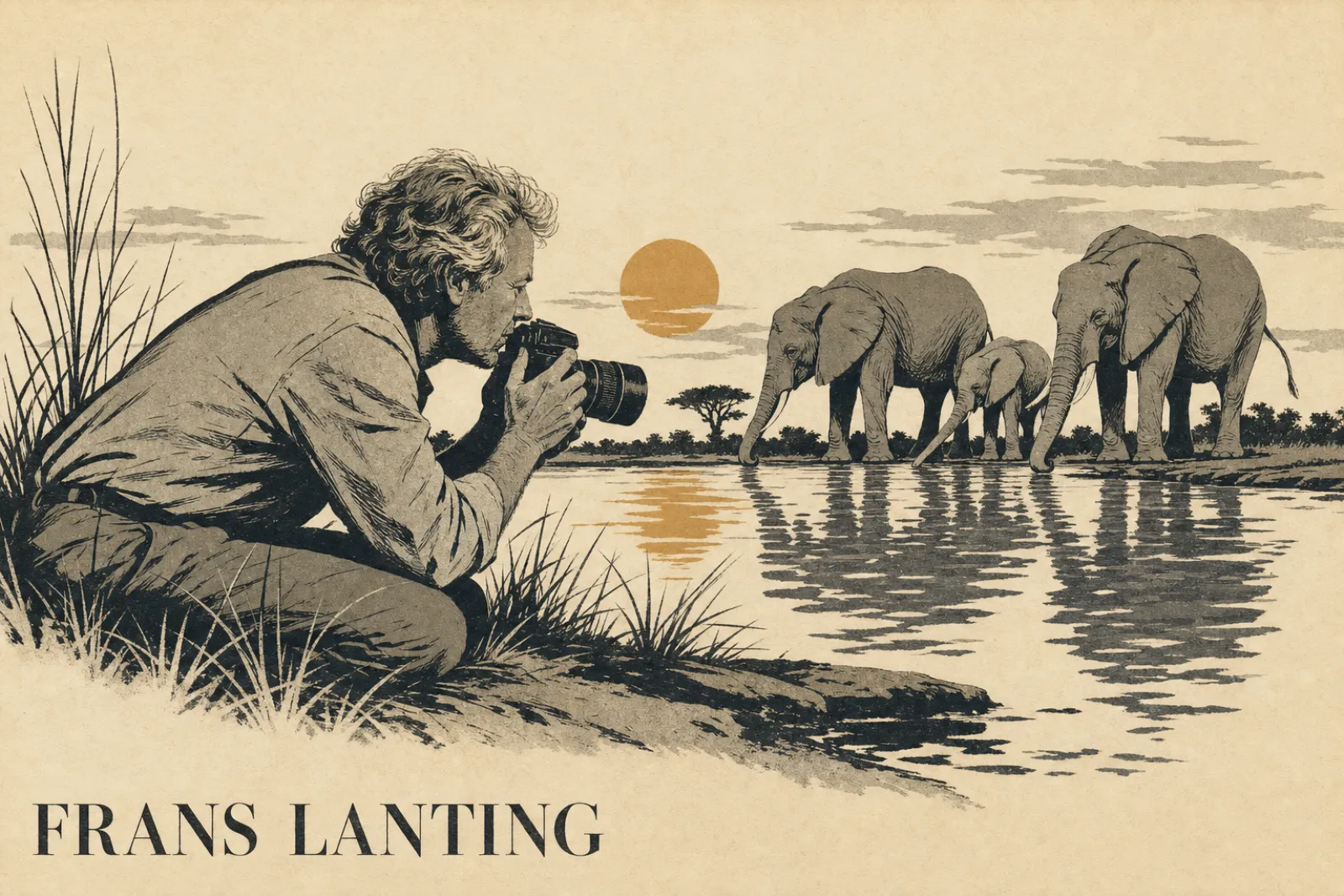
Frans Lanting is a Dutch photographer, born in Rotterdam in 1951, who spent more than three decades photographing wild animals and wild places for National Geographic, where he served as photographer-in-residence. He worked in the Okavango Delta, Madagascar, the Congo Basin, the Amazon and Antarctica. He is known for one idea above all: photographing animals at their own eye level, as individuals with faces, instead of as specimens seen from a distance.
Lanting did not train as a photographer. He took a master’s degree in economics at Erasmus University in Rotterdam, then moved to the United States to study environmental planning, and began photographing the natural world after that. The background shows. His magazine stories were built on field science and argued for the protection of a place, which puts him in the line of conservation photography as much as wildlife photography. He shared a book, Living Planet (1999), with the underwater photographer David Doubilet and the mountain photographer Galen Rowell. Other photographers of wild animals with pages here include Art Wolfe and Nick Brandt.
From economics in Rotterdam to National Geographic
Lanting’s first book, Feathers, appeared in 1982, followed by Islands of the West in 1985. Two books came out in 1990: The Albatrosses of Midway Island, and Madagascar: A World Out of Time. The Madagascar work, done for National Geographic, recorded wildlife and local traditions that had not been photographed before, and it set the pattern for what followed: a long stay in one region, a magazine story, then a book.
The Okavango Delta in northern Botswana was another long National Geographic assignment. The result was the book Okavango: Africa’s Last Eden (1993), made with his wife and working partner Chris Eckstrom, a writer, editor and videographer who had been a staff writer at National Geographic. His own account of his career credits the Okavango coverage with drawing international attention to conservation in Botswana.
Recognition came in the same years. Lanting won World Press Photo awards in 1988 and 1989 and was named Wildlife Photographer of the Year in 1991. In 1997 the Sierra Club gave him its Ansel Adams Award for conservation photography. In 2001 he was made a Knight in the Royal Order of the Golden Ark, a Dutch honour for work in conservation.
Planning to photograph animals from a vehicle in Africa? Safari photography covers focal lengths, support and settings on a game drive.
Bonobos, rainforests and the Eye to Eye idea
Lanting photographed bonobos in the Congo, work that became the book Bonobo: The Forgotten Ape (1997), made with the primatologist Frans de Waal. He spent weeks on platform towers in the rainforest canopy to photograph wild macaws, sailed around South Georgia, where he photographed albatrosses and penguins, and worked among emperor penguins in Antarctica. Rainforest pictures were collected in Jungles (2000) and penguin pictures in Penguin (2003).
The book that named his approach was Eye to Eye: Intimate Encounters With the Animal World, published by Taschen in 1997 alongside a retrospective at National Geographic’s Explorers Hall in Washington. It is a book of close animal portraits in which the eyes of the subject carry the picture. Lanting said at the time that he used the findings of field science as a base, then tried to go past a scientific record to a meeting between two individuals.
Are birds the subject you want to start with? Bird photography explains where to find them, realistic gear and field ethics.
LIFE and the history of the planet
Lanting’s largest single project was LIFE: A Journey Through Time, an attempt, spread over several years, to tell the history of life on Earth in photographs made in the present. Instead of following one animal or one region, he looked for places and organisms that stand for stages in that history, from rock formations and early organisms to the wildlife and habitats of the present. The book was published in 2006. The same pictures were shown with music by the composer Philip Glass, performed by a live orchestra, first at the Cabrillo Festival of Contemporary Music in Santa Cruz, California, in July 2006 and later at venues including Lincoln Center in New York and the Barbican in London.
Later books returned to places he had worked for decades. Into Africa (2017) was also an exhibition, first shown at the Smithsonian’s National Museum of Natural History in Washington. Bay of Life: From Wind to Whales (2022), made with Eckstrom, covered Monterey Bay in California. In October 2018 the Wildlife Photographer of the Year competition, run by the Natural History Museum in London, gave Lanting its first Lifetime Achievement Award.
How an eye-level animal portrait is made
The most teachable thing in Lanting’s work is camera height. Most people photograph animals from standing height, looking down or across. Lanting put the lens at the height of the animal’s eyes, which for small or resting animals means getting down on the ground. The page on photography angles explains why this changes the picture: at eye level the viewer meets the subject as an equal, and the background becomes distant and simple instead of a patch of ground.
The second thing is time. For his pictures of lionesses in Botswana he followed one pride for several weeks, long enough to be there at the moment they woke at dusk to hunt. He has said that reading an animal’s attitude from its body language is what decides whether he gets close enough. That is fieldcraft, and it comes before any camera setting.
The third is choosing the hour. Some of his best known African pictures, the lionesses and the elephants among them, were made at twilight, when the light is low, blue and even. Working in blue hour light means slower shutter speeds and careful support, but it gives a mood that midday sun cannot.
The fourth is using the right tool for the distance. For elusive subjects he used long lenses and cameras triggered by remote control. The guide to telephoto photography covers the long-lens half of that.
Last, Lanting thought in stories and not in single frames. A magazine assignment needs the wide view of the habitat, the behaviour, the portrait and the detail, in an order that makes an argument.
Want to turn a set of pictures into one story? How to create a photo essay covers planning, variety and sequencing.
Photographs and books to look for
- Okavango: Africa’s Last Eden (1993). The book of his Botswana coverage for National Geographic. Look at how often water is in the frame, and how the animals are shown inside their habitat instead of cut out from it. His well known picture of elephants gathered at a water hole at twilight was also made in Botswana, in Chobe National Park.
- Eye to Eye (1997). A book of animal portraits. Notice that in almost every picture the camera is level with the animal and the frame is built around its eyes.
- Eyes of the Night, Botswana. A group of lionesses at dusk, awake and scanning the bush before a hunt. The camera is at the height of their eyes, and each animal reads as an individual.
- Dead Vlei, Namibia (2011). Dead camel thorn trees on a clay pan in front of a dune. The dune is orange and the rest of the scene is blue, so the photograph reads as flat blocks of colour, closer to a painting than to a wildlife picture. The page on colour theory explains why orange against blue is so strong.
- Bonobo: The Forgotten Ape (1997). His pictures of the bonobos of the Congo, with text by Frans de Waal. Watch how gesture and expression make the behaviour clear without a caption.
- LIFE: A Journey Through Time (2006). Read it as a sequence. Each picture stands for a chapter in the history of life, so rock formations and small organisms get the same care as large mammals.
Try this
Give yourself 15 minutes with one animal you can reach easily: a pet, a duck on a pond, a pigeon in a square.
- Take three frames from standing height, as you normally would.
- Get down until the lens is level with the animal’s eyes. Lie flat if you need to. Take ten frames, focusing on the nearest eye each time.
- Stay there. Do not move closer for five minutes. Watch what the animal does and photograph only when it looks toward you or does something.
- Compare the standing frames with the low ones. Look at the background first, then at how the animal seems to regard you.
The one rule: never chase, bait or corner the animal. If it moves away, let it go. The guide to photographing pets has more on getting down to their level.
Questions people ask about Frans Lanting
Where is Frans Lanting from?
He was born in Rotterdam in the Netherlands on 13 July 1951 and studied economics at Erasmus University there. He moved to the United States to study environmental planning and took up photography of the natural world after that.
What is Frans Lanting known for?
He is known for intimate, eye-level photographs of wild animals made on long National Geographic assignments, especially in the Okavango Delta and Madagascar, and for the book and orchestral performance LIFE: A Journey Through Time.
What books has Frans Lanting published?
His books include Madagascar: A World Out of Time (1990), Okavango: Africa’s Last Eden (1993), Eye to Eye (1997), Jungles (2000), Penguin (2003), LIFE: A Journey Through Time (2006) and Into Africa (2017). Several were made with Chris Eckstrom.
What awards has Frans Lanting won?
They include World Press Photo awards in 1988 and 1989, Wildlife Photographer of the Year in 1991, the Sierra Club’s Ansel Adams Award in 1997, the Royal Order of the Golden Ark in 2001, the Lennart Nilsson Award in 2005 and the first Wildlife Photographer of the Year Lifetime Achievement Award in 2018.
More photographers, with the lessons each one teaches, are in the A to Z of photographers.