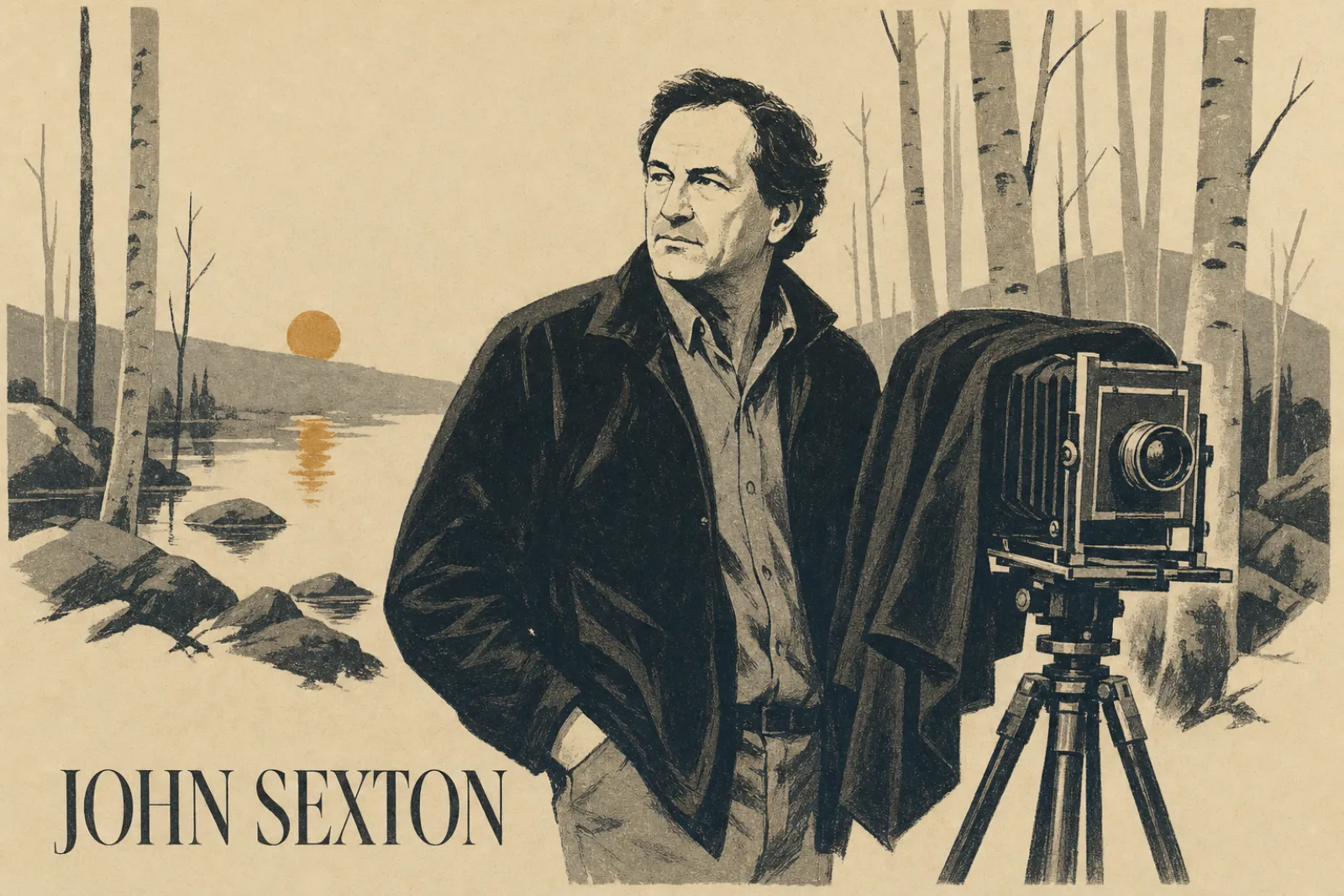
John Sexton, born in 1953, is an American photographer and teacher who made black and white photographs of the natural world in California, the American West and beyond from the 1970s onward. He worked with a 4×5 inch view camera and printed by hand in a traditional darkroom. He is best known for small, close views of trees, rocks and water photographed in the soft light of dusk, and for his years as assistant to Ansel Adams.
Sexton’s direction was set in 1973, when he attended a Yosemite workshop taught by Ansel Adams. From 1979 to 1984 he worked for Adams, first as Technical and Photographic Assistant and then as Technical Consultant. He took Adams’s craft with him: careful exposure, controlled development and a finished print with a long, clean range of tones. He turned it to a different kind of subject. Adams is known for grand views in strong light. Sexton mostly looked for near things in weak light, after the sun had gone, and let long exposures do part of the work. In 1981 he received the Imogen Cunningham Award, named for the photographer Imogen Cunningham.
From a Yosemite workshop to Ansel Adams’s darkroom
Sexton studied photography at Cypress College in California, where he earned an Associate of Arts degree in 1974, and then at Chapman University, where he completed a Bachelor of Arts in Art and Photography in 1976. He taught his first workshop in February 1975 with his friend John Charles Woods, for fellow photography students at Cypress College.
In July 1979 he began work as Adams’s assistant. The job put him close to the working methods of a landscape photographer known for technical care. After Adams died in 1984, Sexton served as Photographic Special Projects Consultant to the Ansel Adams Publishing Rights Trust. He also worked as a consultant to Eastman Kodak and other photographic manufacturers.
Teaching ran alongside the photography for decades. He directed the John Sexton Photography Workshops, taught at Anderson Ranch Arts Center, the Ansel Adams Gallery and the Maine Photographic Workshops, and co-directed the Owens Valley Photography Workshops with Bruce Barnbaum and Ray McSavaney.
Four books: quiet light, trees and machines
Sexton’s work is easiest to follow through his four books. Quiet Light (1990) was the first, and its cover picture, Corn Lily, Eastern Sierra Nevada, became one of his best known. An exhibition of the same name, organised by the United States Information Agency, toured fifteen countries in Europe from 1994 to 1996. Listen to the Trees (1994) kept to one subject, trees. It won first place as Photographic Book of the Year in 1994.
Places of Power: The Aesthetics of Technology (2000) changed the subject and kept the method. Its eighty three photographs set ancient Anasazi cliff dwellings beside Hoover Dam, steam turbine power plants and the Space Shuttle. A photographer known for black and white pictures of the natural world had turned to built and engineered things. Recollections: Three Decades of Photographs (2006) returned to the wider body of work, with fifty five photographs that had not appeared in the earlier books, from places such as Yosemite Valley and the Colorado Plateau.
Later honours included a Lifetime Achievement Award from the North American Nature Photography Association in 2005, the George Eastman Medal in 2014 and induction into the International Photography Hall of Fame in 2018.
Wondering why anyone would carry a 4×5 camera into the woods? Large format photography explains sheet film, camera movements and what the format gives back for the effort.
How the quiet light pictures are made
He waited for the light to go soft. Many of the photographs were made after the sun had dropped behind a cliff or below the horizon. Direct sun gives hard shadows and bright highlights that are difficult to hold on film. The even, low light of dusk has a narrow brightness range, so every part of the subject can be recorded with detail. The guide to blue hour photography covers the timing of that light and how fast it fades.
He let the exposure run long. Low light and a small aperture add up to exposures measured in seconds or minutes. Sexton used that as a tool. Moving water smooths into an even pale tone, which separates it from rock. Still subjects such as trunks and boulders stay sharp. This is the core idea behind long exposure photography, used here for clarity more than for effect.
He built contrast back in on purpose. Soft light can produce a flat negative. Sexton’s notes for Corn Lily, Eastern Sierra Nevada describe giving the film extra development and then chemically intensifying the negative to raise contrast. The scene was gentle and the print is not dull. The light was chosen for its evenness, and the separation of tones was then set by hand.
Want to know how tone replaces color as the thing that holds a picture together? Black and white photography covers seeing in tone, filters and conversion.
He used filters to move single tones. On black and white film, a colored filter lightens its own color and darkens the opposite. Sexton used a green filter to lighten the foliage of a tree on the Merced River, and a yellow filter to bring out faint texture in snow under soft light. Each filter was picked for one job in one picture.
He came in close and came back. The subjects are often a few metres wide: one plant, one boulder, three oaks. He would visit a place, judge the light wrong for it, and return hours later when it was right. The composition is usually simple and settled, with the main form placed firmly and the edges kept clean.
Photographs to look for
- Corn Lily, Eastern Sierra Nevada (1977). The cover picture of Quiet Light. Sexton hung the 4×5 camera a few inches off the muddy ground, with the tripod column inverted, and exposed for four seconds at f/64. Hazy sunlight coming through the canopy above falls on the plant like a spotlight. Look at how that one patch of light separates the plant from everything around it.
- Boulders and Tree, Merced River (1983). Made in Yosemite after the sun had dropped below the cliffs of the river gorge. A long lens and a one minute exposure turn the river into a smooth surface around the rocks. A green filter lifts the tree so it stands apart.
- Boulder, Sunwapta Falls, Jasper National Park, Canada. A large boulder sits at the crest of the falls. Sexton found the afternoon light wrong and went back at dusk. A five second exposure sets the wet, hard surface of the rock against soft grey water.
- Winter Trees, Fog, Yosemite Valley (1990). Three oaks in snow on a bitterly cold December day. A slightly wide lens gives the dark trunks weight in the foreground. Fog lightens the background and creates depth by hiding detail behind the trees.
- Places of Power (2000). A book length series on cliff dwellings, Hoover Dam, power plants and the Space Shuttle. Look at any of these pictures beside one of the forest pictures and compare how tone and detail are handled when the subject is engineered instead of grown.
Try this: fifteen minutes after sunset
Choose a small, still subject outdoors before the sun goes down: one plant, a rock at the edge of water, the base of a tree. Keep it to something about as wide as your outstretched arms.
- Put the camera or phone on a tripod, a wall or a bag so it cannot move. Set the lowest ISO.
- Wait until the sun is fully down and the shadows have lost their edges. Then start.
- Make one frame every three minutes for fifteen minutes, without moving the camera. Let the shutter speed get longer each time. On a phone, use night mode or a manual exposure app.
- Convert all five frames to black and white and lay them side by side.
Find the frame where shadow detail and highlight detail are both easy to see. Then add contrast to that frame only, a little at a time, and stop when the subject separates from its background.
Need help keeping a whole landscape sharp at slow shutter speeds? Landscape photography covers aperture, focus and working from a tripod.
Questions people ask about John Sexton
Did John Sexton work for Ansel Adams?
Yes. He began as Adams’s Photographic and Technical Assistant in July 1979 and worked for him until 1984, later as Technical Consultant. He then served as Photographic Special Projects Consultant to the Ansel Adams Publishing Rights Trust.
What camera did John Sexton use?
His process was large format 4×5 inch photography on black and white film, printed as silver gelatin prints in a darkroom. His own notes on individual pictures mention a Linhof 4×5 view camera with lenses from 120mm to 360mm.
What books did John Sexton publish?
Four: Quiet Light (1990), Listen to the Trees (1994), Places of Power: The Aesthetics of Technology (2000) and Recollections: Three Decades of Photographs (2006).
What does “quiet light” mean?
It is the title of his first book and a description of the light he preferred: the soft, even light of dusk, dawn, fog and overcast days. In that light contrast is low, so detail holds in both the dark and the bright parts of a scene.
John Sexton is one of the photographers in the A to Z of photographers, and he is quoted on the photography quotes page.