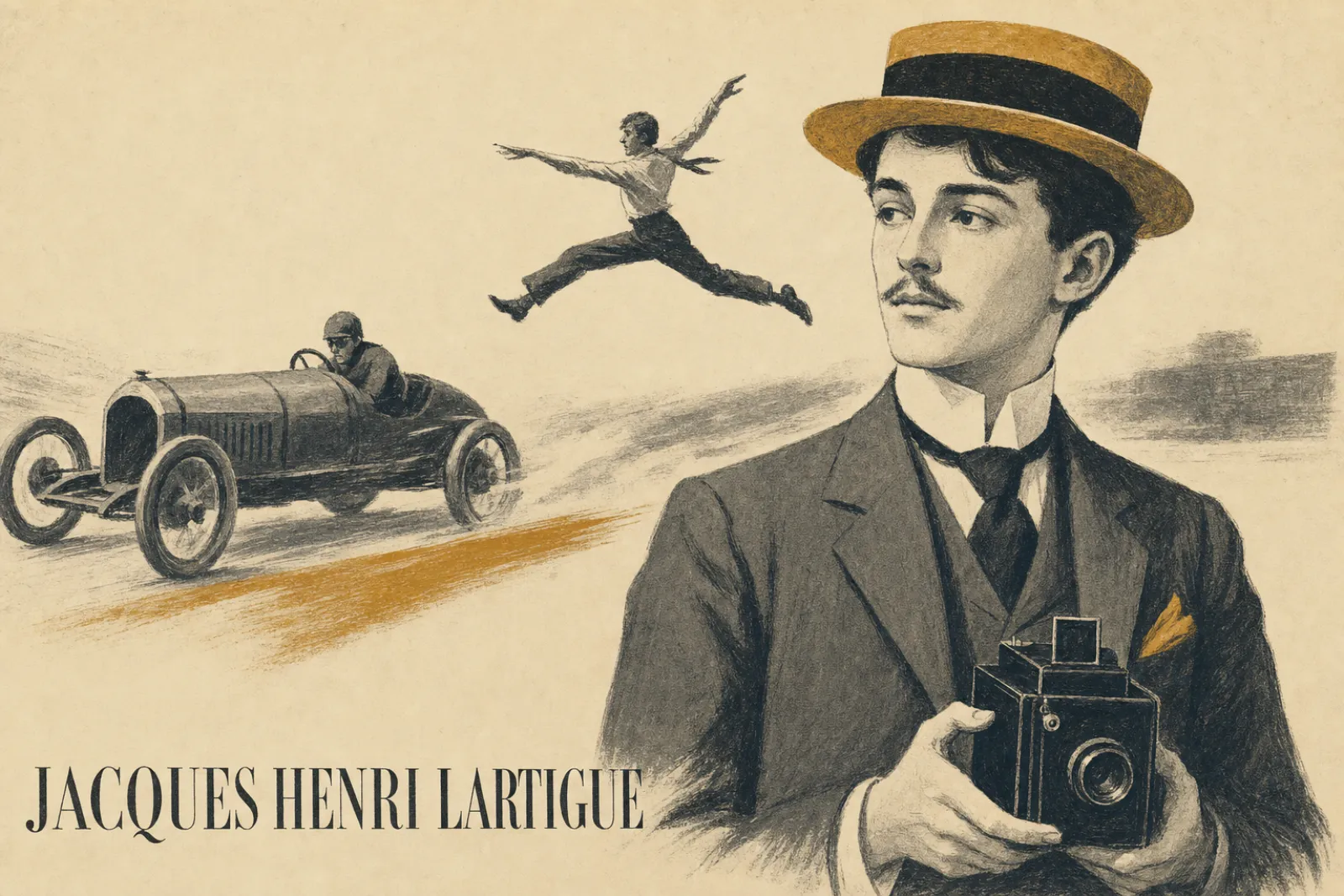
Jacques Henri Lartigue (1894 to 1986) was a French photographer and painter who began taking pictures as a small boy in the first years of the 1900s and never stopped. He photographed his own wealthy family and friends at play: leaping, racing, gliding and playing tennis. He is known for boyhood pictures of people and machines caught in mid-air or at full speed, which went almost unseen by the public until he was 69.
Lartigue had no teacher in the usual sense. His father, Henri, introduced him to photography, gave him his first camera and kept supplying better ones as the boy grew. He belonged to no group and reacted against nothing, because for most of his life he did not think of the photographs as a career at all. That is the useful contrast with the professionals of his time. Where Eugène Atget made plain, patient records of old Paris streets for clients, Lartigue made pictures to keep a good day from disappearing. Much later his work passed through the hands of Richard Avedon, who helped shape the book that made it widely known.
A childhood spent photographing a family that would not sit still
Lartigue was born on 13 June 1894 in Courbevoie, near Paris. His subjects were the people around him: cousins, friends, his parents, and above all his older brother Maurice, nicknamed Zissou, who built a glider and a boat made from a tyre and tried them out at the Château de Rouzat. Lartigue designed a wheeled bobsleigh of his own. The camera recorded each experiment.
The equipment was serious for a child. He worked on glass plate negatives in several sizes, and from 1905 his father gave him more advanced cameras, with which he experimented with movement, multiple exposure and stereoscopic pictures, paired images for viewing in three dimensions. Many of the early pictures now printed as single frames were first made as stereo pairs. In 1912 he was given a new stereo camera and a Pathé cine camera as well. He also used the autochrome process, an early way of making colour photographs on glass.
Speed fascinated him. He photographed car races, including the Grand Prix of the Automobile Club de France, and the early aviators at their airfields, among them Louis Blériot and Roland Garros. He photographed tennis, including the champion Suzanne Lenglen, and other sports. In 1911 he walked the Bois de Boulogne in Paris photographing fashionably dressed women as they strolled past.
How does a camera hold a moving subject still, or let it blur on purpose? How to photograph moving subjects sets out the three choices: freeze, blur and pan.
A painter who kept albums and a diary
Lartigue took up drawing and painting in 1915 and studied briefly at the Académie Julian in Paris. From 1922 he exhibited as a professional painter, and painting was how he described his occupation for decades. The photographs continued alongside, pasted into albums and matched by a diary he kept throughout his life. He left more than 100,000 photographs, about 7,000 diary pages and some 1,500 paintings.
The people in the pictures changed as his life did. He married Madeleine Messager, known as Bibi, in 1919. From 1930 to 1932 his model and favourite subject was Renée Perle, and the pictures of her are among his best known from between the wars. He married Florette Orméa in 1945, and she appears in the beach pictures of the 1950s. He also photographed on film sets and for fashion magazines, and in 1955 he photographed Picasso. The formats moved with the times too, from glass plates to film.
Have boxes of family pictures and no system for them? How to organize and preserve a family photo archive covers sorting, labelling and storage.
Discovered at 69
In 1962 Charles Rado of the Rapho agency introduced Lartigue to John Szarkowski, the photography curator at the Museum of Modern Art in New York. Szarkowski arranged an exhibition at the museum in 1963, and Life magazine published the pictures the same year. The book Boyhood Photos followed in 1966 and Diary of a Century, with a layout by Richard Avedon, in 1970.
Recognition at home came next. In 1974 the newly elected president, Valéry Giscard d’Estaing, chose him to make the official presidential portrait, which Lartigue set against the national flag. In 1975 the Musée des Arts Décoratifs in Paris held his first French retrospective, titled Lartigue 8×80. In 1979 he signed a deed giving his entire photographic output to the French state, and the exhibition Bonjour Monsieur Lartigue at the Grand Palais marked the gift in 1980. He died in Nice on 12 September 1986, aged 92.
How a boy’s snapshots hold up as photographs
The pictures look effortless. The choices behind them can be named and copied.
- He pressed at the top of the action. A jumper slows almost to a stop at the highest point, and that is where Lartigue caught his cousins and friends. The body is fully off the ground, the skirt or coat is spread, and nothing is yet coming down. This is the decisive moment in its plainest form: one gesture at its peak.
- He photographed people who were already playing. These were games among family and friends, repeated all afternoon. A repeated action can be studied before it is photographed, so the position and the frame can be settled first and only the timing is left to solve.
- He stood side on and left room. The stairs, the path or the road usually run across the picture, so the movement reads clearly from one side to the other, with space ahead of the subject to move into.
- He worked in bright daylight. Early plates needed a lot of light for a short exposure. Sunlit gardens, beaches and roads gave him the fast shutter times that stop a body in the air.
- He accepted what the shutter did. His racing car picture is strikingly distorted, probably because he swung the camera to follow the car while the shutter was travelling across the glass plate. The result could not have been planned to the last detail, and it became one of his best known pictures.
- He stayed inside his own world. The subjects knew him, so nobody stiffens. The ease of good candid photography comes from being a normal part of the scene, and a child with a camera in his own garden was exactly that.
Why would a moving shutter distort a racing car? Rolling shutter explains how a shutter that exposes the frame a strip at a time bends anything that moves fast.
The swing of the camera in that frame is the same movement used in panning, where the camera tracks the subject through a slower exposure so the background streaks. Lartigue’s picture shows what a swinging camera and a travelling shutter can do together, and the distortion is the reason the picture feels so fast. Motor races are still photographed with that technique, as the guide to motorsport photography describes.
Photographs to look for
- Cousin Bichonnade in Flight (1905). His cousin is caught in mid-air, as the title says. Notice how everything around her is still and solid, which makes the hovering figure look even less likely.
- Zissou in his Tire Boat, Château de Rouzat (1911). His brother afloat in the boat he made from a tyre. It is one of many pictures in which a family invention is tried out in front of the camera, and it shows how much of Lartigue’s subject matter was simply handed to him.
- My Brother, Zissou, Gets His Glider Airborne, Château de Rouzat (1908). One of the pictures of his brother’s home-built machines at Rouzat. Look at where the glider sits in the frame and how much of the picture is given to the air around it.
- Avenue du Bois de Boulogne, Paris (1911). One of the pictures of fashionably dressed Parisians out walking that he made in the Bois de Boulogne that year. It is close to street photography: a stranger, a public place, and one step chosen out of many.
- Grand Prix of the Automobile Club de France. Car number 6, carrying two men, passes spectators at the side of the road. Look at how the car and the roadside figures are distorted. Museums have long dated it 1912. Later research places it at the race held at Amiens on 12 July 1913.
- Portraits of Renée Perle (1930 to 1932). Pictures from the two years she modelled for him, such as Renée, Nice (1931). They are still, posed and elegant, a different register from the boyhood action pictures.
Want to make a person look as if they are floating? Levitation photography covers the jumping method, including shutter speeds and how to direct the jump.
Try this: one jump, twenty minutes
You need a willing friend, bright daylight, and three or four steps or a low wall.
- Stand side on to the steps, far enough back to include the whole staircase and some space above it. Crouch so the camera is about waist height.
- Set a shutter speed of 1/1000 second, or on a phone simply work in full sun. Focus on the spot where the jumper will be and keep it there.
- Switch off burst mode. The constraint is one press per jump.
- Ask your friend to jump down the steps ten times. Watch the first two without shooting. Then press just as their feet leave the top step, so the shutter opens near the highest point.
- Look at the eight frames in order. Mark which are early, which are late, and which show the body fully in the air with nothing touching.
Most people press late at first. By the last few jumps the timing usually arrives, which is how Lartigue learned it too: with people who did not mind doing it again.
Questions people ask about Jacques Henri Lartigue
How old was Lartigue when he started taking photographs?
He began in the first years of the 1900s, at seven or eight, using cameras provided by his father. Many of the pictures he is best known for were made before he was 20.
Why was his work unknown for so long?
He made the photographs for himself and his family and worked publicly as a painter from 1922. The pictures stayed in his albums until a meeting with John Szarkowski in 1962 led to the Museum of Modern Art exhibition in 1963 and publication in Life.
Is his name written with a hyphen?
Both forms are in use. The foundation that looks after his work writes Jacques Henri Lartigue without a hyphen, and many museums write Jacques-Henri Lartigue.
Where are Lartigue’s photographs kept?
In 1979 he gave his whole photographic output to the French state. The Association des Amis de Jacques Henri Lartigue was entrusted with preserving the work and making it known.
Lartigue is one of the photographers in the A to Z of photographers, and he is quoted on the photography quotes page.