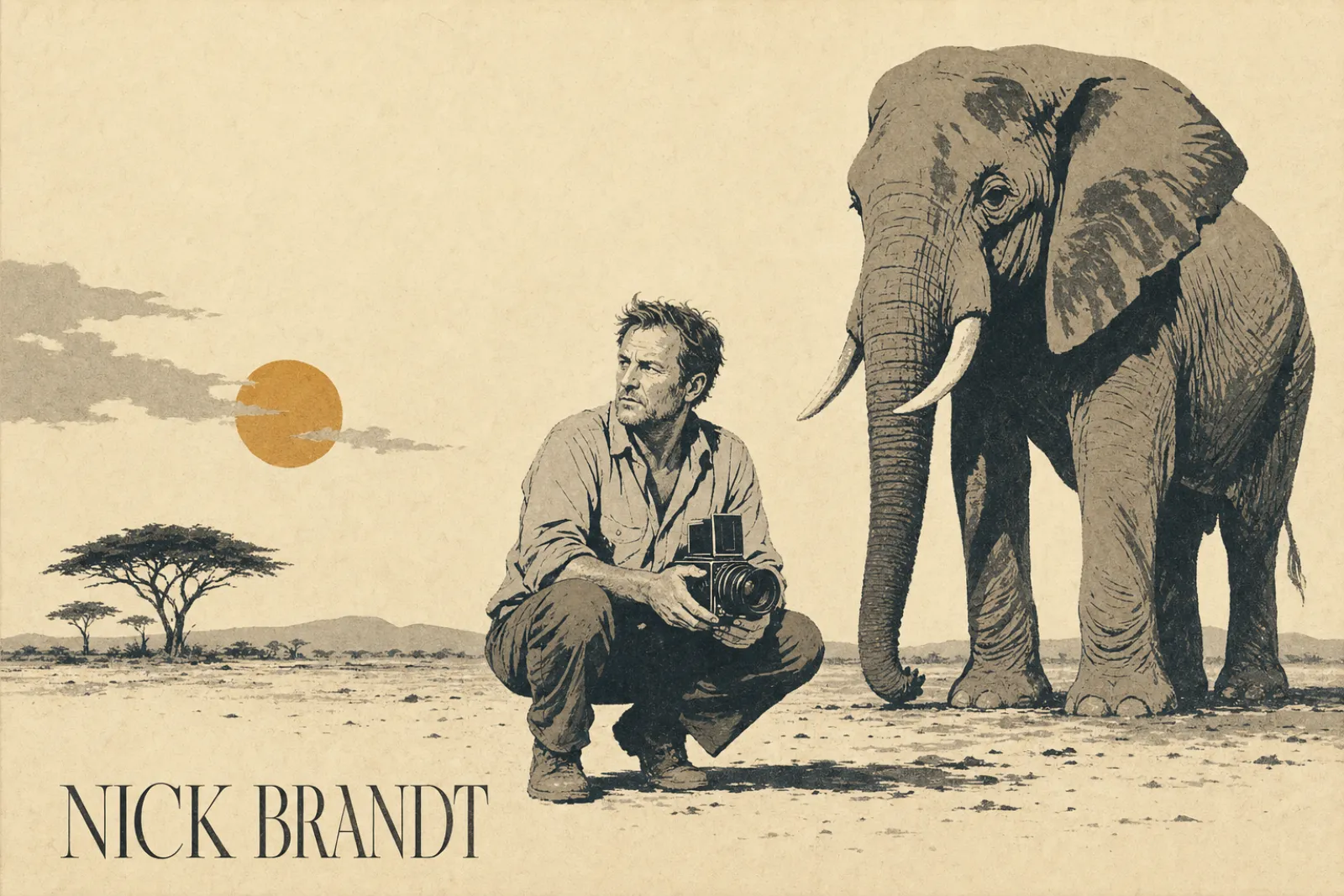
Nick Brandt is a British photographer, born in London in 1964, who began photographing the wild animals of East Africa in 2001. He worked on medium format black and white film, close to his subjects and without a telephoto lens, and made portraits of elephants, lions and other animals in the manner of a studio sitting. He is known for the trilogy that opens with On This Earth and for later series about the damage done to the natural world.
Brandt did not come to this work through wildlife photography. He studied painting and film and spent years directing music videos. He turned to still photography out of frustration that he could not express on film what he felt about the destruction of the natural world. That background shows in the pictures, which are composed and staged like portraits and film scenes more than they are caught like action shots. Readers who want to see how other photographers on this site approached animals and wild places can compare Frans Lanting and Art Wolfe.
From music videos to the Maasai Mara
Brandt was born and raised in London and studied painting and film there, at Saint Martin’s School of Art. He moved to California in 1992 and directed music videos, among them Earth Song (1995) and Stranger in Moscow for Michael Jackson, Porcelain for Moby and Hands for Jewel. It was the directing work that first took him to East Africa, in 1995.
In 2001 he began to photograph there in earnest. The first book, On This Earth, was published in 2005 with photographs made from 2001 to 2004, and carried introductions by Jane Goodall, Alice Sebold and the critic Vicki Goldberg. A Shadow Falls followed in 2009 with pictures from 2005 to 2008. Across the Ravaged Land, with photographs from 2010 to 2012, completed the set in 2013. Read in order, the three titles form one sentence: On This Earth, A Shadow Falls Across the Ravaged Land.
The third book changed the subject. People appeared for the first time, including a ranger with the tusks of a killed elephant, photographed at Amboseli in Kenya in 2011. The book also contained The Petrified, a group of pictures of animal carcasses from Lake Natron.
Thinking of photographing animals on a game drive? Safari photography covers settings and practical tips for working from a vehicle.
Rangers, poaching and Big Life
The change in the pictures had a cause. Poaching in Africa was escalating. In September 2010, in response, he co-founded the Big Life Foundation with Richard Bonham and Tom Hill. The foundation employs local rangers to protect wildlife in the Amboseli, Tsavo and Kilimanjaro ecosystem, which lies across the border of Kenya and Tanzania.
This is the point at which his work stopped being only a record of animals and became an argument about their future. Photography used in the service of protecting species and habitats has a name, and the page on conservation photography explains what the term covers.
Panels, built sets and the same frame twice
After the trilogy Brandt’s methods became more elaborate with each series.
Inherit the Dust (2016) used his earlier animal portraits again. He had them printed as life size panels and erected in East African places where the animals once lived: sites of industrial development, factories and wasteland. He then photographed each panel in its new surroundings as a wide panorama.
This Empty World (2019) was his first work in colour. He built sets on Maasai land and left cameras with motion triggers in place until animals walked into the frame. Then, from the same camera position, a second scene was built and photographed with people from local communities: a petrol station or a highway, for example. The two exposures were combined into one picture. The prints were large, up to 60 by 130 inches.
The Day May Break followed in chapters. Chapter One, photographed in Kenya and Zimbabwe in 2020 and published in 2021, shows people and animals together in the same frame at wildlife sanctuaries. The people had been affected by climate change and environmental damage, and the animals lived in the sanctuaries. Chapter Two (2022) was made in Bolivia at the Senda Verde animal sanctuary. Chapter Three, SINK / RISE (2023), was photographed entirely under water off the coast of Fiji, with South Pacific islanders seated on sofas and chairs. It was his first series with only people as subjects. Chapter Four, The Echo of Our Voices (2024), was made in Jordan with Syrian refugee families posed on stacked boxes.
How is a very wide picture made from several frames? Panorama photography explains how to shoot and stitch one.
How the pictures are made to work
No long lens. For the trilogy Brandt used a Pentax 67II, a medium format film camera, with fixed lenses and no telephoto or zoom. His reasoning was that nobody would photograph a person from a hundred feet away and expect to capture their spirit, so he would not do it to an animal either. A short lens used close keeps the land and sky around the animal in the picture and gives the sense of standing next to it. This is the opposite of the usual advice in telephoto photography, and the comparison is instructive.
The animal as a sitter. The trilogy treats wild animals as subjects of portraits, not as specimens or as action. The animal is still, the framing is formal and the place is part of the description. The idea is close to the environmental portrait of a person in their own setting.
Black and white film. The first three books were shot on black and white film. Removing colour pushes attention to shape, tone and weather, and it sets the pictures apart from the colour that most wildlife photography relies on. The basics of working this way are in the guide to black and white photography.
Building the picture. In the later series very little is found by chance. Panels are erected, sets are built, sofas are placed under water. Brandt’s sets have been compared with film production in their scale. The lesson for a photographer with fewer resources is that a picture can be planned around an idea and then constructed.
One camera position, two moments. This Empty World depends on the camera not moving between the animal exposure and the human one. Because the viewpoint is fixed, the two scenes fit together when combined. The same principle applies to any composite made from a tripod.
Scale. The panels in Inherit the Dust are life size, so an elephant on a panel is as big as an elephant. Set against factories and wasteland, the size makes the loss easy to read. Getting the relation of sizes right is the subject of scale in photography.
Photographing under water for the first time? Underwater photography introduces the equipment and the way light behaves below the surface.
Photographs and series to look for
- Cheetah and Cubs, Maasai Mara (2003). From On This Earth. A picture from the first years of the project, when the method of the trilogy was being set: medium format film, a fixed lens and no telephoto.
- A Shadow Falls (2009). The second book of the trilogy, with photographs made from 2005 to 2008. Its title is the middle of the sentence that the three books spell out.
- Ranger with Tusks of Killed Elephant, Amboseli (2011). From Across the Ravaged Land. A ranger is shown with the tusks of an elephant that had been killed. It marks the entry of people, and of the cause of the animals’ decline, into his work.
- The Petrified. The pictures of animal carcasses from Lake Natron, published in Across the Ravaged Land. They extend the portrait idea to creatures that are no longer alive.
- Inherit the Dust (2016). Life size panels of animal portraits standing among factories, industrial development and wasteland. Look at how the size of each panel relates to what surrounds it.
- SINK / RISE (2023). Islanders seated on furniture under water off Fiji. The sitters stand for South Pacific islanders threatened by rising seas, and the ordinary furniture in an impossible place carries the point.
Try this: an animal portrait with no zoom
This exercise practises Brandt’s main constraint: get close with a normal or wide lens and make a portrait, not a snapshot.
- Choose an animal you can safely be near: a pet, a farm animal behind a fence, a bird that is used to people in a park.
- Use a phone’s main camera or a fixed lens. Do not zoom at all.
- Set the camera to black and white.
- Get down to the animal’s eye level and move closer slowly. Stop if it shows any sign of stress, and never approach a wild or unfamiliar animal.
- Wait until the animal is still. Make ten frames in fifteen minutes, and include some of its surroundings in each.
- Choose the frame in which the animal looks most like an individual, and note how far away you were when you took it.
Questions people ask about Nick Brandt
What camera did Nick Brandt use?
For his East African trilogy he used a Pentax 67II medium format camera with black and white film and fixed lenses. He did not use telephoto or zoom lenses. This Empty World, published in 2019, was his first series in colour.
Are the animals in Inherit the Dust real?
The animals are his own earlier photographs, printed life size on panels. The panels were physically set up in places where development had replaced the animals’ habitat, and each scene was then photographed.
How was This Empty World made?
Sets were built on Maasai land and cameras with motion triggers recorded animals that entered them. A second scene with people was then built and photographed from the same camera position, and the two were combined into one image.
What is the Big Life Foundation?
It is a conservation organisation that Brandt co-founded in September 2010 with Richard Bonham and Tom Hill, in response to a rise in poaching. It employs local rangers to protect wildlife in the Amboseli, Tsavo and Kilimanjaro ecosystem of Kenya and Tanzania.
Nick Brandt is listed in the A to Z of photographers.