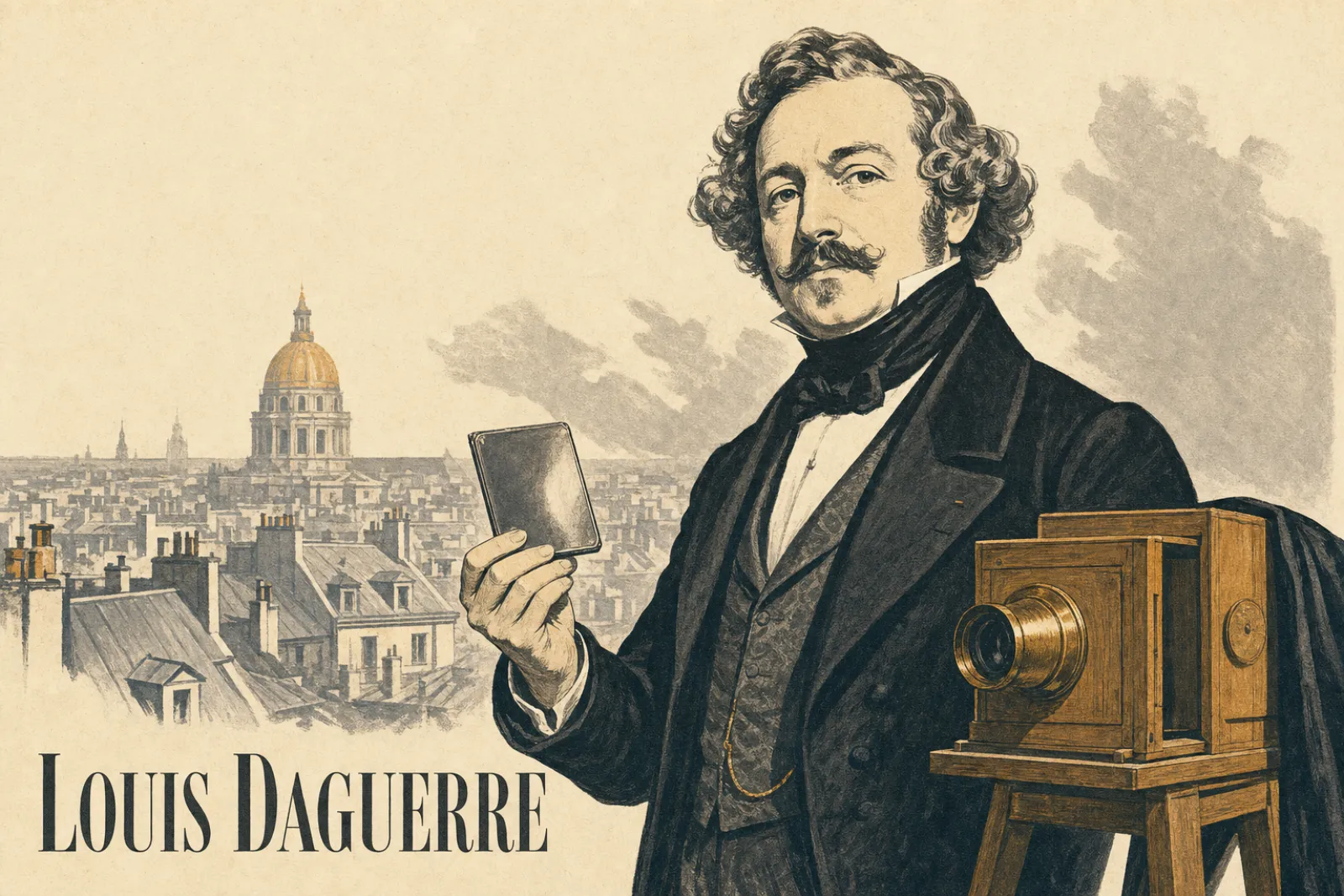
Louis Daguerre (1787 to 1851) was a French painter and stage designer who gave his name to the daguerreotype, the first photographic process to be made public. He worked in Paris, where he ran the Diorama, a theatre of huge painted scenes transformed by changing light. He is known for the small, mirror-bright pictures on silvered copper plates that he showed to the world in 1839.
Daguerre was a showman of illusion before he was an inventor. His full name was Louis-Jacques-Mandé Daguerre. He learned panorama painting from Pierre Prévost and built his photographic process on the experiments of his partner Nicéphore Niépce. His rival was the Englishman William Henry Fox Talbot, who had been working separately on a paper process and made it public within weeks of the French announcement. Within a generation the portrait studios of Paris, Nadar’s among them, had moved on to glass negatives and paper prints, and the daguerreotype was no longer made.
How does the daguerreotype fit with what came before and after it? The history of photography covers Niépce’s first plate, the 1839 announcements, Talbot’s calotype and the processes that replaced them.
Panoramas, stage sets and the Diorama
Daguerre was born on 18 November 1787 at Cormeilles-en-Parisis, near Paris. He was apprenticed in architecture, theatre design and panorama painting, and he became a celebrated designer of stage scenery, admired for his effects of light.
In 1821 he went into partnership with the painter Charles Marie Bouton, and in July 1822 they opened the Diorama in Paris, on what is now the Place de la République. The audience, as many as 350 people, stood on a platform that turned to face one enormous painting and then another. Each scene was painted on linen in layers, partly opaque and partly translucent. Daylight from skylights and windows was directed onto the front or through the back by screens, shutters and coloured blinds, so that a view could pass from day to night or from calm to fire while the audience watched. The opening behind which each picture appeared was about 7.3 metres wide and 6.4 metres high. A second Diorama opened in Regent’s Park, London, in 1823.
The Diorama made Daguerre well known. It also explains what he wanted from a camera. He used the camera obscura as an aid to his painting, and he wanted to keep the picture it threw.
From Niépce’s partner to the plates of 1837 and 1838
In the later 1820s Daguerre made contact with Nicéphore Niépce, who had already recorded a camera image, and the two became partners. Niépce died in 1833. His son Isidore inherited his share, and Daguerre went on with the experiments.
Daguerre’s own method was different from Niépce’s. He used a sheet of copper plated with silver, polished it, and exposed it to iodine fumes to make the surface sensitive. His central discovery was that a fairly short exposure in the camera left an image that could not yet be seen, and that mercury vapour would bring it out. He fixed the result at first with a strong solution of common salt and later with hypo.
The earliest daguerreotype that can be dated with confidence is a still life of plaster casts made in 1837. The following year he pointed the camera out of a window at the Boulevard du Temple. He tried to interest private investors in the process, without success.
1839: announcement, fire and a pension
On 7 January 1839 the scientist and politician François Arago described the invention, in general terms, to the French Academy of Sciences. On 8 March 1839 the Diorama burned down. The fire destroyed Daguerre’s laboratory, his written records and most of his early experimental plates.
Arago then persuaded the French state to buy the process. Daguerre received a pension for life of 6,000 francs a year and Isidore Niépce one of 4,000 francs, and on 19 August 1839 the working details were explained step by step to a joint meeting of the Academy of Sciences and the Academy of Fine Arts. France presented the process as a gift, free to the world. There was one exception. A few days earlier, on 14 August, an agent acting for Daguerre had applied for a patent in England, and photographers there had to pay for a licence.
Daguerre was made an officer of the Legion of Honour in 1839. He died at Bry-sur-Marne, about 12 km from Paris, on 10 July 1851. His name is one of the 72 inscribed on the Eiffel Tower. Fewer than twenty-five photographs securely attributed to him survive, among them still lifes and views of Paris.
What the process demanded of the picture
The teachable part of Daguerre’s work lies in the limits he worked inside.
- One plate, one picture. A daguerreotype has no negative. The plate that was in the camera is the finished picture, and the only way to copy it was to photograph it again. Every decision had to be right at the moment of exposure.
- Minutes, not fractions of a second. In 1839 a subject in bright sun needed an exposure of several minutes or more. Anything that moved left no trace. The camera had to be fixed and the subject had to be still, which is why his surviving plates are casts, buildings and streets. The same reasoning, used on purpose, is behind modern long exposure photography.
- Daylight only. There was no artificial light strong enough to expose a plate. Pale objects such as the plaster casts in the still life of 1837 depend on the angle of that light to show their shape. Read the plates with the guide to the direction of light beside you and the method is plain.
- Detail as the selling point. The silver surface held far finer detail than any paper process of the time. Daguerre chose subjects that showed it off: plaster casts and the buildings of Paris. The page on texture in photography explains how side light reveals surfaces of this kind.
- A mirror, reversed. The image is laterally reversed, as in a mirror, unless a prism was used. The polished plate also reflects the viewer, and it has to be tilted to the right angle before the image shows as a positive. The surface tarnishes and marks easily, which is why plates were sealed under glass.
- A painter’s arrangement. Daguerre was a painter first, and his still lifes are arranged groups of studio objects, not things found by chance. The site’s guide to still life photography sets out the same choices of subject, arrangement and background.
Why does a slow exposure empty a busy street? Shutter speed explains how exposure time decides what is recorded and what is lost to motion.
Others soon removed the worst of the limits. Gold toning, introduced by Hippolyte Fizeau in 1840, made the image stronger, and faster lenses and more sensitive plates brought exposures down to seconds within a few years. That made the daguerreotype portrait possible.
Plates to look for
- Still life with plaster casts, also called L’Atelier de l’artiste (1837). The earliest reliably dated daguerreotype. A group of plaster casts arranged as a still life in the studio. Look at how the light gives white objects their shape.
- View of the Boulevard du Temple (1838). A view down a Paris boulevard, taken from a window of his studio. The street looks empty because the traffic moved through a long exposure. In the lower left a man stood still to have his boots cleaned, and he and the bootblack registered. They are regarded as the earliest people known to appear in a photograph.
- Views of Paris (later 1830s). Daguerre also photographed Notre-Dame, about 1838, and the Pont Neuf, at some point from 1836 to 1839. As in all his plates, the scene is reversed left to right. Compare them with the Boulevard du Temple for what a long exposure does to a city.
- The Diorama paintings (1822 to 1839). The Paris Diorama and its pictures were lost in the fire of 1839. They are worth knowing about, even from descriptions and prints, because they show that his subject from the start was light changing over a fixed scene.
Interested in photographing a city from above as Daguerre did from his window? The guide to cityscape photography deals with vantage points and light.
Try this: one plate, one chance
This takes about fifteen minutes and a windowsill.
- Gather four or five pale objects: cups, a plaster ornament, a shell, a folded white cloth.
- Arrange them on a sill or a table beside a window, with no other light on in the room. Overlap them and vary their heights.
- Fix the camera or phone on a tripod or a stack of books. Do not move it again.
- Spend ten minutes arranging and looking. Move one object at a time and watch what the shadows do.
- Take one photograph only. There is no second plate.
Then judge it as Daguerre’s audience did: by how much detail and how much sense of solid form it holds. If you want to push the idea further, the guide on how to use a tripod will help you work with slow exposures in dim light.
Questions people ask about Louis Daguerre
What did Louis Daguerre invent?
He invented the daguerreotype, a way of fixing the image of a camera on a silvered copper plate, made public in 1839. Before that he was co-inventor of the Diorama, a theatre of painted scenes animated by light, which opened in Paris in 1822.
Did Daguerre take the first photograph?
No. His partner Nicéphore Niépce had recorded a camera image in the 1820s. Daguerre’s process was the first to be published and widely used.
Who is the person in the Boulevard du Temple photograph?
Nobody knows. He was a man having his boots cleaned on the pavement in 1838, and he stayed still long enough to be recorded during an exposure of several minutes. Some writers have questioned whether a bootblack is really what the plate shows.
How did Daguerre make money from the daguerreotype?
The French government bought the process in 1839 in exchange for a pension of 6,000 francs a year for life and gave it to the public. He also took out a patent in England.
For more photographers to study, see the A to Z of photographers.