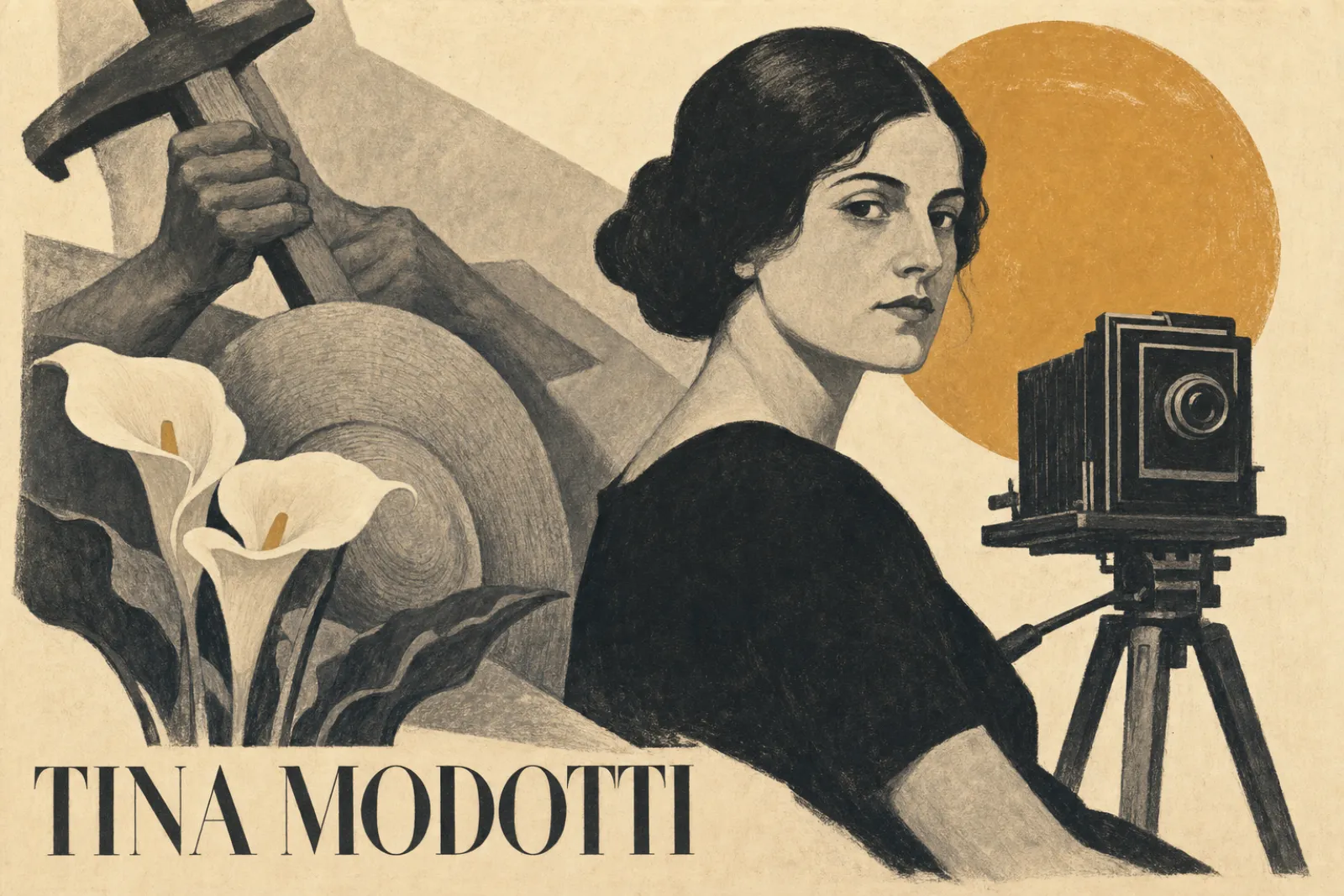
Tina Modotti (1896 to 1942) was an Italian-born photographer who made nearly all her work in Mexico between 1923 and 1930. She photographed flowers, buildings, tools, hands, murals and the working people of a country just out of revolution. In a career of about nine years she joined the hard, clear form she learned from Edward Weston to open political purpose, and her close views of workers and their emblems are what she is known for.
Modotti learned photography from Edward Weston, first in Los Angeles and then in Mexico City, where she ran his portrait studio in return for lessons. She took his discipline, the sharp lens and the carefully seen object, and turned it toward people and causes he left alone. Her work was admired by Manuel Álvarez Bravo, who met her in 1927 and who later trained Graciela Iturbide.
Udine, San Francisco and a Hollywood detour
Modotti was born in Udine, in north-east Italy, in August 1896. Her mother was a seamstress and her father a mason. In 1913, aged 16, she emigrated to the United States to join her father and sister in San Francisco. She worked as a seamstress and model and acted in the city’s Italian theatre.
In 1918 she moved to Los Angeles with Roubaix de l’Abrie Richey, known as Robo. She had small parts in silent films, the largest of them in The Tiger’s Coat in 1920. Through Richey’s circle she met Weston, and she became his model, then his partner and apprentice. Richey died of smallpox in Mexico in February 1922, while Modotti was on her way to join him. She saw a country she wanted to return to.
Mexico City with Weston, 1923 to 1926
In 1923 Modotti and Weston moved to Mexico City and opened a portrait studio. She managed it, and in return he taught her to use the camera and to print. They arrived in the middle of what was called the Mexican Renaissance, and their friends were its painters and writers, Diego Rivera and Jean Charlot among them.
Her early pictures show how fast she learned. They are still lifes and architecture: flowers, a church interior, a stairway, a stadium. Her prints from these years are on platinum and gelatin silver paper. Unlike Weston she was already drawn to subjects that pointed outside the frame, toward how people lived. In 1926 the two were commissioned by Anita Brenner to photograph folk art and religious objects for the book Idols Behind Altars. Weston went back to California in November 1926. Modotti stayed.
Want to try the kind of table-top picture she began with? Still life photography covers arranging, lighting and framing objects.
A camera for the cause, 1927 to 1930
Modotti joined the Mexican Communist Party in 1927, and her work changed with her politics. From 1924 to 1928 she photographed the murals Rivera was painting at the Secretariat of Public Education, making hundreds of record pictures of them. She photographed marches, meetings, mothers and children, and labourers at work. Her pictures were printed in the magazine Mexican Folkways, in the party newspaper El Machete, and in left-wing papers in Germany and the United States.
In 1928 she met the exiled Cuban activist Julio Antonio Mella. He was shot dead in 1929 while walking beside her in the street. She was arrested, questioned and cleared. In December 1929 the National Library held a one-woman show of her photographs, advertised as the first revolutionary photographic exhibition in Mexico. In 1930 she was expelled from the country during a campaign against communists.
She went to Berlin and then, in 1931, to Moscow. There she gave up photography for political work. She served the Republican side in the Spanish Civil War from 1936 to 1939 and went back to Mexico under an assumed name in 1939. She died in Mexico City in January 1942, of heart failure, in a taxi on her way home from a dinner.
Asking what makes a picture documentary and not simply a record? Documentary photography explains the aims and methods of the genre.
How a Modotti photograph is put together
One subject, moved in close. Flowers with nothing around them. A labourer’s hands gripping a shovel. Modotti left out the room, the street and the sky whenever they added nothing. This is filling the frame used as an argument: the thing shown is the only thing that counts.
Repetition makes the form. A stadium, telephone wires, a crowd of sombreros seen from above. She looked for one shape repeated many times, and set the camera where the repeats ran in clean rows. The page on patterns and repetition covers the same idea.
The viewpoint is chosen, not found. She shot down on a parade and up at wires against the sky. A high or low camera angle flattens depth and turns a scene into a design of lines and tones, which is why some of her pictures sit close to abstract photography.
Objects stand in for people and ideas. A typewriter is a portrait of the man who wrote on it. An ear of corn, a cartridge belt and a guitar laid together make a political emblem with no slogan. This is still life doing the work of a poster.
Light gives things weight. In her pictures light rakes across skin, cloth and wood so that every surface shows. The treatment of texture is what keeps the political pictures from looking like diagrams.
The picture is finished in the camera. Her frames are tight to the edges, with nothing spare around the subject. Composing this way leaves no room for rescue later by cropping, so every edge has to be checked before the shutter is pressed.
Wondering how tone carries a picture when colour is gone? Black and white photography covers seeing, shooting and editing in monochrome.
Photographs to look for
- Roses, Mexico. One of her early flower studies, made while she was learning from Weston. Look at how a close view turns a familiar subject into a study of form before it reads as flowers.
- Interior of Church, Tepotzotlán, 1924. A platinum print made on a visit during Holy Week in April 1924. She used the soft tones of platinum to bring out the abstract side of the composition, so that the architecture reads as shapes first.
- Stadium, Mexico City. An architectural abstraction from the Weston years. Look for rhythm: one built form repeated until it becomes a pattern.
- Workers Parade, 1926. A May Day march in Mexico City photographed from above, so that the men are seen as a field of wide hats. It was first printed in Mexican Folkways that year. The crowd reads as a single body, which suits a picture about solidarity.
- Telephone Wires, Mexico, 1925. Wires against the sky. It is a picture of modern technology and also of pure line.
- Hands of the Puppeteer, Mexico City, 1929. A gelatin silver print, one of a group of pictures of puppets and the hands that work them. It is hard not to read it as a picture about who controls whom.
Interested in how lines steer the eye through pictures like the wires and the stadium? Leading lines in photography shows how to find and place them.
Try this: three tools, one emblem
Give yourself 15 minutes, one sheet of plain paper or cloth, and three objects that belong to one job or one person: a cook’s knife, spoon and onion, or a gardener’s glove, trowel and seed packet.
- Lay the cloth near a window or in open shade outdoors. Use no flash.
- Arrange the three objects so they touch or overlap. Stand over them and shoot straight down.
- Move in until the objects reach three edges of the frame. Nothing else may show.
- Make six frames, changing only the arrangement. Do not crop afterward.
- Choose the frame where a stranger could tell whose objects these are.
Questions people ask about Tina Modotti
How was Tina Modotti connected to Edward Weston?
She was his model, partner and pupil. They moved to Mexico City together in 1923, where she ran his studio in exchange for instruction, and they worked side by side until he returned to California in November 1926.
Why did Tina Modotti stop taking photographs?
She was expelled from Mexico in 1930 for her communist activity. After a short time in Berlin she moved to Moscow in 1931 and gave her time to political work. Reports of later photographs by her have not been substantiated.
How did Tina Modotti die?
She died in a taxi in Mexico City in January 1942, aged 45. The cause was recorded as heart failure. She is buried in the Panteón de Dolores, and her gravestone carries lines by the poet Pablo Neruda.
Where can her photographs be seen?
Her prints are held by the Museum of Modern Art and the Metropolitan Museum of Art in New York, the Art Institute of Chicago, the San Francisco Museum of Modern Art, the Philadelphia Museum of Art and the Baltimore Museum of Art.
Tina Modotti is one of many photographers in the A to Z of photographers.