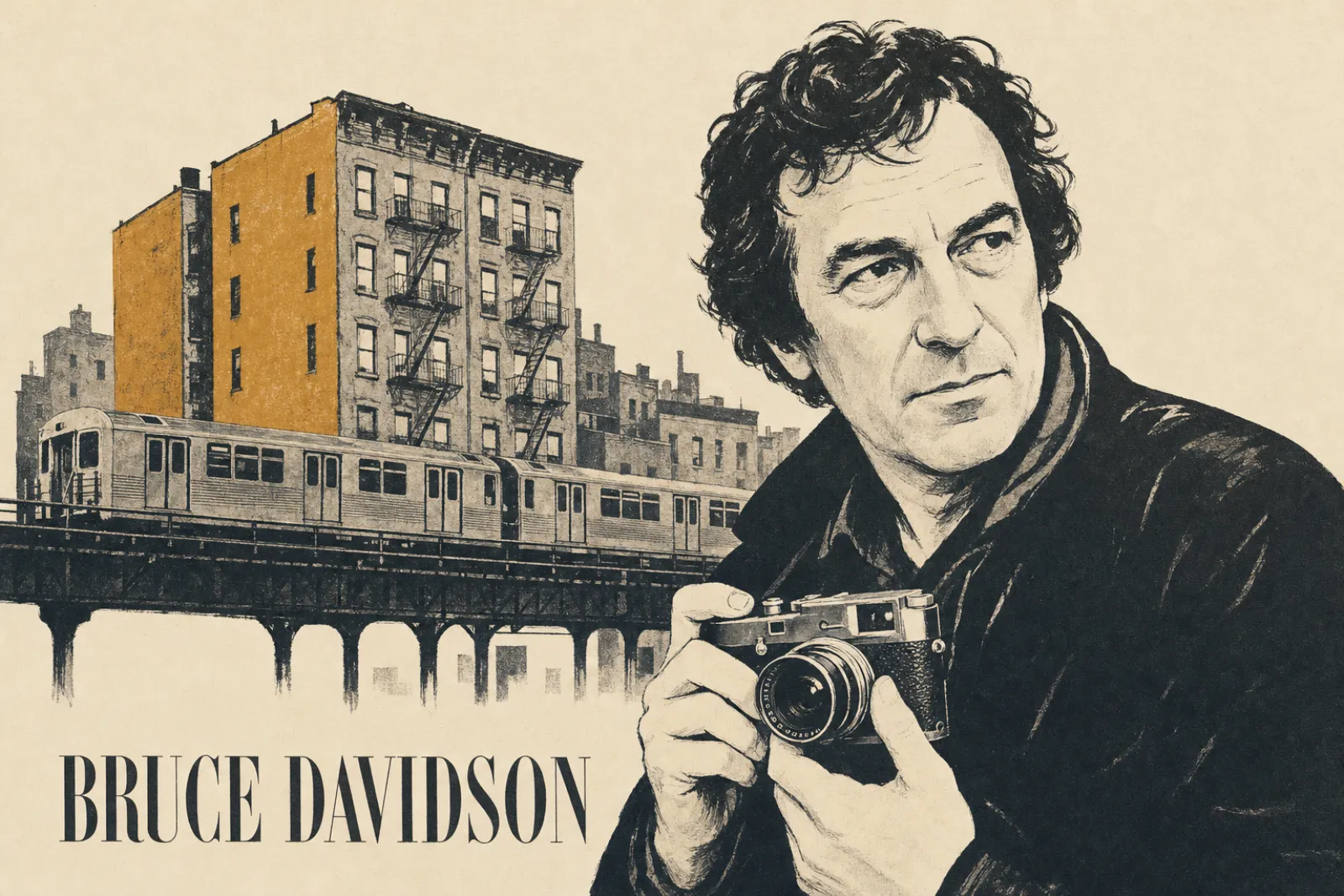
Bruce Davidson is an American photographer, born in Oak Park, Illinois, in 1933, who joined Magnum Photos in 1958 and spent most of his working life photographing New York. He made long documentary projects about small, closed groups: a circus, a teenage gang, the civil rights movement, one block in East Harlem, the subway. He is known for staying with a subject for months or years until the people in it accepted him.
Davidson’s training was unusually formal. He studied photography at the Rochester Institute of Technology and then went to Yale, where his teachers included the painter Josef Albers. The decisive meeting came during army service near Paris, where he met Henri Cartier-Bresson, a founder of Magnum, who became a mentor. Davidson took the small camera and the respect for the single frame from that tradition, but he moved away from the passing observer. He wanted to be inside the group. For his subway pictures he looked back to Walker Evans, who had photographed riders in secret, and did the opposite by letting people see the camera. His East Harlem work can be set beside that of Jacob Riis, who photographed New York tenements long before him. The comparison shows what was different: Davidson worked with the consent of the people in his pictures.
A darkroom at ten, Magnum in 1958
Davidson began photographing at the age of ten, and his mother built him a darkroom. As a teenager he won a prize in the Kodak National High School Competition. He studied at Rochester from 1951 and went on to graduate work at Yale. He was then drafted into the United States Army, served at Fort Huachuca in Arizona and was posted to a headquarters near Paris. Pictures he made in Montmartre while stationed there were published in Esquire.
He left the army in 1957, began to freelance, and joined Magnum in 1958. That year the agency’s picture librarian sent him to the Clyde Beatty Circus, which had raised its tent at Palisades Amusement Park in New Jersey. Davidson noticed a clown named Jimmy Armstrong standing alone outside the tent in a tuxedo and top hat, smoking and holding a bunch of paper flowers. He travelled with the circus for a few weeks and photographed Armstrong away from the ring. Davidson has said that Armstrong seemed to understand it was the private moment he was after and not the clown’s face. When he left he gave Armstrong his own Yashica camera.
In 1959 he read a report of a gang fight in Prospect Park and, through a social worker, met a group of Brooklyn teenagers who called themselves the Jokers. He stood with them on street corners at night and went with them to Coney Island, working with a 35mm Leica for eleven months. Esquire published the pictures in 1960, and a Guggenheim Fellowship followed.
How do you turn months of pictures into one story? How to create a photo essay covers planning, visual variety and the edit where the essay takes shape.
The South, and one block in Harlem
In 1961 The New York Times assigned Davidson to cover the Freedom Riders in the South. He kept photographing the civil rights movement until 1965. The pictures were later collected under the title Time of Change. They belong to the history told in photography and social movements, where the camera served as witness.
From 1966 to 1968 he spent two years on a single block of East 100th Street in East Harlem. He first obtained the agreement of a local citizens’ committee. Then he changed his tools. He put away the 35mm camera and carried a 4×5 view camera, a tripod, a dark cloth and a powerful strobe. A large format camera is slow and cannot be hidden. That was the reason for it. Davidson felt the equipment gave dignity to the act of making a picture, and it meant that every photograph was an agreement between two people facing each other. In 1967 he received the first grant for photography awarded by the National Endowment for the Arts.
The Museum of Modern Art showed the photographs in 1970 in an exhibition organised by John Szarkowski, and Harvard University Press published East 100th Street the same year. Mildred Feliciano, a resident and activist who wrote the foreword, used the pictures as evidence when she pressed city agencies about conditions on the block. An expanded edition appeared in 2003.
How do you photograph someone in their own home or street so the setting tells part of the story? Environmental portrait photography covers choosing locations, real light and directing people in their own space.
Underground in colour
Davidson also made films, among them a short drama of 1972 based on the writing of Isaac Bashevis Singer. In the spring of 1980 he turned to the New York subway, then covered in graffiti and widely thought dangerous. He trained for it with a diet, exercise and morning runs. He carried cameras, lenses and film in a canvas bag, along with police and subway passes and a small wedding album of prints to show people what he was doing.
He started in black and white and soon changed to colour, working on Kodachrome slide film. He found that the strobe, bouncing off the painted steel of the cars, produced colour he had not expected. The flash also announced him. Sometimes he introduced himself and asked first. Sometimes he photographed and explained afterward. He took addresses and sent prints. At one station he was robbed of a camera at knifepoint. The work was shown at the International Center of Photography in the early 1980s and published by Aperture as Subway in 1986. A later edition was printed from new scans of the Kodachrome slides.
From 1992 to 1995 he photographed Central Park, published as Central Park in 1995. In 1998 he went back to East 100th Street to record how the block had changed. He received a Lucie Award for documentary photography in 2004 and the lifetime achievement Infinity Award from the International Center of Photography in 2018.
How Davidson’s pictures are made to work
Access before pictures. Every major project began with permission and time: weeks with the circus, eleven months with the Jokers, two years on one block. The closeness in the frames is the visible result of hours when no picture was made. The guide to documentary photography treats this field work as the centre of the job.
The camera chosen for the relationship. With the gang he needed to move and react, so he used a 35mm Leica. On East 100th Street he wanted people to present themselves, so he used a view camera on a tripod. The lesson is that equipment sets the terms between photographer and subject. A hand camera takes. A tripod camera asks.
Flash used openly. In the subway the strobe did three things. It gave enough light for slow, fine grained colour film in a dark carriage. It made the colours of paint and clothing vivid. And it told everyone a photograph had been made. Flash photography for beginners explains the basics, and balancing flash and ambient light shows how the background exposure is set apart from the flash.
Colour only when the subject needed it. Davidson’s earlier projects were in black and white, and he began the subway that way too. He changed for the subway because colour was part of what the place was. That is a useful test for any project, and colour in photography sets out how colour directs attention and mood.
Prints given back. He showed people earlier pictures before he asked, and sent prints afterward. It was courtesy, and it was also how the next person came to trust him.
What do you say to a stranger you want to photograph? Street portraits covers the approach, what to do when the answer is no, and sharing photographs back.
Photographs to look for
- The Dwarf, Palisades, New Jersey, 1958. Jimmy Armstrong outside the circus tent, in costume but off duty. Notice that the picture is about a man’s private thoughts and that the spectacle of the circus is kept out of it.
- Brooklyn Gang, 1959. Teenagers on street corners at night and on outings to Coney Island. Look at how close the 35mm camera is and how little the subjects react to it after months of his company.
- Freedom Riders, 1961. The start of his five years of work on the civil rights movement, later collected as Time of Change. Look for where Davidson stood in relation to the riders and what that position does to the viewer.
- East 100th Street, published 1970. Large format portraits of the residents of one block and the places they lived. Study the stillness. People are looking back at a camera they agreed to stand before, and the large negative records their surroundings in full detail.
- Subway, begun 1980, published 1986. Flash lit colour pictures of riders and graffiti covered cars. Notice what direct flash does to skin, fabric and paint inside a dark carriage.
Try this: ask, show, photograph
This takes about 20 minutes and practises the East 100th Street method on a small scale.
- Choose one place where you are already known a little: a shop you use, a neighbour’s doorway, a market stall.
- Put two or three of your own photographs on your phone or in your pocket as prints.
- Ask one person if you may make a portrait where they stand. Show them the photographs so they know what you do.
- Put the camera on a tripod, a table or a wall. Do not hold it to your face. Stand beside it and talk.
- Make no more than six frames. Wait between each one.
- Offer to send or bring them a copy, and do it.
The constraint is the fixed camera and the six frames. A camera that stays put lets the person settle and look back at it, which is what gives Davidson’s portraits their weight.
Questions people ask about Bruce Davidson
What is Bruce Davidson best known for?
He is best known for long documentary projects in New York, especially Brooklyn Gang from 1959, East 100th Street, published in 1970, and Subway, published in 1986. His photographs of the civil rights movement from 1961 to 1965 are equally well regarded.
What camera did Bruce Davidson use for East 100th Street?
He used a 4×5 large format view camera on a tripod with a dark cloth and a strobe. He chose slow, visible equipment so that each picture was made with the agreement of the person in it.
Why did Bruce Davidson photograph the subway in colour?
He began the project in black and white in 1980 and changed to colour soon after. He found that flash on the painted steel cars produced colour that was essential to showing what the subway was like, and he worked on Kodachrome slide film.
For more photographers to study alongside Davidson, see the A to Z of photographers.