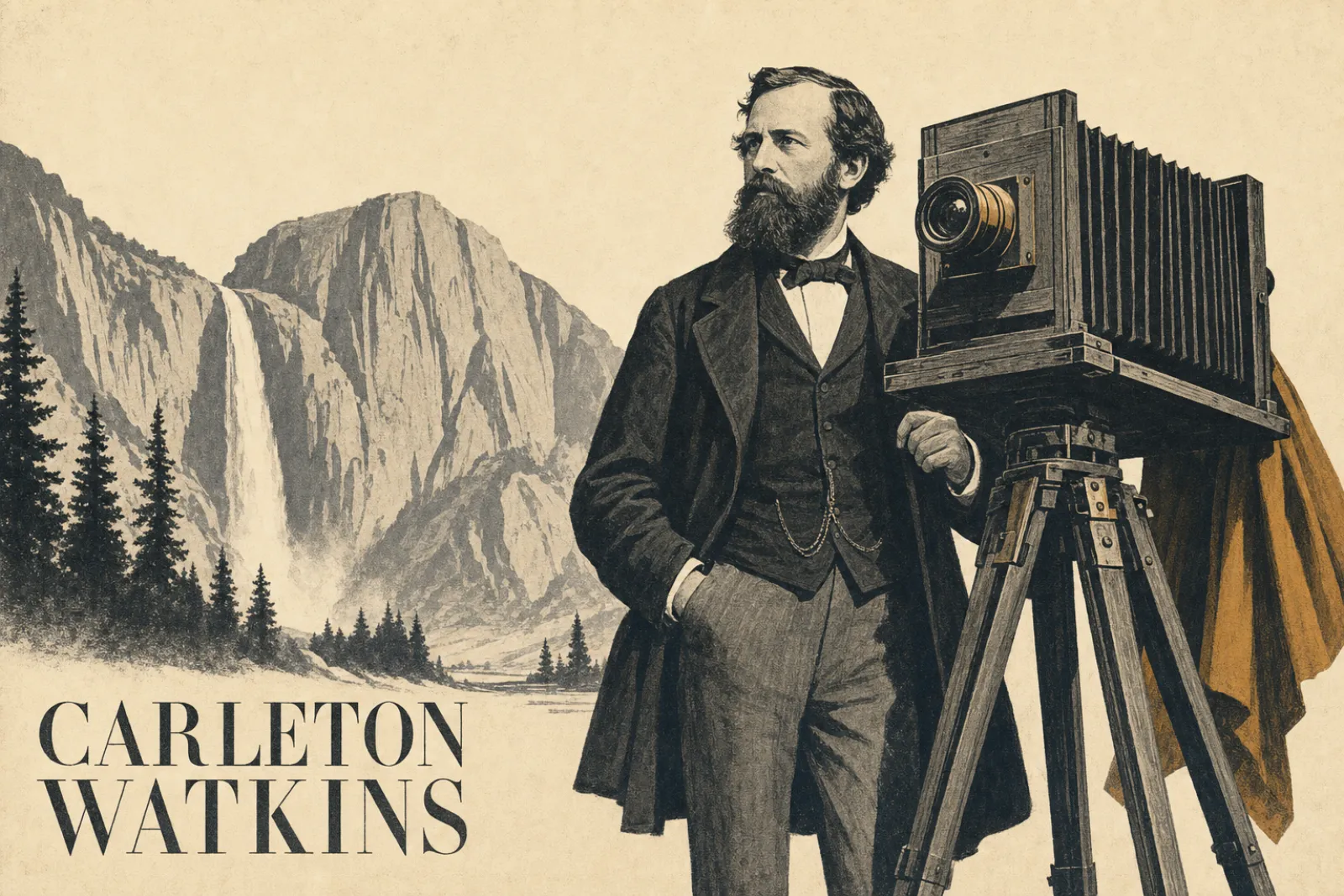
Carleton Watkins (1829 to 1916) was an American landscape photographer who worked from San Francisco for more than four decades. He carried a huge camera into Yosemite Valley in 1861 and came back with glass negatives 18 by 22 inches across. Those pictures were among the first views of Yosemite seen in the eastern United States, and they are tied to the 1864 law that set the valley aside for the public.
Watkins came to photography by chance. He learned the basics of the trade from Robert H. Vance, a San Francisco studio photographer, and then left the portrait room for the mountains. His contemporary Eadweard Muybridge reached Yosemite in 1867 and photographed some of the same scenes, and the two are often set side by side: Watkins calm and stately, Muybridge restless and strange. Readers who know the valley through Ansel Adams are looking at ground that Watkins photographed decades before Adams was born.
From a bookstore counter to a mammoth camera
Watkins was born on November 11, 1829, in Oneonta, New York. In 1851 he went to California with a childhood friend, Collis Huntington, in the years of the Gold Rush. He did not work in photography at first. He delivered supplies to mining operations for Huntington and then clerked in a bookstore that stood close to Vance’s studio. When one of Vance’s employees left without warning, Watkins was asked to mind a studio. Vance showed him the essentials and expected to take the work back, but the customers were satisfied with what Watkins made.
By 1861 he was in business for himself, and that year he made his first trip to Yosemite. He took two cameras. One was a stereoscopic camera, which made the paired pictures that gave an impression of depth in a hand viewer. The other was a mammoth-plate camera that used glass plates of 18 by 22 inches. One archive’s account of the trip puts the weight of his equipment at nearly two thousand pounds. He returned with thirty mammoth plates and one hundred stereo negatives.
The size mattered because, before enlargers came into use, a large print was made exactly the same size as its negative. A big picture needed a big plate. The idea survives in large format photography, where a sheet of film many times larger than a small camera’s frame records fine detail and smooth tone.
Wondering how glass plates fit into the story of the medium? The history of photography walks through the wet plate years, when a negative had to be coated, exposed and developed on the spot.
Yosemite, the 1864 grant and a name on the map
In 1862 the Yosemite photographs were shown at the Goupil Gallery in New York. Two years later, in 1864, President Abraham Lincoln signed the bill that protected Yosemite Valley. Museum and reference accounts credit the Watkins photographs with a part in that decision, and the grant is treated as a step toward Yellowstone in 1872 and the national park system. A peak in the park, Mount Watkins, carries his name.
In the middle of the 1860s the California State Geological Survey hired him to photograph the Yosemite region. He went back to the valley at least seven times over two decades. In 1867 he won a medal at the Universal Exposition in Paris, opened his Yosemite Art Gallery in San Francisco, and travelled north to photograph Oregon and the Columbia River.
The landscape was not his only subject. From the early 1860s he photographed mines for use in legal cases, including the New Almaden mercury mine near San Jose, and he photographed the Mariposa mining estate of John and Jessie Fremont. In 1873 and 1874 he travelled to Utah with the landscape painter William Keith.
Losing the negatives and starting again
Watkins was a better photographer than businessman. In the 1870s he lost his gallery, and the negatives in it, to a creditor, J. J. Cook. Cook and the photographer Isaiah Taber went on printing the pictures without his name. Photographs had little protection in law at the time, and Watkins could not stop it. His answer was to go back to the same places and photograph them again. He called the replacement pictures his New Series.
His eyesight began to fail in the 1890s and by 1903 he was almost blind. The 1906 San Francisco earthquake and fire destroyed his studio and most of what was in it, at a time when he was negotiating the sale of his archive to Stanford University. In 1910 he was committed to Napa State Hospital, where he died on June 23, 1916. He was buried in an unmarked grave on the hospital grounds.
How a Watkins view is built
A camera that size could not be hurried. Every picture was a decision made before the plate was prepared, so the work happened in the choice of where to stand. Watkins looked for a position that gave the subject a clear structure: a cliff face set against open sky, a river leading inward, a single tree isolated from the forest behind it. Changing the camera position by a few metres was his main tool, because nothing could be fixed afterward.
He gave the eye somewhere to start. Many of the views have rocks, water or fallen timber near the camera, then the valley floor, then the wall of granite behind. That is the layering described in foreground, midground and background, and it is what turns a flat record of a mountain into a space the viewer seems able to walk into.
He also had to make size readable. A cliff thousands of feet high can look like a boulder on paper. The viewer needs something of known size to measure against, which is the idea behind scale in photography. His view of the Grizzly Giant in the Mariposa Grove is described as the first photograph to show the whole of that tree, and it works because the sequoia is seen entire, from the ground to the crown.
Finally, he made each scene twice. The mammoth plate was for the wall. The stereo view was for the hand viewer, and his gallery offered more than a thousand of them. Making a large, slow picture and a small, quick one of the same subject is a habit worth copying.
Want to apply this in the field? Landscape photography techniques, light and composition covers how to organise a wide view, and photographing mountains deals with light and scale at altitude.
Photographs to look for
- The 1861 Yosemite mammoth plates. The thirty large negatives from the first trip. Look at how much detail holds from the nearest rocks to the far cliffs, and how still everything is.
- The Grizzly Giant, Mariposa Grove. A giant sequoia shown from base to top. Notice that the whole tree is in the picture, which the mammoth plate made possible and which had not been done before.
- Cathedral Rocks, Yosemite Valley. A granite formation titled with its height, 2,600 feet. Compare the weight of the rock against the open sky above it.
- Cape Horn near Celilo (1867). A mammoth-plate view on the Columbia River in Oregon, made on the trip north. A railway runs through the scene near Celilo. It is a landscape with industry in it, so look at how the line is given a place in the view.
- View from Inspiration Point, Yosemite Valley (1879). A late view, made after the first negatives had passed out of his hands. It shows him photographing a familiar place again from the start.
Planning a trip to a park of your own? How to photograph national parks covers what to expect on the ground, and finding and scouting locations explains how to choose a viewpoint before the light arrives.
Try this: one plate, one position
Take a camera or phone to a place with a strong vertical subject: a large tree, a rock face, a tall building. Give yourself 15 minutes and a limit of three exposures.
- Spend the first ten minutes walking without photographing. Look for the one spot where the subject stands clear of what is behind it.
- Find something near your feet that leads toward the subject, and something of known size to stand beside it.
- Hold the camera level and steady, or use a support. Make three frames from that spot only, changing nothing but the height of the camera.
- Afterward, pick one frame and say out loud why the other two are weaker.
Questions people ask about Carleton Watkins
What camera did Carleton Watkins use?
He used a mammoth-plate camera that took glass negatives of 18 by 22 inches, and a stereoscopic camera for paired views. Both went with him to Yosemite in 1861.
Did his photographs help protect Yosemite?
The photographs were exhibited in New York in 1862, and in 1864 Abraham Lincoln signed the bill that protected Yosemite Valley. Museum accounts describe the pictures as an influence on that law.
What happened to his negatives?
He lost a first body of negatives to a creditor in the 1870s and remade many views as his New Series. Much of what remained in his studio was destroyed in the 1906 San Francisco earthquake and fire.
Where and when did he die?
He died on June 23, 1916, at Napa State Hospital in California, having lost most of his sight years earlier.
For more photographers from every period, see the A to Z of photographers.