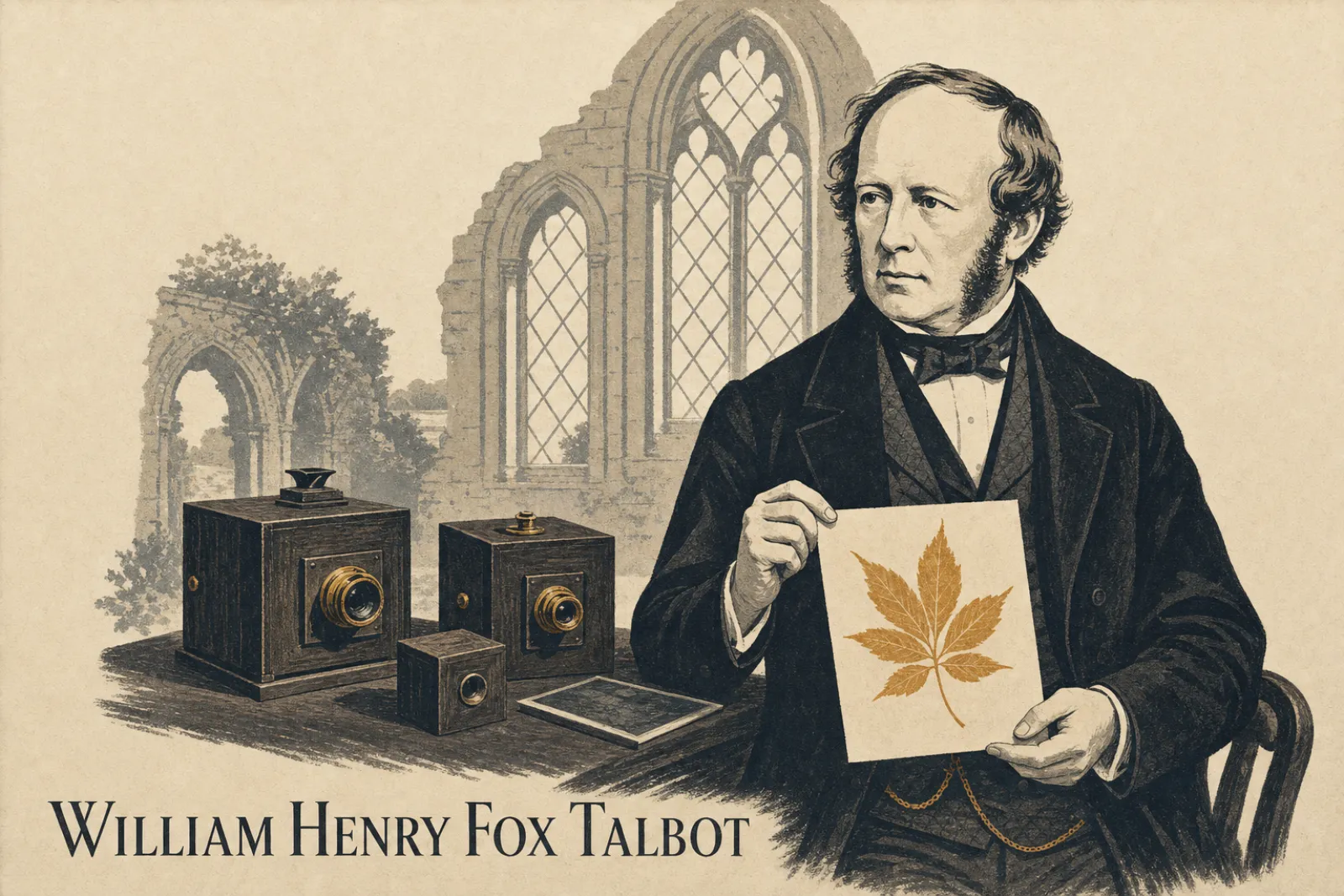
William Henry Fox Talbot (1800 to 1877) was an English scientist and landowner who invented photography on paper. Working at Lacock Abbey in Wiltshire from 1834, he found how to make a negative on sensitised paper and print positives from it, then how to develop an image that the eye could not yet see. He is known for the calotype and for The Pencil of Nature, the first commercially published book illustrated with photographs.
Talbot was not a painter and did not come from the theatre, as his French rival Louis Daguerre did. He was a Cambridge mathematician and a Fellow of the Royal Society. Daguerre’s process gave a single, very sharp picture on a metal plate. Talbot’s gave a softer picture on paper that could be printed again and again. The portrait studios of the next generation, such as that of Nadar in Paris, and Victorian amateurs such as Julia Margaret Cameron, worked with glass negatives and paper prints: Talbot’s principle of negative and positive, carried forward in other materials.
A failed sketch at Lake Como
Talbot was born on 11 February 1800 at Melbury in Dorset. He was an only child, and his father died early. He went to Harrow School and then to Trinity College, Cambridge, where he won the Porson Prize for classics in 1820 and graduated with high honours in mathematics in 1821. He published mathematical papers, was elected to the Royal Society in 1831, and sat as Member of Parliament for Chippenham from 1832 to 1835. He married Constance Mundy in 1832.
In October 1833, on a journey in Italy with Constance, he tried to sketch the scenery of Lake Como with a camera lucida, a drawing aid that uses a prism to lay the view over the paper. He could not draw well enough to be satisfied. He began to think about making the images of nature print themselves on paper.
He started experiments at Lacock Abbey in the spring of 1834. He soaked writing paper in a weak solution of table salt, dried it, and brushed it with silver nitrate, which formed light sensitive silver chloride in the paper. A leaf or a piece of lace laid on the paper and put in the sun left its outline in white on a darkened ground. He called the results photogenic drawings. A strong solution of salt made them stable enough to keep.
In the summer of 1835 he put the paper in small wooden cameras. Constance called them mousetraps, because of the way they were left about the house and grounds. In August 1835 one of them produced a tiny negative of a latticed window in the abbey. It is the earliest camera negative known to survive.
Where does Talbot’s work sit beside Niépce, Daguerre and what came after? The history of photography sets the first processes in order, from the camera obscura to digital.
1839 and the race he had not known he was in
Talbot then put the work aside for other studies. In January 1839 news came from Paris that Daguerre had fixed the image of the camera. Talbot moved quickly to establish what he had done. He showed his photogenic drawings at the Royal Institution on 25 January 1839 and described his method to the Royal Society on 31 January. That year a better fixing agent came into use too: sodium thiosulphate, known as hypo, which made prints properly fast to light.
Photogenic drawing was slow. A camera picture needed an exposure of an hour or more. Late in 1840 Talbot found the answer. A short exposure left an invisible, latent image on paper prepared with silver iodide, and a wash of gallic acid and silver nitrate brought it out. Exposures fell to a minute or two in bright sun. He named the process the calotype, patented it in February 1841, and received the Rumford Medal of the Royal Society in 1842.
The patent shaped what followed. Daguerre’s process had been made free in France. Talbot charged for licences in England, and the calotype was taken up by relatively few people there. In Scotland, where the English patent did not apply, it spread more freely. In 1854, in the case Talbot v. Laroche, a jury accepted that he was the inventor of the calotype but found that the newer wet collodion process did not infringe his patent. He did not seek to extend it.
The Pencil of Nature and the printing works at Reading
To show what photography was for, Talbot set up a printing establishment at Reading in 1844, where prints were made from his negatives in quantity by sunlight. The Pencil of Nature was published by Longman in six parts from 1844 to 1846. It contained 24 prints, each pasted in by hand, with a text by Talbot on how each was made and what uses he foresaw: recording collections of china and glass, copying printed pages and prints, even serving as evidence. It did not sell well, and he stopped after six parts. About forty substantially complete copies survive. A second book, Sun Pictures in Scotland, followed in 1845.
From the 1850s he turned to the problem of printing photographs in ink. He found in 1852 that gelatin treated with a dichromate hardens in light, and he developed a process he called photoglyphic engraving. He also worked for some twenty years on the decipherment of Assyrian cuneiform, and published on etymology and antiquities. He died at Lacock Abbey on 17 September 1877. The abbey now houses a museum of his work.
Why a Talbot print looks the way it does
- The image is in the paper, not on it. A salted paper print has a matt surface, and the silver image lies among the paper fibres. The negative was paper too, so its fibres printed through. The result is soft and slightly grainy, with broad masses of tone in place of fine detail. Talbot’s best pictures are built from large shapes of light and dark, which is what the process could hold.
- Sunlight was the only light. Even a calotype needed a minute or two in bright sun, so Talbot worked outdoors and let the sun model his subjects. The direction of light is the first thing to study in any of his plates.
- Nothing could move. Buildings, ladders, carts, shelves of books and sculpture were his subjects because they held still. Where people appear, they were posed and asked to keep still.
- He arranged like a painter he admired. In The Pencil of Nature he wrote that Dutch painting gave authority for taking scenes of daily and familiar life as subjects. An open doorway was enough. The same habits underlie still life photography: a few objects, one light, careful placing.
- Every print is a contact print. Negative and paper were pressed together in a frame and left in the sun, so the print is the size of the negative. The method survives almost unchanged in cyanotype printing, another process of the 1840s.
Want to make a print with sunlight and paper yourself? Alternative photography processes gives an overview of the historical methods that can still be practised.
The negative is his lasting idea. Because the camera image was reversed in tone, it could be used as a stencil for any number of positives. Every roll of film exposed since worked on that principle, as the guide to shooting on film describes.
Photographs to look for
- Latticed Window at Lacock Abbey (August 1835). A very small paper negative made in one of the mousetrap cameras. The tones are reversed, so the window is dark where the glass was bright. Look at it as proof of the idea, not as a composition.
- Photogenic drawings of leaves and lace (1830s). Camera-less pictures made by contact. Notice how the veins of a leaf and the threads of lace record at full size and in exact detail, which no camera picture of the time could match.
- The Open Door (1844). Plate VI of The Pencil of Nature: an open doorway in sunlight, with a shadow falling across it. Talbot made versions with a narrower and a wider shadow, so compare them if you can. The site’s page on contrast explains why a split of light and dark tones holds the eye.
- The Haystack (1844). Plate X. Talbot’s note beside it says that photography brings in a multitude of minute details that no artist would trouble to copy. Look at how much of the surface of the hay the paper holds.
- A Scene in a Library. Plate VIII, a picture of books in a library. Talbot’s note is not about the books. It imagines photographing people in a dark room by rays the eye cannot see.
- The Ladder. Plate XIV, and the only plate in the book with people in it. The figures are grouped around a ladder. The grouping is stiff because it had to be held.
How should a set of pictures be ordered and laid out on the page? Photo book design covers planning, format and layout.
Try this: an open door in raking light
Take fifteen minutes on a sunny morning or late afternoon.
- Find a doorway or gate with sun falling across it from one side and a darker space behind.
- Lean one ordinary object in it: a broom, a spade, a bicycle, an umbrella.
- Use a tripod or rest the camera on something solid. Talbot could not hold his camera in the hand, and a fixed camera makes you place things with more care. The guide on how to use a tripod will help if this is new.
- Make six frames, moving only the object, until its shadow becomes part of the design.
- Convert the best frame to a single warm brown tone and look at whether the picture still works as three or four large shapes.
Questions people ask about William Henry Fox Talbot
What did Fox Talbot invent?
He invented photogenic drawing on salted paper in the mid 1830s and the calotype, patented in 1841. The calotype used a developed paper negative from which many positive prints could be made. That negative and positive system was the basis of photography until digital sensors.
Who invented photography, Talbot or Daguerre?
Both, separately, by different methods, and Nicéphore Niépce made a camera image before either. Daguerre’s process was announced in January 1839 and Talbot showed his own results later that month. Talbot’s surviving negative of 1835 predates the announcement.
What is the difference between a calotype and a daguerreotype?
A daguerreotype is a single image on a silvered copper plate, very sharp and impossible to print from. A calotype is a paper negative that gives soft paper prints in any number.
What is The Pencil of Nature?
It is Talbot’s book of 24 photographic prints with his commentary, issued in six parts from 1844 to 1846. It was the first commercially published book illustrated with photographs.
For more photographers to study, see the A to Z of photographers.