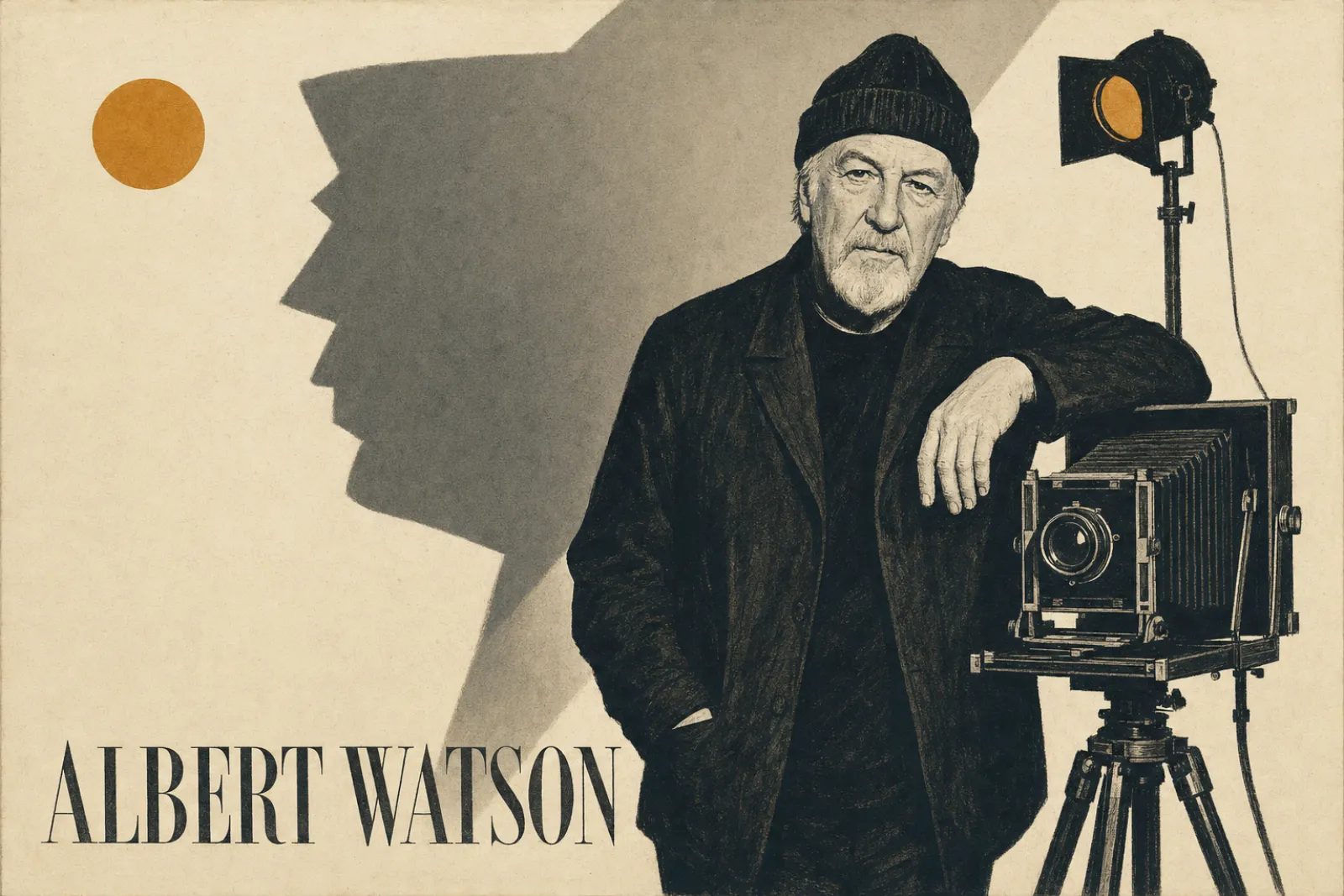
Albert Watson is a Scottish photographer, born in Edinburgh in 1942, who built his career in Los Angeles and New York from 1970. He made fashion pictures, celebrity portraits, advertising, still lifes and landscapes, and refused to stay in one of those boxes. He is best known for a 1973 portrait of Alfred Hitchcock holding a plucked goose and for the 2006 portrait of Steve Jobs that appeared on the cover of Jobs’s biography.
Watson came to photography sideways. He trained as a graphic designer in Dundee and then studied film and television at the Royal College of Art in London, and he treated photography as a sideline until he moved to the United States. That training explains the pictures better than any list of famous sitters does. He worked in the same magazine world as Richard Avedon and Irving Penn, and Photo District News later named him alongside both of them on its list of the 20 most influential photographers. Where many magazine photographers of his generation settled into one recognisable look, Watson moved between studio and street, people and objects, colour and black and white.
From Dundee graphic design to a goose in Los Angeles
Watson was born in Edinburgh and grew up in Penicuik, Midlothian. He has been blind in one eye since birth. He studied graphic design at Duncan of Jordanstone College of Art and Design in Dundee, where he also learned his way around a darkroom, and then studied film, television and photography at the Royal College of Art.
In 1970 he moved to Los Angeles with his wife, Elizabeth, an elementary school teacher. His first professional work that year was a test session for Max Factor, which bought two of the pictures. Advertising and magazine work followed.
The picture that changed things came in 1973. Harper’s Bazaar wanted a portrait of Alfred Hitchcock for a Christmas feature about the director’s cooking, and the plan was to show him presenting a roast goose on a plate. Watson suggested something else: Hitchcock holding an uncooked, plucked goose up by the neck, with a ribbon tied around it. The result is a joke, a portrait and a piece of graphic design at once, and it was Watson’s first celebrity portrait.
In 1975 he won a Grammy Award for the photography on the cover of the Mason Proffit album Come and Gone. In 1976 he shot his first assignment for Vogue and moved to New York.
How does a portrait say something about a person through an object or a setting? Environmental portrait photography covers how props and surroundings carry meaning in a picture of a person.
Magazine covers, film posters and a 4×5 camera
From the mid 1970s Watson’s output was enormous. He photographed more than 100 covers for editions of Vogue and around 40 for Rolling Stone, and shot fashion photography for Harper’s Bazaar, GQ and Mademoiselle. He made advertising campaigns for clients including Prada, Chanel, Levi’s, Gap and Revlon, directed more than 100 television commercials, and photographed the posters for films including Kill Bill, Memoirs of a Geisha and The Da Vinci Code.
Alongside the commissions he kept making pictures for himself, often on the same trips. In 1990 he was allowed to photograph objects from the tomb of Tutankhamun at the Egyptian Museum in Cairo, and treated those ancient artifacts with the same care he gave a film star. He also photographed in Morocco, the subject of one of his books. His books gather this mixture: Cyclops (1994), Maroc (1998), Albert Watson (2007), Strip Search (2010), UFO: Unified Fashion Objectives (2010) and Kaos (2017).
In 2006 Fortune magazine sent him to photograph Steve Jobs. Watson was still working with a 4×5 film camera, which Jobs remarked on. Watson asked Jobs to think about the next project on his table and about times when people had challenged him. The portrait that came out of it, a head and one hand against white, was used by Apple on its homepage when Jobs died in 2011 and on the cover of his biography.
In 2013 Watson spent five weeks on the Isle of Skye, working twelve hours a day in October and November because he wanted wind, rain and mist. The resulting landscape photographs were presented as his first fine art project. He also photographed the 2019 Pirelli Calendar.
His honours include a Lucie Award, the Royal Photographic Society’s Centenary Medal and Honorary Fellowship in 2010, and an OBE in 2015 for services to photography.
Why a Watson picture reads from across the room
Watson has described his own work as graphics, film, or a mixture of the two. Those two habits are the teachable part.
The graphic habit. A designer thinks about shape before detail. The Hitchcock portrait works as a silhouette: a round man, a long neck of goose, a plain ground. The Jobs portrait is a triangle of hand and chin under a pair of eyes. Watson tends to fill the frame with the subject and keep the background empty, so that the outline does the work a caption would otherwise have to do. Strong tonal contrast keeps that outline legible when the picture is reduced to the size of a magazine cover.
The film habit. Other pictures look like a single frame from a story: a figure caught in the middle of something, a hillside on Skye under heavy weather. Here he lets the setting in, and the light is moody and directional. His archive moves between the studio and the outdoors, and between people, objects and places.
Where does the light go to make a face look carved instead of flat? Direction of light explains what front, side and back light each do to a subject.
Direction by thought, not pose. The instruction to Jobs was not “look at the lens” but a thing to think about. The face followed. This is a useful way to direct anyone who is stiff in front of a camera.
Planning a trick in the camera. For a 1992 picture of Mick Jagger, made for Rolling Stone, Watson wanted the singer’s face merged with a leopard’s. He photographed the leopard first, marked the position of its eyes and mouth on the viewfinder with a china marker, rewound the film, placed Jagger to match the marks and exposed the same frames again. Four of the twelve frames lined up. It is a plain film double exposure, made reliable by careful registration.
The print is the picture. Watson has said that he makes his own prints. He printed some of the Skye pictures very large in black and white on linen, and others as smaller pigment prints in colour.
What actually changes between a file on a screen and a finished monochrome print? Black and white printing covers neutral tones, paper choice and proofing.
Photographs to look for
- Alfred Hitchcock, Los Angeles (1973). The director holds a plucked goose by the neck with a ribbon around it. Notice how little else is in the frame, and how the deadpan expression makes the joke.
- Kate Moss, Marrakech (1993). A nude study made on the model’s nineteenth birthday, during a session that ran from early morning into the evening. It is a lesson in patience: the picture came from a long day of work with one person, not a quick sitting.
- Golden Boy, New York City (1990). A close portrait of a five year old boy who was modelling in an advertising shoot, made with an 8×10 camera. The black and white negative was toned in the darkroom so that his skin looks like bronze and he resembles a metal statue. It shows Watson treating a person as a still life.
- Mick Jagger, Los Angeles (1992). The leopard double exposure described above. Look at where the two sets of eyes meet.
- Steve Jobs (2006). A 4×5 film portrait against white. The hand at the chin and the direct stare came from what Watson asked him to think about.
- The Skye landscapes (2013). Hills, pools and rock formations in autumn weather, photographed with a lens chosen to distort and exaggerate the land. Compare them with his studio work: the same taste for a strong central shape is there.
Want to make a picture of an object with the care Watson gave the things from a tomb? Still life photography covers arrangement, background and lighting for things that do not move.
Try this: one person, one object, one plain wall
This takes about 15 minutes with a camera or phone.
- Find a plain wall near a window. Ask someone to stand a step in front of it.
- Give them one ordinary object that says something about them: a tool, a book, a piece of food. Ask them to hold it up, not down by their side.
- Take five frames. Before each one, squint until the scene blurs. If the person and the object do not make one clear shape, move them until they do.
- For the last two frames, stop posing them. Ask them to think about something specific, such as the hardest thing they did this year, and photograph the face that arrives.
- Look at the five pictures at thumbnail size. The one you can still read when it is tiny is the one that follows Watson’s method.
Questions people ask about Albert Watson
Is Albert Watson really blind in one eye?
Yes. He has been blind in one eye since birth. It did not stop him training in graphic design and film, or working as a photographer from 1970.
Who took the Steve Jobs photograph on the biography cover?
Albert Watson took it in 2006 on a 4×5 film camera, on an assignment for Fortune magazine. Apple placed the same portrait on its homepage after Jobs died in 2011.
How many Vogue covers has Albert Watson shot?
More than 100, across the magazine’s international editions, starting after his first Vogue assignment in 1976. He also photographed around 40 covers for Rolling Stone.
What is the story behind the Hitchcock goose photograph?
Harper’s Bazaar commissioned it in 1973 for a Christmas feature on Hitchcock’s cooking. The brief was a roast goose on a plate. Watson proposed that Hitchcock hold a plucked goose by the neck instead, and that became his first celebrity portrait.
Albert Watson is one of the photographers in the A to Z of photographers, and he is quoted on the photography quotes page.