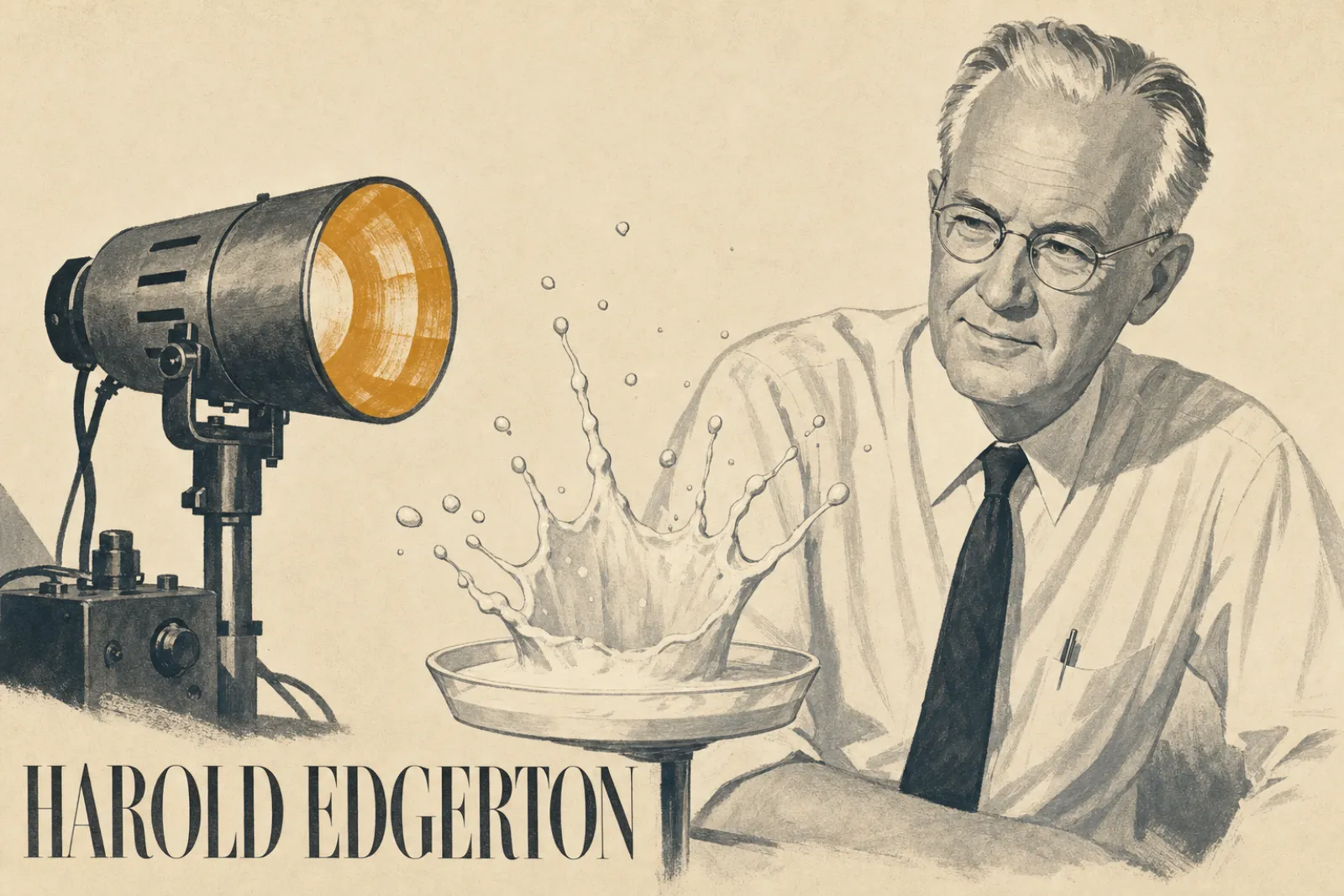
Harold Edgerton was an American electrical engineer who worked at the Massachusetts Institute of Technology from the late 1920s until his death in 1990. He turned the stroboscope from a laboratory instrument into a practical light for cameras, and with it he photographed things too fast to see: a splash of milk, a bullet striking an apple, a balloon bursting. He is known as the man who made the electronic flash, and he was widely known as Doc.
Edgerton was trained as an engineer, not as a photographer, and his subject was motion itself. It is useful to set him beside Eadweard Muybridge, who in the nineteenth century broke movement into rows of separate frames. Edgerton’s answer to the same problem was different. He left the shutter alone and shortened the light. He credited the MIT engineer Charles Stark Draper with inspiring him to photograph everyday objects by electronic flash, and in 1937 he began a long association with the photographer Gjon Mili.
Nebraska, MIT and a flashing lamp
Edgerton was born on 6 April 1903 in Fremont, Nebraska. He took a degree in electrical engineering at the University of Nebraska in 1925, then went to MIT, where he earned a master’s degree in 1927 and a doctorate in 1931. He stayed at MIT for the rest of his working life and was named Institute Professor in 1966.
He used stroboscopes in his doctoral research on electric motors, and in 1931 he arrived at a stroboscope that could fire a very brief, repeatable flash of light. Timed to match a spinning or moving object, the flashes made it appear to stand still. Pointed at a camera’s subject in a dark room, one flash made a sharp picture of something moving far too quickly for any shutter.
The tubes were filled with xenon gas. An electrical charge sent through the gas produced a flash that was very bright and lasted only millionths of a second, and the tube could be fired again and again. That is the principle inside every electronic flash made since.
Why does a short burst of light stop motion when a fast shutter cannot? Flash duration explains how the length of the burst sets the sharpness.
Milk, bullets and athletes
With his colleague Kenneth Germeshausen, Edgerton began in 1932 to photograph events that the eye cannot follow, and drops of milk were among the first subjects. An early black and white version, Milk Drop Coronet Splash, dates from 1936. Hummingbirds, athletes, bullets and bursting balloons followed.
He published the results for a general audience. Flash! Seeing the Unseen by Ultra High-Speed Photography, written with James R. Killian Jr., appeared in 1939. In 1940 he worked with MGM on Quicker’n a Wink, a short film built on his high-speed footage, which won an Academy Award. Later books included Electronic Flash, Strobe (1970), Moments of Vision (1979) and Stopping Time (1987).
Night reconnaissance, atomic tests and the sea floor
During the Second World War Edgerton built very powerful flash units for photographing the ground from aircraft at night. They were used in 1944 to record troop movements before the Normandy landings, and he received the Medal of Freedom in 1946.
In 1947 he and two partners, Germeshausen and Herbert Grier, formed the company EG&G. It designed timing and photographic systems for United States atomic tests, including a camera able to photograph an explosion from seven miles away.
From 1953 he worked with the French undersea explorer Jacques Cousteau, building underwater cameras with electronic flash and developing sonar techniques for searching the sea floor. The work earned him the nickname Papa Flash. He was awarded the National Medal of Science in 1973 and entered the National Inventors Hall of Fame in 1986. He died in Cambridge, Massachusetts, on 4 January 1990.
How Edgerton stopped time
Make the room dark and let the flash be the exposure. In a dark room the shutter can stay open and record nothing. The only light the film receives is the flash, so the exposure lasts as long as the flash does. His flashes lasted only millionths of a second, so the exposures did too. This is still the basis of high-speed photography with flash. It depends on the dark. In daylight the shutter decides the sharpness, and high-speed sync is a different tool with different limits.
Let the subject take its own picture. No hand is quick enough to fire at the right instant. For the milk drops Edgerton passed a beam of light across the path of the falling drop. When the drop broke the beam, a detector sent a pulse through a circuit and the flash fired after a delay he could adjust. Changing the delay moved the picture earlier or later in the splash.
Choose a subject the light can describe. He used milk because it is opaque and bright, so the frozen splash reads as a solid form. Clear water would have shown less. This is a decision about contrast: a pale subject against a dark or coloured ground.
Repeat the flash to draw the whole movement. With the shutter held open in a dark room and the strobe firing many times a second, one negative records a series of positions: every stage of an athlete’s swing fanned out across the frame. His strobe could fire up to 120 times a second for this kind of picture. This multiflash method turns motion into a diagram. The site’s guide to double exposure photography covers the related idea of putting more than one image on a single frame.
Do it again until it is right. Edgerton began photographing milk splashes in 1932, and the version everyone knows was made in 1957. The pictures look like accidents and are the opposite.
New to flash and want the basics before trying to freeze a splash? Flash photography for beginners covers when and how to use one.
Photographs to look for
- Milk Drop Coronet (1957). A drop of milk lands on a red pan and the splash rises in a ring like a small crown. It was made on 10 January 1957, and colour prints of it were made by the dye transfer process. Notice how solid the milk looks, and how the red ground sets it off.
- Football Kick (1938). One of his pictures of athletes. Look for what the flash shows that the eye never sees at a game.
- Gussie Moran’s Tennis Swing (1949). A tennis player in motion, made eleven years after the football picture. Ask what the photograph tells you about the swing that watching it would not.
- .30 Bullet Piercing an Apple (1964). A rifle bullet caught during its impact with an apple. The exposure is short enough to hold a bullet still.
- Cutting the Card Quickly (1964). Made in the same year as the apple. Notice how a title can bring humour to a technical demonstration.
- The bursting balloon pictures. Edgerton used the same short flash to show balloons at different stages of bursting.
Try this: freeze a drop with a flash
Allow 20 minutes. You need a camera with manual exposure, a flash that can be set to low power, a tripod or a stack of books, a tray or baking dish with a little milk in it, and a spoon. Darken the room as far as you can. Set the camera to ISO 400, f/8 and about 1/200 second, and the flash to 1/32 power, placed close to the tray. Switch to manual focus (the guide to camera focus modes shows how) and focus on a pencil held where the drops will land, then take the pencil away. If you have a tripod, the guide on how to use a tripod properly will help you lock the framing. Let drops fall from the spoon and press the shutter as each one lands. Take thirty frames. You will miss most of them, which is the point: afterwards, count how many show a crown and you will see why Edgerton built a trigger.
Getting blur around a sharp core in your flash pictures? Balancing flash and ambient light explains where the ghost image comes from.
Questions people ask about Harold Edgerton
What did Harold Edgerton invent?
He developed the modern stroboscope and the electronic flash that grew from it, beginning in 1931. He also developed underwater cameras, sonar techniques and, through his company EG&G, cameras for photographing atomic tests.
How was the milk drop photograph taken?
A dripper released milk onto a red pan in front of a camera connected to xenon flash tubes. The falling drop interrupted a beam of light, a detector triggered the flash after a set delay, and the flash, lasting only millionths of a second, made the exposure.
Why was he called Papa Flash?
The name came from his years working with Jacques Cousteau, beginning in 1953, when he supplied the flash equipment for underwater photography on Cousteau’s expeditions.
Was Harold Edgerton a photographer or a scientist?
He was an electrical engineer and a professor at MIT. Art museums collected the pictures all the same. Prints of Milk Drop Coronet are held by the Museum of Modern Art in New York, the Art Institute of Chicago and the San Francisco Museum of Modern Art.
For more photographers and what each one can teach, see the A to Z of photographers.