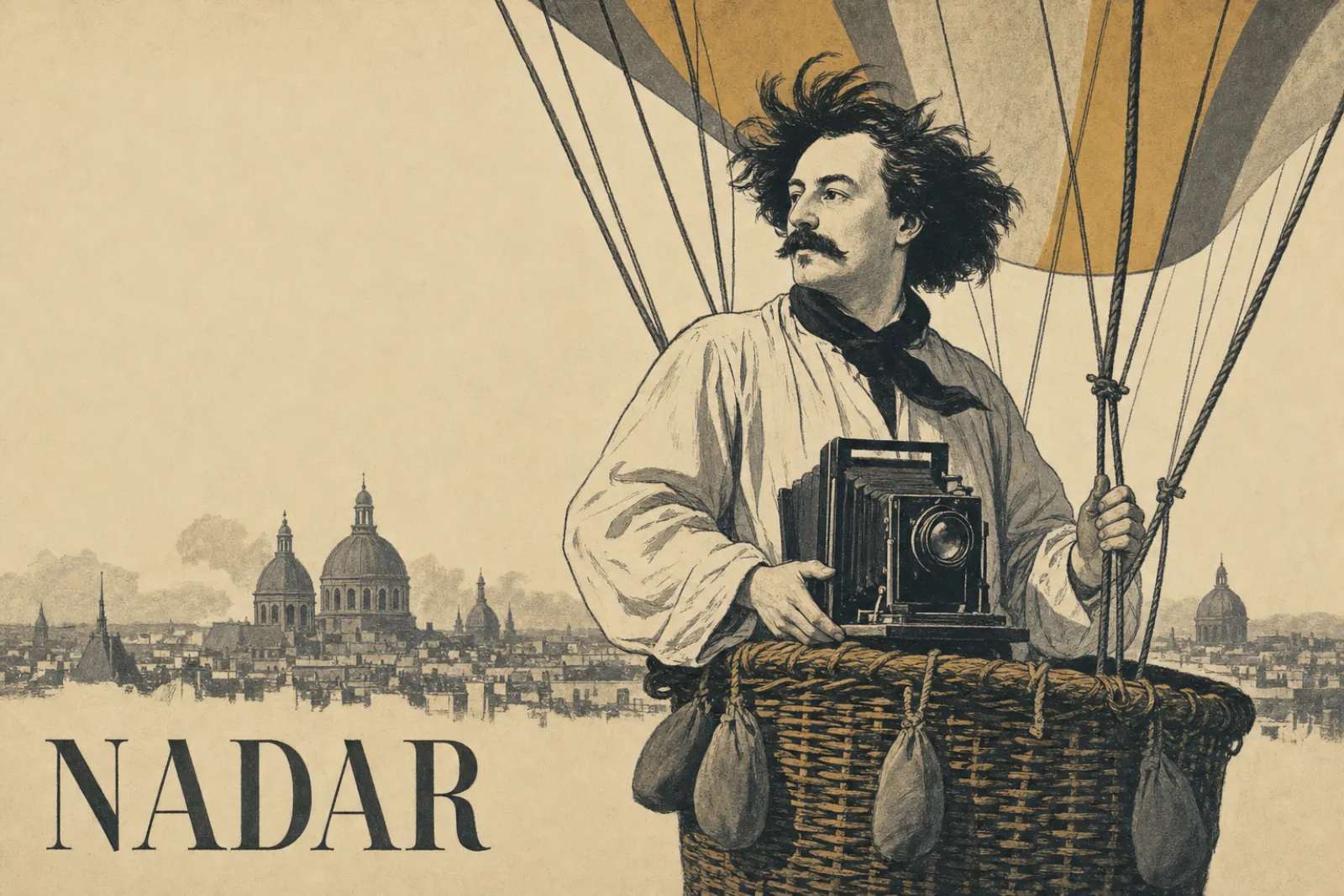
Nadar (1820 to 1910) was the working name of Gaspard-Félix Tournachon, a French caricaturist, writer, balloonist and photographer. From the mid 1850s he photographed the writers, painters, musicians and actors of Paris in a studio that became one of the best known in the city. He is known for plain, direct portraits that put all the attention on the face, and for taking the first photographs from the air.
Nadar came to the camera fifteen years after Louis Daguerre made photography public, and he worked with the process that replaced the daguerreotype: wet collodion negatives on glass, printed on paper. That put him in the line of William Henry Fox Talbot, whose negative made multiple prints possible. What he brought to it was a caricaturist’s eye for what makes one face unlike another, and a wide acquaintance among the writers and artists of Paris. His English contemporary Julia Margaret Cameron also photographed the eminent people she knew, but she worked as an amateur and pursued soft focus and allegory where Nadar ran a business and kept things plain.
From Tournachon the caricaturist to Nadar the brand
Gaspard-Félix Tournachon was born in April 1820. His father, Victor Tournachon, was a printer and bookseller. He began to study medicine but gave it up after his father died, and made a living in Paris writing for newspapers and drawing caricatures. The name Nadar started as a nickname among friends, said to come from a habit of adding “dar” to the ends of words, which turned Tournachon into Tournadar and then Nadar.
His caricatures appeared in Le Charivari from 1848, and in 1849 he founded a satirical paper of his own, La Revue comique. His largest project as a draughtsman was the Panthéon Nadar, a single huge lithograph crowded with caricatures of the literary figures of the day, published in the first half of the 1850s. It required him to study hundreds of faces, many of them belonging to people he would later photograph.
He took up photography in 1854, the year he married his wife, Ernestine. He had helped his younger brother Adrien set up as a photographer, and the two soon fell out over who could use the name. Nadar took Adrien to court in a case that ran from March 1856 to December 1857. He won the sole right to the name Nadar. From then on the name worked as a trademark.
The studio on the rue Saint-Lazare and the move to the boulevard
His first studio was at 113 rue Saint-Lazare, where he worked by daylight. Many of his sitters came from the literary and artistic world he already knew as a caricaturist. Over his career he photographed the poet Charles Baudelaire, the writers Théophile Gautier, George Sand, Alexandre Dumas and Victor Hugo, the painters Eugène Delacroix and Jean-François Millet, and the composers Hector Berlioz and Gioachino Rossini.
In 1860 he moved to 35 boulevard des Capucines. A huge sign, lit by gas, ran across the front of the building. The actress Sarah Bernhardt, born in 1844, sat for him in the 1860s.
New to photographing people? Portrait photography covers what makes a strong portrait, with settings and lens choices.
Up in a balloon and down in the catacombs
Nadar was fascinated by flight. In 1858 he made the first aerial photographs, from a balloon about 80 metres above Petit-Bicêtre, near Paris. This was hard to do with wet collodion, because each glass plate had to be coated, exposed and developed within minutes, in the basket. He took out a patent that year for using aerial photography in map making.
In 1863 he had an enormous balloon built, named Le Géant, with a capacity of about 6,000 cubic metres. Its first ascent from Paris, on 4 October 1863, drew a huge crowd. Its second flight, on 18 October, ended in a hard landing near Hanover, where the balloon was dragged along the ground for 16 kilometres. With the novelist Jules Verne he was active in a society that promoted heavier than air flight. He sold the balloon in 1867, deep in debt. During the siege of Paris in 1870 and 1871 he helped organise the balloons that carried mail and passengers out over the Prussian lines.
He was equally early with artificial light. He showed portraits made by electric light in 1859 and applied for a patent on the method in 1861. In the first half of the 1860s he took his equipment underground, into the catacombs and then the sewers of Paris. The light was electric, powered by dozens of Bunsen batteries. Exposures ran as long as eighteen minutes, so he dressed mannequins as workmen and posed them among the bones and pipes to give a sense of scale.
How do you light a subject when there is no daylight at all? Flash photography explains how artificial light works and how to control it.
In April 1874 the group of painters later called the Impressionists held their first exhibition in the studio on the boulevard des Capucines, which he lent to them. In 1886 Nadar and his son Paul produced what is described as the first photographic interview: a sequence of pictures of the chemist Michel Eugène Chevreul, then a hundred years old, in conversation with Nadar, published in Le Journal illustré on 5 September. Paul Nadar, born in 1856, took over the Paris studio in the 1890s. Nadar ran a studio in Marseille for some years, published his memoir Quand j’étais photographe in 1899, and died in Paris on 20 March 1910. He is buried in Père Lachaise cemetery.
What Nadar took out of the portrait
Studio portraits of his time usually came with sumptuous decor and accessories. Nadar’s portraits remove nearly all of it.
- No decor. He turned away from the elaborate studio settings that were traditional. Nothing competes with the sitter. The principle is set out in the guide to separating a subject from the background.
- The person is the whole picture. With no setting to show, the sitter is the only subject. The modern descendant of that choice is the headshot, which strips a portrait down in the same way.
- Daylight. He preferred natural daylight in the studio. How the direction of a single light shapes a face is explained under portrait lighting patterns.
- Few props. He avoided unnecessary accessories.
- The pose belongs to the sitter. He was recognised for breaking with the conventions of the studio portrait and treating his subjects as active participants. His portraits are noted for natural poses and individual character.
Want to practise one soft light from the side without buying anything? Window light portraits shows how to place a person beside a window and control the shadow side.
The lesson is one of subtraction. When the setting, props and costume are removed, the only variables left are light, distance, the angle of the head and the expression. Those are the ones a portrait photographer has to control anyway.
Portraits and pictures to look for
- Charles Baudelaire (1855). A portrait of the poet from Nadar’s first years with a camera. Look at how little there is in the frame besides the man himself.
- Théophile Gautier (about 1856). A portrait of the writer from the rue Saint-Lazare years. Note how the picture depends on the sitter alone, with no setting to help.
- George Sand (1864). The novelist at about sixty, photographed in the boulevard des Capucines years. Notice where the light falls and how the absence of decor keeps the eye on the face.
- Sarah Bernhardt (about 1864). The actress at about twenty, near the start of her career. Compare the picture with the portraits of writers: the approach is the same, a natural pose and no elaborate setting.
- The catacombs and sewers of Paris (first half of the 1860s). Underground views lit by battery powered electric light. Look for the mannequins standing in for workers.
- The Chevreul interview (1886). A series, not a single picture. The scientist was photographed at fast shutter speeds while he talked, and his words were taken down in shorthand. It anticipates the picture story and the candid portrait.
Try this: a portrait with everything taken away
You need one person, one window and fifteen minutes.
- Hang a plain dark blanket or sheet on a wall beside a window, or use a bare wall.
- Seat your subject about a metre in front of it, turned so the window lights one side of the face.
- Ask them to wear something dark and plain. No props.
- Frame from the chest up. Keep the camera at their eye level.
- Talk to them. Ask a real question and photograph while they answer. Make twelve frames.
Pick the frame where the person looks most like themselves, not the one where they look best. The portrait posing guide has more on what to do with shoulders and hands.
Questions people ask about Nadar
What was Nadar’s real name?
Gaspard-Félix Tournachon. Nadar began as a nickname and became his signature as a caricaturist and then as a photographer. He won the exclusive right to it in court in 1857, after a dispute with his brother Adrien.
Did Nadar take the first aerial photograph?
Yes. He photographed from a balloon near Paris in 1858, and in the same year patented the use of aerial photographs for mapping.
Who did Nadar photograph?
Many of the leading French writers, artists and performers of his time, including Charles Baudelaire, Victor Hugo, George Sand, Alexandre Dumas, Eugène Delacroix, Hector Berlioz, Franz Liszt, Jules Verne and Sarah Bernhardt.
What is Nadar’s connection to the Impressionists?
The first Impressionist exhibition was held in April 1874 in the studio at 35 boulevard des Capucines in Paris, which Nadar lent to the painters.
For more photographers to study, see the A to Z of photographers. Photography’s first decades are set out in the history of photography.