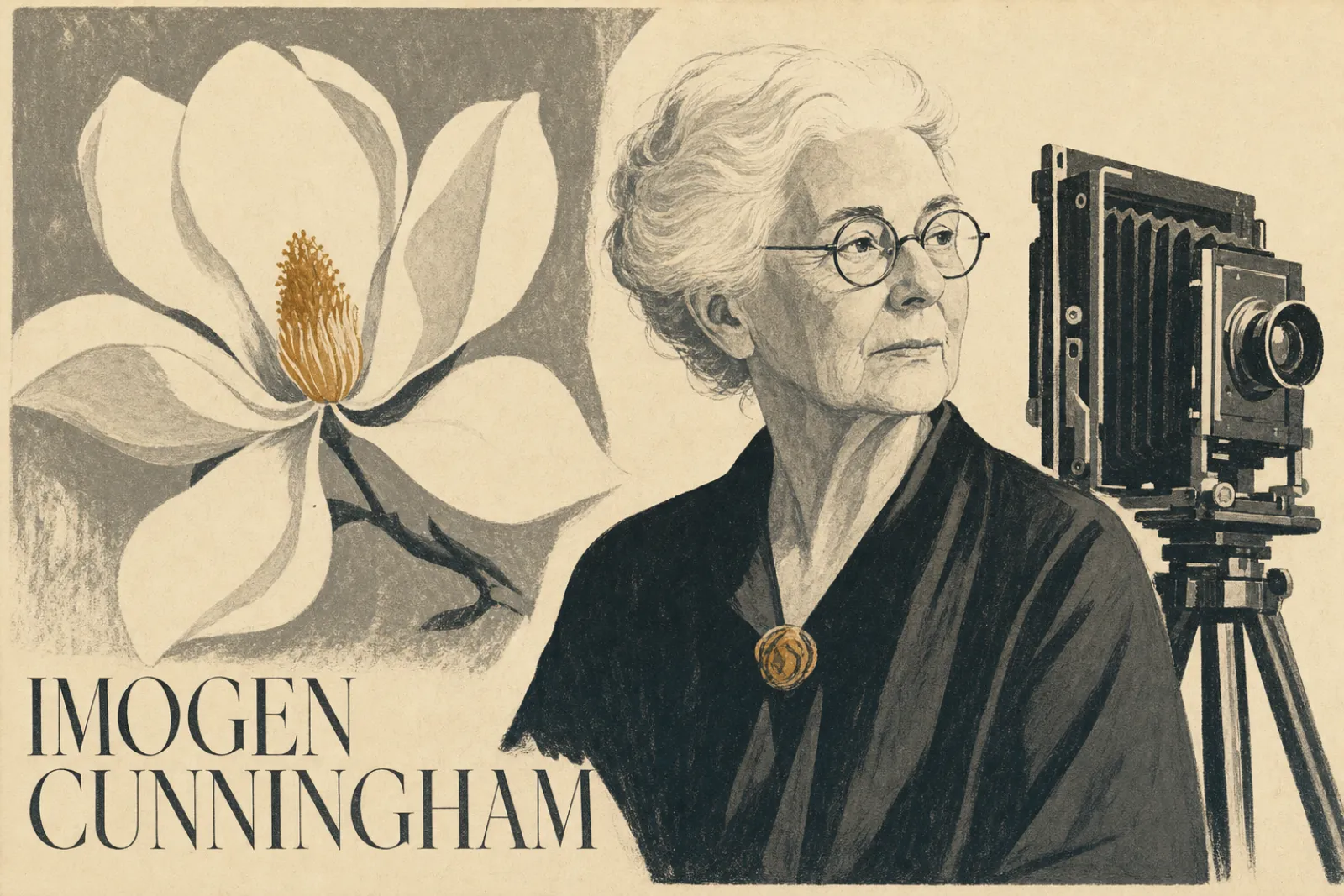
Imogen Cunningham (1883 to 1976) was an American photographer who worked for about seventy years, first in Seattle and then in the San Francisco Bay Area. She made portraits, plant studies, nudes, industrial scenes and street pictures, and she kept changing her approach as she went. She is best known for her sharply focused close views of flowers from the 1920s, above all Magnolia Blossom, and as a founding member of Group f/64.
Cunningham began in the soft focus style of the early 1900s and then helped to end it. She decided on photography after seeing the work of Gertrude Käsebier, learned printing in the Seattle studio of Edward S. Curtis, and by the early 1920s was making hard, clear studies of plants. In California she worked alongside Edward Weston and Ansel Adams, and with them founded the group that argued for sharp, unmanipulated pictures. Photography movements and the ideas behind them explains what that group was arguing against.
A chemistry degree and a Seattle portrait studio
Cunningham was born in Portland, Oregon, on 12 April 1883, and her family moved to Seattle in 1889. In 1901 she ordered a 4×5 inch view camera by mail, and her father built her a darkroom in the woodshed. She studied chemistry at the University of Washington from 1903 to 1907 and wrote her thesis on photographic processes.
From 1907 to 1909 she worked in the Seattle studio of Edward S. Curtis, where she learned platinum printing and negative retouching. A fellowship then took her to Dresden in 1909 to study under Robert Luther at the Technische Hochschule. Back in Seattle in 1910 she opened her own portrait studio. In 1913 she published an article titled “Photography as a Profession for Women”. Her pictures from these years were soft and allegorical, in the manner the Pictorialists admired.
What is a platinum print, and why did early photographers prefer it? Alternative photography processes describes platinum and palladium printing alongside the other handmade methods.
The garden years: plants in sharp focus
In 1915 Cunningham married Roi Partridge. They had three sons, the first born in 1915 and twins in 1917. That year she closed the Seattle studio and the family moved to California, settling in Oakland in 1920. With small children at home she could not travel far, so she photographed what was within reach. She made plant studies in her own garden in the afternoons while the children napped.
The timeline kept by her estate dates her first sharp focus nature studies to 1921, and she studied magnolia flowers between 1923 and 1925. The flowers stopped being botanical records and became studies of form, pattern, light and dark. Ten of her photographs were shown in the Film und Foto exhibition in Stuttgart in 1929.
In 1932 she exhibited at the M. H. de Young Memorial Museum in San Francisco with Group f/64. The seven members were Cunningham, Ansel Adams, Edward Weston, Willard Van Dyke, Sonya Noskowiak, John Paul Edwards and Henry Swift. The name refers to a very small lens aperture, a setting that holds a scene sharp from front to back. The group had disbanded by the end of 1935.
Why does a small aperture keep more of a scene sharp? What is depth of field explains the relationship, and large format photography describes the kind of camera the group used.
Faces, a second camera and a late career
Portraits paid the bills throughout. In 1931 Cunningham photographed the dancer Martha Graham, and Vanity Fair published two of the pictures and hired her to make portraits of arts figures. She and Partridge divorced in 1934. That year she went to New York for the magazine and photographed Alfred Stieglitz. She also worked with Dorothea Lange on a documentary project at Oroville, California.
In 1938 she began using a Rolleiflex, a twin lens camera making square negatives 2 1/4 inches across. It was far lighter and quicker to use than a view camera. In the 1940s she took up street photography as a side project. She opened a studio at 1331 Green Street in San Francisco in 1947 and taught at the California School of Fine Arts.
Recognition came late and in quantity. The magazine Aperture devoted an issue to her in 1964. She was elected a fellow of the American Academy of Arts and Sciences in 1967 and received a Guggenheim Fellowship in 1970. In 1973, at ninety, she began a series of portraits of very old people. She set up the Imogen Cunningham Trust in 1975 to look after her archive. She died in San Francisco on 23 June 1976, aged 93. The portrait series was published in 1977 as After Ninety.
How Cunningham turned a flower into a form
The plant studies are the clearest place to see her method, and the same choices appear in her nudes and portraits.
- Move in until the subject stops being a thing. Magnolia Blossom is an extreme close view, not a conventional botanical picture of a whole plant. To fill the frame this completely removes the context that would make the picture a record of a plant.
- Keep everything sharp. The plant studies are in sharp focus and unmanipulated. Sharpness through the whole subject requires a small aperture and a steady camera. Stopping down is the practical side of the f/64 idea.
- Let light describe the surface. Her close views rely on light and shadow to show form. Soft light lets a curved surface shade gradually from white to grey, where hard sun would cut it into black and white patches. Diffused light lets curves read as curves.
- Look for shape before subject. A title such as Triangles names the geometry, not the thing photographed. She approached plants and the human figure the same way, as shape and tone first.
- Work with what is near. The garden pictures came from a constraint. She photographed her own plants, at home, in short spells. The result was one narrow subject studied many times.
- Do not settle. She made her first double exposure in 1923, a portrait of her mother. She took up colour work for a magazine in 1940 and experimented with Polaroid film in the 1960s.
Want to try the plant studies yourself? How to photograph flowers covers close focusing, light and backgrounds.
Curious about combining two images in one frame? Double exposure photography explains how it is done in camera and afterwards.
Photographs to look for
- Magnolia Blossom (1925). An extreme close view of a magnolia flower. Notice how light, shadow and pattern take over from botanical description. The Cleveland Museum of Art catalogues its print with a second title, Tower of Jewels.
- Two Callas (about 1925). A study of two calla lilies. Compare one flower with the other, and notice how little else the picture needs.
- Triangles (1928). The title names shapes, not a subject. Look for the geometry first, and only then for what was in front of the camera.
- Martha Graham (1931). Portraits of the dancer. Vanity Fair reproduced two of them, and that led to Cunningham’s magazine work. Compare a portrait of a performer with the stillness of the plant studies.
- After Ninety (published 1977). Portraits of people over ninety, begun in 1973 when Cunningham was about ninety herself. The pictures are plain and unhurried, made by a photographer who shared her sitters’ age.
Try this: one plant, fifteen minutes
This exercise practises her main move, which is closing in until an ordinary object becomes a form.
- Choose one flower, leaf or vegetable. Put it near a window with soft light, out of direct sun, with something dark behind it.
- Steady the camera or phone on a table, a stack of books or a tripod.
- Make a first picture showing the whole object.
- Now move closer for each frame until the object touches all four edges, then closer again until it runs out of the frame. Use a small aperture if your camera lets you choose one.
- The constraint: twelve frames only, one object, and no frame may show the background on more than one side.
- Convert the last four frames to black and white and compare them with the first.
Find the frame where you stop seeing a flower and start seeing curves and tones. That is the distance she worked at.
Questions people ask about Imogen Cunningham
What is Imogen Cunningham known for?
She is known for sharply focused close studies of plants made in the 1920s, especially Magnolia Blossom, and for her nudes and portraits. She was also a founding member of Group f/64 and kept working into her nineties.
What was Group f/64?
It was a group of seven California photographers, formed in 1932, who favoured sharp focus and plain presentation over the soft, painterly look of Pictorialism. Cunningham, Ansel Adams and Edward Weston were among the members. The group showed together at the de Young museum in San Francisco in November 1932 and had disbanded by the end of 1935.
What camera did Imogen Cunningham use?
Her first camera was a 4×5 inch view camera ordered by mail in 1901. From 1938 she also used a Rolleiflex, which made square 2 1/4 inch negatives and suited portraits and street work.
How long did Imogen Cunningham work as a photographer?
About seventy years. She got her first camera in 1901 and began the portraits for After Ninety in 1973, three years before she died.
Imogen Cunningham is one of the photographers listed in the A to Z of photographers, and she is quoted on the photography quotes page.