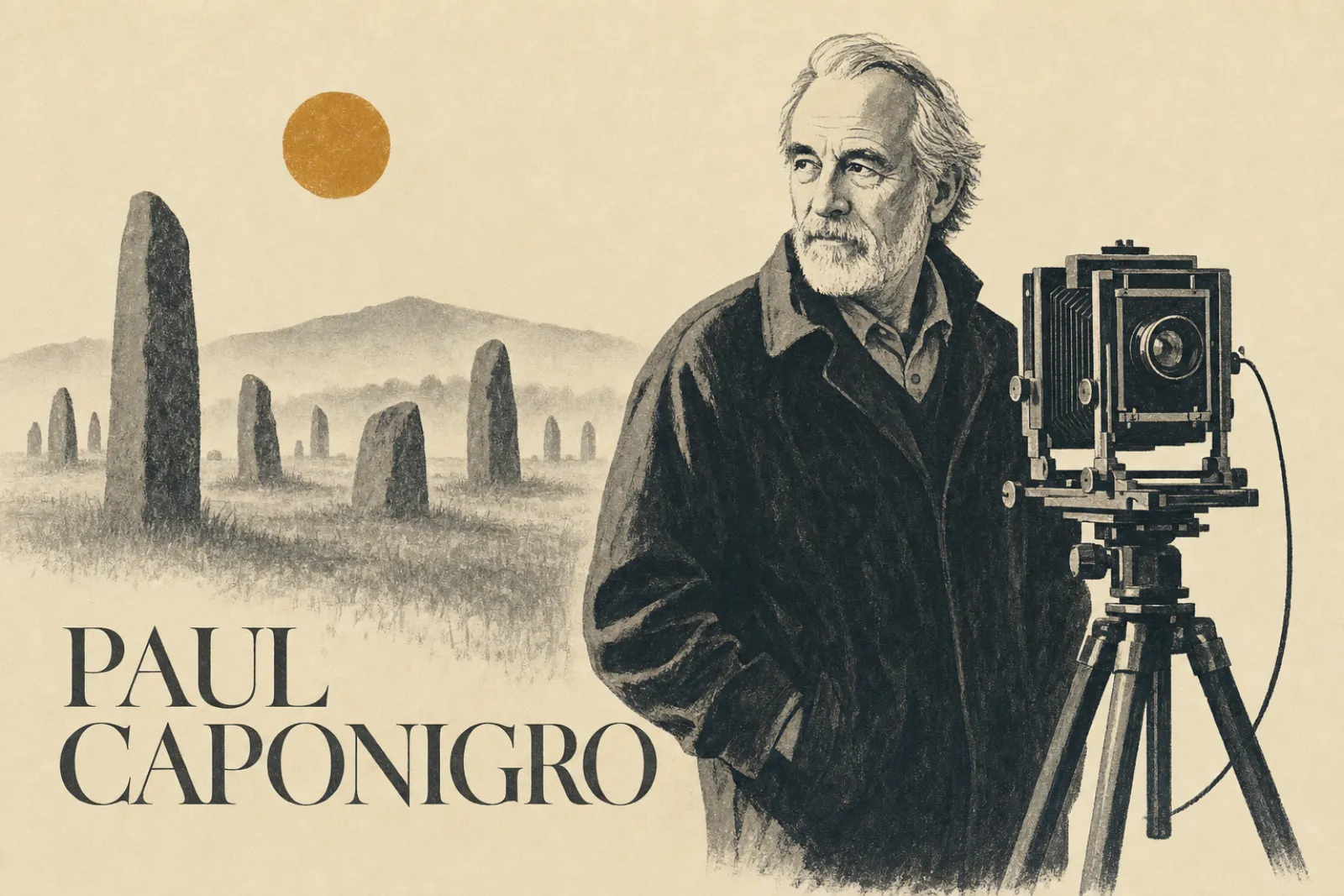
Paul Caponigro (1932 to 2024) was an American photographer from Boston who worked for nearly seventy years in black and white with large view cameras. He photographed woods, streams, stones, flowers and fruit in New England, and the standing stones of Ireland and Britain. He is best known for Running White Deer, a 1967 picture of a herd of deer blurred into a pale ribbon across a dark Irish wood.
Caponigro belonged to the generation that learned directly from the West Coast school. He met Ansel Adams, studied with Minor White, and absorbed the sharp focus and fine printing of Edward Weston and the Bay Area photographers. In San Francisco he also met Dorothea Lange. He took their craft back east and turned it to a quieter purpose. Where Adams photographed grand views, Caponigro more often pointed the camera at something small and close, and he was as interested in the mood a picture carried as in the facts it recorded. He was also a trained pianist, and he said that his musical training shaped the way he photographed.
A pianist from Boston who was drafted to San Francisco
Caponigro was born in Boston on 7 December 1932, the son of Italian immigrants. He began piano lessons as a small child and bought his first camera at about twelve. In 1950 he entered the Boston University College of Music, and left after a year.
In 1953 he was drafted into the Army and posted to the Presidio in San Francisco. It was a lucky posting. A civilian employee there, the photographer Benjamen Chinn, became a mentor. Caponigro studied at the California School of Fine Arts, where Adams had set up one of the first photography programmes in the United States, and he met Adams at his home.
He was discharged in 1955. He worked in the darkroom of an advertising agency, then went to Rochester, New York, to study with Minor White. White’s contemplative approach to photography, in which a picture could carry an inner state as well as a subject, stayed with Caponigro for life. His first solo exhibition was at George Eastman House in Rochester in 1958.
Why did this whole school of photographers choose to work without colour? Black and white photography explains what removing colour does to light, shape and tone.
New England woods, Irish deer and standing stones
Through the 1960s Caponigro taught part time at Boston University and worked as a consultant to the Polaroid Corporation on technical research projects. He also worked as an architectural photographer. His own pictures came from the woods and fields of New England: a rock wall in West Hartford, Connecticut, two leaves in Brewster, New York, a stream in Redding, Connecticut. Many were close studies, not views. An apple or a sunflower could fill the whole negative.
He received Guggenheim Fellowships in 1966 and 1975, and three grants from the National Endowment for the Arts. In 1967 he was in Ireland and England, where he photographed the landscape and the prehistoric stone monuments, among them Avebury and Stonehenge. He was still photographing these megaliths a decade later, and they became the subject of his book Megaliths, published in 1986. He later photographed the temples, shrines and gardens of Japan in the same spirit.
His other books include Landscape (1975), The Wise Silence (1983), Sunflower (1985), The Voice of the Print and New England Days (2002). He was married to Eleanor Morris, who designed many of his books and exhibitions; they divorced in 1976. Their son, John Paul Caponigro, became a photographer and digital artist.
Caponigro lived for many years in New Mexico. He had first visited Maine as a boy and was one of the first teachers at the Maine Media Workshops. In 1996 he moved to Cushing, Maine, and he died there on 10 November 2024, aged 91. The Royal Photographic Society awarded him its Centenary Medal and Honorary Fellowship in 2001, and he was inducted into the International Photography Hall of Fame in 2024.
What goes into a landscape picture beyond finding a view? Landscape photography covers light, composition and the settings that keep a scene sharp from front to back.
How Caponigro made a quiet picture hold attention
A slow camera. He used Deardorff view cameras in the 5×7 and 4×5 inch sizes. A view camera stands on a tripod, shows the scene upside down on a glass screen, and takes one sheet of film at a time. Nothing about it is quick. That suited his way of working, which was to stay with a subject until the picture felt settled.
One subject, close, with nothing around it. Many of his best pictures have no horizon and no sky. A patch of water, a leaf, a rock face fills the frame from edge to edge. With the usual clues to size removed, the subject can read as something else: his apple looks like a field of stars. This is the simplest lesson to borrow. Move in until you fill the frame, and see whether the thing in front of you turns into something larger.
Light from behind and from the side. Many of his woodland and water pictures depend on backlighting, which makes leaves glow and water shine and lays a bright edge on a dark shape. The shadows carry as much of the picture as the lit parts.
Time as a material. Running White Deer depended on a slow shutter speed. The light was dim, so the exposure had to be about one second with the lens wide open. He set the camera among the trees, framed the grass field and the dark wood behind it, and had the deer driven down the field by the owner’s sheepdog. The trees stayed sharp and the animals became a streak.
The print as the finished work. Caponigro made his own prints, and one of his books is called The Voice of the Print. The title makes the point. A negative can be printed darker or lighter, with more or less contrast, and each choice changes what the picture says. He kept those choices in his own hands.
How is a monochrome print tuned for tone, paper and neutrality? Black and white printing walks through the choices that decide how a print looks in the hand.
Photographs to look for
- Running White Deer, County Wicklow, Ireland (1967). A herd of about two dozen white deer runs across a field in front of dark trees. The deer are blurred and the trees are sharp. Notice how the pale band of animals divides the frame like a line of music across a page.
- Apple, New York City (1964). Often called Galaxy Apple. An apple photographed close, so that the marks on its skin read as stars. Even after you recognise the fruit, the night sky does not go away.
- Rock Wall, West Hartford, Connecticut. An early picture, dated 1959. Look at how a plain rock surface is made to carry a whole picture with no other subject.
- Reflecting Stream, Redding, Connecticut (1968). One of the New England woodland pictures. Look at how he uses the surface of the water, and at how the tones are distributed across the frame.
- The Stonehenge and Avebury pictures (from 1967). Stone and Tree, Avebury dates from 1967 and Stonehenge Puddles from 1977. Compare several of the megalith pictures and note how differently the light describes the same kind of stone.
Curious about objects on a table as a subject in their own right? Still life photography covers arrangement, background and light for subjects like his apple and sunflowers.
Try this: lose the scale
This takes about 15 minutes with any camera or phone. No tripod is needed.
- Pick one small natural thing: a piece of fruit, a leaf, a stone, a patch of bark, a puddle.
- Put it in soft, diffused light, near a window or in open shade.
- Move in until the subject fills the frame and nothing else is visible. No table edge, no hand, no horizon, nothing that tells a viewer how big it is.
- Set the picture to black and white. Take ten frames, turning the subject or changing your angle a little each time.
- Show the best frame to someone without saying what it is. If they need a moment to work it out, or see something else in it first, you have done what Caponigro did with an apple.
Questions people ask about Paul Caponigro
How did Paul Caponigro photograph Running White Deer?
He found a herd of white deer on an estate in County Wicklow in 1967 and asked the owner’s permission to photograph them. The deer were gathered at one end of a field and driven down it past his camera. Because the light was low, the exposure was about one second, which blurred the running animals.
Who taught Paul Caponigro?
Benjamen Chinn introduced him to the San Francisco photographers while he was in the Army there. He met Ansel Adams, and after his discharge he studied with Minor White in Rochester, New York.
What camera did Paul Caponigro use?
He worked with Deardorff view cameras that took 5×7 inch and 4×5 inch sheet film, and he photographed only in black and white. He made his own prints.
Was Paul Caponigro a musician?
Yes. He studied piano from early childhood, spent a year at the Boston University College of Music and played the classical repertoire all his life. He said his musical training influenced his photographs.
Paul Caponigro is one of the photographers in the A to Z of photographers, and he is quoted on the photography quotes page.