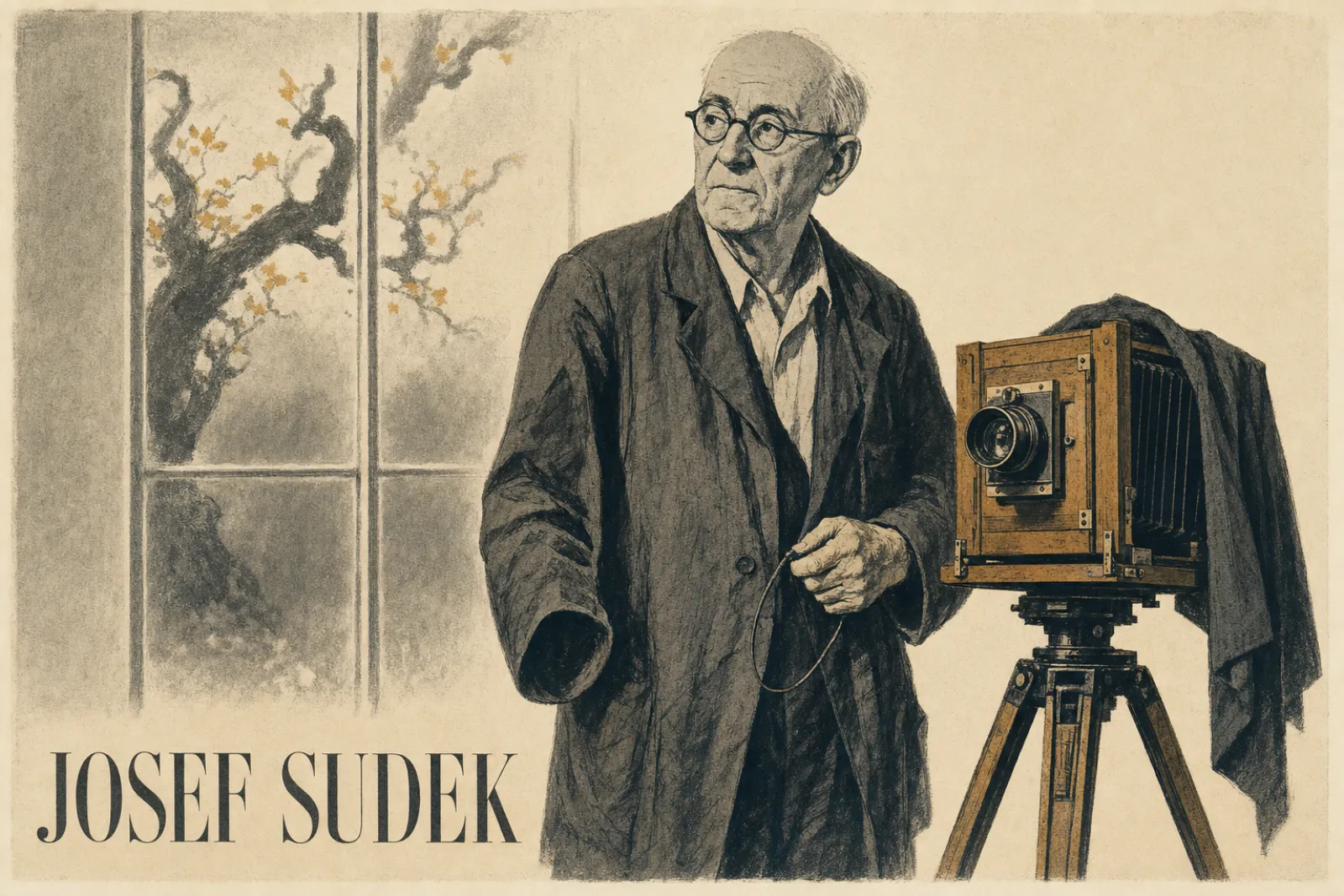
Josef Sudek (1896 to 1976) was a Czech photographer who spent almost his whole working life in Prague. He photographed the city, its cathedral and gardens, the window of his own small studio and the objects on his table, using large wooden cameras that he worked with one arm. He is known for quiet, dark, finely printed pictures that earned him the name “Poet of Prague”.
Sudek trained as a bookbinder and came to photography as an amateur. He studied under Karel Novák at the State School of Graphic Arts in Prague from 1922 to 1924, and in 1924 he founded the Czech Photographic Society with his friends Jaromír Funke and Adolf Schneeberger, after he was shut out of the established amateur photography movement. His early pictures were soft and Pictorialist, and the International Center of Photography names the American Clarence White as an influence. In 1936 his work hung in an international exhibition in Prague alongside that of Man Ray and László Moholy-Nagy. Like Eugène Atget in Paris, he is remembered as the photographer of one city, though his pictures are far more about light than about record.
A bookbinder who came home from the war with one arm
Sudek was born in Kolín, in Bohemia, on 17 March 1896. He was apprenticed to a bookbinder from 1910 to 1913 and started taking photographs during those years. He was drafted into the Austro-Hungarian army during the First World War and sent to the Italian front, where he was wounded. His right arm was amputated. He could not go back to bookbinding, and he was discharged with a disability pension.
Photography became his trade. One of his first long projects, made from 1922 to 1927, was in the hospital and home for war veterans in Prague, where he photographed disabled soldiers like himself. In 1924 he began to photograph the completion of St. Vitus Cathedral, a building site inside a Gothic church. A portfolio of fifteen of those photographs, Svatý Vít, was published in 1928 and made his name. In the late 1920s he took a small wooden garden studio in the Újezd district of Prague, and he kept it until he died.
In the 1930s he worked as a commercial photographer, making advertising pictures and portraits, and contributing to the Prague weekly Pestrý týden. His first solo exhibition was held in Prague in the early 1930s.
1940: the end of enlarging
The change that defines his later work came in 1940. From that year Sudek stopped making enlargements. He printed only contact prints, laying the negative directly on the paper so that the print was exactly the size of the negative. To get prints large enough to hang on a wall he had to use large negatives, so he moved to large format view cameras that took negatives as big as 30 by 40 cm. He worked them with one arm, sometimes with the help of an assistant.
The same years closed him in. During the Second World War and the German occupation he withdrew to his studio and worked on what was within reach. The result was The Window of My Studio, a series made from 1940 to 1954. The subject hardly changes: the pane of the studio window and the garden beyond it, with a tree showing through the glass. From the 1940s he also made still lifes out of informal arrangements on the windowsill: drinking glasses, eggs and other everyday objects.
Wondering how to shoot a pane of glass without your own reflection in it? Photographing through glass explains why reflections appear and how to control them.
He also went back out. During and after the war he made night views and panoramas of Prague, and he photographed the woods of Bohemia and, from 1952, the Mionší primeval forest in Moravia. Praha panoramatická, a book of 284 panoramic plates, was published in 1959. A first monograph of his work, with 232 photogravure plates, had appeared in 1956. Sixteen books were published in his lifetime.
Recognition came late and mostly at home. He was named Artist of Merit by the Czechoslovak state in 1961 and received the Order of Labour in 1966. His first solo exhibition in the United States was held in New York in 1972, and George Eastman House gave him a retrospective in 1974. He died in Prague on 15 September 1976. Unlike Josef Koudelka, the best known Czech photographer of the next generation, he built his reputation without leaving the country.
How Sudek made a dark print glow
Almost everything in a Sudek photograph follows from a few fixed choices.
- Contact printing. A contact print involves no enlarging lens, so nothing is lost between negative and paper. Fine detail and smooth tone survive even in the deepest shadows. It also means the picture cannot be cropped or resized later. Sudek had to decide the final framing on the ground glass. He was demanding about prints, and he also worked in pigment and carbon processes, which he returned to in 1947.
- A low key. Many of his prints are shadowy and low in key, sitting mostly in the dark greys. In a print like that the eye goes at once to whatever small area is bright. The method is the one described in the guide to high key and low key photography: the mood comes from where the tones sit, not from underexposure.
- Light from behind and through. The studio window pictures are lit by the window itself. Sudek was fond of the way the glass refracted light. A pane lit from behind becomes a glowing screen, which is what backlighting does to anything translucent.
- Twilight and night. He often worked at dusk and after dark, when detail drops away and shapes are left. Fog and mist simplify a scene in a similar way, softening edges and separating near from far in layers of grey.
- The same subject, for years. The window series ran for fourteen years. He named and extended other series over decades. The pictures gain from being seen together, because the changes of season and weather become the subject.
- Plain objects. His still life photographs use what was at hand, arranged simply and placed close to the window. The light does the work.
Curious what happens between a negative and a finished print? Darkroom basics walks through making a first print, including dodging and burning.
His panoramas work differently. The frame is long and narrow, and he used it for views of Prague. A frame that long needs something to hold every part of it, so the panoramas are worth studying for what he put at the two ends.
Want to try a very wide frame of your own? Panorama photography covers how to shoot and stitch one with any camera.
Photographs and series to look for
- Svatý Vít (1928). The St. Vitus Cathedral portfolio, photographed during the final years of the building’s construction. Look for the workers’ tools set beside Gothic architectural detail, and for what the light does inside the building.
- The Window of My Studio (1940 to 1954). Compare several. Note the blurred images and strong shadows, the tree seen through the glass, and the small objects that sometimes sit on the sill.
- Labyrinths (begun 1948). Layered assemblages of objects in the crowded interior of his studio, with paper and glass prominent. Sudek gave the series its name in 1963. Unlike his still lifes these are deliberately disorderly, so look for the forms he found in the clutter.
- A Walk in the Magic Garden (1948 to 1964). A garden series that he kept adding to for sixteen years. Follow it as a sequence and look at how much he drew from one small place.
- Praha panoramatická (1959). The Prague panoramas. Watch how he fills the long frame from one end to the other.
- Vanished Statues (1952 to 1970). Begun after he visited the Mionší primeval forest. He waited for the light that gave the ancient trees a ghostly look. The site’s guide to forest and woodland photography deals with the same problem of finding order among trees.
Try this: one window, fifteen minutes
Choose one window at home on a wet, misty or cold day, or breathe on the glass to fog it.
- Turn off the room lights so the window is the only light.
- Stand close and focus on the glass itself, not on the view. Let the outside go soft.
- Set exposure for the bright glass, so the room falls dark. On a phone, tap the brightest part of the pane and drag the exposure down.
- Make ten frames without moving the camera more than a step. Change only what is on the sill: nothing, then one object, then two.
- Do not crop afterwards. Sudek’s contact prints could not be cropped, so frame it finally in the camera.
Convert the best frame to black and white and check that it has one bright area and no more. The guide to black and white photography covers the conversion.
Questions people ask about Josef Sudek
How did Josef Sudek lose his arm?
He was wounded while serving in the Austro-Hungarian army on the Italian front during the First World War, and his right arm was amputated. He had trained as a bookbinder, a trade he could no longer follow, and he turned to photography.
What camera did Josef Sudek use?
From 1940 he used large format view cameras, with negatives up to 30 by 40 cm, and printed them by contact. He also used a panoramic camera for the long views in Praha panoramatická.
Why is Sudek called the Poet of Prague?
He spent almost his whole working life in Prague and photographed it from the cathedral in the 1920s to the night views and panoramas made during and after the Second World War. His pictures favour mood and light over description, and “Poet of Prague” is the name by which he became known.
What is The Window of My Studio?
It is a series Sudek made from 1940 to 1954 from inside his garden studio in Prague. Each picture shows the studio window, with the garden visible through the glass. It is his best known work.
For more photographers to study, see the A to Z of photographers.