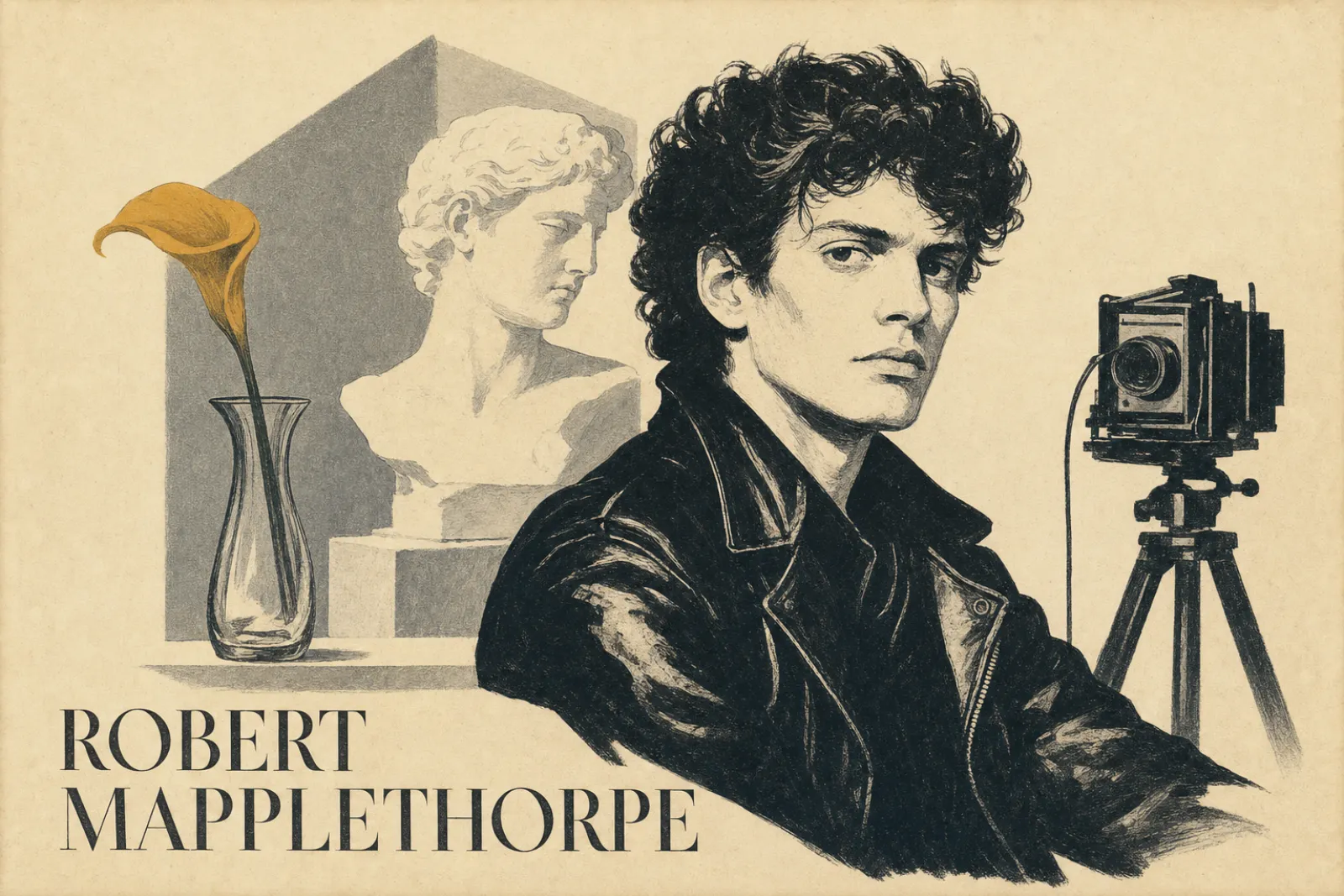
Robert Mapplethorpe (1946 to 1989) was an American photographer who worked in New York City from the early 1970s until his death. He made black and white studio photographs of flowers, faces, statues and the human body, all treated with the same strict attention to shape and light. He is known for that formal perfection, and for the national argument that broke out in 1989 over an exhibition of his work.
Mapplethorpe trained as an artist, not as a photographer. He studied drawing, painting and sculpture at Pratt Institute in Brooklyn and came to the camera as a way of making images for collages. Two people shaped what followed: the singer and poet Patti Smith, with whom he lived as a young man, and Sam Wagstaff, who gave him the camera he used for most of his career. His prints were made from 1979 to 1989 by Tom Baril, who went on to photograph flowers, landscapes and architecture himself. Where Diane Arbus went out to find her sitters where they lived, Mapplethorpe brought almost everything into the studio.
From Pratt and the Chelsea Hotel to a first show of Polaroids
Mapplethorpe was born in Queens, New York, on November 4, 1946. He enrolled at Pratt Institute in 1963 and left in 1969 without a degree. He met Patti Smith in 1967, and in 1969 the two moved into the Chelsea Hotel in Manhattan.
In the early 1970s he acquired a Polaroid camera and began using his own instant pictures in mixed media work. Photography soon took over. His first solo exhibition, Polaroids, was held at the Light Gallery in New York in 1973. The instant camera suited a beginner with an artist’s eye: every picture could be judged on the spot and made again.
Curious about learning with a camera that hands you the print straight away? Instant film photography explains how Polaroid and Instax film work and how to shoot with them.
The Hasselblad years: portraits, flowers and the body
Mapplethorpe met Sam Wagstaff in 1972. Wagstaff helped him buy a loft on Bond Street, and in 1975 gave him a Hasselblad 500, a medium format camera that produces a large, finely detailed negative. With it he began photographing the people around him: artists, musicians, socialites and film stars. In 1975 he photographed Patti Smith for the cover of her album Horses. From 1976 he contributed to Interview magazine, and in 1977 his work was shown at Documenta 6 in Kassel, Germany. His portrait sitters included Andy Warhol, Truman Capote, William S. Burroughs and David Hockney.
His other subjects ran alongside the portraits. He photographed flowers, among them orchids, calla lilies and tulips. He photographed classical statues. He photographed nudes, both male and female, lit and posed like sculpture. Some of his photographs of men were sexually explicit. He gathered a group of those, a group of flower studies and a group of male nudes into three portfolios named X, Y and Z. In 1980 he met Lisa Lyon, a champion bodybuilder, and over the next few years made a long series of portraits and figure studies of her, published in 1983 as Lady: Lisa Lyon. The Black Book followed in 1986. Its studies of Black male nudes have been criticised by some writers as objectifying their subjects.
In the 1980s Mapplethorpe worked mainly in the studio and pushed the finish of his prints further. He had platinum prints made on paper and on linen, and worked with Cibachrome and dye transfer colour prints and with photogravure. The Whitney Museum of American Art gave him his first major American museum retrospective in 1988. That year he set up the Robert Mapplethorpe Foundation to support photography in museums and to fund medical research into HIV and AIDS. He died of an AIDS related illness in Boston on March 9, 1989, aged 42.
The Perfect Moment and the argument that followed
The Perfect Moment was a travelling retrospective of more than 150 works organised by Janet Kardon at the Institute of Contemporary Art in Philadelphia, where it opened in December 1988. It included the X, Y and Z portfolios. In June 1989 the Corcoran Gallery of Art in Washington cancelled its showing less than three weeks before the opening, and the exhibition went to the Washington Project for the Arts instead. When it reached the Contemporary Arts Center in Cincinnati in 1990, the museum and its director, Dennis Barrie, were charged with obscenity. A jury acquitted them in October 1990. The affair fed a long political debate in the United States about public money for the arts.
In 2011 the Getty Research Institute acquired Mapplethorpe’s archive, and in 2016 the J. Paul Getty Museum and the Los Angeles County Museum of Art staged a joint retrospective, Robert Mapplethorpe: The Perfect Medium.
How a Mapplethorpe photograph is made to work
Whatever is in front of the lens, the picture is built the same way. That sameness is the lesson.
- One subject, isolated. A flower, a face or a torso is set against a plain ground with nothing else in the frame. The eye has one thing to look at. The page on separating a subject from the background shows how tone alone can do this: light on dark, or dark on light.
- Treat everything as form. Museums that hold his work describe his aim as perfection in form. A tulip, a hand and a marble head are all photographed as shapes with edges, curves and surfaces. This is the discipline of still life photography applied to living subjects too.
- Balance the frame. His compositions are often centred and evenly weighted, and they show the interest in classical form that ran through his studio work. The guide to symmetry in photography explains why a balanced frame feels calm and deliberate.
- Light for shape. In the studio the light can be placed so that it runs across a surface and shows its curve. Shadow is used to draw the edge of a petal or a muscle. The common arrangements are set out in studio lighting setups.
- Control the tones. Deep blacks, clean whites and a long run of greys between them give the prints their polish. The guide to contrast in photography covers how the direction and quality of light set that range.
- Finish the print. He treated the print as an object, and used a professional printer and costly processes such as platinum to get the surface he wanted. An overview of platinum and related methods is in alternative photography processes.
Want to try a single flower as a subject? How to photograph flowers covers getting close, choosing an aperture and working with natural light.
Photographs to look for
- Patti Smith, cover of Horses (1975). Smith stands in a plain white shirt with a black jacket slung over her shoulder. The picture was taken by natural light in Sam Wagstaff’s apartment in Greenwich Village. By Smith’s account he took about twelve frames. Notice how little there is in it: a wall, a figure and daylight.
- Self Portrait (1980) and the self portraits that followed. In 1980 Mapplethorpe photographed himself as a rebel, in a black leather jacket with a cigarette in his mouth, and he went on making self portraits through the decade. Seen together, they show a photographer using his own face to test what clothes, pose and light can change. The page on self-portrait photography covers the practical side of doing the same.
- Lady: Lisa Lyon (1983). Portraits and figure studies of a bodybuilder, published as a book with a text by Bruce Chatwin. Look at how the body is lit and posed like sculpture.
- Parrot Tulips (1988). A late flower study, later acquired jointly by the Getty and the Los Angeles County Museum of Art. Compare it with Tulips from 1978 and decide what changed in his treatment of the same subject over ten years.
- Self Portrait (1988). Made the year before his death. Mapplethorpe wears black against a dark ground, so that his head seems to float, and holds a cane topped with a skull. The depth of field is very shallow, and the face is slightly out of focus. It is a plain demonstration of how focus and tone can carry meaning.
Why does so much of this work stay in black and white? Black and white photography looks at what tone, shape and texture do once colour is taken away.
Try this: one flower, one light, ten frames
This takes about fifteen minutes and needs one cut flower, a glass or vase, a window and a piece of black or white card.
- Stand the flower on a table beside a window so that the light comes from one side. Turn off the room lights.
- Prop the card behind the flower so that it fills the whole background.
- Put the camera or phone level with the flower. Place the flower in the centre of the frame.
- Take ten frames. Between each one, move only the flower: turn the stem a few degrees, or tilt the head towards or away from the window.
- Do not move the camera or the card.
- Convert the ten frames to black and white and choose the one where the outline of the flower is clearest. Note which way the flower faced in relation to the light.
Questions people ask about Robert Mapplethorpe
What camera did Robert Mapplethorpe use?
He started with a Polaroid camera in the early 1970s. From 1975 he used a Hasselblad 500, a medium format camera given to him by Sam Wagstaff.
Why was The Perfect Moment controversial?
The exhibition included sexually explicit photographs alongside the portraits and flowers. The Corcoran Gallery of Art cancelled it in 1989, and in 1990 a Cincinnati museum and its director were tried for obscenity and acquitted. The dispute set off a national debate about public funding for the arts.
How did Robert Mapplethorpe know Patti Smith?
They met in New York in 1967 and lived together as young artists, including at the Chelsea Hotel from 1969. They stayed friends for the rest of his life, and he took the cover photograph for her 1975 album Horses. Smith wrote about those years in her 2010 memoir Just Kids.
What does the Robert Mapplethorpe Foundation do?
Mapplethorpe set up the foundation in 1988. It promotes photography, supports museums that show it, and funds medical research into HIV and AIDS.
Mapplethorpe is quoted on the photography quotes page, and the A to Z of photographers leads to others who worked in the studio with the same care.