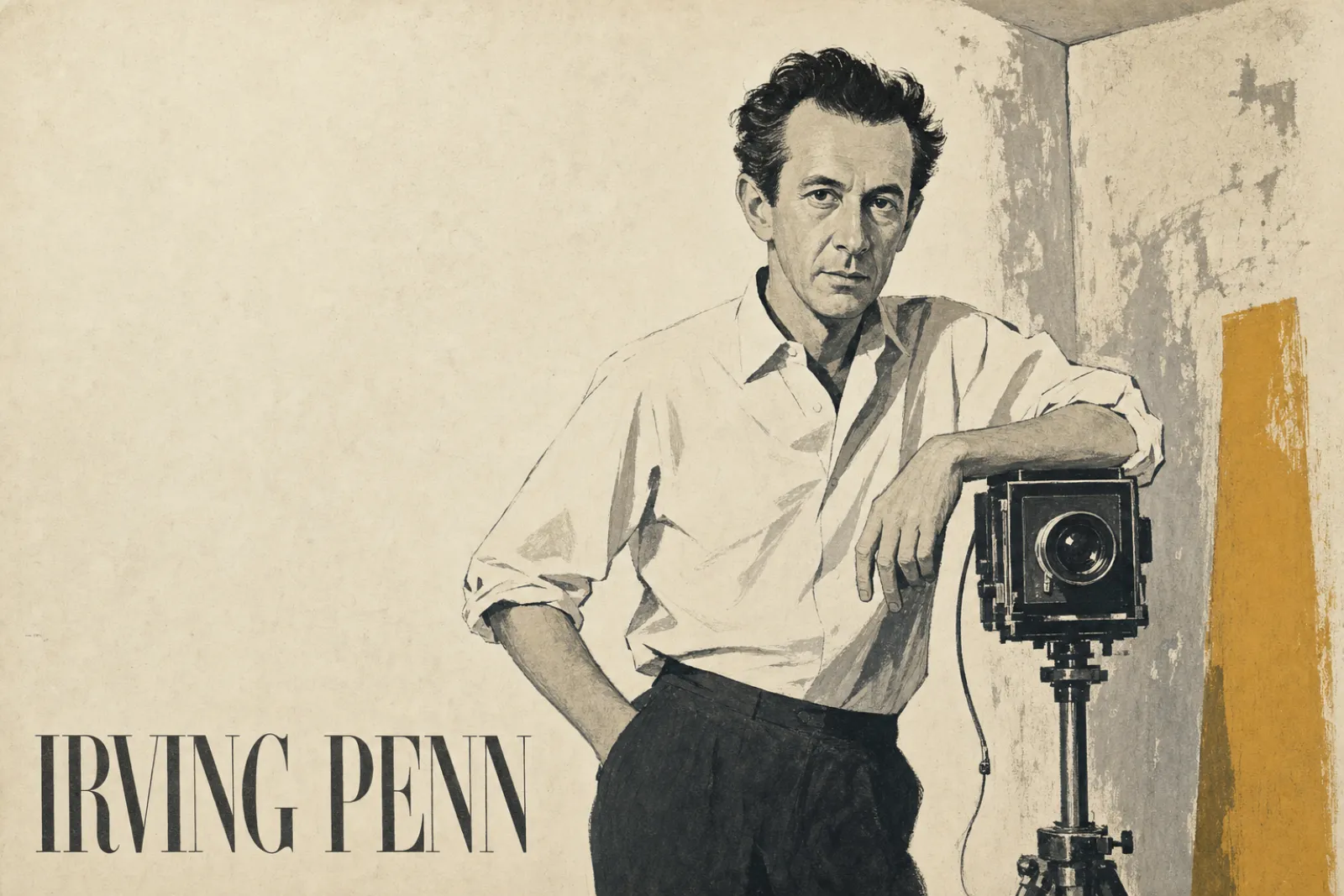
Irving Penn (1917 to 2009) was an American photographer who worked for Vogue from 1943 until his death, mostly from a studio in New York. He made fashion pictures, portraits and still lifes, and carried his studio method to Peru, Africa, Nepal and New Guinea. He is known for placing every subject, from a couture model to a fishmonger to a cigarette end, against a plain backdrop and letting nothing else into the frame.
Penn trained as a designer and painter, not as a photographer. He studied under Alexey Brodovitch, the art director of Harper’s Bazaar, and was hired at Vogue by its art director Alexander Liberman. He was among the first photographers to pose people against a bare grey or white backdrop, and he kept emptying the picture for the rest of his career. His work is worth studying beside that of Richard Avedon, another photographer of fashion and portraits who worked against plain backgrounds, and his pictures of tradespeople invite comparison with August Sander, who also photographed workers as types with their tools.
A designer who picked up a Rolleiflex
Penn was born in Plainfield, New Jersey, on 16 June 1917. His younger brother Arthur became a film director. From 1934 to 1938 he studied design at the Philadelphia Museum School of Industrial Art under Brodovitch and worked as his assistant. In 1938 he bought his first camera, a Rolleiflex, with money earned from published drawings. He worked as an art director at Saks Fifth Avenue in New York, then spent 1941 and 1942 travelling through the American South to Mexico to paint.
Liberman hired him in 1943. That year Penn made his first colour photograph, a still life, and it ran as the Vogue cover of 1 October 1943. In 1944 and 1945 he volunteered with the American Field Service, serving in Italy and then in India. Back at the magazine in 1946 and 1947, he began a long series of portraits of writers, artists and performers.
What makes an arrangement of objects hold together? Still life photography covers composition, lighting and setup for the genre Penn started in.
The corner, the curtain and the daylight studio in Cuzco
For his early portraits Penn set two walls at an angle to make a narrow corner and asked his sitters to stand or sit inside it. Truman Capote, Marcel Duchamp, Georgia O’Keeffe and Igor Stravinsky were among those photographed there. The corner gave people very little room, and each sitter’s response to the tight space became part of the portrait.
In 1948, after a fashion assignment in Lima, Peru, Penn stayed on and went to Cuzco. He worked in a daylight studio there and made portraits of local people. After Cuzco he kept looking for ways to bring strangers into a neutral room, or to bring the room to them.
In 1950 Vogue sent him to Paris for the couture collections. His backdrop was a theatre curtain found for him in the city, and he went on using it for years. He married the model Lisa Fonssagrives in London in September 1950. In Paris, and then in London and New York, he made the Small Trades: full length portraits of fishmongers and other tradespeople, each in work clothes with the tools of the job. The series, made in 1950 and 1951, runs to 252 portraits.
How does a plain room and one window make a portrait? Window light portraits explains how to place a sitter in soft daylight of the kind Penn preferred.
A tent studio, platinum prints and street debris
Penn began advertising work in 1952 and published his first book, Moments Preserved, in 1960. In 1967 he had a portable tent studio built so that he could carry the Cuzco method anywhere. He took it to Dahomey (now Benin) in 1967, Nepal later that year, Cameroon in 1969, New Guinea in 1970 and Morocco in 1971. The travel portraits were collected in 1974 as Worlds in a Small Room.
From 1964 he taught himself platinum printing, an old process that he helped to revive. He coated the paper by hand and fixed it to sheets of aluminium. In 1965 he built a laboratory for the work in a barn on Long Island.
The new prints needed subjects. In 1972 he photographed cigarette ends, and the Museum of Modern Art showed the series in 1975. Street Material followed, and the Metropolitan Museum of Art showed it in 1977. The Museum of Modern Art gave him a retrospective in 1984, and he received the Hasselblad Award in 1985. He photographed his 165th Vogue cover in 2004 and died at home in New York on 7 October 2009, aged 92.
Wondering what a platinum print is? Alternative photography processes describes platinum and palladium printing and the other handmade methods.
How Penn made a plain backdrop do the work
- Take away the setting. Penn removed rooms, streets and props and put the person in front of plain paper, a theatre curtain or canvas. He even scraped down his own early paintings to use as backdrops. With no setting, the viewer reads posture, clothing and face. It is the most complete form of separating a subject from the background.
- Use one soft light. The Cuzco studio was lit by daylight, and he came back to that kind of light again and again. A single broad source gives a gradual fall from light to shadow, and that roundness is much of the look. Natural light photography covers how to find and use it.
- Give the sitter a constraint. The corner, a chair, a small table to lean on. A limit produces a gesture, and the gesture is more telling than a pose the sitter chose. This is a different idea from most portrait posing, where the photographer arranges the body directly.
- Treat everyone the same. A famous painter, a fishmonger and a child in Cuzco got the same backdrop, the same light and the same attention. Equal treatment is the argument of the work.
- Leave nothing spare. Penn cut out anything that did not contribute to the picture. To fill the frame with the subject is the simplest way to do the same.
- Finish in the print. He printed some pictures in platinum years after he made them, including many of the Small Trades. Tone, paper and surface were part of the picture. Black and white printing covers the same concerns for a modern print.
The travel portraits raise a question worth thinking about. Penn brought people out of their own surroundings and into his studio, on his terms, and showed them without the context of their daily lives.
How should a visitor approach photographing people from another culture? Cultural sensitivity in photography sets out the issues of consent, context and representation.
Photographs to look for
- Truman Capote, a corner portrait. The young writer crouches on a chair in the corner, lost in an overcoat. Look at how the converging walls press in on him.
- The two children, Cuzco (1948). A boy and a girl, probably brother and sister, each rest an arm on a small round table and look straight into the lens. Notice the directness of their look. Nothing tells the viewer where the room is.
- The Paris fashion pictures (1950). Couture photographed against the theatre curtain. With no set and no props, the shape of the clothes is the whole picture.
- The Small Trades (1950 to 1951). Workers from Paris, London and New York, full length, with their tools. Look at several together. The repeated setup makes the differences in stance and dress stand out.
- Picasso, Cannes (1957). A portrait of the painter. Compare it with the earlier corner portraits and ask what has changed in how Penn handles a famous sitter.
- Cigarettes (1972). Discarded cigarette ends printed in platinum and palladium. The care of the printing is set against the worthlessness of the subject, which is the point.
Try this: the corner portrait
This takes about 15 minutes and practises Penn’s habit of removing everything except the person.
- Find a plain corner of a room, or a plain wall near a window. Take down or move anything on it.
- Turn off the room lights so the window is the only source.
- Ask one person to stand in the corner or against the wall. Give them one object to use: a chair, a stool or a small table.
- Do not tell them how to stand. Ask them to get comfortable, then wait.
- The constraint: ten frames, one position for the camera, no props other than the one object, and nothing in the frame except the person, the object and the wall.
- Make the last three frames closer, so the top of the frame cuts the forehead.
Compare the first frame with the last. Look at what the hands and shoulders did once the person stopped thinking about the camera.
Questions people ask about Irving Penn
What is Irving Penn known for?
He is known for fashion photographs, portraits and still lifes made for Vogue over more than sixty years, almost always against a plain backdrop. He is also known for the Small Trades portraits of workers and for reviving platinum printing.
What camera did Irving Penn use?
His first camera was a Rolleiflex, bought in 1938 with money earned from published drawings. One of his Rolleiflex cameras was shown in the Metropolitan Museum of Art’s centenary exhibition in 2017.
What are Irving Penn’s corner portraits?
They are a group of early portraits in which the sitter was placed in a narrow corner formed by two walls set at an angle. Truman Capote and Marcel Duchamp were among the sitters. The tight space drew a different reaction from each person.
Where is Irving Penn’s archive?
Penn gave most of his archive and 130 prints to the Art Institute of Chicago in 1995. He established The Irving Penn Foundation in 2005, and the Metropolitan Museum of Art marked the centenary of his birth with a retrospective in 2017.
Irving Penn is one of the photographers listed in the A to Z of photographers, and he is quoted on the photography quotes page.