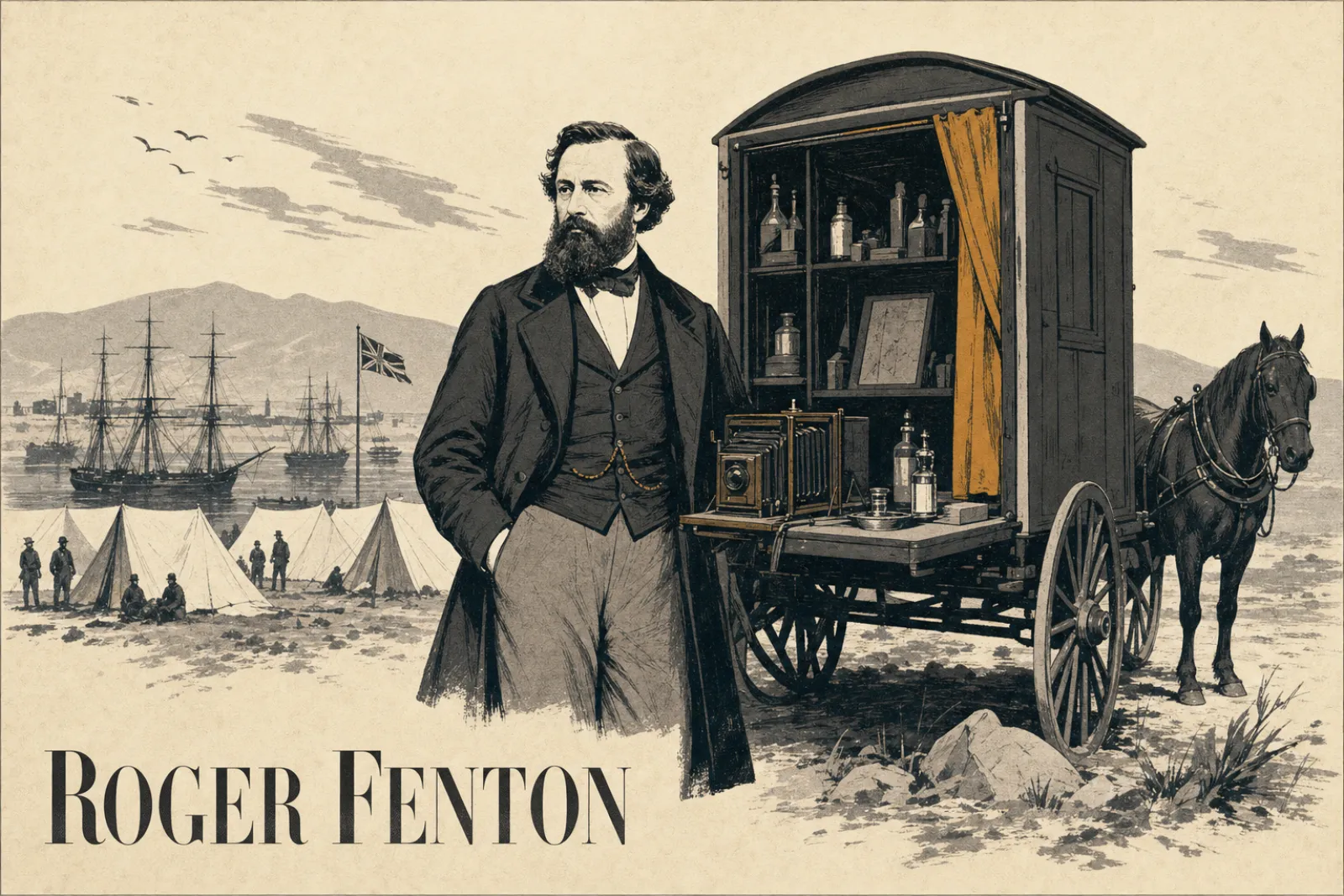
Roger Fenton (1819 to 1869) was a British photographer who worked for about ten years, from the early 1850s to 1862. In that time he photographed Russia, the British royal family, the collections of the British Museum, cathedrals, landscapes and still lifes. He is best known for the photographs he made in 1855 during the Crimean War, the first extensive photographic record of any war.
Fenton came to the camera as a painter and a lawyer. He studied painting in Paris, where he named Michel Martin Drolling as his teacher, and later in London under the history painter Charles Lucy. He learned photography on paper negatives, the family of processes that began with William Henry Fox Talbot, and most likely took instruction from Gustave Le Gray in Paris. A few years after Fenton, Mathew Brady and his team carried the same kind of slow glass plate equipment to the American Civil War.
A painter and lawyer who helped found a society
Fenton was born on March 28, 1819, in Heywood, Lancashire. He took a degree in London in 1840, read law, and exhibited paintings at the Royal Academy in 1849, 1850 and 1851. The photographs shown at the Great Exhibition in Hyde Park in 1851 caught his attention, and he took up the camera that year.
In 1852 he travelled to Russia, where he photographed Kiev, Moscow and St Petersburg. The same year he published a proposal for a photographic society, and in 1853 he became a founder and the first secretary of the Photographic Society in London, which held its first meeting that January and later became the Royal Photographic Society.
Two commissions followed. In 1853 the British Museum asked him to record objects in its collection, and he set up an open air studio on the roof to do it. In 1854 he was introduced to Queen Victoria and Prince Albert, who commissioned portraits of the royal family and were keen supporters of photography.
Curious where paper and glass negatives sit in the timeline? The history of photography covers the first processes and the wet plate years that Fenton worked through.
Four months in the Crimea with a wine merchant’s van
In 1855 the print publisher Thomas Agnew and Sons commissioned Fenton to photograph the war in the Crimea, with the encouragement of Prince Albert and the Secretary of State for War. The war was unpopular at home, and reports in The Times had been critical. The photographs were meant to offset that.
Fenton sailed in February 1855 and landed at Balaklava on March 8. He brought an assistant, Marcus Sparling, a servant, and a horse-drawn van that had belonged to a wine merchant and had been converted into a travelling darkroom. He worked with wet collodion on glass, which meant each plate was prepared in the van, exposed while still damp and developed at once. He stayed until June, fell ill with cholera, broke ribs, and came home with more than 350 usable large negatives. An exhibition of 312 prints opened in London that September and then toured the country.
The pictures do not show fighting. Exposures were long, so nothing that moved could be recorded, and Fenton did not photograph the dead or the wounded. What he made instead were portraits of officers and men, groups posed outside tents and huts, the crowded harbour at Balaklava, camps, and empty ground where battles had taken place. Many are early examples of what would be called environmental portraits: people shown with the place and the tools of their work.
Asking how this relates to news photography as it developed later? Exploring the world of photojournalism describes what the field became, and documentary photography covers longer projects that tell a story in pictures.
Cathedrals, costumes and fruit
After the Crimea, Fenton travelled widely over Britain, photographing abbeys, cathedrals, country houses and open country. In 1857 he photographed the Palace of Westminster as it neared completion, with the clock tower still unfinished. Around 1858 he made about forty studio pictures of imagined scenes of life in the East, posed in London with friends and models in costume. They are fantasies of their period, not records of anything he saw.
In 1860 he turned to still life, arranging fruit and glassware for the camera. In 1862 he gave up photography, sold his equipment and negatives, and went back to the law. He died on August 8, 1869, at Potters Bar, aged 50.
How Fenton worked within a slow process
Every limit of his equipment became a decision about arrangement. Because nothing could move, he posed. His Crimean pictures are mostly posed: officers and men arranged in groups outside their tents and huts. The lessons carry straight into photographing groups, where the task is still to give each face a clear place.
He used daylight only. The British Museum studio was in the open air on the roof, and the still lifes depend on daylight to show the texture of fruit and glass. His choices are a working lesson in natural light.
He chose his viewpoint to explain a place. In Moscow he photographed the domes of the churches in the Kremlin, and in Britain he recorded abbeys and cathedrals at length. That attention to buildings is the starting point of architectural photography.
He also understood that words change a picture. His best known photograph shows an empty track littered with cannonballs. It was published under the title Valley of the Shadow of Death, and the title does much of the work. That is the argument for taking care over photo captions.
The same photograph raises a question that has never gone away. Two versions exist, one with cannonballs lying on the road and one with the road clear. In 2007 the filmmaker Errol Morris concluded that the version with the clear road was made first. Whether the cannonballs were then placed on the road for the picture, or were being gathered by soldiers for reuse, is still argued.
Photographs to look for
- Valley of the Shadow of Death (1855). A bare ravine and a track scattered with cannonballs, with no person in sight. Notice how the absence of people carries the meaning, and compare the two versions if you can find both.
- The photographic van with Marcus Sparling (1855). Fenton’s assistant sits on the converted van. It is a picture of the equipment that made all the others possible.
- Cantiniere (1855). A full-length portrait of a French cantiniere, one of the women attached to French regiments, in the dress of a Zouave regiment. Look at how much the uniform tells you.
- Roslin Chapel, South Porch (1856). From the architectural work. Watch how the stonework is described by daylight alone.
- Pasha and Bayadere (1858). One of the costume pictures staged in the studio. It is useful as an example of how completely a scene can be invented in front of a camera.
- Decanter and Fruit (1860). From the last group of still lifes. Look at how differently the glass and the fruit take the light.
Try this: a portrait that cannot move
Allow 15 minutes, one person and a place where that person works or spends time.
- Use daylight only. Put your subject near a window or outdoors in open shade.
- Include two or three objects that say what the person does. Arrange them and the person before you raise the camera.
- Ask the person to hold still for a slow count of five for each frame, as Fenton’s sitters had to. Make no more than six frames.
- Write a title of five words or fewer for the best one. Then write a second, different title and see how it changes the picture.
Want to go further with posed portraits? The complete guide to photographing people covers light, pose and expression for sitters who can move.
Questions people ask about Roger Fenton
Was Roger Fenton the first war photographer?
He is noted as one of the first war photographers, and his Crimean work of 1855 is described as the first extensive photographic record of a war. He made more than 350 negatives there in under four months.
Why are there no battle scenes in his Crimean photographs?
His process needed long exposures, so only still subjects and posed groups could be recorded. He also chose not to photograph dead or injured soldiers.
Was Valley of the Shadow of Death staged?
Two versions exist, one with cannonballs on the road and one without. Errol Morris concluded in 2007 that the clear road came first, but why the cannonballs appear on the road in the second is still disputed.
Why did he stop photographing?
He gave up photography in 1862, sold his equipment and negatives and returned to legal practice. One museum account says he was troubled by how commercial the medium had become.
For more photographers from every period, see the A to Z of photographers.